Australianism
p. 25 · Read in the full issue
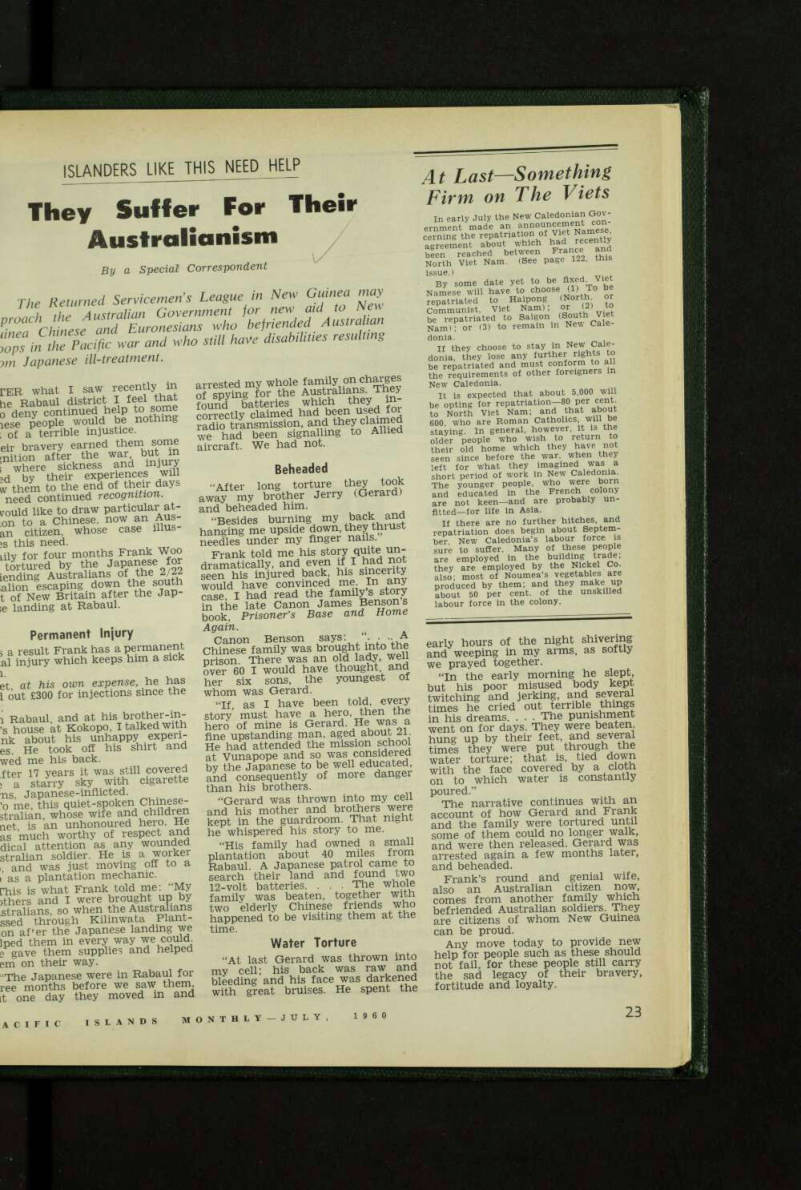
Islanders Like This Need Help
They Suffer for Their Australianism
By a Special Correspondent
The Returned Servicemen’s League in New Guinea may ZTmLXTZo G n :ZrwL Australian Zs inTe Pacific war and who still have disabilittes ym Japanese ill-treatment.
rER what I saw recently in hp Rabaul district I feel that 0 deny continued help to some iese people would be nothing ; of a terrible injustice. eir bravery earned them some ;nition after the war but m where sickness and injury >d by their experiences will w them to the end of their days need continued recognition. vould like to draw particular at on to a Chinese, now an Aus an citizen, whose case Ulus ;s this need. lily for four months Frank Woo tortured by the Ja P a^® e 9^92
Lending Australians of.the 2/22
-alion escaping down the south t of New Britain after the Jap ;e landing at Rabaul.
Permanent Injury
5 a result Frank has a permanent al injury which keeps him a sick et at his own expense, Joe has 1 out £3OO for injections since the i Rabaul. and at his brother-in ’s house at Kokopo, I talked with nk about his unhappy expen es. He took off his shirt and wed me his back, fter 17 years it was still covered > a starry sky with cigarette
ns Japanese-inflicted.
'o me, this quiet-spoken Chmese stralian, whose wife and children net, is an unhonoured hero. He as much worthy of respect and dical attention as any wounded stralian soldier. He is a worker i and was just moving off to a i’ as a plantation mechanic, rhis is what Frank told me; “My ithers and I were brought up by stralians, so when the Australians ssed through Kilinwata Plant on aPer the Japanese landing we Iped them in every way we could, g gave them supplies and helped em on their way. ‘The Japanese were in Rabaul for ree months before we saw them it one day they moved in and
arrested my whole family on charges of spying for the Australians. They found batteries which they ui" correctly claimed had been used foi radio transmission, and they n we had been signalling to Allied aircraft. We had not.
Beheaded
“After long torture they took away my brother Jerry (Gerard) and beheaded him.
“Besides burning my back and hanging me upside down they thrust needles under my finger nails.
Frank told me his story quite un dramatically, and even if I had not seen his injured back, his Sl i| would have convinced me In any case, I had read the family s story in the late Canon James book, Prisoner's Base and Home Again.
Canon Benson says; “. • -A Chinese family was brought into the prison. There was an old lady, well over 60 I would have thought and her six sons, the youngest of whom was Gerard.
“If, as I have been told, every story must have a hero, then the hero of mine is Gerard. He was a fine upstanding man, aged about 21.
He had attended the mission school at Vunapope and so was considered by the Japanese to be well educated, and consequently of more danger than his brothers.
“Gerard was thrown into my cell and his mother and brothers were kept in the guardroom. That night he whispered his story to me.
“His family had owned a small plantation about 40 miles from Rabaul. A Japanese patrol came to search their land and found two 12-volt batteries. . . . The whole family was beaten, together with two elderly Chinese friends who happened to be visiting them at the time.
Water Torture “At last Gerard was thrown into my cell; his back was raw and bleeding and his face was darkened with great bruises. He spent the
early hours of the night shivering and weeping in my arms, as softly we prayed together.
“In the early morning he slept, but his poor misused body kept twitching and jerking, and several times he cried out terrible things in his dreams, . . . The punishment went on for days. They were beaten hung up by their feet, and several times they were put through the water torture; that is, tied down with the face covered by a cloth on to which water is constantly poured.”
The narrative continues with an account of how Gerard and Frank and the family were tortured until some of them could no longer walk, and were then released. Gerard was arrested again a few months later, and beheaded.
Frank’s round and genial wife, also an Australian citizen now, comes from another family which befriended Australian soldiers. They are citizens of whom New Guinea can be proud.
Any move today to provide new help for people such as these should not fail, for these people still carry the sad legacy of their bravery, fortitude and loyalty.