Dre Changes Coming
pp. 21-151 · Read in the full issue
Antas Bows Out, But
SSi?.; r. fiz tas ==
S Super Constellation on the mal Qantas flight was fl o wl jky lantain J. G. Morton, who flew L e P DC3 that made the Qantas ;ural flight between Sydney and Moresby on April 2, 1945—15 ntas in future will eaU at Port sby, in Electras, only on i s Far >m service between longkong, and it is not permitted arry any traffic between New ea and Australia, is last fact has not been re d happily m NG, for tne *as are faster, but the arrange t was apparently forced upon is still operating its in i\ p-NG services, but only until it September when it pulls out leaves it all to TAA.
Taa & Ana
inaugural DC6B flight got rom Sydney on July 9 and the stt DC6B got away on July 11. \A won the right to be the first tralian domestic airline to ■ate overseas when TAA’s gen manager, Mr. John Ryland won ss of a coin from Ansett’s man ig director, Mr. Reg Arnett, ach airline has two services a k on set days, and each has ext v a service on alternate rri s (Details are on p. 157.)
Both airlines are wooing the customers with promises of six course menus, with free cigarettes and liquors, for first-class passengers.
Mr. Ansett met success with his campaign to win the right to fly his service through to Lae. ine Civil Aviation Departments Plan was for Ansett to terminate at Port Moresby, and TAA to go on to Lae but the Ansett chief said he would lose too much through-traffic.
He took one of his DC6B’s to the Territory in June, loaded with aviation officials, and landed it at Lae to prove it could be done safely.
Qantas had been using a DC4 on
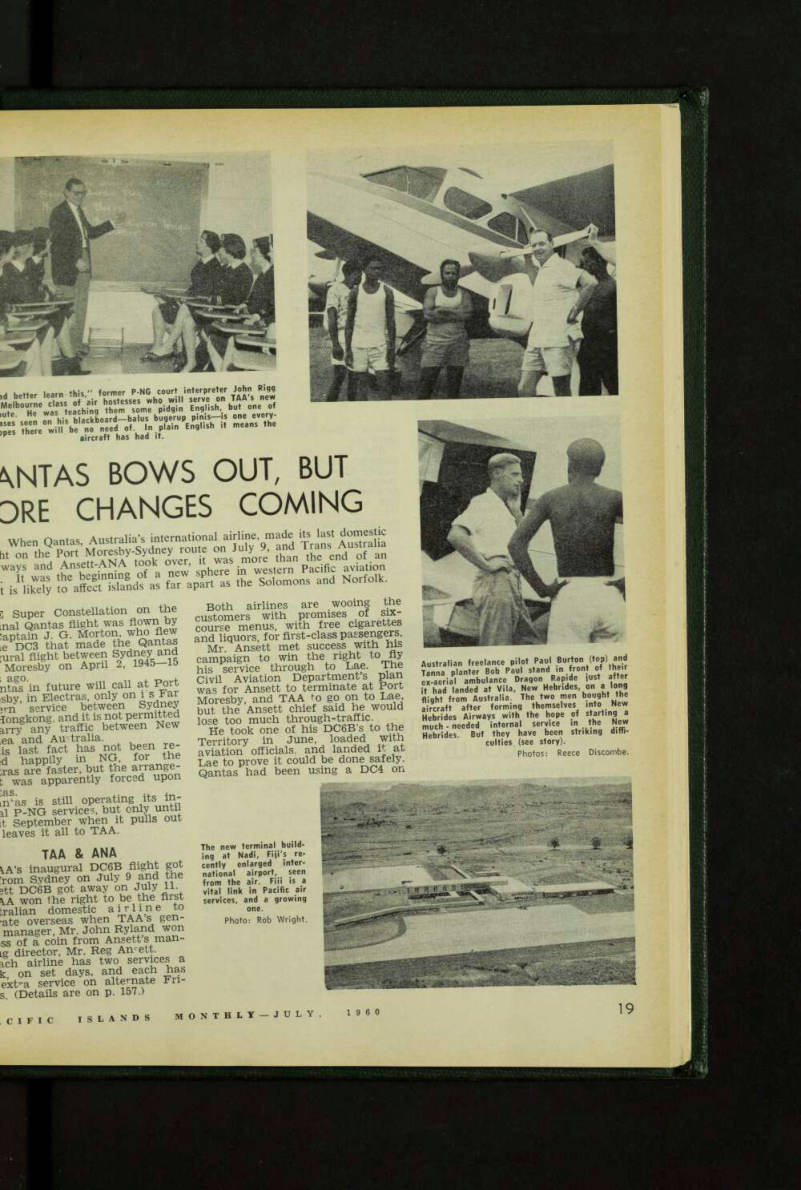
[?] better learn this," former P-NG court interpreter John Rigg [?] Melbourne class of air hostesses who wii serve on TAA's new pute. He was teaching them some pidgin English, but one of [?] ases seen on his blackboard - balus bugerup pinis-is one every [?] pes there will be no need of In plaing English is means the aircreft has had it.
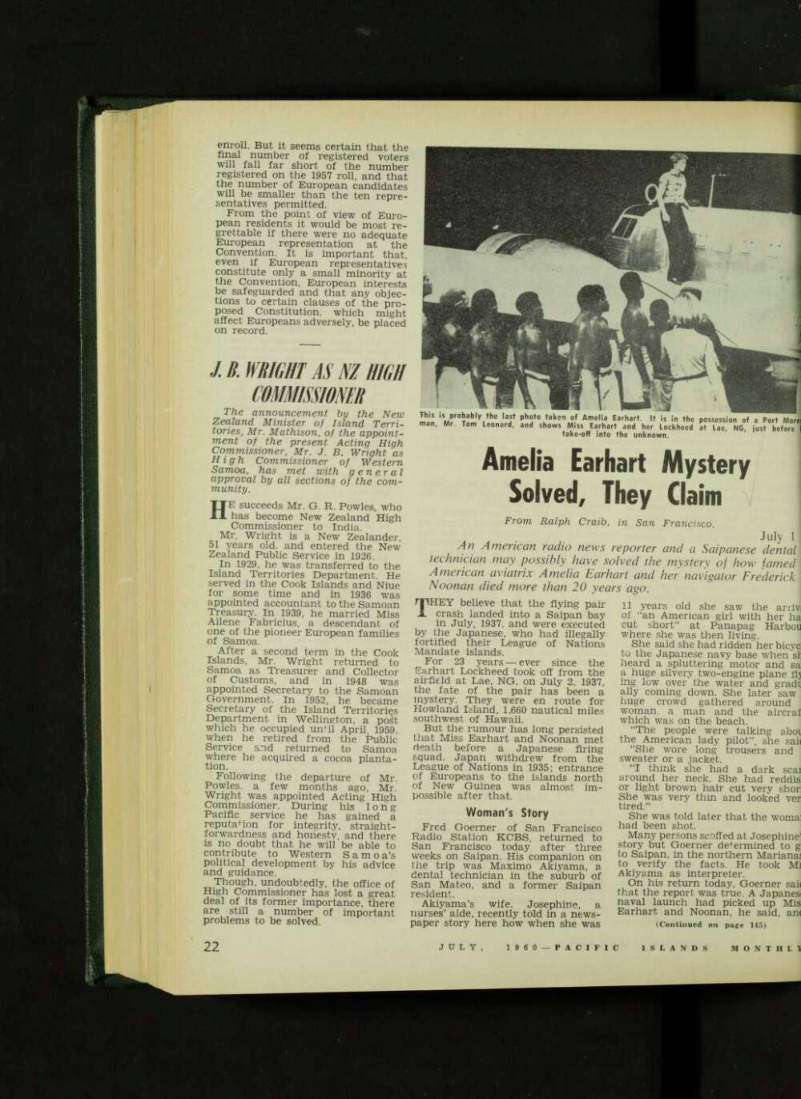
The new terminal build ing at Nadi, Fiji's re cently enlarged inter national airport, seen from the air. Fiji is a vital link in Pacific air services, and a growing one.
Photo; Rob Wright.
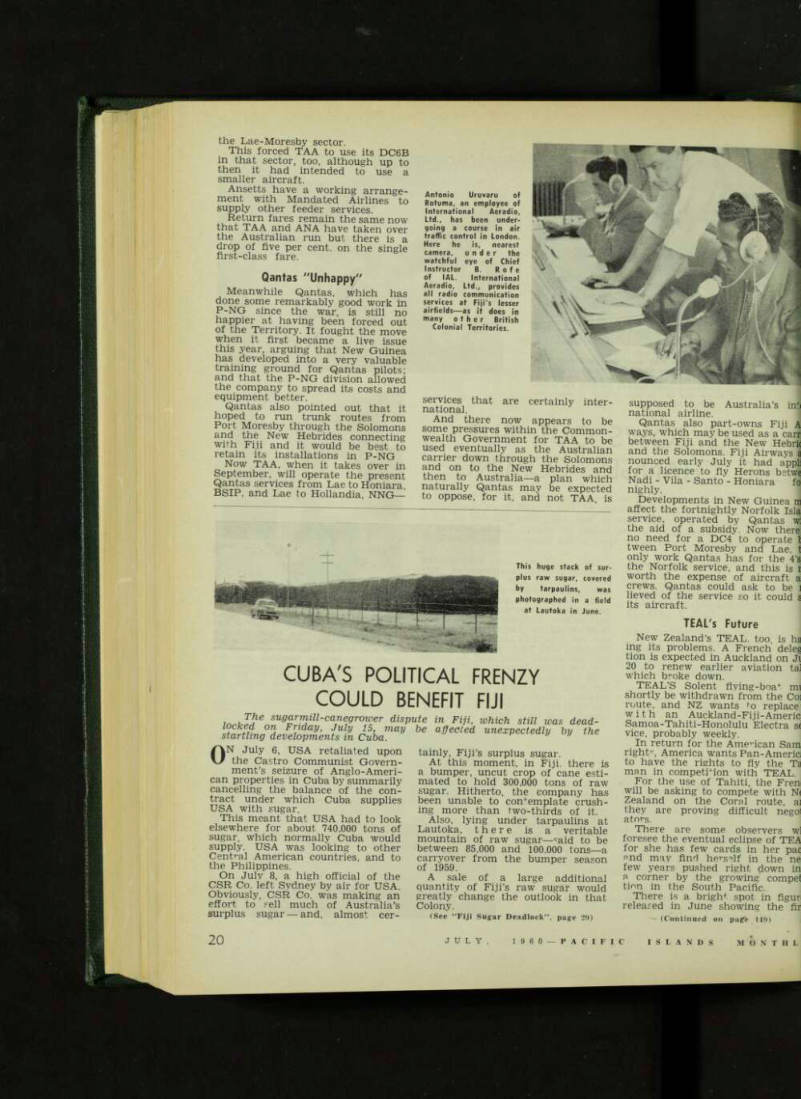
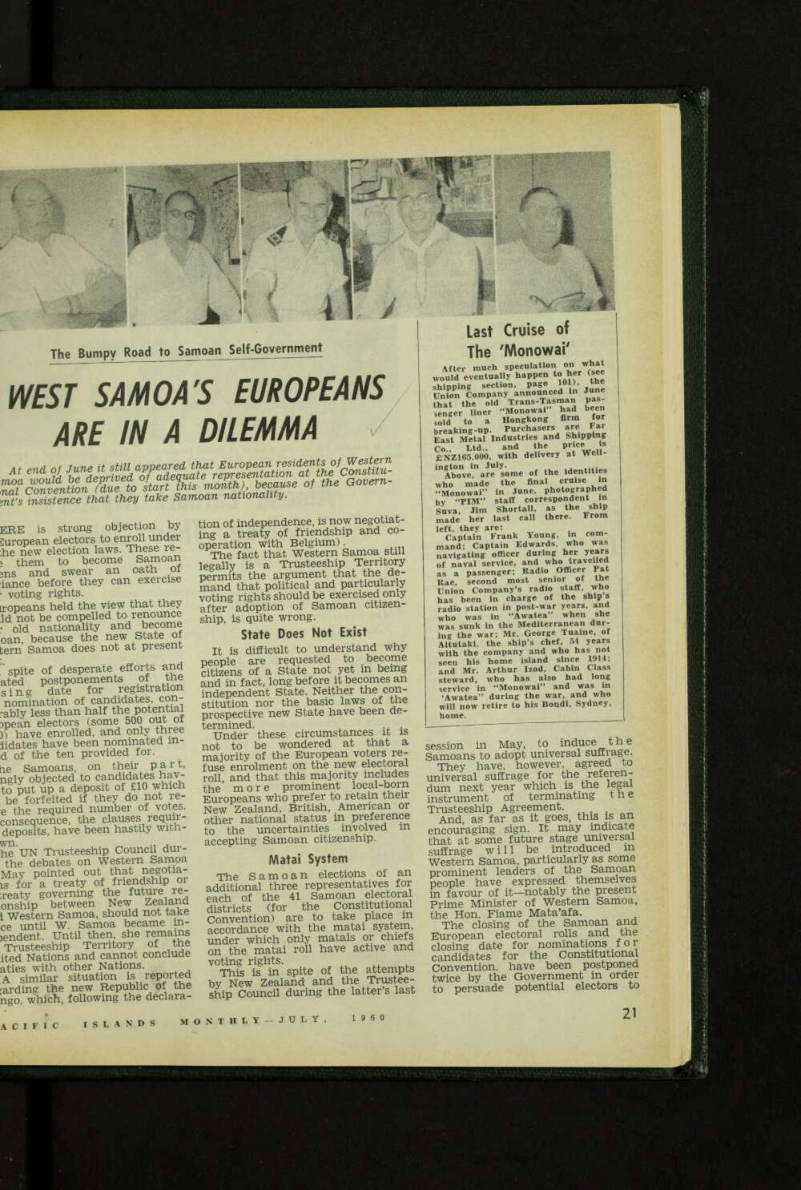
Australian freelance pilot Paul Burton (top) and Tanna planter Bob Paul stand in ex-aerial ambulance Dragon Rapide just after it had landed at Vila, New Hebrides, on a long flight from Australia. The two men b ought the aircraft after forming themselves into New Hebrides Airways with the hope of starting much- needed internal service in the New Hebrides. But they have been striking diffi culties (see story).
Photos; Reece Discombe.
the Lae-Moresby sector.
This forced TAA to use its DC6B in that sector, too, although up to then it had intended to use a smaller aircraft.
Ansetts have a working arrange ment with Mandated Airlines to supply other feeder services.
Return fares remain the same now that TAA and ANA have taken over the Australian run but there is a drop of five per cent, on the single first-class fare.
Qantas "Unhappy"
Meanwhile Qantas, which has done some remarkably good work in P-NG since the war, is still no happier at having been forced out of the Territory. It fought the move when it first became a live issue this year, arguing that New Guinea has developed into a very valuable training ground for Qantas pilots; and that the P-NG division allowed the company to spread its costs and equipment better.
Qantas also pointed out that it hoped to run trunk routes from Port Moresby through the Solomons and the New Hebrides connecting with Fiji and it would be best to retain its installations in P-NG Now TAA, when it takes over in September, will operate the present Qantas services from Lae to Honiara, BSIP, and Lae to Hollandia, NNG—
services that are certainly inter national.
And there now appears to be some pressures within the Common wealth Government for TAA to be used eventually as the Australian carrier down through the Solomons and on to the New Hebrides and then to Australia—a plan which naturally Qantas may be expected to oppose, for it, and not TAA is
supposed to be Australia’s inti national airline.
Qantas also part-owns Fiji A ways, which may be used as a carr between Fiji and the New Hebric and the Solomons. Fiji Airways a nounced early July it had appli for a licence to fly Herons betwe Nadi - Vila - Santo - Honiara fo: nighly.
Developments in New Guinea ra affect the fortnightly Norfolk Isla service, operated by Qantas wi the aid of a subsidy. Now there : no need for a DC4 to operate I tween Port Moresby and Lae, t only work Qantas has for the 4’s the Norfolk service, and this is r worth the expense of aircraft a crews. Qantas could ask to be i lieved of the service so it could s its aircraft.
TEAL's Future
New Zealand’s TEAL, too is ha ing its problems. A French deleg tion is expected in Auckland on Ji 20 to renew earlier aviation tal which broke down.
TEAL’S Solent flying-boat mi shortly be withdrawn from the Coi route, and NZ wants fo replace with an Auckland-Fiji-Americi Samoa-Tahiti-Honolulu Electra s( vice, probably weekly.
In return for the American Sam right*, America wants Pan-Americi to have the rights to fly the Ta man in competflion with TEAL.
For the use of Tahiti, the Freni will be asking to compete with N( Zealand on the Coral route, ai they are proving difficult negol ators.
There are some observers wl foresee the eventual eclipse of TEA for she has few cards in her pac and may find herself in the ne few years pushed right down in a corner by the growing compel tion in the South Pacific.
There is a bright spot in figun released in June showing the fir
(Continued on pag'e 149)
Antonio Uruvaru of Rotuma, an employee of International Aeradio, Ltd., has been under going a course in air traffic control in London.
Here he is, nearest camera, under the watchful eye of Chief Instructor B. Rofe of IAL. International Aeradio, Ltd., provides all radio communication services at Fiji's lesser airfields—as it does in many other British Colonial Territories.
six months of TEAL’S jet prop Electra operations. Both the Fiji and Trans-Tasman services showed a 31 per cent, increase in passenger traffic compared with the same period last year when DC6 s were used.
New Hebrides
In June, there appeared to be plenty of work offering in the New Hebrides for the ex-aerial ambulance Dragon Rapide owned by Messrs.
Bob Paul and Paul Burton, which the two men flew to the New Hebrides, from Australia, in May.
But officially, apparently, they couldn’t take what was offering be cause they still hadn’t been given permission to undertake regular ser vices.
Bob Paul is an Australian planter on Tanna and Mr. Burton is an Australian freelance pilot. The two men last year formed themselves hflo New Hebrides Airways with the idea of starting a much needed in ternal service in the New Hebrides.
Shortly after the Rapide, with the two men aboard, arrived in Vila via the Solomons in May ( PIM, June, p. 141) it was flown to Tanna, where it caused great interest among the natives after landing on a new air strip near Lenakel.
It was the first passenger aircraft to land on Tanna, and the strip had been cleared by the locals under Mr. Paul’s supervision. Mr.
Paul had put a great deal of work in on building airs f rips in the hope that the service could begin operat ing.
In June the Rapide made several local flights and on one occasion dropped supplies to isolated Futuna and on another flew out a sick woman from Tanna on a mercy mission.
South Pacific Air Lines South Pacific Air Lines’ firs* month of operation between Honolulu and Tahiti was described by company president J. H. Dollar, in June, as “beyond anticipation”.
He said extra services would probably have to be run in July to cope wflh the Bastille Day celebra tions in Papeete.