They’ll Talk Our Way
pp. 19-151 · Read in the full issue
It's Open Season For Opinions They’ll Talk Our Way Out Of New Guinea
By a Staff Writer
On the New Guinea front, June was the month of itements”. They were being made by Prime Ministers and nomists; building contractors and coffee planters even by 4ew Britain native. ( ; The Australians have been here 50 rs isn’t it about time they got out?”) All the statements concerned the future of the Territory, and them up and subtract the number you first thought of; and ! may draw the lucky prize.
statement that got the most iblicity was that of Mr. R. G. enzies, Australian Prime Mm who returned from abroad attending the Prime Minister’s rence in London—on June 20. .and pressmen in Sydney that he changed his mind about the r of self-determination for i-New Guinea. said that he would rather see endence come in the Territory > the natives were ready for it, risk the hostilities delays could had once thought that it was • to go slowly in granting in idence, he said; but the pre g thought now was “if in doubt, :>ner”—and he now belonged to school. (“But that does not ” he interpolated, “that you vrite a timetable out for, say, ars’ time.”)
Mr. Hasluck Started It
b statements, of course, had r started rolling weeks before, ff by Mr. Paul Hasluck, Aus ,n Minister for Territories, who accompanied Mr. Menzies l< The Hague, on May 25, he ed “against rushing into cal changes in New Guinea.” leal change without social ge didn’t mean a *hing, he said, as Australia’s aim in its NG tory to put the two million r es economically on their feet •e thinking of political develop ne of the worst things to do a primitive people is to i to a certain standard of living out teaching them how to look ■ themselves when they are m ndent.” . , ... bo could disagree wi f h that? 1 June 10, Mr. Hasluck was in Francisco, where he World Affairs Council of hern California, and said that future of what he called the
European “migrant p9pulation” in Papua and New Guinea “is in timately linked to the future of the
indigenous population”. If Eur9~
peans were to continue to stay in P-NG it would be “only on terms of partnership with the indigenous group”. , , , The future, he said, would depend largely on the way the relationships between the indigenous and the European peoples were worked out.
A lot of Americans thought in stinctively of the overthrow of George 111 and depositing tea in Boston harbour when “colonialism” was mentioned; or the end of British
rule in India, or the presently emerging states of Africa.
But some of the areas of the world were unique, Mr. Hasluck continued, and were in no position to govern themselves. “What we must recognise is that each situa tion is unique unto itself.” (over)
Obstacles in the way of self-gov ernment for New Guinea, he said, included “the almost unbelievably primitive people who are divided by 500 distinct languages.”
Australia took pride in its NG administration, which was “provid ing the people with the rungs of a ladder,” which would make it possible some day for them to govern themselves. Those rungs in clude establishment of law and order, establishment of a common language, improving health and food supplies, and providing ways of earning a living.
These tasks must be accomplished before the natives were suited to determine their own fu f ure. A time table was unpredictable—but Aus tralia’s goal was to reach a point where the natives could govern themselves, and he hoped that when that time came “we are able to sit down in a friendly way and reach an agreed course of action”.
Who could challenge any of that?
Australia Into Line Mr. Hasluck also in June but this time in New York, told a New York Times reporter that the Territory would not be ready for self-govern ment for 30 years although he ex pected Australia “to be under great pressure in the coming years to grant independence.”
It was probably no real surprise, following all this talk by Mr.
Hasluck and Mr. Menzies, when on
June 25 the United Nations Trustee ship Council asked Australia to fix early target dates for political, social and educational development in New Guinea. The move, accom panied by quite a fanfare, was sponsored by Russia and India, two of four nations which had drawn up a report on the Territory. The other two were Belgium and Britain, who drew up a less direct formula, which was rejected.
On June 27, now back in Can berra, Mr. Hasluck said that Aus tralia would “set immediate and realistic” target dates for stages of educational, social and economic advancement in the Territory. (This was by way of being a major policy statement and is dealt with else where) .
On June 26, H. J. Roethof, des cribed as a expert ex plained why the Dutch in their part of New Guinea are pressing ahead for independence, perhaps within 10 years. “Recent developments— particularly in Africa—have set the Dutch thinking ... (developments) convince us that it is no longer pos sible to develop colonial territories towards self-government in an orderly way.” And in Canberra, Leader of the Federal Labour Opposition, Mr. A. Calwell, said: “It is unrealistic at present to believe that the people of P-NG will be fit for self-government in 30 or 40 years.”
He renewed a suggestion made a year ago that an all-party com mittee visit New Guinea and report on its future; and said that Mr.
Menzies’ statement placed Mr Hasluck on the horns of dilemma: and that he (Calwell) intended to
visit the Territory forthwith. (A few days previously, in Di win, Mr. Calwell said that Labour Party favoured an agr< ment on P-NG between Indones
(Continued on page 149)
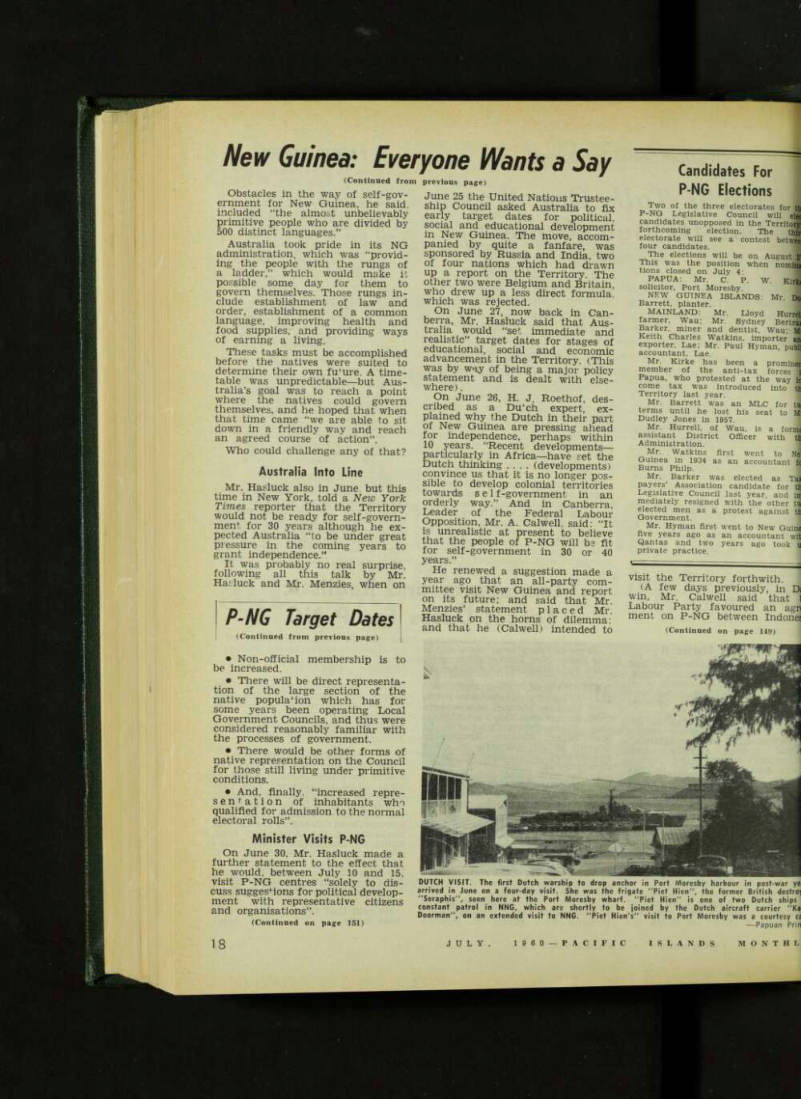
DUTCH VISIT. The first Dutch warship to drop anchor in Port Moresby harbour in post-war ye[?] arrived in June on a four-day visit. She was the frigate "Piet Hien", the former British destroy "Seraphis" , seen here at the Port Moresby wharf. "Piet Hien" is one of two Dutch ships constant patrol in NNG, which are shortly to be joined by the Dutch aircraft carrier "Ka[?] Doorman", on an extended visit to NNG. "Piet Hien's" visit to Port Moresby was a courtesy ca[?] —Papuan Prin[?]
md and Australia to keep the is quo until the natives were y to choose for themselves — itement which brought rumbles the Dutch in NNG). week or two earlier, Sir Douglas and, an Australian economist, that it might be a good idea astralia and Holland met their is on their own ground, handed Jew Guinea over to the United □ns, but agreed to continue their Dnsibilities of trusteeship pro w the UN nominated two other ■tries of the SE Asia area to P ate also. This, he thinks, would an interesting and perhaps ex g experiment in raising the liv standards and political status of NG natives.”
What Port Moresby Thinks
Port Moresby, on June 21, e leading European residents e statements: There was more i commonsense in them than the others put together.
'he time is not ripe to talk of
iting self-government to the
■itory,” said Mr. H. H. Stubbs, hiding contractor and vice-pre at of the Port Moresby Chamber Commerce. He said that the ves don’t discuss it, and neither ■he Europeans —the only people talked about it were politicians, e thought Mr. Menzies’ state t unwise, and that the time to n to think about independence when the natives, who at pre spoke 500 different languages, d exchange views with one :her. , e said that when independence ; come most people expected it ie a joint government of natives Europeans—and that’s what the ves wanted. r. C. P. Kirke, Chairman of the t Moresby Town Advisory Coun who is a solicitor, and also a didate for this year’s P-NG islative Council, said he did not why Australia should admit that /as unable to judge the proper b for self-government, he Australian Government should think in ferms of “hostilities”, should direct its policy to in ising co-operation between the igenous and immigrant popula ls. “On this basis, independence Id emerge harmoniously, in a n of representative and respon e govenment.” ;e said the Prime Minister’s ;ement seemed to suggest that Europeans would have to get when self-government came. He sonally did not believe it.
Ir. E. A. James, an ex-MLC (he gned last year over the methods d in introducing income tax to Territory) said it certainly would better to grant independence be -3 hostilities developed—but surely
it was possible to arrive at the proper stage for granting independ ence without considering such a thing as hostilities.
Three days previously, on June 18, at the opening of the new Public Service club (the Kone Club) in Port Moresby the Administrator, Brigadier D. M. Cleland had said that the future of white residents of Papua-New Guinea was secure.
“We are here and we are going to stay here. Those who talk about something else happening in a short time do not know what they are talking about.”
He deplored the talk of low morale in the Public Service and “insecurity” of European residents as a whole.
Exploitation and Colour Bar
And, finally, among the despatches from Australian newspaper corre spondents who were sent to the Territory while the June furore was at its height, were these two; Brian Harris, in the Brisbane Telegraph of June 23, in a story headlined “Natives Pay Higher Prices in NG Shops—Exploitation in Port Moresby,” said; “Some shops here are flagrantly exploiting Papuan natives. A survey showed one price for foods for white people and a higher price for natives who receive one-fifth European wages or less.”
The second was from Frank O’Neill, and appeared in the Sydney Sunday Mirror of July 3. The head line said, “Colour Bar Holds Back Progress in NG”; and O’Neill re ported : “If there is any doubt whether segregation operates against the natives in New Guinea, it is swiftly dispelled by talks with the more enlightened native leaders here.
“Stories they told me of insuhs and indignities they have suffered made me feel almost ashamed of being an Australian.
“They insist that this colour bar is holding up their advancement.”
One of the native leaders to whom he spoke was “Dr. Reuben Taureka, a graduate of Suva Medical School.” He complained that people sometimes called him “Boy”; and once a European woman asked him to get up and let her sit in a bus seat.
Another leader was Marua Rama Rarua, one of the three native MLC’s. He also had sometimes been called “Boy”, has been kept waiting in offices and, he said (according to the story): “Segregation even extended to the passenger terminal at the airport, where there were separate places for whites and natives to wait.”
FOOTNOTE; Graduates from Suva Medical School are not “Doctors” —although naturally any Mainland Australian reading the story would identify “Dr” Reuben Taureka and his troubles with his own GP down the road. Marua Rarua Rarua may be correct in that native passengers go and sit by
themselves in the one airport wait ing room, but we have never noticed that they do. Certainly there are no seats marked “Whites” and “Coloureds” or wai t i n g-rooms marked similarly—as there are in South Africa and some American States. As usual with newspaper stories, there is some truth in these despatches; but the damage is done because it is only a very small part of the whole story.
(See Commentary, p. 25)