P acific Report
pp. 115-143 · Read in the full issue
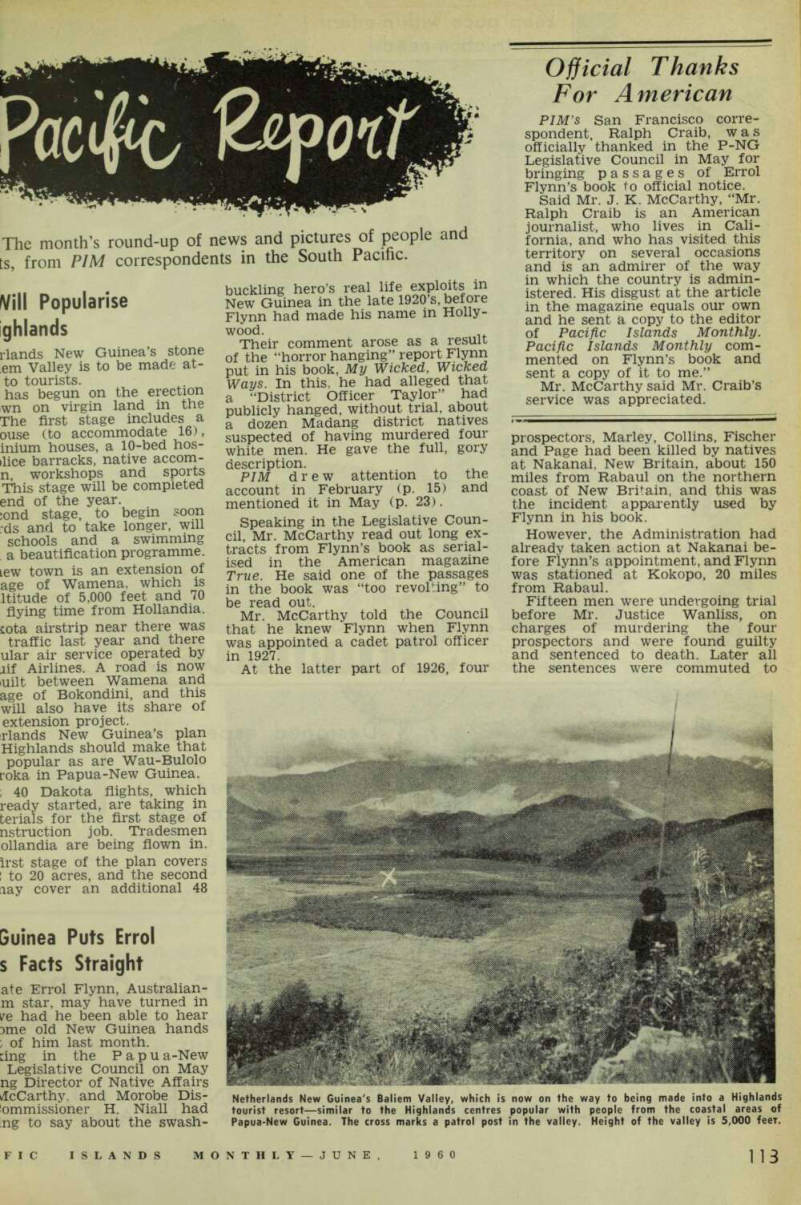

The month’s round-up of news and pictures of people and ts, from PIM correspondents in the South Pacific.
Will Popularise
ghlands
rlands New Guinea’s stone ,em Valley is to be made at to tourists. has begun on the erection wn on virgin land in the The first stage includes a
ouse (to accommodate 16),
inium houses, a 10-bed hos ilice barracks, native accom n, workshops and sports This stage will be completed end of the year. ;ond stage, to begin soon •ds and to take longer, will schools and a swimming a beautification programme. iew town is an extension of age of Wamena, which is Ititude of 5,000 feet and 70 flying time from Hollandia. mta airstrip near there was traffic last year and there ular air service operated by iif Airlines. A road is now iuilt between Wamena and age of Bokondini, and this will also have its share of extension project, rlands New Guinea’s plan Highlands should make that popular as are Wau-Bulolo roka in Papua-New Guinea. ; 40 Dakota flights, which ready started, are taking in terials for the first stage of nstruction job. Tradesmen ollandia are being flown in. irst stage of the plan covers I to 20 acres, and the second nay cover an additional 48
Guinea Puts Errol
s Facts Straight
ate Errol Flynn, Australian m star, may have turned in ve had he been able to hear ime old New Guinea hands ; of him last month. :ing in the Pa p u a-New Legislative Council on May ng Director of Native Affairs McCarthy, and Morobe Dis bmmissioner H. Niall had ng to say about the swash
buckling hero’s real life exploits m New Guinea in the late 1920’5, before Flynn had made his name in Holly wood.
Their comment arose as a result of the “horror hanging” report Flynn put in his book, My Wicked, Wicked Ways. In this, he had alleged that a “District Officer Taylor” had publicly hanged, without trial, about a dozen Madang district natives suspected of having murdered four white men. He gave the full, gory description.
PIM drew attention to the account in February (p. 15) and mentioned it in May (p. 23).
Speaking in the Legislative Coun cil, Mr. McCarthy read out long ex tracts from Flynn’s book as serial ised in the American magazine True. He said one of the passages in the book was “too revolting” to be read out.
Mr. McCarthy told the Council that he knew Flynn when Flynn was appointed a cadet patrol officer in 1927.
At the latter part of 1926, four
prospectors, Marley, Collins, Fischer and Page had been killed by natives at Nakanai, New Britain, about 150 miles from Rabaul on the northern coast of New Britain, and this was the incident apparently used by Flynn in his book.
However, the Administration had already taken action at Nakanai be fore Flynn’s appointment, and Flynn was stationed at Kokopo, 20 miles from Rabaul.
Fifteen men were undergoing trial before Mr. Justice Wanliss, on charges of murdering the four prospectors and were found guilty and sentenced to death. Later all the sentences were commuted to
Netherlands New Guinea's Baliem Valley, which is now on the way to being made into a Highlands tourist resort—similar to the Highlands centres popular with people from the coastal areas of Papua-New Guinea. The cross marks a patrol post in the valley. Height of the valley is 5,000 feet.
: imprisonment by the Ad tor, Brig a d i e r-General gle man had been executed, gusting scene” of the public i at Madang as described by dimply did not happen”. a foul lie that slanders the >f a distinguished District Ax. Edward Taylor, who was Officer of New Britain at ; as well as being the most eflection on the reputation Australian administration,”
McCarthy. ! Flynn was never employed Administration at Madang never carried out a patrol, ministration had cancelled intment after he had been lort months at Kokopo. cCarthy said he presumed rote the lies to get money i, but he also believed that ad personally disliked Mr.
Taylor. aylor later had been Dis ficer at Salamaua when as there in 1933 [as a re as he had admitted in his s then practising a confid ;k on the native people by ig to change copper coins r er by the use of quick ,ylor was investigating these its, said Mr. McCarthy, but eft the country suddenly, y to Hongkong, “where we ard of him through the g police”. cCarthy added: “The police ?kong stated that Flynn, arrival there, reported the thousands of pounds of un aonds, which Flynn stated found in New Guinea. I j. Taylor lost no time in
giving the man’s character to the Hongkong police.”
Mr. McCarthy said that there were other exaggerations, lies and untruths in the book.
Nobody saw Errol Flynn in the country again after 1933 which was, he commented, a pity, “for we could have used a man in the war that was to come who was pre sumably capable of taking Burma almost single handed”.
“I have no doubt that the articles and the book will have caused Mr.
Taylor, now in honourable retire ment, great distress,” said Mr.
McCarthy.
“According to Flynn, he is a murderer and a brutal executioner of men condemned without a trial.
I hope that this telling of the truth and its official publication in Hansard will alleviate some of Mr.
Taylor’s sufferings that the lies of Errol Flynn have caused him.
“I also hope that this will be taken as an official contradiction of the slandering he has done to the Gov ernment of this country.”
Mr. McCarthy said Australia was sometimes criticised by members of the United Nations fofe- the in adequacy and slowness of its educa tional programme in P-NG. But a great deal of the criticism came from groups who did so for reasons of their own. They were prepared to grasp at any instance that would give them further ammunition to fire at the Administration.
Highly-exaggerated reports of past history which purported to give evidence of how the brutal colonial administration treated an inferior people were “particularly
—New Guinea in May put his facts straight.
acceptable to these political aei tators.”
He felt that when the opportunity offered some of those lies should be brought to light so that they could be officially denied and the truth told, as it was now being done in the Flynn case.
District Commissioner Niall toll the Legislative Council that he hai shared the same house and offic with Errol Flynn all the time tha Flynn had been a patrol office (about three months). Flynn ha never been on a bush patrol—“th only patrolling he did was betwee: his house and the Kokopo hotel”, Mr. Niall said the world kne’ little about New Guinea and ws therefore prone to believe what: read. The Territory could receh bad publicity from such account as Flynn’s.
Mr. Niall said it was not rights claimed by one reader in PIM, ths some or all the Nakanai murder® had been hanged. None was hange (Mr. Niall was apparently n ferring to a letter published in Pll in March, p. 26, from Mr. A. i Eldred, of Wau, who said his reco lection was that two of the Nakan* if not more, had been hanged# Rabaul in 1927. Mr. Eldred said had been his job to build* scaffold for the hangings, althoj “he did not see the actual drops!
Fiji Fishing Company
"Before End of I 960"
Plans for the establishment o| tuna fishing base and a canner® Levuka, Fiji, were still very mu alive and definite progress was| ing made, Mr. A. G. McCown I in Suva late in May.
Mr. McCown said that since! return from Japan last year it® not been possible to give mj publicity to the progre:s of 9
sequent negotiations.
To establish a company of tM proportions £500,000 to £BOOl was now the anticipated figure-1 volved a great deal of tedious <1 fidential negotiation and invest!
Mr. J. K. McCarthy, Acting Director of Native Affairs in P.
NG, who had some thing to say abou Errol Flynn's facts
the many factors involved, s true that following dis in Japan it became evident irould not be worth establish nall company, Mr. McCown isequently a good deal more would now be involved —far an could be found in Fiji, was now every indication s outside capital would be , ble from non-Japanese soon. ipanese would have a certain 1 interest, of course, and »uld do the actual fishing, panese interest preferred ere be a substantial Fiji I participation in the com r. McCown said, t confident that a Fiji tuna company would be formed ;he end of 1960 and that would be under way next fear it had been proposed cannery would handle tuna )art of the year, and pine uring the remainder of the ow it was more probable f would be handled instead pples, Mr. McCown said. He ed that one of the Burns >ion recommendations was jef industry and these two ;s could be linked, about the Levuka trochus ndustry, Mr. McCown said tput was dependent upon pplies. It was well known ire had been a heavy fall us prices and this had dis l the fishermen who had heir attention to other pro itervals, however, as a ile quantity of shell was a ted, the factory went into on and was exporting or blanks.
JcCown said that plastic had hit the trochus button ut he was convinced that the trochus but f on was re to favour, as few of the stood up to the boiling and ng that a genuine shell pould stand.
Tonga Is Planning For
Desiccated Coconut
Tonga produces an average of 20,000 tons of copra a year, though output fluctuates widely with climatic conditions, and there is a feeling that most of that may be exported in the form of desiccated coconut eventually.
Tonga Copra Board considers that by using its own shipping it can deliver the product overseas at a competitive price and make more from it than it can make by ex porting copra.
Time will tell, but a desiccated coconut pilot plant is at present on order from the well known Chula
firm in England. Capable of pro ducing 400 tons a year it should be in operation early in 1961.
New Zealand consumes about 1,100 tons each year, and that market will be the first target.
If the trade develops it would also provide useful additional work for Tonga’s own shipping and make it economic for Tongan vessels (there is only Aoniu at present but a larger vessel seems to be in the offing) to uplift Tongan cargo in New Zealand and thus make further savings in freight and in landed costs of imported goods.
Together with desiccated coconut, Tonga is also looking into the pos sibilities of a wall-board industry employing coconut by-products, and
Chief-of-Staff of International head f the Salvation Army, Commissioner [?]y, recently made a visit to the Sal [?]y in Port Moresby. Among those he to were Papuan Tamarua Lahui. —Papuan Prints.
industry. A pilot plant for ing fibre is at present on resent the sales agents for ra produced on Tongatapu nfic Vegetable Oil Corpora ' San Francisco, while all rom the Haapai-Vavau area Unilever. latter is sold at contract while the Tongatapu copra in the dollar area on com at free-market prices to the ailable market. The standard jan copra is steadily improv present about 70 per cent, classed as first grade. » are very considerable losses ra through rats — at least worth is lost from this cause Vavau area alone, and the j much higher on Tongatapu. erage loss in Vavau is esti at 40 per cent, and is as 80 per cent, in some areas, ombat it a programme of mding with aluminium bands ;n under way on a limited ad there is also a plan for ension of a poisoning pro i which so far has been con to business premises and Ihinoceros beetle is still con ) the Vavau area but there constant danger that despite ;ine measures it will spread rhere is a feeling, however, e beetle would already have established in Tongatapu if >ns were suitable for it there, mght by some that the cooler might be the saving factor, s beetles have twice been in ships arriving in Tonga le Solomons to load copra in
recent months. The latest was found on the Cederbank at Haapai in March.
Nausori-Levuka Flights
Are Coming
Fiji Airways’ Beaver amphibian aircraft made a survey flight from Nausori to Levuka on May 2, and as soon as a pontoon has been established at Levuka regular flights will commence. The single fare will be £4/10/-. Meanwhile some charter flights are taking place as traffic offers, the charter rate for the aircraft being £2B per hour.
The Beaver has been kept fairly busy since it was brought from Aus tralia some months ago. Captain J. Laing, who on completion of his service in Fiji with the RNZAF immediately joined Fiji Airways, is the pilot. While the Savusavu air strip is under repair the Beaver has been maintaining that service, making water landings.
New Life for Niue
Woven Goods
As a result of a display of Niue Island basket ware and other woven pandanus goods in a New Zealand store, there are indications that this trade can be considerably expanded.
PIM stressed in an article more than a year ago that there is a very definite New Zealand market for well made Islands baskets and table mats and that there are many large towns there where these items are totally unknown or where re tailers were keen to handle sup plies but do not know how to go about it.
Some months ago, Mr. A. Mcßean, headmaster of Niue High School, on leave in the South Island, arranged a display of goods for two days in a large store in Christchurch to test the response.
The result was overwhelming. The firm which allowed the display im mediately placed an order for £250 worth of similar items and a pro mise of further monthly orders for this amount or more.
On his return to Niue, Mr. Mcßean reported his findings and a Niue Weaver’s Association, a sort of co operative society, was subsequently formed by the women of the island interested in the trade.
The trade so far has been in the hands of local firms who, if they have made any effort to promote business overseas, have not been very successful from the point of view of the producers.
The situation appears to have been that the price offering to pro ducers, after the local firms and the overseas retailers have had their cut. was not sufficient to en courage the production of a high
Gee! Is This It?
[?] first taste of yaqona—Fiji's name [?]-for Auckland City Town Clerk Fred (left) and Auckland's Acting Lord [?]g Savory in Auckland in May. The offered by 25-year-old Fijian Rasola, flown to New Zealand by TEAL in help promote expansion of TEAL's [?]requencies to Fiji. During the two Rasola's visit. New Zealanders sipped through 35 gallons of yaqona. One ran recipe details on "how to mix kava".
Niue basketmakers at work. There are in dications that the trade can be expanded—see story at right.
or consistent product, issociation. by selling direct Slew Zealand retailer, should a higher return, yer, there have been some pains. Poor shipping con i have delayed deliveries, and t is not made until the goods he retailer. As the associa fs its individual members at 3 that they deliver the goods 3 for shipment, there has me discouragement to pro vhen purchasing has had to 3d through lack of funds, major obstacle to greater in the basket trade is the is and consequent high cost jilting the goods overseas. ,y of meeting this problem be to adopt a design of vhich will permit close nest the items for packing, ght be practicable to have idles fitted in New Zealand, t a folding type of hinged But any change from lal designs would certainly ;ed by the producers and the instructing them in new 5 would be a major task, so, viewed as a contribution sconomy of this little island, t well pay major dividends ong run. What is now clear s that a brisk New Zealand does exist.
'loves Against
Guinea's "Kuru"
Papua-New Guinea Admin l, in May, announced a plan i the Fore area in the Highlands of New Guinea special kind of restricted nove involves 30,000 natives ver 884 square miles of the y.
Ldministration’s action is an to stop the spread of the ry disease, kuru, or “laughing so called because of the y to laugh which the victims one stage of the disease, fc there is no known cure for though teams of researchers
from Australia and the United States have been working in an at tempt to solve the problem.
The Administration has accepted the findings of Professor J. H.
Bennett, of the University of Ade laide, who has proved almost con clusively, according to the Admin istration, that kuru is spread through a genetic process from father to son.
The Assistant Administrator of the Territory, Dr. John Gunther, releasing details of the Administra tion’s move, said statistics seemed to show that kuru killed one-half of the women in the Fore area and caused one-tenth of the deaths among the men.
Dr. Gunther was Director of Health of P-NG when the disease was first discovered a few years ago and has since taken a close interest in research work.
He recently made a visit to Aus tralia during which he had talks with Professor Bennett and other medical men who are investigating kuru.
Dr. Gunther’s view has been that kuru is a social problem as well as a medical one and that some action should be taken on the social plane while the medical men continue to investigate the medical reasons for the disease.
Dr. Gunther said that as a result of the larger fatality rate among women, in some areas of the South Fore area there are now two and a half times more men in the villages than women.
He added that this had caused the men to seek employment outside their villages. This led to the pos
sibility of kuru spreading through out the Territory.
To prevent this, the Minister for Territories, Mr. P. M. Hasluck, had agreed that the people of the kuru affected area should be restrained from moving out of their own region.
Dr. Gunther said every effort would be made to return all Fore men to their own district.
He emphasised that this would be done by strictly legal means and that no “strong arm” tactics would be used.
The Administration would appoint a medical panel, which would in clude leading geneticists from the United States, England and Aus tralia to examine whether the genetic hypothesis on kuru was correct.
IB On The Increase
In New Caledonia
Tuberculosis is on the increase in New Caledonia. In five years, 1,060 new cases have been reported, de spite the work that has been going on to stamp the disease out.
Medical men have called for re newed efforts by the public to help fight the disease —especially to give financial help. New Caledonia has a modern sanitorium in the mountains outside Noumea, and has recently opened a modern TB block at the Noumea general hospital.
Shell-Divers Back
At Suwarrow
A team of 40 Manihiki and Penrhyn shell divers are now at Suwarrow atoll in the Cooks to re sume mother-of-pearl shell diving in that lagoon. Mr. D, C. Brown’s licence extends to the end of October, that is, the commencement of the hurricane season.
Apart from the visits of several yachts, Suwarrow has not been inhabited since the Japanese Solar Eclipse Expedition was there in October, 1958, and the last shell
Gunther, Assistant Administrator of Papua-New Guinea.
Dr. Vincent Zigas of Kainantu, who was the first man to investigate kuru as a medical problem. First reports of it came from anthro
pologists.
was done there some years that. gh the lagoon is deep and conditions not very popular he divers, some very fine black-lip shell has been there on the two post-war ns that Mr. Brown, of iga, had teams operating for eriods. There is every reason )ose that a lot of good shell [able in this lagoon, lext few months should show r the local divers are equal task he previous two occasions they d in only the shallower parts lagoon. This time they will certainly have to go deeper, itions are under the control Tom Neale, who will watch ings on behalf of the Ad ation to see that undersized not fished.
Has First
ibly Election
Island has had its first i-style democratic election •esentatives to the island’s ;ive Assembly, and the vot iponse was reported highly tory. een members were elected, per cent, of the registered who totalled 2,118 in all, id their voting rights. There nly 29 informal votes. The followed a publicity pro j explaining the system hly to the population, elected members were, for Electorate: Togia Pahiva; lapa, Tamatoe Tom; for Lilu, Feleti; for Hikutavake, a Poepata; for Toi, Liumai for Mutalau, Talipule; for ia, Kaliatama; for Liku, Nogotau; for Hakupu, Aue; for Avatele, Tagaloa for Tamakautoga, Peika; ifi South, Robert Richmond id for Alofi North; Arumaki tnd. ether, 39 members stood for the maximum number for ie electorate being five for j, the largest electorate where Les were registered, first meeting of the new As was scheduled for May 2. e of the old Assembly ended ch 31 but the new members lot be sworn in until their had been submitted to the or-General of New Zealand proval and confirmation.
's Gold in Them
Oceans!
3 may be as much mineral on the bottom of the Pacific as there is in “them thar surrounding it, according to pps Institution of Ocean ia report. uple of years ago, following
an IGY cruise, Scripps announced that they had located valuable deposits of manganese east of French Polynesia. A more detailed report has now been compiled by Henry W.
Menard Jr., Associate Professor of Geology at Scripps.
The report s »ys ‘tot “fflions of 5c once have been paved with volcanic ash shot out of underwater volcanoes and distributed by ocean currents. Dredges have lately recovered numerous slabs of the material, once ash, now consoli dated as rock.
A characteristic slab, the report says, is one inch thick and five inches across. It is believed that the layer, once continuous, has been broken up by chemical action and by worms and other bottomdwelling creatures hundreds of thousands of years ago. The slabs
now being recovered are manganese ° x ide. , .
Billions of tons of nickel and cobalt are associated with these vast manganese deposits, and m addition rounded manganese nodules of more recent origin dot the areas tiiat's missing at pre
nsiso{!
them-eatoce^denthstonro
the ocean depths, to pro
Stoerlf wealth
mmerai weaitn.
Samoa's New Telephone
, r .
Exchange Nearly Ready
3 ' ' Apia’s new telephone exchange, which will accommodate 1,500 sub scribers compared with the present 500, is expected to be completely installed by July. (Over)
It comprises six switchboards equipped for 600 lines initially, ana one toll board provided for laM extensions to outer areas. Its maidl mum capacity is 1,200 lines, and til new exchange will eventually tal 1,500 subscribers by converting son single connections into party lines
Tonga Will Try Bamboo j
(Among Other Things)
When the ill-fated fishing vess Teiko came south from Japan re) cently her cargo included cutting of a few varieties of Japanel bamboo. They have since been planted at the Tongatapu expert mental station.
These were specially selected ii Japan, at the request of Princ Tungi, as varieties suitable fo furniture making. The South Pacifi Commission had pointed out th commercial possibilities of bambot If it proves successful in Tong it could be the basis for an expoi furniture industry as well as pro viding local needs. It would be further avenue of employment ft the expanding population.
And among other agricultun produce also being tried in Tong will soon be an item less famili* in the South Pacific —olives. Whe Mr. Julio Masasso, officer in char? of the experimental station, M on leave this year he will sele some olive varieties in Italy If experimental introduction to Tong The Tongans are not likely to ’ much excited by olives as an ite of diet, but there is considered be a useful export market for tl product. Tonga climate may, course, turn out to be unsuitab Many vegetables equal to the bf that New Zealand can produce a readily grown on Tongatapu, %: Tonga would like to get in 1 the Fiji vegetable import trade. I Fiji has turned thumbs down it.
The people in Tonga say ® don’t know why. Their veget* certainly look healthy enough. ■ But in Suva the Departmeiji Agriculture says that there* plant diseases in Tonga which not exist in Fiji, and they f to keep it that way.
Though Fiji won’t take tnt Tonga is managing to markjt quota of watermelons and fl apples in New Zealand. ■ The same restrictions appl* Fiji to Tonga’s meat, but in To) they consider that a mooted poult meat industry could find an overs market, with eggs for local* sumption a useful by-product.*
The Ex-Editor
Was Under Fire
Ex-editor of the South Pat Post , Mr. A. E. Stephens (“Stev; has created a record in Papua# Guinea that few journalists wilj hope to equal: The number of tt
iis works have been “men on adjournment, in the egislative Council is now sressive. ieparted from Port Moresby le probably considers better Sydney, some months ago. 3ril, p. 134). But he is still red by the members of jegco. Perhaps not with —but remembered, anyhow, n Peta, one of the three tembers, led the attack at meeting of the Council. He to an article written by dens in the Sydney Sunday if early April, connecting lationships in Papua-New idth those in South Africa, n denied that conditions in dtory were anything like Africa and contended that oing the Territory a dis > publish such irresponsible in Australia where the 3re quite uninformed about were, said Simogen, good amongst the Europeans and es. but the article was not cture of general conditions erritory. “When my people ited and maybe it will take s—they5 —they will themselves be mswer such articles.” was no racial unrest at all Guinea, and articles such tephens’ one should not be I for general reading, is supported by Mr. R. a nominated member, and ; of the Papua-New Guinea anch of the RSSAILA. Mr. said that such an article icularly damaging because ralian public knew nothing elationship between Euro id natives and so believed y read. i that the P-NG RSSAILA shortly after the article in early April, and had adio to all leading news i Australia and the Terri is had read, in part: “We ; the article as a distortion ruth and an abuse of all iples of journalism. We . . . interpret the article as a 3 attempt to create mischief
and intend to bring the matter be fore the Government.”
Mr. Bunting said that with the exception of the local Lae news paper—the New Guinea Courier —all other newspapers had ignored the radio. (PIM also used it).
Dr. John Gunther, Assistant Ad ministrator, said that he felt the article was scurrilous, and had told
Mr. Stephens so when he had re cently been in Sydney. However, he felt that the Chamber should note that the body of the article did not mention Africa and that Stephens had stated that the banner headline, “NG Smoulders Africa on our Doorstep”—had been put there by the sub-editor and not by Stephens, and so also had the photographs of the African shootings that appeared down the side.
Stephens had said, further, that he had expressed all of the senti ments separately and on various previous occasions while he had been in the Territory.
To various calls of “rubbish” from the other side of the Chamber, Dr.
Gunther then gently subsided.
"Macuata" In Trouble
Off Fiji
The Fiji trading ketch-gone-yacht Macuata was towed back to Suva from 60 miles out with a broken tail shaft on May 29.
The ketch had been delayed
New
Building
The latest addition to Port Moresby's growing business area Papua House, Cuthbertson St. -contains three shops and several offices. It was officially opened in May. —Papuan Prints.
days while repairs were )ut to the auxiliary motor, ally sailed on May 28. before sailing time Captain resigned and Mr. Lidgard, r. decided to take command r oyage to Auckland, lat evening, advice was re- Suva from Auckland Radio ; that the ketch was in and required a tow back Due to freak radio condi e ketch’s signals had not ,rd in Suva. eared that the ketch had line trouble and had just t to return to Suva when ; broke. iva Harbour Master, Cap i. James, put to sea in the 3wing launch No. 8 in the urs of May 29. Mr. Alan f Cable & Wireless staff, •uited as volunteer radio Radio contact was estab tween tug and ketch and dio, and the two vessels ised about 10 a.m. The was rough but the tug ack with her charge about tch was to go on the PWD or repairs early in June.
iments On The
Front
ry of the Rhinoceros beetle locality in Fiji, the intro to the Colony of what to be a valuable means of control, and interesting >rm an electrical means of ; and killing the beetles are in the battle major enemy to the coco announced in mid-May ties had been found at Moturiki Island, between ad Viti Levu. team was immediately de to the island to treat every ne 6,800 in all —with . This operation was ex i take about three weeks. ; quarantine regulations as the infected area of Viti e been extended to Motu sls leaving there now re ispection certificates. 5 credit side, the beetle m authorities in Fiji are ; guarded optimism con beetle with the scientific Gigas, of the Scaritids hich has been located in y an SPC entomologist, ipplies of this predator re rived in Fiji and were re the Komave area on the st of Viti Levu. ate results appeared ex promising. Some supplies • reached Western Samoa ler consignments of these ill be arriving from West intervals. biological control of the >s beetle is the real answer
to the problem, other methods are constantly being explored and the latest of these is an electrical means, which is used widely in the United States for killing other kinds of in sects such as mosquitoes and moths in private residences. (See PIM, May, p. 142).
The first of these devices is be lieved to have been brought to Fiji by Mr. S. Barry Philp, of Korotoga, mainly for residential use. It was seen by the Coconut Pests’ people and some inquiries were made with the manufacturers in California.
As a result, Mr. L. G. Marcus, president and general manager of Gardner West Coast Distributors, of Sacramento, manufacturers of the device which has the trade name of Insect-O-Cutor, gave demonstra tions of the equipment in Western Samoa and Fiji in March-April.
The device attracts the insects by means of an ultra-violet or infra red lamp, then electrocutes them as they come into contact with a wire screen or grid. The machine was found to be effective in attract ing and killing Rhinoceros beetles.
Unlike insect predators which would spread themselves widely throughout Fiji once became established, to do their job of killing the beetles electric devices would only be effective over a very re stricted area and in a widely in fested area a great many such machines would be called for.
However, the electrical device, in portable form, might be a very useful weapon for use in a new area of infestation, in a drive to clean up the situation before it becomes out of hand.
The Government is interested in the machines for this aspect of the campaign in Fiji and has now been told that similar and less costly models are being produced in the United Kingdom as the result of experimental work carried out by the Commonwealth Institute of En tomology. The English model, less the motor generator set required to supply the power, is believed to cost about £6. The machine requires a power source of only about 80 wat^s Consideration has been given to the possibility of these machines killing commercially valuable insects as well as pests, but it is believed that all such insects are not nigh" fliers and would therefore not be affected.
Experiments have also seemed to indicate that the electrified screen may not be essential. It has been found that the beetles fly at the lamp and on striking it, fall. They will not be killed, but a funnel shaped trap can be placed below the lamp and the beetles captured alive.
It is expected that the Govern ment will be carrying out further experiments with these electrical insect exterminators later in the year.
Raoul Casualties
n a Week the second time in a week sing ship was diverted to p a sick man from the Raoul weather observing station in The Union Company’s mo was diverted to pick up 0 man on May 22. He was to Auckland.
May 26 the British Bucknall vessel City of Winchester, from Panama to Brisbane, mechanic off the island who een injured in an explosion, hip was diverted 400 miles, le took the injured man to le. Raoul is in the Kermadecs.
Ansett-ANA Air
Scheduled
n recent years, Ansett-ANA 1 making a number of Sand m flying-boat air tours from t to as far east as Tahiti in mths ahead. first of these was to leave r about mid-June and there lers scheduled for the second ' July, of August, and of Sep >. Ports of call are understood Suva, Nukualofa, Aitutaki, e, Moorea, Bora Bora, Sata (Apia), Suva, and back to 7 via Lord Howe.
te Enterprise Rears
gly Head at Tarawa
three thousand residents of islet, the commercial head rs of Tarawa and of the t and Ellice Islands Colony, tching with interest a curious on which has developed in cal commercial world, : in the years before World I some of the South Pacific’s irms had branches in those >, but after the war they did id the situation favourable to ig off again from scratch. In place the Government estab the Trade Scheme —later to e known as the Colony Whole ociety. r still, encouragement was to the establishment of native rative societies, who pur l their goods wholesale from WS and retailed them in the s. The CWS withdrew largely the retail business, but has ued to operate some stores at a, mainly to provide the more live “luxury” lines in demand ;he European population and who can afford them —items the average co-operative could not afford to handle ibly. co-operatives probably could sir own overseas buying if they i, but—theoretically anyway— WS is best placed to do this
for them. It has its buying agents overseas, its own shipping, and it probably gives a certain amount of financial credit to the co-operatives.
The government’s shipping organ isation operates at a considerable loss, however, largely because of the widely scattered geographical make-up of the Colony, and this has resulted in high freight rates to distant points.
So that these distant communities are not penalised unfairly the Gov ernment has worked out an average freight rate —at present about £6/10/- per ton —and this is loaded onto the landed cost of all goods handled by the CWS, whether for
trans-s hipm e n t to far away Christmas Island, or for local de livery to co-op. stores at Tarawa, The standard freight rate system has naturally been welcomed in the distant islands, but there has been some opposition in Tarawa. Out of this opposition has sprung some thing which the Government, with its Government-backed co-ops., is reported to be watching with a somewhat jaundiced eye, something that the book does not provide for —yet!
Two bright young local boys, Phillip Wilder and Henry Schutz— who operate one of the two Betio picture theatres—have answered the
question: “Why should we pay this extra freight in Tarawa”, with the answer; “No reason at all”.
They’ve set up their own store and are importing their own goods from overseas—not through the CWS. And what is more, they’re selling them less the £6/10/- per toe CWS loading. Business is brisk—oi it was in May—but people were wondering what might happen. Gov. ernments do not usually allow these things to proceed for long, thougl in this case a lot of people seem te be barracking for private enterprise Progress will be watched with in terest.
Sugar Negotiations
Reported Deadlocked
Negotiations between the Fiji Can Growers’ Association and th Colonial Sugar Refining Compan concerning the price to be paid fc raw cane in 1960 appeared t be deadlocked at the end of Ma; and the Fiji Government the stated that if an agreement coni not be reached within a reasonabl period it might be necessary for tfc Governor to set up a Commissio of Inquiry.
The negotiations have been undf way for many mon hs past. Pri( to his visit to Australia early i May, the Governor had discussioi with both parties, and while in Au tralia he had discussions with tl heads of a milling company. statement on these discussions k released.
Mr. A. D. Patel has been repr senting the Planters and Mr. J.
Potts the CSR. Mr. John Amputc Commissioner of Labour, has bei assisting as meditator.
They re Missing Eight
Million Bottles
South Pacific Brewery’s I Johns stood beside a crate of I favourite beverage, South Pad Lager, in Port Moresby in May, a
Mr. Bill Johns, of South Pacific Brewer
pleased with the world in e might: In early June he f and headed for 4i months in Europe, secure in the ige that the old brewery i of getting enough empty had just about solved itself :te of the restrictive practices b rival Australian breweries, e fact that, on Mr. John’s :ions, 8,000,000 bottles have missing” in the Territory re war. . . i Pacific Brewery is doing well at present and it is all for greatly increased pro “when the time comes’. me will be when the P-NG are allowed to drink alcohol, jht now leading natives are mighty vociferous on the As they pointed out in ley are now the only people Pacific Islands whq are some means of drinking
For Tonga's
casting Station
British Government will nga a start when it gets its iroadcasting station into mi (the building for it has r been finished, PIM, May, The Government will give a transcription equipment cords to the value of more 1,600.
Samoan Chief
by Knife
Bst Samoan chief, Tia Sefu, s hacked to death with a e, and his son, Joane Tia bout 20, was terribly injured le same knife following an in the village of Falefa, 15 ;ast of Apia, in May. ations were that the chief tacked by a group of young s who had been drinking in ly hours of the morning. His d gone to his father’s assist
ation Dropping
nerican Samoa
us takers are now winding up i complete population survey erican Samoa. Figures show pulation is declining. 156, population was 20,154 and rrent report indicates a drop Since 1956, a total of 2,883 ns have migrated to the US. [t’s Still Samoa—lf Far From , PIM, May, p. 86).
c Integration Scheme
s "No Response"
rican writer C. Hartley n, who for 30 years has been imentator on South Pacific
matters and who is probably best known for the book, Introducing Australia, told radio listeners in Fiji in May that neither Australia nor New Zealand could be thought of as an open market for expanding
Fiji production.
“I found the Australians almost wholly preoccupied with New Guinea and the New Zealanders chiefly concerned about their imminent withdrawal from Samoa,” he said.
“It seemed to me that the A ustralians and New Zealanders were in a phase of little interest in the Islands save those for which they have direct responsibility.
“My efforts to revive the idea that the South West Pacific should
be thought of as an area with in terlockmg problems . . no The limited integration achieved by the South Pacific Commission seemedtobe taken as a kind of proof that area integration was indeed an idle dream,
Rapua S Monument TO
Simple Man
r A simple monument to a simple man, was how Mr. Jus ice R. T. Gore described the monument to the late Sir Hubert Murray, which was un veiled in Port Moresby late in the evening of May 24. (Over)
Moresby—being Port Moresby a lot of other things to say the memorial to Papua’s amous Lieut.-Governor. Some s would have liked to see a ed statue of Sir Hubert. have been rude about the in itself.
Judge Gore was probably and those who knew Sir ; most intimately feel that aid have approved the con f a memorial park, of which mntain, and its wall with ig-fountains (ladies to the gentlemen to the left?) take y a small corner, resent, the large harbour-side r here Lower Port Road meets Road on the way to Kone and which will become the ■ial Park, has been filled in ot surfaced. The fountain has been laid out as a garden tien the trees already planted grown, it will be a very it spot, indeed. 3 ort Moresby, of course, at seasons of the year, the > are forces to be reckoned jo that even with the feeble i-spray with which the foun > now equipped, those using inking taps, or sitting within t, are likely to get a shower On the evening of the un
veiling a crowd of several hundred residents watched fascinated as the fitful breeze wafted the spray nearer and nearer the famous felt hat of Administrator D. M. Cleland, which he had parked at the back of his chair while he performed the un vening It is thought that the spray hazard may be overcome by instal ling porcelain “frogs” which will merely spout water into the lower basin John Hubert Plunkett Murray went to Papua as Chief Judicial Officer in 1904. In 1908, he became Lieutenant-Governor and he re mained in this office until he died suddenly while on an official visit to Samarai, in 1940.
Later that same year, a Memorial Fund was started but war and post war uncertainties intervened and it was not until 1951 that a real at tempt at reviving the idea was made.
Working committees were formed in Papua and Australia and with a very generous grant from the
Commonwealth Government, suf ficient money was available for the present memorial.
At the opening ceremony, the president of the Memorial Com mittee, Judge Gore, said that a fountain was chosen as being symbolic. . . “for Sir Hubert Murray was a fountain of learning, a fountain of wisdom, a fountain of justice and of friendship.”
Addresses were given also by Kabua Gairo, Supreme Court in terpreter, who has 60 years of ser vice to the Crown; and the Admin istrator, Brigadier Cleland.
Official guests who went from Australia for the occasion were Pro fessor P. D. F. Murray, of the New England University, who is a son of Sir Hubert; Mrs. Mary Pinney, daughter of Sir Hubert; Miss Maura Pinney, grand-daughter of Sir Hubert; Mr. Leonard Murray, a nephew of Sir Hubert, who himself gave long years of service to Papua, and who was the Administrator from 1941 to the end of Civil Ad ministration, in 1942; Mr. W. H.
Champion, who was Government Secretary in Papua before the Pacific War, and for a year after Sir Hubert’s death, Acting Lieut.-Gov ernor; and Mr. J. T. Bensted, Director of Works in Papua before the war. (Mr. Bensted and Mr.
Champion are two of the few re maining officers who were in the Papuan service in the days when the Territory was still called British New Guinea).
Many Deaths In
The Solomons
Some of the outlying islands of the BSIP have been having a seri ous whooping cough epidemic.
Murray
Memorial
The new Sir Hubert Murray memorial foun tain, unveiled in Port Moresby on May 24.
Below, at the unveiling ceremony, is Supreme Court interpreter Kabua Gairo, who gave an ad dress, Administrator D.
M. Cleland (centre) and Mr. Justice Gore. —Papuan Prints.
80 deaths, mostly among a, have been reported from , and Lord Howe (not to be d with the Lord Howe island f Australia), most of the resulting from pneumonia iria following the original in
il for Indian
ration to NZ
Lalbhai Patel, President of lian Association of New Zea ild a gathering of Indians in jring a visit last month that ociation would continue to 'Jew Zealand authorities to leir immigration policy, and ndians in.
Patel was replying to Mr. r Pratap, President of the lians Friendship Association, d requested Mr. Patel to get iciation to induce New Zea to open their doors for immigration—“even on a ystem, as is being done by ited States for the residents Pacific Islands”.
's Investigate The
Hugh Case"
sequel to the “Dr. Donohugh (PIM, May, p. 137) two were in American Samoa in an investigation which they ill bring out the true facts incidence of leprosy in are Dr. Byron Olson, head ologist from Carv i 11 e,
Louisiana, and Dr. Paul Fasal, of San Rafael, California, who was consultant in leprosy to the US Public Health Service. They ex pected to take a few weeks on their survey. [ln March, Dr. Donald Donohugh, a Government Medical Officer in Pago Pago, reported directly to the Press that the spread of leprosy in American Samoa had assumed ominous proportions. Following this statement, he was dismissed, but was re-instated again pending an inquiry and a medical investigation.
The inquiry was held in April by the American Samoa Legislature, but it will not publish its findings until after the medical team, brought from the US, has made its survey.] In May, Dr. and Mrs. Donohugh planned to leave Pago on a visit to NZ and Australia, before returning to the US after the doctor’s tour of duty.
They Gave Fred a
Warm Welcome
Fred Hargesheimer, the former American airman who was shot down over New Britain by the Jap anese in 1944 and who spent more than seven months behind the lines until taken out by submarine, finally made a return visit to the New Britain village of Nantambu in May.
It was a great success.
Hargesheimer, now living in White Bear, Minnesota, arrived in Sydney in early May on his sentimental journey to Nantambu, whose natives
had nursed him back to health (PIM, May, p. 135).
When he reached Rabaul he went to the village by ship with Matt Foley, now of Rabaul, but formerly with the Coastwatchers. They arrived at midnight, and the head man of the village came aboard wearing the ribbons which he won for helping the Allies in the war. He and Hargesheimer recognised each other right away.
Later the village gave Hargesheimer a big reception and a feast, with natives coming from miles away to welcome the American. The village itself now only has a population of about 40, and many of the old identities are dead. (Over)
[?]esheimer (centre) with Mr. Matt Foley, chats in Rabaul with Commander A. W. Savage, the battle class destroyer HMAS "Tobruk”, which was on a visit to Rabaul when Mr.
Hargesheimer made his return visit to Nantambu. See story above.
ieadman, Laua, gave a speech in English, in which he said pie had looked after Harges in the war because the air as a hero. They were now touched that he had come ielighted Hargesheimer took recording of the speech to ick to ex-servicemen’s asso i in America. in Rabaul later, Harges met again Aida, a woman of ibu, who had specially helped >e him back to health. She a widowed mother of seven, j brought six of the children ir to see the former airman, ssheimer’s return made an lon on the New Guinea too. Commented the New Times Courier : “An orchid Hargesheimer, the pilot who jack. As everyone who met dd: ‘What a helluva nice Yes, it’s good to get visits allows like that”.
Leahy Cattle Case
Years Later
a hearing lasting two days, :h Court of Australia, in Syd- May 24, reserved its decision appeal made by the Admin n of Papua and New Guinea the verdict of that Terri- Supreme Court, under which chael J. Leahy was awarded damages, and all legal costs, >ect of alleged mistreatment cattle on his large farm at in the Morobe District, case has been dragging on .rs. ’e 1950, “Mick” Leahy, New pioneer, was experimenting >astures on the high lands
overlooking the Markham Valley, with a view to establishing herds of good cattle there. He had consider able success, both in introducing grasses and in acclimatising cattle.
Then came disaster. The Queens land cattle tick somehow got through the Territory’s guard, and Mr.
Leahy’s herds —imported at great
expense from Australia —were badly infected before the danger was re cognised. In 1954, officers of the Agriculture Department accepted the task of eradicating the cattle tick on Mr. Leahy’s Zenag property.
Certain measures were taken in 1954-5, but they were not successful.
Several months later, Mr. Leahy’s cattle began dying from red water fever —he lost 53 head.
Mr. Leahy insisted that there had been serious negligence on the part of Agriculture Department officials; and eventually, on the advice of the Rabaul solicitor, Mr. Dudley Jones, he went to the Territory Supreme Court with a claim against the Ad ministration for £18,625, for dam ages sustained. The claim was heard in December, 1958, by Chief Justice Mann; and the latter, hav in g examined lengthy evidence, found that there had been a con tract made by the Department to treat Mr. Leahy’s cattle with a view to eradicating ticks; that the De partment’s officers had been negligent in carrying out the tasks allotted them under the contract; and that in consequence Mr. Leahy had suffered injury and loss. He awarded Mr. Leahy £4,055 damages, and ordered the Administration to pay the legal costs.
After a considerable delay, the Administration decided to appeal against the verdict. It appeared that the Administration was not so much concerned with the merits of the
AY SUVA. Chatting after the annual service and parade on Anzac Day, which com ; the war dead of Australia and New Zealand, are War I veteran C. Abrahams (left); W. Foubister, CO of the Fiji Military Forces; Cr. C. A. Stinson, Mayor of Suva; and rks. President of the Returned Soldiers and Sailors Association. Photo: C. L. Cheng.
:laim, as with the alarming [ties opened up by the it liability of the Administra : damages claimed to have used by the negligence of its 5 of whom there are ds in Papua-New Guinea, in close contact with private .SG. i was a further long delay he appeal reached the High in May, 1960. It was sub by Mr. Holmes, QC, and Mr. instructed by the Common- Urown Solicitor; and opposed If of Mr. Leahy by Mr. N. H.
KC. and Mr. A. H. Conlon. ed by Mr. Dudley Jones, i his Sydney agents, Messrs.
Patience and Mclntyre, the Administration, it was ed that the Department did ;pt responsibility for the per se of such tasks as the iion of ticks its officers tuthorised merely to take easonable step to carry out zy of assisting primary pro in every reasonable way. of individual officers to carry h tasks did not involve the stration in financial re- Qity. There had been no con he Department’s officers had been instructed to give most possible assistance to thy, and there was no charge ,t service. If they failed to on with the spraying, in ,nce with their promises, ?as nothing to prevent Mr. limself from proceeding with aying. lost his cattle early in ,esponsibility for the loss was ing argued five years later.
e For The
• In The BSIP
ara in the last few months ;en having an outbreak of •y with liquor apparently ain attraction. Among the were 25 cases of beer, with cases of whisky, gin, rum, tgne and liqueurs—all from !wong Chow Hotel. The also removed a number of ! Later, considerable quan )f stolen liquor were found in sand on a beach.
I Doorman" on its
to Dutch New Guinea
srlands New Guinea’s aircraft Karel Doorman, accom by two destroyers, Lin and Groningen, left the lands on May 31 on the first of “their showing the flag” f South East Asia and Aus- The carrier will be stationed andia after visiting Fremantle Australia) and then making ig haul round the south and >asts of Australia. The ships
are expected in Hollandia at the beginning of August and to be back in the Netherlands in December, The visit of the ship has set off the usual stream of abuse from the Dutch-hating Indonesians, who see in it a “threat to Indonesia’s security”. ( PIM , May, p. 17).
Thou'ro Rrmnmn P.NG l ney re Drmymy r nu I aiA/c lln Tn Hato LaWS up 10 UdTO Work on amending and codifying the laws of Papua-New Guinea is now going on, and a year to two may finish the job.
And the job is certainly overdue, according to Mr. Justice Kelly, who has just retired from the Papua-
New Guinea Supreme Court bench after ten years as a judge, and a connection with the Territory which has extended over 30 years, in Sydney, in June, where he is holidaying before making arrange ments to build his own home in Bris bane, Judge Kelly said that the necessity for amendments to the Territory’s laws have followed the linking of two territories which were separate before the war, each with its own i eg i s i a ture and laws. And bi addition, some of the old laws were now well out of date, Some maximum fines still being followed by judges today were set early in the century, and bore little relation to present values, said Mr.
Justice Kelly. (Over)
job of bringing them up to ong overdue. The late Chief Sir Beaumont Phillips was on them before he died and k is now being continued.” w Kelly’s connection with Territory of New Guinea in 1930, when he set up in Rabaul. There were only ivate practitioners and three aw officers in the whole of lew Guinea then. He had an extensive practice when je out, and in 1939 he joined r Force as a Flight ing the war he practised in until he was appointed to G Supreme Court bench in a Supreme Court judge he l based in Port Moresby and ved on circuit throughout ritory for his regular sit -New Guinea has in addi the Chief Justice, four ; Court judges, all of whom nissioned by the Queen, and ve no administrative links j P-NG Administration. An gainst a decision of a P-NG adge is to the High Court alia. -New Guinea has only four gistrates—in Port Moresby, Rabaul and Lae. but Mr.
Kelly predicts that this will be increa c ed. igh Mr. Justice Kelly and i (they have no children) * in Brisbane. Mr. Justice )es not anticinnte “an earlv nt”. He has left the Terri mch, but he is still a few om the retirement age and some plans to occupy him- Brisbane.
Justice Kelly doesn’t re how many cases he’s , but presumably he remem case which created a con in Australia last year. This =n he fined a Lae farmer, 1 John Sear, £lOO on a Df having unlawfully killed lis native workers. Sear had :he native, who later died jtured spleen. was a public outcry that ilty should have been more that it was injustice of the an against the black, igh Mr. Justice Kelly y had no comment to make following the outcry (and 1 not discuss the Sear case other New Guinea case) it ;nerally realised in New that that fine was in correct on to the maximum of £5OO dmum set in the Criminal 1900.
BSIP Shipping
/ith The UK
people in May heard with ism an announcement that ch shipping line Koninklijke amsche Lloyd, proposed to
extend its services and give a direct shipping link between the UK and Honiara. At present the Dutch service from the UK goes as far as New Guinea.
The company plans to make quarterly calls with 12-passenger air-conditioned 10,000 ton vessels, with freezer and cooler space. The first voyages will be something in the nature of an experiment and the BSIP people are going to watch them with great interest.
At present all UK cargo to the BSIP is transhipped at Hongkong.
Hope For Internal
New Hebrides Airline
Loaded to the Plimsoll, or whatever aircraft have, a former Queensland ambulance Dragon Rapide renamed Miti Vaka II (or “dreamboat”) flew off from Cairns, Queensland, on May 19, to bring an internal air service to the New Hebrides.
The Rapide arrived at Vila in late May, after a long flight via New Guinea and the Solomons—a route apparently made necessary because French authorities wouldn’t allow a direct flight from Australian terri tory.
Flying the aircraft was Sydney freelance pilot, Paul Burton, accom panied by Tanna planter Bob Paul.
The two men last year formed themselves into New Hebrides Air ways Ltd., and built many of their own airstrips on private land in the New Hebrides, with the idea of starting a much needed internal service—linking possibly the New Hebrides and the Solomons, There is no air link between the two areas at present. But the two men have found it hard going, and planter Bob Paul has complained that French authorities have previously adopted a dog-in-the-manger attitude “in an effort to keep them out of the air”. They still haven’t permission to fly.
In Honiara, the pair made a sur vey of local conditions with the view to possible charter work within the BSIP. The aircraft made a flight over Auki, on Malaita, and on to Ysabel.
The Court of Appeal in Suva in May reduced the sentence of three years with hard labour imposed upon Otto Louis Wendt by a Western Pacific High Com missioner’s Court at Nukualofa last September, to two years without hard labour. Wendt had been found guilty of the fraudulent conversion of £BO2 of Tonga Club funds while serving as treasurer of that club.
Two more Japanese servicemen, in hiding since World War 11, gave themselves up at Guam Island in May within a few days of one another. At intervals in the years since the war ended small groups have been surrendering at this major US base.