Acific Shipping And Cruising Yachts
pp. 99-113 · Read in the full issue

Though the worth of UNO is often assessed purely on its capabil ? as a war-preventing or peace-making organisation, and its spicuous success in many international fields of endeavour is rred, its prestige was certainly not enhanced by the results of the 7 of the Sea Conference. There, by one vote short of the 55 re ed for a two-thirds majority, agreement on territorial waters : fishing rights failed.
S conference was a graphic smonstration of how under the resent UN system of one ry-one-vote the solution to an lational problem can be iged by parties having no real iction with it. ty-four of the maritime nations, ig three-quarters of the world’s ing, were in agreement, 28 ime nations owning less than ith of the world fleet were ed, or abstained. ;y were joined by nations such lung a r y, Byelorussia, and loslovakia who possess not a i ocean-going ship or an inch astline, yet they had the same I power as the great maritime as. Thus was demonstrated the iity of the one-nation-one-vote r in issues of this kind.
CONTRACT JOB: The Tonga rnment’s 228-ton, 500-hp motor iifofua took on her first pri contract job in May—the de of two big steel pontoons 3 the Tasman from Auckland bbart. The contract was ged by Captain G. W. Duns- Auckland shipbroker and le surveyor. i pontoons, which had been for floating sections of the land Harbour bridge into posi during construction, each
measure 109-ft by 29-ft. Hifofua lost the tow at one stage in a storm 500 miles out. • SOLD TO TAHITI; Business must be looking up in French Polynesia if the delivery of three ships to that area within a month or so is any indication. First de livered was the 209-ton, 31-year-old wooden twin-screw motor vessel Foxton, veteran New Zealand coaster, which, with Inaha, was purchased by a syndicate last year for recon ditioning and resale.
Leaving Auckland, April 14, under command of Captain Ron D.
Barnett, and with the head of the syndicate, Mr. Lewis Graham, as chief engineer, Foxton was handed over to her new owner. Mr. Tony Bambridge, at Papeete, days later. She is to undergo some alter ations and will be renamed Namiota after Mr. Bambridge’s second daughter.
Foxton’s registry, transferred from New Zealand to Fiji last year when the vessel changed hands, was again transferred to Papeete in May.
Passing through Suva by air in May on return to Auckland, Captain Barnett said that he would be clear ing Auckland again late in the month or early June with 243-ton composite-built twin screw motor vessel Aranui, sold through the agency of Captain G. W. Dunsford to Wing Man King, of Papeete.
Built in Auckland in 1945, Aranui is one of a type originally intended for the American Army. Several others are in Islands’ service from New Caledonia to Micronesia.
Captain Barnett said that the French Polynesia government had now received instructions that no further funds were to be granted for the purchase of second-hand foreign tonnage.
On May 19, a somewhat similar vessel, the 24-ton Gaitcha, dropped in to Suva with a broken lubricat ing oil sump shaft. Under command of Captain Henri J. Helme and with Mr. Mara Maratua as mate and Mr.
Gilles Paquier as chief engineer, this vessel was on delivery from Noumea to Papeete, where she was on be handed over to Marcel Hart Societe of Raiatea.
Gaitcha was built in Tasmania in 1945 and was well known under the name of Hiahd until purchased in Sydney by Societe des Transports Maritimes Caledoniens in mid-1957 for the New Caledonia trade. Cap tain Helme, who was born in Tahiti, was making his first visit home for 11 years.
For five years he was master of the old Maria del Mar, which was
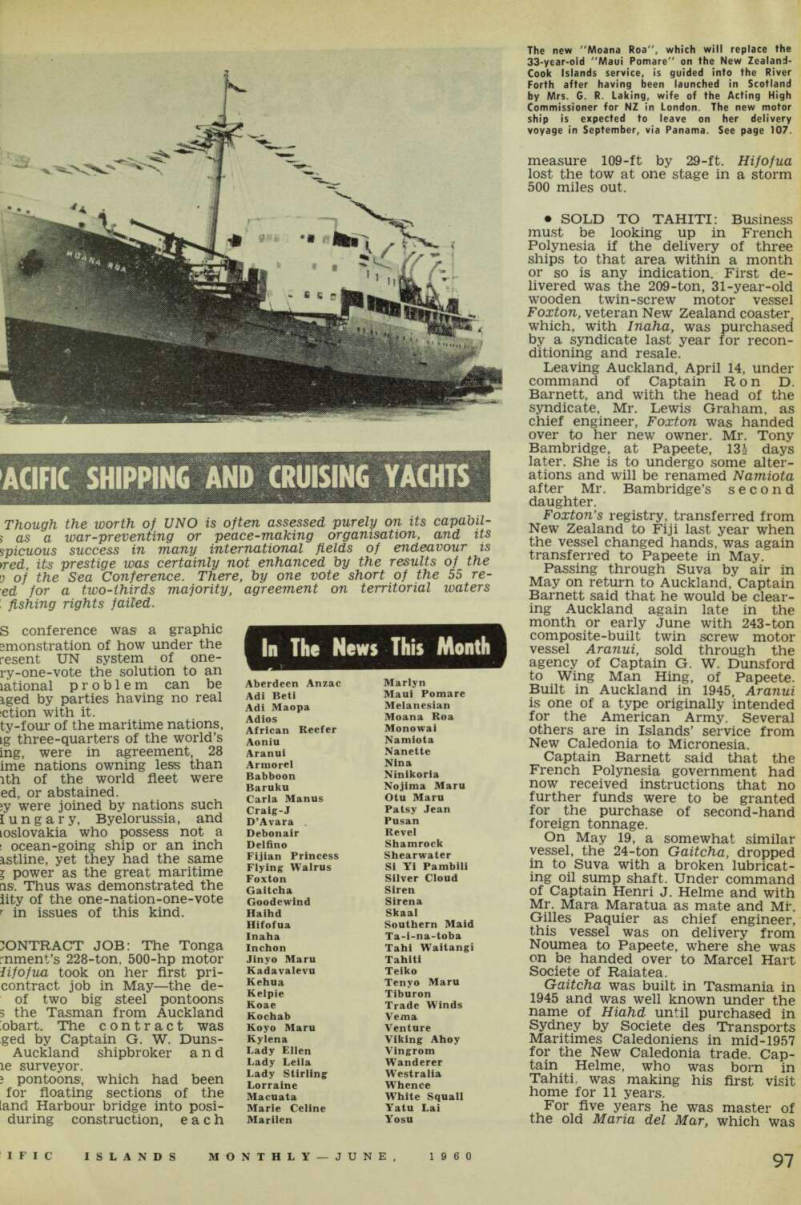
The new "Moana Roa", which will replace the 33-year-old "Maui Pomare" on the New Zealand- Cook Islands service, is guided into the River Forth after having been launched in Scotland by Mrs. G. R. Laking, wife of the Acting High Commissioner for NZ in London. The new motor ship is expected to leave on her delivery voyage in September, via Panama. See page 107.
lally sold for scrap to Japan, s lately commanded Lorraine. of Gaitcha’s crew had been cross from Tahiti, tain Helme said that he had i a large stock anchor lying ; edge of Conway Reef when ssed very close on May 16. nchor had the appearance of of no great age. Does it per jelong to some Japanese fish ssel?
Uam-Nz Link Forecast:
;ular shipping link between and New Zealand seemed as the result of a visit by . O’Connor, general manager big Guam company, to New id in May. company, Jones & Guerrero, irge food contracts with the ilitary forces and would uplift s of primary produce in part ige for logs from a mill which impany owns in the Philip vessel Sirena, which has y made one or more voyages stralia since it was purchased the US Army in Japan last would provide the link, ever, there were some doubts the plan raised in late May Mr. O’Connor indicated that oduce was costly and that he fill up this trip in Sydney, in Sydney on June 7 three of ew were injured, and the ship 3d, in an engine-room ex i.
Uva Po On Guard: As
May 1, VRO-Suva Post Office sumed the entire responsibility lallships radio-telephone guard Formerly the Post Office i provided contact with the inter-island fleet only, and Eladio-VPD, the Cable & Wire !o. station located near Lau 3ay, maintained contact with essels voyaging outside the . This station now handles norse communications, includ e 500 kc/s continuous watch, a. Post Office now maintains nous watch on 2182/4073.9/kc/s. Calls on 2182 kc/s are red on that frequency, then
ttle coast station shifts to 4379.3 kc/s—unless the ship is unable to listen on that frequency for technical reasons. If that is the case Suva PO will use 2110 kc/s as its working frequency, but this frequency is only used where essential.
Suva PO has roll-calls at 0230/- 0400/2130/2300 GMT daily, including holidays. The latest weather information is first broadcast then traffic is cleared, after which the complete 4 and 8 Mc/s shipping bands are tuned for calls from vessels unable to use the spot frequencies mentioned above. Suva PO uses 8811.5 kc/s when replying to 8 Mc/s calls and 4379.3 kc/s when replying to 4 Mc/s calls.
It is thus important for overseas shipping to note that though Suva PO is maintaining continuous watch on the 4 and 8 Mc/s bands, the re ceivers are crystal controlled on the spot shipping frequencies of 2182/- 4073.9/8262.3 kc/s, and calls on any
*SS£ To l-TaTl
?^_ r eceivea al tne lOUr r
umes -
Few overseas vessels will probably have these 4 and 8 Mc/s spot fre quencies, but if they have the in ternational calling and distress fre quency of 2182 kc/s they will be heard at any hour if they are with in range.
Suva PO broadcasts storm warn ings on the shipping frequencies,
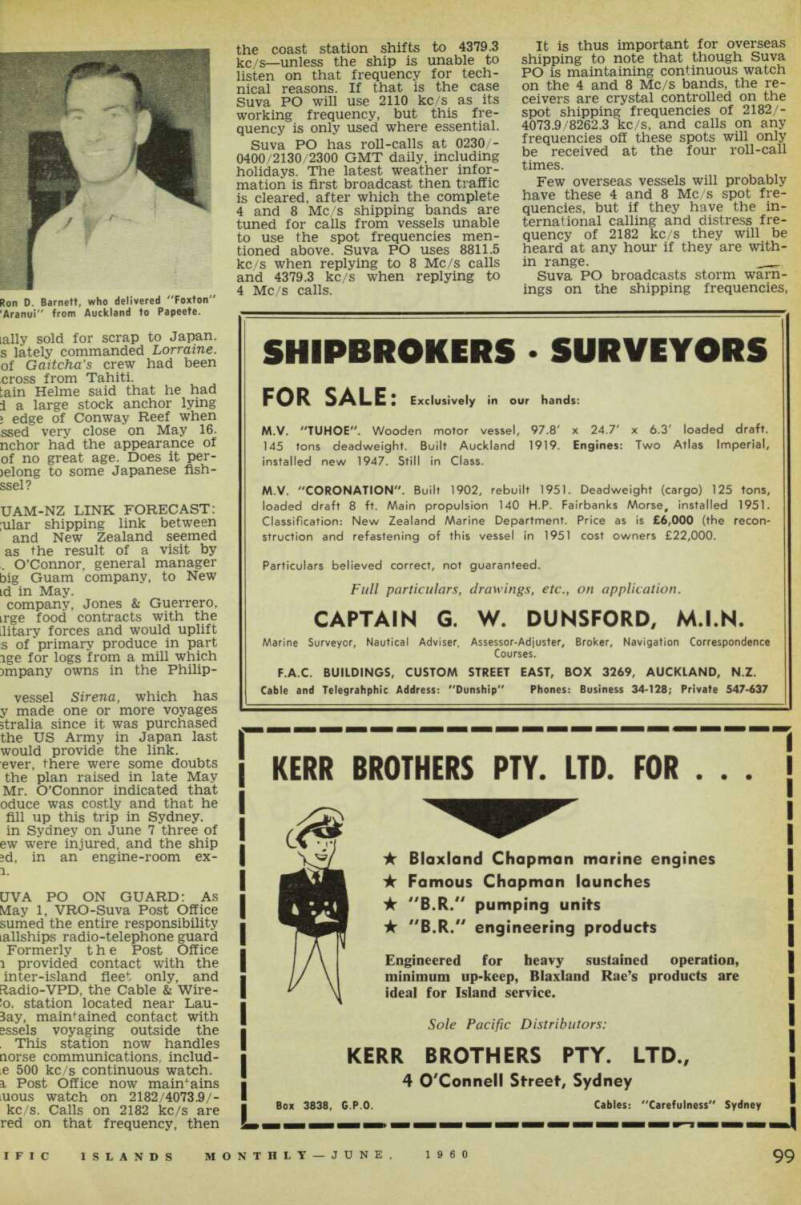
Ron D. Barnett, who delivered "Foxton"
'Aranui" from Auckland to Papeete.
ji alerts are in force, hourly GMT half-hour (e.g. 0030/d:T, etc.) The Suva broad station on 930 kc/s and one e of its other frequencies 80/6005/840 890 kc/s) broad e same information on the NE YACHTING: Like the ketch Aoniu, which has be le yacht Trade Winds, the ding ketch Macuata, name ?ed, left Suva for Auckland May as the yacht of well Auckland boat-builder Roy : in new paintwork and with Iterations to her accommo the 128-ton, 14-year-old Suva-built vessel was com by Captain Henry Simpson run south. With him was Jdgard, Percy Dawson, Brent , Mr. and Mrs. “Snow” —all of whom came up from
New Zealand—and several Fijian crewmen.
Mr. Jim Lidgard, Roy’s son, who came up to assist with the work of preparing the ship for sea after her lengthy lay-up in Suva’s Bay of Islands, flew back to the family business.
Mr. Roy Lidgard said that he will probably reappear in Fiji waters in a few months time with friends, then he will return to Auckland to deliver the 55-ft x 141-ft yacht Lady Leila, which he was building for himself but was persuaded to sell to Captain Percy London, of Sydney, who crossed the Tasman in his yacht Tahi Waitangi last summer.
The terms of sale included delivery to Sydney. Next winter Mr. Lidgard will possibly cruise to Polynesia in Macuata.
• Now Sheep And Cattle;
Fijian crewmen returning to Suva from Hongkong some time ago re ported that the stock ship Delfino would be going off the trans-Pacific lamb trade and would be running cattle in future. They were incorrect, however, as Delfino, back in Sydney from Hongkong, called for another gang of Fiji stock-tenders, loaded her fourth big cargo of Australian lambs, and headed for San Diego again in May.
When the 8174-ton ex-passenger liner (Westralia ) put in to Suva for fresh water on May 23 there was the usual strict quarantine. The lamb tally was given variously as 26,800 and 28,500, of which only about 100 had died since the vessel left Syd ney a week earlier, indicating that earlier ventilation and feed problems have been mastered.
The drainage from the stock pens had also evidently been increased in Hongkong, judging by the numerous outlets in the vessel’s sides along the waterline.
The pens have apparently now
been re-designed so that either sheep or cattle can be carried by some simple alterations. A cattle cargo was carried from Darwin to Brisbane on the run sou h from Hongkong.
Delfino is apparently having staff ing problems, as many changes of officers had recently taken place.
Captain J. P. Sullivan, in command at Suva, was said to be the third master since the vessel arrived in Sydney some weeks earlier. En gineers had also changed. Of the crew there were said to be 32 Fijians, including stockmen, a few Australian stockmen, a dozen Chinese cooks and stewards, and the officers were of various nationalities.
As usual, the ship created a great deal of interest in Suva, many hundreds of people assembled to ex-
THE SUVA SCENE. Top left, the handsome yachts "Goodewind" and "Babboon" on Suva s Public Works Deoartment slipway. "Babboon" was later in legal trouble, and "Goodewind (another view of her is below left) later reached Australia. At right is the scene ,n . Suva . harbour near the Whippy shipyard in May when the Suva vessel "Kadavalevu" filled and sank after being caught on a concrete embankment on a falling tide.
The stock-ship "Delfino" arriving in Suva for fresh water in the course of another lamb run to California in May. See above.
greetings from a distance ;nds on board.
'Air Advantage; If One
want to be landed with an ne in the Islands one has ery careful where one is ake for instance the girl a launch on Penrhyn Northern Cooks, in March. ires to be named either - which means “coral head” nau Moana, which means y across the sea” or some nilar. ns just possible that when ng lady is old en(pugh to diat she has been inflicted e may feel inclined to re e party responsible, perhaps name that was prevalent Jew Guinea small-ship crew pre-war years—Silibaga.
;F-Blasting Galore:
(gramme of widening and ig the cargo-lighter reef in the Cooks is proceeding od a similar big programme to commence in the Gil l Ellice Islands.
Cooks, where PWD Super ,t W. H. Ryan is devoting time to the job, the project great assistance from the Z Navy in the supply and of over-age ammunition as formerly dumped at sea. h, 296 such bombs were ex >y the Ryan team at Tau id Tukao, Manihiki, result , considerable improvement. is a lot to learn about suc reef-blasting, if the maxi :ect is to be obtained with liable ammunition —and if villages are not owered with hunks of coral, m learnt the job the hard er undergoing a special ex course with the Navy at 1 Some of his experience is ig passed on to the Gilberts, bout 20 passages are to be in the next year or two. 80,000 has been set aside job, most of it provided UK’s Colonial Welfare and nent Fund. Navigational h as beacons are also being ted there.
Q-Light-Em Beacons:
ectiveness of reflector-tape which are being established entrances to the reef ge s at Avarua, Avatiu, oa, and Rutaki, Rarotonga, watched with interest in :ands. ost of establishment will be Dwer than lighted beacons, ibly the tape will have to be sly sealed in some trans container to prevent rapid ition. But even so there may i loss of reflection through ation of salt spray and [ents.
Craft using the beacons will naturally have to play a searchlight or torch on them as they approach • UNDER CONTROL; That new harbour embankment at Betio, Tarawa, which was showing signs of erosion, is not going to collapse after all, according to a Government statement. Action has now fur“ero“lon effectiVely preVent Tn Mav work was nroceedine also onth^ a LrThage W S ref of the harbour where two of the largest local vessels will be able to berth at the same time when this job is completed soon.
• Changes In Ninikoria :
The GEIC Government vessel Nini koria, 288 tons, one of the finest vessels in the South Pacific Islands trade, was in Suva in May for a general refit and installation of cathodic protection to the hull. The latter simply consists of three groups of zinc electrodes mounted aft, ’midships, and forward on either side well below the waterline.
Chemical action between these and the hull plates se s up a weak electric current which, it is expected, will prevent bottom growth.
The ship had accumulated a dense growth of coral branchlets about two inches long since she was
ix months ago. Work on ivernment ships has this i withdrawn from private i given to the Fiji Public spartment. mand of Ninikoria now— [ the ship just before she iwa for Suva —is Captain ington-Strong, who was irbourmaster at Hongkong ne that the ship was built 1958. through his meeting Cap idie at that time that he nterested in the Gilberts led to apply for the com en it recently became avail pshire-man, Captain War- Itrong has 29 years of naval He specialised in naviga the cadets now training in should have a first-class this field. Mrs. Warrington so travelled south to Suva, iptain P. J. Kenny, of Lon relinquished the command e years in GEIC service.
Captain Kenny’s wife was invalided home last year with a badly broken arm and this had decided him to resign. He caught Orsova at Suva— with a few hours to spare.
Ninikoria’s chief engineer is now Mr. T. L. Macquarie, who travelled north from Auckland in the phos phate vessel Vingrom in February to replace Mr. J. Robinson, of Suva.
Well known in the Islands, Mr.
Macquarie has a son in the Cook Islands PWD. The chief officer is Mr. S. J. Taomia, of Nanomea, who received his Second Mate’s certificate in Auckland last year. He will return there to sit his Mate’s ticket next year. The junior officers are two cadets in their fourth year.
They will eventually go to New Zea land if their preliminary work is satisfactory.
• More Koreans: Until 1958
the Korean flag was virtually un known in the South Pacific, then came a few Korean tuna longliners to join the Pago Pago fishing fleet.
Last year the first Korean ship ever to visit Fiji showed up. This was the heavy-lift ship Yosu.
In May, another, Inchon, 3,818 tons, with the same type of Ameri can-built C-2 hull but not rigged for heavy lifts, called at Nukualofa and Suva under time charter to the Japanese Banno firm, and a third, Pusan, will call later in the year.
These vessels will load ore and copra in the Islands and coal and timber in New Zealand, so a good deal is likely to be seen of the Koreans this year. Inchon was under command of Captain Lee Seyong, The chief engineer, Won Ki Chun, and the second mate, Ahn Sungsoo, were serving in Yosu last year.
The latter vessel is now running steel barges from Hongkong to Colombo. • A DEAD LOSS: Though the Gilbert and Ellice Islands Colony has two fine modern ships in Ninikoria and Moana Raoi, the Resident Commissioner said in Suva in May that the Government has to foot a loss of between £20,000 and £25,000 a year at present.
Apart from a few very small co operatively owned craft, no ship ping in Colony waters is operated by private enterprise—the Wholesale Socie y is backed by the Govern ment. .
To maintain communications its necessary for the Government to operate many uneconomic routes, some over great distances —to Fan ning and Christmas, for example. An average freight rate for all services has been set at £6/10/- per ton re gardless of distance. Even cargo landed direct at Tarawa from over seas and not subject to further trans-shipment, is subject to this rate of loading.
The Resident Commissioner did not say so, but it is understood that negotiations are in hand for a pro portion of the Colony’s copra to be made available to a Suva crushing mill in exchange for a direct freight service from Fiji. This would re duce landed costs, as most cargo reaches Tarawa through trans-ship ment from Ocean Island at present.
The copra back-loading would
On Research
[?]iversify 's research vessel "Verna"
Wellington, NZ, on a cruise round [?]he may be seen in the Islands some See "PIM" May, page 111.
Photo: P. Shortall.
[?]n F. Warrington-Strong and his wife nikoria" at Suva in May. Captain Strong took over command of the from Captain P. J. Kenny (below) 9 years in the Royal Navy, lately as ourmaster, Hongkong. Captain Kenny ears with GEIC vessels and returned on in May. See story this page.
"Ninikoria" on the Suva PWD slipway in May.
ie link worthwhile. The of some copra to Fiji pparently involve negotia h Lever’s who buy the en [C output on yearly con the present time.
S That Bottle: There’S
aled lemonade bottle head across the South Pacific nt which will be worth a ib. to PIM to the finder, led at 0215 GMT, on March
.375, 177 W from the yacht
inds, its route will be any ess. It could curve south r Zealand and westward to merica. then perhaps back the Kon-Tiki route, could curve north into the a and perhaps finish up on Guinea, Solomons, or New a beach. The chances are t we’ll never know.
Jmons Replacements:
e GEIC has turned thumbs a wooden ships for its routes, the Solomons Gov is evidently returning to hips. It has lately been con the tenders received for an oden vessel to replace the steel Melanesian lost in 8, with all hands, ier has just been placed mders-Roe of the UK for ’t vessels with ventilated pable of carrying 10 tons ht of cargo or 30 passengers 3 holds are empty, tails of these craft are but the name of the uggests that they may be m or plywood in construe i is to be used for the trans itaff and equipment during icoming colony-wide map vey. ! BAD EXAMPLE; Recent into Solomons Government losses have not enhanced jge of the Government as ner. e investigation into the ; and loss of the 60-ft >n a reef in the Russells in the master said in March auxiliary engine had been [oniara for repair and the compass was lit by an iron ane lamp which was d about 12 inches from the rht was not a good one, the was dirty and not easy to re was a crack in the card, e was a large bubble in the a result, says the report iddence, “he was awakened ap”. ie hoped was a floating log mfortunately to be a reef as some miles away from ;’d hoped it was. lip had been surveyed by ernment in November and “conditional certificate of tiiness, subject to certain de
fects being made good within four months”. Unfortunately, the reefs had not been informed of this certificate.
• Spc Boatbuilding
COURSE: Selected trainees from all the South Pacific Commission member territories will be as sembling in Honiara in July for a two-year course in boat-building, and marine engine installation and maintenance. Each trainee will re ceive free transport, food and accom modation and £3 per month pocket money. A Cook Islands notice says that the trainees will be expected to return to work in their home territories at conclusion of the course, but they will not become Government employees.
C Coming Via Panama: The
new NZ Government vessel Moana Roa, for the Cook Islands —NZ trade, will be delivered via Panama, with a full load of cabin passengers and cargo, and she will call at Rarotonga en route to Auckland in
September-October.
Captain J. Hare, Electrician T.
Dooran, and Chief Steward W.
Kain were to leave Auckland by air on June 3 to join the ship. The Chief Engineer, Mr. F. Evans, has been standing by the vessel for some months. It is assumed that other members of the ship’s company will be found from UK personnel.
Gross tonnage is now given as 3,050 tons. Service speed will be 13J knots. The colour scheme will be pale green hull, white superstruc ture, red funnel with a black band, buff derrick and masts, and dark green waterline.
Moana Roa is certain to be for ever confused with the GEIC Wholesale Society’s 504-ton Moana Raoi in newspaper references.
Pending the arrival of the new vessel, the Cook Islands Adminis tration is arranging three calls by outside vessels to assist Maui Pomare in uplifting this season’s citrus and tomato crop.
As in the past two years, it is expected that the refrigerated Danish LaurTzen Line Reefer vessels, on their southbound empty runs from the United States, will be available. These ships are engaged in running frozen meat from New Zealand to California and Japan.
First Rarotonga call this year was to be made at the beginning of June by African Reefer. • LISTENING-IN: Unseen from the shore, but active on their work ing radio frequencies, the Japanese tuna fleets are back on the job until November. For radio men in terested in their movements it may be of interest that the Nippon Suisan fleet, headed by the mother ship Nojima Maru- JMKU uses 3030 kc/s and the Taiyo Gyogyo fleet headed by the mother-ship Tenyo Maru No. 3- JBRT uses 2060 kc/s.
The ships use Japanese Katakana code but a smart morse operator cani pick out the position of the vessels as these are given in figures the same as international code.
Any evening now the mother-ship; can be heard on their roll-cal schedules. Last year Tenyo Man No. 3 sent regular messages t( Suva Radio once she came inu range, and her posi'ion is includet in these messages. Later in th season these mother-ships will b replaced respectively by Jinyo Maru JKBM and Koyo Maru-J HVK, an late in the season a third fleet wii probably appear headed by ot Maru, of the Hokosuisan Co., a ne 1 contender in the South Pacific tun harvest. To know where they ai working can be interesting and j times useful. • TEIKO INQUIRY: An offici; inquiry into the circumstances sir rounding the loss of the Tonga tuna longliner Teiko opened i Nukualofa on May 12, but no fini ings had been received by PIM shipping roundsman up to late Ma In April. Tonga Copra Boan Aoniu bound from Nukualofa Apia and the Tokelaus, hove to a point about 27 miles north Vavau in the area of the presum loss of Teiko while a memorial sc vice was conducted by a Tong pastor. Many wreaths, taken aboa at Nukualofa and Vavau, were ci into the sea as a tribute to t memory of the 22 seamen lost in t March disaster.
• New Management: Manai
ment of the Fiji provincial vess Yatu Lau and Ta-i-na-tobaM taken over in May by the Stan Shipping Service, a registered ■ ness formed by Roy W. Sellarsi Captain Stan Brown, of Maroro.'i will also operate the Shell sm ships bunkering service at Prim Landing by the Suva HarU Master’s office.
• Soon For Sale?: It Wasl
dieted in Suva in May that the! ernment would soon call tent for the 60-ton wooden auxili ketch Adi Maopa, 56 ft x 5? ft; the 49-ton wooden m vessel Adi Beti, 53J ft x 144 ftl ft; and the 27-ton twin sc wooden launch Venture, 45 ft xs ft x 5i ft. All are well know| Fiji Government service.
Another well known Fiji 1 which changed hands in May!
Fijian Princess, which will rej in Fiji waters. This 119-ton I was built by W. Baker, at Na Lomaiviti, in 1948. The Bl family has sold the ketch I syndicate headed by Mr. A* Evans.
• Nh Patrol Craft:
Kraft Boatyard, Bulimba, Que land, was the successful tent recently for building a new wo; 68-ft patrol vessel for the Bi Administration in New Hebii
iction will commence shortly,
leld-designed, she will have of 181 ft and a draught of
fin Gardner engines will give
peed of 10 knots. There will
enger accommodation for 12,
'go capacity of four tons.
St Crossing: Uss Co.’S
i i left Sydney on May 27 on t trip across the Tasman to aland. The voyage ended the y’s passenger service between
ia and NZ, begun in 1876.
Pacific Islands cruise from id, on June 2, she will be
for sale.
of Cruising Yachts
\Ns-Tasman Race: The Royal
Yacht Club of Auckland has an a Trans-Tasman Auckland to Race, to start late January or iruary next, subject to a minimum itries being received. RORC Rules -ft. minimum waterline will apply, •son Girl” or other approved dis io transmitter will be compulsory ild probably be arranged in Auck td yachts must have self-draining and carry approved dinghies, y of the inflatable type, act date of closing of entries will meed later and the entrance fee £ NZS/5/-, about SUSIS.OO. Boats equired to assemble for inspection and at least a week in advance tarting time. raditional trophy is the Trans- Cup (and miniature) which has npeted for seven times in five d and two eastbound races. There be the Rangi Cup (and miniature) irst boat across the finishing line, umsoring club is keen to receive rom overseas yachtsmen and will possible assistance and encourage them. Interested owners should the secretary, Royal Akarana lub, GPO Box 854, Auckland, New for fuller details. •ODEWIND, of England, cleared • Noumea and Sydney on May 7, hed Coff’s Harbour. NSW, on May Australian landfall. Michael transferred to the motor yacht ST but the crew otherwise re unchanged—see May PIM.
LING AHOY, Brisbane-built motor hich was purchased over a year Suva from the Seventh Day Ad lission, has lately been fitted with if 60-hp Buda diesels in place of nal Southern Cross motors. Owner lubber, of Invercargill, NZ, was in Suva late May and this craft, y brought to Fiji by Mr. Hugh mder charter to the ‘‘Blue Lagoon” t about 12 years ago, should sail Zealand in June.
IMROCK, of Wellington, NZ, gaff 1-ft. yawl, with owner L. R. Smith, , and his father E. Smith aboard, »t Suva April 29, 12 days out from NZ. This yacht will cruise Fiji or several months then head west ' New Caledonia, New Guinea, and i.
NETTE, of Whangarei, an H-28 rned by Charlie Capon, was ex o clear that New Zealand port for we and Brisbane in May.
YING WALRUS and the Wells )f Westview, BC, after a lengthy Whangarei, NZ, was to clear for
Noumea, and all points westward, in continuation of their world cruise, on May 31. • PATSY JEAN and NINA of New Zealand were to clear Whangarei for Raro-
•as r sHsT SteS
PATSY °JEAN will presumably e» chased in 1958, *is she sat in a cradle on the beach in poor condition. • SHEARWATER, of Brisbane, which left Russell, NZ. early April, was back in her home port by the end of the month.
This yacht cruised Tonga-Fiji last year. ... „ , • WHENCE, a 25-ft. cutter with Gordon and Roberta Lopez and their three-yearold daughter Roberta aboard, cleared Bora Bora for Maupiti, Suwarrow, Pago Pago and Suva on April 3. This yacht is from San Diego, Cal.
• MARIE CELINE with Winston‘ WilHams of San Pedro, and three other Americans aboard, cleared Papeete in April for some loca i cruising, perhaps as far west as the Cooks.
-a r: tz'zst'szstz
A^^l^fo'r'Bora^Boll,‘"suwarrow. "samoa!
SS .indolences ”o TSLfSA
papeete two wee ks after the yacht arrived there last December. Ed is a Ham, W6PDV, and may be heard on the 10metre band. The yachts commercial R/I signal letters are W 85182. WANDERER 111, Eric Hiscock’s latest, is apparently expected soon at Papeete, as there are reports of considerable mail ac cumulating there cumulating mere. • KELPIE, 65-ft. schooner gaff-rigged on the fore, owned by Newport, Cal., yacht broker George Minnies, and with his sons
and Joseph, and George McLeod e Estoban aboard, which has been ch Polynesia waters since last t, was headed for Honolulu in MOREL, 38-ft. cutter, purchased and Jane Van Blaricon of San 0 at Southampton. England, is ific bound. The yacht made a fast crossing from the Canaries to s. lUA, which we said in April would loing any deep-water cruising this doing some after all. She left •ei April 30 for the Cooks, Tahiti, and may call at New Guinea and i, during a 12 months’ cruise, ’eter Ashcroft, Selwyn Matheson, ;tlt (all of Whangarei) and Donald tastings). She was damaged at fa in May—see final item this page. 4AL, 35-ft. double-ender cutter of re have no previous record and as sailed to Papeete by two Nor some time ago, is reported now at that port.
RILEN and the Gee family sailed >lulu from Papeete in mid-March. 54-ft. schooner of Newport, Cal., masts between the Cooks and >me months ago. New masts were down from the US and the yacht igged at Papeete. James Uhlman, 1 author, joined the crew there passage north in March. □LENA—other versions make it II and KAILANI—a 32-ft. steel nanned by Ted and Izzie Mangels Jerry, 11, of Newport, Cal., at at Papeete, will sail for Samoa, sbane and Sydney after the July ons.
AE, 30-ft. ketch manned by Mr. s. Carlton Taylor, which left , Cal., last August and spent some Honolulu, arriving at Papeete in lylor built the yacht at Paulsboro, JSA, in 1958.
IITE SQUALL and the Norgroves and, NZ, bound for the US, were te in May.
VER CLOUD of Auckland, S4-ft. left Papeete westbound for Aus a Islands ports in May.
INDERER of Auckland, with T. n and crew, was in Papeete in I planned to head westward soon. iONAIR of New Zealand, about to r Fiji, again suddenly cancelled >r the second year in succession.
Roberts had notified Fiji of his departure date and Suva ETA, it further advice that the yacht ot sail this year.
ADE WINDS which sailed from Apia in early April, was in Pago mid-May and there was talk of a charter to Apia interests, failing lext port would presumably be and Honolulu.
FE PAMBILI, reported out of Bal y March, was in Papeete in May. ith African yacht is heading west.
DY ELLEN, 73-ft. Sydney ketch rossed the Pacific in 1958 with lorn, wife, and crew of 10, lately hands at Jamaica.
BBOON, 52-ft. 73-year-old wooden , which arrived in Suva under a ownership and control some ago, and later was purchased in ith by a Suva resident, was re i by another American who ar the Colony in May. At the end Mr. Paul Didier and his wife were and making preliminary plans to California. This fine yacht has a aplex legal history.
• MARLYN, a converted naval Fairmile launch which has traded on the NZ coast and to the Chatham Is. in recent years was north-bound on an Islands cruise in May under charter to a party of 16 South Islanders who had each put in £250. The 110-ton cargo vessel, commanded by Cap tain R. J. Barnett (no connection with Captain R. D. Barnett mentioned else where in connection with the vessels FOX TON and ARANUI) left Auckland May 12, called at Raoul in the Kermadecs, and was expected at Nukualofa later in the month. Next port was to be Suva. • KOCHAB, of England, arrived in Papeete from New Zealand late April after a fast 19-day passage. Honolulu. Mexican coast, Panama, and the West Indies is the route planned. With Dr. John Franklen-Evans is Dick Pohe and Leo Conaglen. • ABERDEEN ANZAC, 45-ft. Scottish fishing vessel, with 10 aboard including two women, was at Barbados in mid- April bound for Galapagos, Papeete, Raro tonga, Raoul and Auckland where an early August arrival is planned. The 27-ton craft will be offered for sale there. The voyage commenced from Southwick, Surrey.
• Carla Manus, Ex-Amohine, Which
traded in New Guinea waters for several years until sold in Sydney last year, ar rived at Auckland May 19 bound Tahiti with Mr. W. Mitchell in command. The 66-ft. schooner was to continue her voyage about May 24. • LADY STIRLING, of Auckland, the 48-ft. motor-sailer in which Stan Worthing ton and family cruised the Western Pacific in 1956-58, made a cruise to Norfolk Island in April-May under the command of Mr.
L. K. Mclver. Bad weather was ex perienced, anchors being lost at Norfolk and some other damage suffered but the yacht was safely back at Russell, NZ, on May 19. • TAHI WAITANGI, 58-ft. ketch with owner-skipper Percy London and four Sydney crewmen aboard, struck trouble on a Tasman crossing after leaving Auckland on May 4. Exceptionally heavy seas bat tered the yacht and forced London (a 76years-old retired businessman) to use the auxiliary engine. Their fuel became ex hausted before they reached Sydney. An RAAF Sabre jet found them drifting, after they had radiod for assistance, and a tug towed them into Newcastle harbour on May 23 after a three-days’ battle against mountainous seas off the NSW coast.
• REVEL, 30-ft. Auckland yacht In which John and Marlene Smith made a honeymoon cruise to Australia in April, 1958, left the home port again on May 21 bound Papeete, Honolulu, and Canada.
Marlene is a trained nurse. John was a crewman in MARCO POLO in 1957 for a time. The run to Papeete should take perhaps five weeks. • ADIOS, with Tom and Janis Steele aboard, arrived in Port Moresby from Noumea on May 24. The Americans, the Stars and Stripes well in evidence, an chored next to Moresby’s remaining yacht ing family—Mr. and Mrs. Myles Lewis, of SOUTHERN MAID, who live on board with their two youngsters pending their next adventure on the high seas. Myles Lewis is an air pilot with Patair. It’s not known yet how long the Steele couple will re main in Port Moresby, but when they de part it will be via Darwin to Ceylon. • D’VARA, West Australian yacht, with Stan and Dorothy Bradfield, left Port Moresby on March 12 after about 16 months of working holiday there, to continue their world cruise. When we last heard of them on May 26 they were in Madang, NG, awaiting a spare part for their auxiliary engine to arrive from Australia. Some where around the islands between Samara! and Rabaul a piece of nipa palm fouled the propeller and had managed to do some damage to a gear. After Madang their planned route is Hollandia, NNG, Cocos Islands, Red Sea, Mediterranean and eventually Canada.
• Yachts Damaged At Raro
TONGA: The May 24 seismic wave which swept the Pacific caught the New Zealand yachts KEHUA and NINA. and the American yacht TAHITI in Avatiu Har bour, Rarotonga, at 9-30 p.m. on that day.
KEHUA and TAHITI rolled together and the former lost her mainmast. TAHITI was holed in several places. Both were thrown ashore. NINA remained afloat and appeared undamaged. There was con siderable turbulence in this little harbour.
TAHITI, owned by Lorrin Smith of Hono lulu, recently made a voyage to Suwarrow Island. Mr. Smith has been employed in Rarotonga for many months past and the yacht is based there at present.
The " Shamrock” team. —L. R- Smith and his wife, and (right) Mr. E. Smith. This Wellington yacht was in Fiji waters in May-June.
See p. 109.