Sydneysider Goes Walkabout
pp. 67-75 · Read in the full issue



The Tourists Are Back In Asia
Keep to the high valleys amongst the shepherd folk; to > rushing snow-fed streams. Keep your eyes on the white iped ring of mountains that surround you; walk in the gardens Shalamar or Nishat : Then Kashmir is, indeed, the fabled id of the poets; the earthly paradise of the ancient Persians.
’ let your eyes fall to ground vel, and you’re sunk. One of ie many ways that Kashmir ; from the rest of India (to it is hitched, by all accounts, ingly) is that its dirt is wet In other words, mud. the weeks before we arrived, hole area had had more than rmal quota of rain, but that bly makes little difference to ormal picture. The Vale of nir is a natural drainage sump.
Dal Lake at Srinagar and the Jhelum that winds itself ?h the Vale of Kashmir and r into Pakistan, both made is by the poets of the past ie travel brochures of the pre spread out into an amazing ork of canals and waterways ilong these the people have ;heir huddled villages of mud, bricks, fired brick and un d timber, fronts of the hole-in-the bops face outward to the pass ater traffic instead of to any and the adjacent gardens which the people live, are a foot or two above the sur ing swamp.
Does Kashmir c About It?
Y when you move back into ountains, one or two thousand >ve the 6,000 ft of Srinagar, pital, does the Jhelum emerge its mud and become a smaller ifinitely gayer stream, rushing - pebbled bed. From its banks marching away up the moun into the perpetual snows, are line and fir trees that are air’s biggest income producer, hmir is, of course, disputed >ry—disputed between India 3 akistan all the years since ion. And now, in part of its ;rn border, disputed between
t India and Chou En-Lai’s China.
About 90 per cent, of the population is Muslim; and about the same pro portion (so it is said) would vote to join Pakistan—if they got a chance to do so which up to date they have not.
Why India denies these people a free choice in this matter is some thing only India can explain, though the Kashmiri who thinks that his troubles would be over if he got into the Pakistan fold is probably kidding himself.
The lot of the average citizen in the sub-continent of India is pitiful.
The lot of the Kashmiri is worse only in degree. The fact that he appears to have the filthiest villages, the dirtiest towns and the greatest number of unwashed citizens per head of population may seem so only in contrast with the undeniable beauty of the surroundings.
The arable land is divided and subdivided into holdings no larger than suburban lawns, for Kashmir shares Asia’s fundamental problem:
Too many people for the available resources.
There are various solutions offered for this—from Communism, to the enterprising outfit responsible for the large sign near the BOAC city terminal in New Delhi—in its own way a quite practical introduction to the problems of the country.
“Plan your family,” says the sign. “Use Tib-Tabs. For Birth Control.”
With some 400 million Indians already inhabiting this part of Asia, even Tib-Tabs have come a bit late on the scene.
Meantime the travel literature continues to sing the songs of fair Kashmir and there is a steady stream of tourists through this State, 99 per cent, of them Ameri can, with a sprinkling of well-to-do Indians and a few English who work in the country and take short leave in the mountains. Of English tourists, in tourism’s broadest sense, there are nil.
The Ancient Road Is Closed The Indian official view of Kashmir is that it has always been an integral part of India and they carefully exclude any mention of Pakistan in their tourist literature.
The 570-miles road from New Delhi to Srinagar, they are careful to note, is the “only road into the valley”.
This is not so. Before the days of air transportation and the present comparatively new road over the 8,000 ft Banihal Pass (in the Pir Panjal Range that cuts Kashmir off from the northern plains of India), the way into the Vale of Kashmir was from Rawalpindi, in Pakistan.
This means of exit and entry is now closed. In Srinagar we were given a lift by a young Englishman
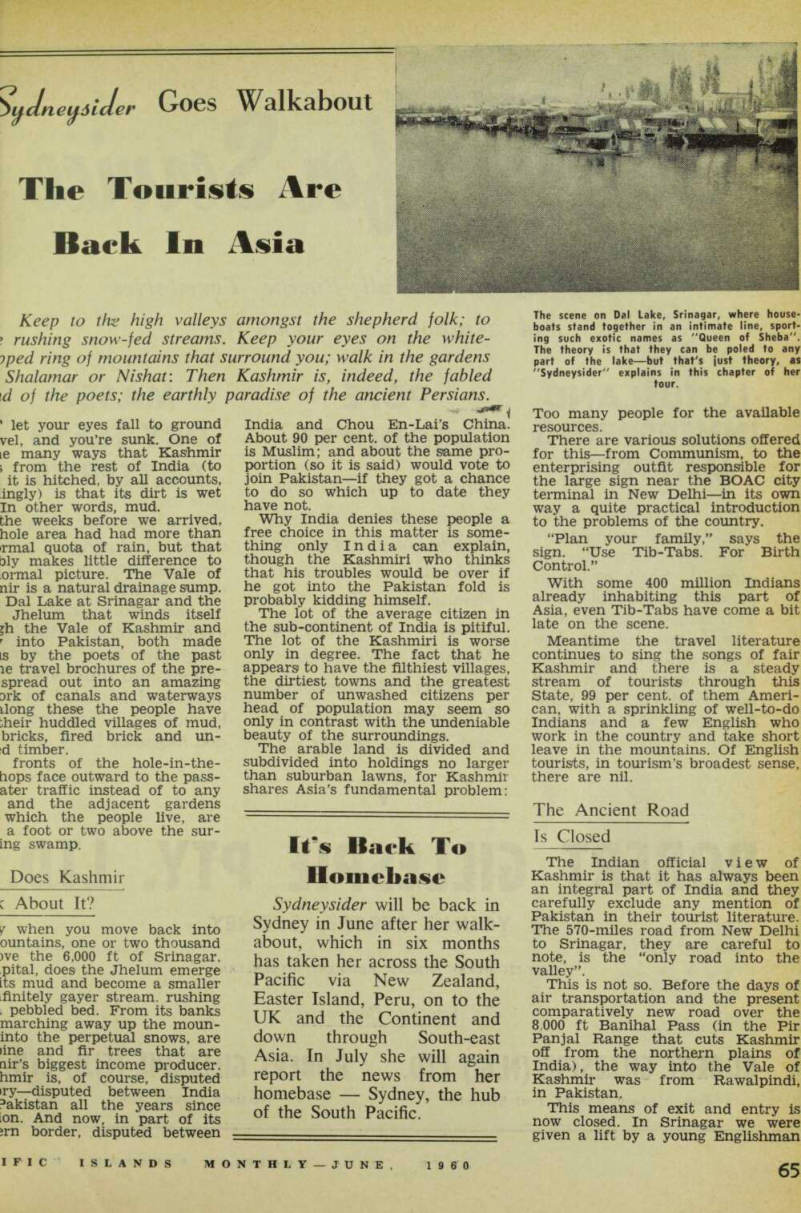
The scene on Dal Lake, Srinagar, where house boats stand together in an intimate line, sport ing such exotic names as "Queen of Sheba".
The theory is that they can be poled to any part of the lake —but that's just theory, as "Sydneysider" explains in this chapter of her tour.
attempting to drive a Ford from Malaya to the UK. ow he had strayed into ,ir only to find that he had outh about again, to get into in, as the old direct route ised by the jealous Indians. s Of New Guinea
mote Kashmir
a I staggered into the waiting >f the airport at Srinagar to ;he impedimenta of air travel, st tripped over a small case ; floor plastered over with Philp Line labels—“ Passenger \olo”. Shades of Captain Bill y in remote Kashmir! srs of the case were Lois lie and Jack Corbett, pro of educational films (Lobett tions) of California, who in =vious three months had in a week in Fiji and a round Bulolo to Papua-New Guinea Im-making world tour, i we met them they had just ted a week in Kashmir. They n their way to Bombay, and tii we left them —two out of lousands of perambulating we have encountered who aterested in more than just off another name on an ry. jrms of mere transportation, ir is not remote any longer, Srinagar’s airport, remoteness ime and primitiveness—does /•er. atched a trio of elderly an she-tourists head in the m marked “Toilets” and, in leconds, I watched them come / back. A little later I headed e same direction myself, ng in my hand the necessary on of coins. ial Note For The
e People
were in the airline business, ive written into the lATA tent a prohibition on all in-the-slot lavatories or jhments presided over by bs whose only means of liveli ; obviously is. It does nothing ! morale of air travellers, de at some strange foreign air ir an hour while the plane re to be unable to find the try penny for the slot; or to assed by the attendant, who iround you with a piece of towel and a wail for back , annas, cents or whatever the egal tender happens to be. ily recourse you have, at the it, is to take from the bottom r bag some of the miscellane oins of travel —threepences, 5, the aluminium bits and of France and Italy—and a handful her way. If you fast, you will be at the door
before she finds that she has been betrayed, and lets out the first howl of anguish.] But at Srinagar there was a vari ation on the usual theme. Two teenage boys were in charge and, with the more positive approach of their sex, didn’t wait for business, but came out and hustled it in.
The romantic thing to do in Srinagar is to live in a houseboat.
But when, in London, I had been given the choice —houseboat or hotel that had once been a Maharajah’s palace—the romance of houseboat ing seemed no compensation for coping with the four servants that went with it. Moreover, Maharajahs have a reputation for knowing when they are well off.
The houseboats are slightly more elaborate versions of what Mr.
Noah once built. In theory, they can be poled or rowed “to any part of the lake or river that the hirer fancies”, but in practice they rarely are. In an intimate line they stand side by side, canned-sardine fashion, along the edges of a muddy canal or the far side of the swampy Dal.
They sport exotic names like Queen of Sheba, Pin Tail, Chicago, Colombo (“with flushing toilet”).
Our ex-Bulolo, American friends of the educational films, had tried out the houseboat idea, and pro fessed themselves satisfied—“except for the hawkers”.
The Hawker Trouble Is Immense Whenever they sat down at the dinner table, there would be the noses of half-a-dozen amphibious merchants pressed on the window panes.
When they went up on deck, fur salesmen, laundry-men, jewellers, etc., would rise up from under their feet like a cloud of mosquitoes.
We got much the same treatment when we ventured on the lake in the local version of the gondola, or walked in the public street—but we could always escape to the sanctuary of the Maharajah’s garden where we have nothing more rapaci ous to contend with than the hotel servants.
No sooner had we pushed off from the shore, and the smell of Rich Foreign Tourist had been wafted on the breeze, then half a dozen flat boats, paddled madly by opportunist shopkeepers, converged on us from six directions.
Photographers, a floating chemist shop, and trinket merchants rammed their boats alongside and did every thing short of beating us over the head, to attract attention.
On, on. on would go the persistent voices, whining, sibilent, persuasive —and wholly maddening.
No tipping, says the notice behind the door in Delhi’s plushest hotel (government-owned and run). “Any
it who solicits tips or accepts will lose his job.” Fifteen per is added to the bill to cover rvants’ loss. theory it is a good way out. ;he lads who bring up your ge wait expectantly until you peeled off the right number of notes. The woman in the ng-room at the swimming pool down the blessings of God you give her another. The servant says significantly that 11 be off duty when you leave lay. jy From The Tourists ,n Ancient Art in that particular hotel, no in view of the 15 per cent., do not make a welter of it. tiere, reefing money off the b has reached a peak of tech perfection that in the course st one day runs into real T. r shoes are virtually taken your feet and whisked away cleaned —for a consideration, i cannot produce laundry or ng on the instant, you are left in ibt that your non-co-operation wrecked the family budget of oom servant for at least a i. very minute of your de •e is known by some telepathy jhout the hotel and the whole ;akes some opportunity to get your feet. :s Are The r Of The Day even the disappointed Indians isonably quietly, found later in Hongkong’s New ories, close up to the border d China, that all the kids in e-field left what they were and threw stones at our car one of the passengers had pted to make a movie shot, ilarly, I was pursued and i all over the Kowloon wharf rickshaw coolie who swore he i the film I was attempting to jf the nearby street. rule here is that you bribe me in sight before (not after) et your camera into position, n’t worry,” said the young i tea planter, as he backed the behind out, to overhang a above Kandy, Ceylon. “I’m x> it.” idn’t doubt it, but it seemed putting overmuch faith in a car’s brakes, d hired it ourselves the previ iay down in Colombo, had i the 70-odd miles to Kandy irere now being shown over a ;tate by our Indian host, who ffered to drive as he knew the this plantation there were
about 400 acres established in tea— planted right up the almost; vertical side of the mountains; there were 500 workers on the estate, some of them of the third generation to work there Our host had been born in Madras, but was a Singalese citizen by virtue of the fact that he had married a girl born in Ceylon, although she is of Indian parents. The workers on the estate were also Indian. Singalese do not work on the tea plantations.
If you wanted to make sweeping, and certainly superficial, sta f ements about Ceylon generally you could say that the Indian, Tamilspeaking part of the population, affects to despise the head Singalese “because they are lazy”.
The Singalese, on the other hand, hate the guts of the Indians and devote quite a slice of their time to annoying them and keepmg them in India—for which last you can scarcely blame them, as Ceylon is a small, lush country while India is huge, mostly dry, and over populated. if you wanted to make more snap judgments, you could say that while 50 per cent, of the Singalese are living an uneventful peasant exist ence, the energies of the other 50 per cent, are devoted exclusively to filling in forms, making other people fill in forms, or filing and keeping track of forms. No country I’ve ever visited is so carried away by the full processes of fumbling bureaucracy as Ceylon. (Over>
the tea, copra and rubber tlons you can thank British and industry of the past, ritish colonial administration e built the network of excel led roads, the railways and institutions. But for this no )f praise is currently forth
iy Remembers
British guide books mention Portu- Dutch —but nothing about the who ruled the island (accord their lights, honourably) for irs.
Singalese has not got to so much as other Asians his next meal is coming and consequently can in in politics to his own ruina- And here, too, and for the reason, the process of dis ,tion goes on faster, le mountains beyond Kandy p to and stemming away Juwara Eliya, at 6,000 ft, are df million acres of Ceylon’s states —her biggest overseas earner. needs a cool climate, a well i situation and above 100 of rain a year. The soil on the tea bushes are planted— they are in bearing they are 0 a fiat topped, level shape, 18 inches to 2 feet high—is poor-looking, broken rubble, iderable amount of manuring artificial fertiliser is carried
)n Ceylon’s Tea
1 lions i estate has its own tea >r y—a place of elaborate lery and driers —in charge of jerienced tea-maker, but the mportant asset on the estate team of tea pickers who have up to the job. lanical tea picking has been n Ceylon but is not favoured. , because the machine is not linating and picks everything appens to stick up above the nding foliage—not just the x>p leaves and the bud”, of dvertisement. Secondly, for nical picking, the tea bushes . be planted in hedges, or and Ceylon’s long established > have not been planted in ay. tea planter in Ceylon has a i kind of relationship with his force. He can’t, as in New a, for example, “pay them off ’, or send them “back to their . The plantation is their place, ) long as he owns the planta he responsibility of the people is his. recent years there has been opulation on some plantations.
This has not been solved in the normal way by funnelling off surplus labour into outside industries, but in rationing the work on the estate. The Indian tea workers belong to the plantation, and scarcely at all to Ceylon. The estate is their livelihood and their security and, once off it, they are aliens.
In Ceylon there is much talk of nationalising the tea industry, which would be as good a way as any of wringing the neck of the goose that lays golden eggs. Most estates are still owned by European companies and individuals, although it is possible to drive the 110 miles from Colombo to Nuwara Eylia and not see one European face.
All over the East this inconspicuousness of the European is now an
established fact. They are still there, in considerable numbers, but they don’t sit in the front windows of administration or commerce—which is as it should be.
It is only in Ceylon that the effect of the withdrawal of Euro pean supervision is obvious. It is the final justification of all the prophesies of all the I-told-you-so pukka sahibs who ever lived In addition, the once-famous hotels of the inland towns now are grubby, dark and decrepit. Where knobs fall off, they stay off. Where the carpet is worn and torn, it re mains that way. The menus are still in French, but the food is atrocious. Giggling Indian school girls and their staid parents make up the clientele. (Over)
gkong, bigger, brighter, more ng than ever—the biggest vindow in Asia, someone calls rrently at the beginning of its jason. is down to bedrock in ervoirs and dams and water is ble only from 4.30 p.m. to m. rou axe one of those people ke to scrub your teeth or take ih at other times, you have op water from a bucket that >tel staff obligingly leaves full, jerform your ablutions in a i dipper. ould be worse, they say. Two ago the water position was [ that it was available for only ours every second day. water shortage may have a >n soon —if the Hongkong Y administration can agree led China on supply of water the newly constructed Shum- Reservoir which is on the side of the Bamboo Border. mid-May, heavy negotiations going on over an issue that be possible only when dealing Jie Red Chinese or with Mr. ommunist China insists on r ing the water free to the ;ong Colony; Hongkong, on iher hand, insists on paying ery pint of it. So far, no one idged an inch, though on the :ong side, work is proceeding e pipeline through 10 miles New Territory, and it is ex to be complete before the f this year. ) will lose face over this one? it out and it is obvious that s, as in most other respects, :ong can’t win whichever way arble drops.
kong Embarrassed By
Fourist Rood current with the water m, is the hotel shortage, t propaganda of recent years suddenly bore embarrassing ind Hongkong is flooded with s. In mid-May it was calculated or every hotel bedroom there four prospective occupants. hotels figure largely in the it building boom that is ing towering skyscrapers into ;y. One hotel of 35 storeys is Jd for the site of the three waterfront building which our lends, Butterfield and Swire, recently sold for £Stg.6oo,ooo. will move into new leased ses closer to the down-town he greatest Asian enigma con to glitter and glow—a guessed million existing in the area at the end of the war, held ); with the 99 years’ lease of ejw Territories that constitute, a, at least seven-eighths of the having another 37 years to nd the stock market reaching that are an all-time high, nge goings-on in a Colony
that according to all the signs, portents and prophets, is just living on borrowed time Chou En-Lai and his millions could snutf it out overnight World Refugee Week, May 8-15, had more than normal significance in Hongkong, with the European community behind most of the collection-boxes and with the European community and visitors doing most of the contributing.
The smart little Suzie Wongs, their cheong-sams slit just a fraction higher still this year, pass the boxes by, uninterested. The Terylene-suited young Chinese men don’t see the problem, either. It is none of their business. Typical!
It is strictly the business of the
British administration which is stemming the continuing drift over the Red border as successfully as holding water in a sand-sieve, Week by week the drift goes on, with more refugees finding a nook or hole in the squatters’ huts that fester on the hillsides, or bedspace on some stairway or hall. Ultimately, if they are lucky, they may even get a room in the gigantic blocks of Government-built flats that con stitute the fantastic Resettlement Area.
Britain has got rid of most of her headaches in Asia. But even with the wisdom of Solomon and a whole battery of crystal-balls, it would be difficult to see a cure for this one.