Danger! Seismic
pp. 59-63 · Read in the full issue

Some Hints For Islanders
Danger! Seismic Seawaves!
By John Grover
Not every earthquake under the sea will generate a seismic vave only a few do. And rarely are they of the magni j of the Chile earthquakes which sent shock waves right >ss the Pacific to Australia.
luake occurs, a ship’s master )uld start his engines and ve seawards just as soon as ices a withdrawal of the sea is, if he is able to notice any since, as in the instance of t quakes in Chile, great sea can be generated long es away and there may be rthquake shock to provide g, any unusual withdrawal sea from the shore line should garded with suspicion. It I indicate an approaching seawave. sea may withdraw slowly for minutes in the greater waves, e warning is distinct enough.
Solomons experiences seismic es relatively frequently. This use many earthquakes occur sea to the south and near 3 main island, although they are too small to have feet. Many waves along the
southern rugged “weather” coast lines of the Solomons —which are the coastlines mainly affected—are usually considered as not worthy of reporting.
There are no European settle ments or plantations there as a rule and it is rare that the effects are noted on the more sheltered lee coast, such as that where Honiara lies.
Grounded At Anchor But small ships may be grounded where at anchor—which is what happened to the late Henry Kuper in the big earthquakes of October, 1931, on San Christoval. With great presence of mind, Kuper had his anchor carried seawards on the ex posed sea bed, to the full extent of the anchor chain. Thus, when the sea waves came back his ship was afloat and not swept ashore.
During the 1939 earthquakes be tween West Guadalcanal and the Russell Islands, a small ship at
Lavaro plantation, on the west coast of Guadalcanal, was lying at anchor but ended up by being carried inland hundreds of yards through the plantation and finally being wrapped around a tree. You can still see its remains today.
The house at Lavaro plantation, which was then right on the beach, was completely destroyed.
It’s rare that catastrophic sea waves occur like that on San Christoval and such as the sea waves of last month in the Pacific.
The San Christoval seawaves de stroyed 18 major villages on the south coast.
Mr. Ernest Palmer, who was near the epicentre at the time in his 200-ton small ship gave a vivid de scription of that 1931 phenomenon.
He said that the ship was lying be calmed one and a half miles off shore when there was a rumbling crescendo of noise and the ship was shaken violently.
Mountains Move
“The steep mountain-sides started to slide out to the shoreline and into the sea with a roar,’’ he said.
“Marunga Harbour was slowly emptied of water. The five-fathom anchorage could be seen exposed.
“Then the sea rose slowly, creep ing up the beaches, above high wa f er mark, over the rim of higher ground into the lower lying swamps,
hen about two minutes later i to recede. e pent-up water burst through ligher beach ramparts and it with it large quantities of ,tion and debris; the nearby usually a few feet wide, was ninute the width of the bay. e onrush was met by a new sweeping shoreward and the and commotion were terrific, hough well out beyond the horn line, the sea around the vas at this time discoloured ouds of churned-up bottom mt, and for a time the ship winging round in circles, out itrol. >m the landslides there was ited a strong gust of wind lasted for several minutes y means of which the ketch ble to make its way seawards under sail alone). Four waves )bserved and the sea for some from the shore was confused ;ide rips. e rest of the day was spent g eastward towards Cape Sur igainst the rising south east wind. Rumbling noise pre the seaquake shocks, which ed frequently during f he day. med each time that the ship itruck a rock, it vibrated so y that it was noticeable in of the heavy sea and wind was now blowing at full gale from the south east,”
They Did Not Know
yas seven days before rescue ;ions were begun and the DO ht to the spot, for on the jrn, more sheltered coastline, had been no conception of lagnitude of the disaster, ies were taken from the tree les where they had been t with broken limbs, and ed from exposure and starva at heights up to at least 20 rom the ground.
Fifty bodies were found, of which 18 had evidently been killed out right, and 32 had died of injuries and exposure.
True casualties were never known, as the surviving population fled to the mountains, and there they suf fered further casualties from epidemics.
Modern seismological instruments can pick up the peculiar vibration which is set up if a seismic sea wave (or tsunami) has been gen erated. We call this the T-wave.
Jet Plane Speed
This shock wave in the sea travels across the Pacific at about 490 miles an hour —the speed of a jet plane.
In the shallower waters of the Solomons it travels at about 90 mph.
As the speed is a function of the depth, the shoreline effects are usually quite slow moving.
There is absolutely no danger to shipping in open waters as the height of the wave may only be about two feet in a wave length of 20 miles; inshore the wave is higher and slower moving.
The rise of water is relatively leisurely, yet the speed of retreat is sudden, and this is usually re sponsible for any damage, if the wave is large enough.
The last big earthquake in the Solomons was a deep-focus one centred at Vella Lavella on August 18 last year and faulting on the west coast of Ranongga. This trans mitted a shock to the sea and gen erated a seismic seawave.
Islanders at Bori village on the north end of the island saw the wave go by them at right angles to the shore without affecting them.
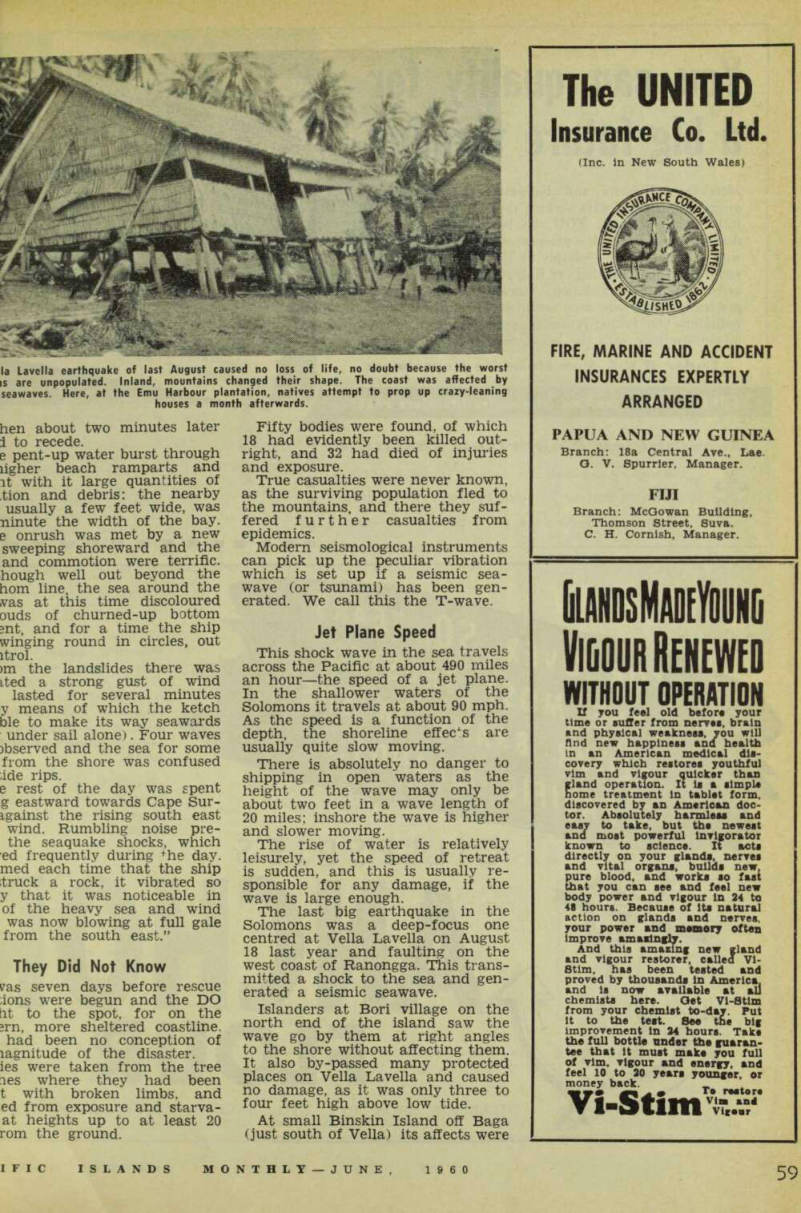
It also by-passed many protected places on Vella Lavella and caused no damage, as it was only three to four feet high above low tide.
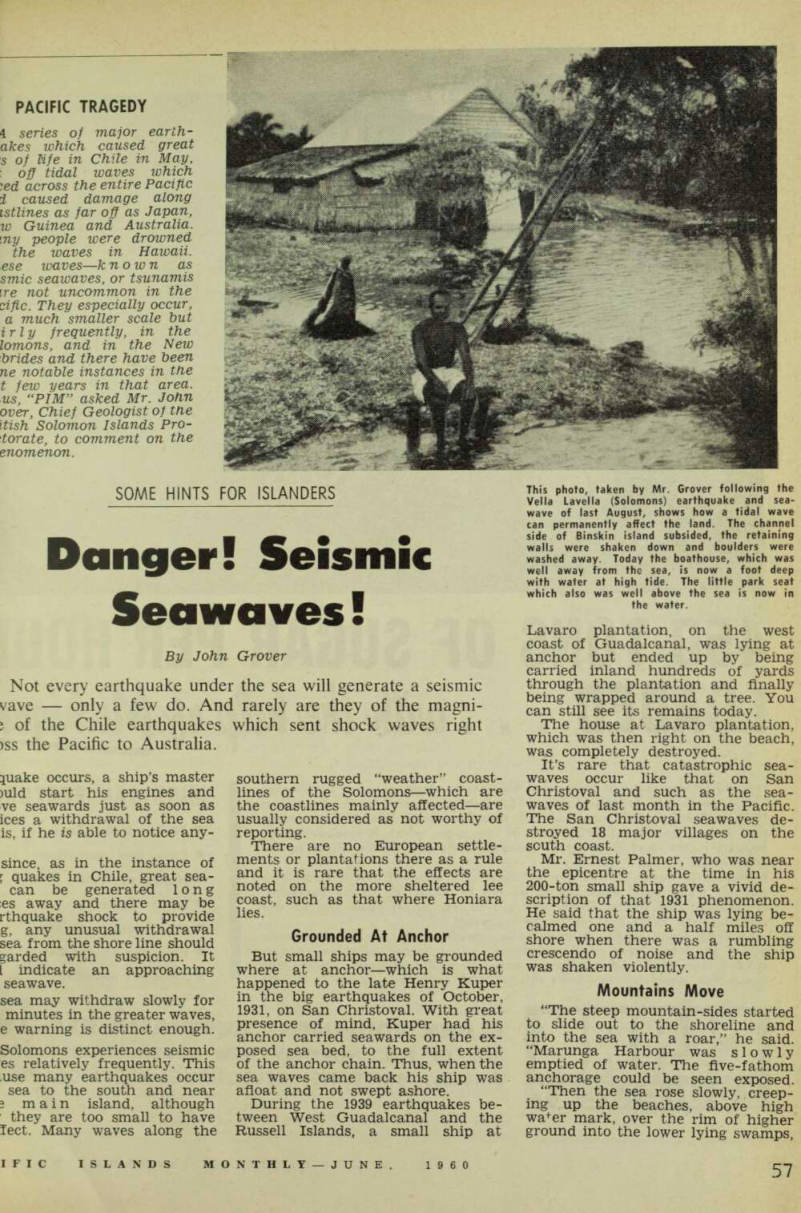
At small Binskin Island off Baga (just south of Vella) its affects were
[?]la Lavella earthquake of last August caused no loss of life, no doubt because the worst [?]s are unpopulated. Inland, mountains changed their shape. The coast was affected by seawaves. Here, at the Emu Harbour plantation, natives attempt to prop up crazy-leaning houses a month afterwards.
;d by funnelling in a channel subsistence of the land.
Florrie Binskin, resident Dr 50 years, was thrown to r of her house by the earth ier table and shelves emptied ly everything by the severe which consolidated the ve mud and coral filling, the area to subside by more >ur feet.
tand By The Canoes!"
ea receded, her double front ere shaken off their hinges, rd the islanders shouting in m language, “Stand by your the water is coming!” Slowly l came through her front [ling her house gradually to i inches depth, and engulfing personal belongings. ;nly it retreated, taking everything with it (except vy furniture and stove, etc.). >oy later on had to dive in f to get saucepans to cook oral gardens on the channel I saw them later—had been d by the sea’s action, taghorn coral had been flat ,nd laid down pointing sea ,nd hundreds of substantial head coral growths, previ hazard to shipping, had been I off.
Binskin, who is about 70, arly all of her possessions second time in her life; the jasion was during the Jap ivasion. low, at high tide, her small > no longer a few feet above ;1, but within six inches of m she hears splashing under hroom she says that all she s that it is fish and not es!
Great Radius
earthquakes of August, jre felt over a radius of 300 Greatest damage was done mountains of central Vella which are unpopulated, was killed, and the only that were damaged or col were improperly built with gonal bracing. : tanks were destroyed in Diaces, all of them because re supported on inadequately i stands, again often without only person to suffer loss the seismic seawave itself to have been Mrs. Binskin. is was a very great earth- Df a magnitude (on Guten istrumental scale) of about Solomons has previously felt eismic seawaves originating s far off as Alaska, four to Dusand miles away. 57, we observed effects from amchatka tsunami, which i us in 13 and-a-half hours.
The effects resembled high tides but there was no damage.
Since, in areas of the South Pacific seismic seawaves might be expected from time to time, it is certainly as well that they should be understood.