First Journalist
pp. 55-57 · Read in the full issue

Some More Copies of His Old Journal Located
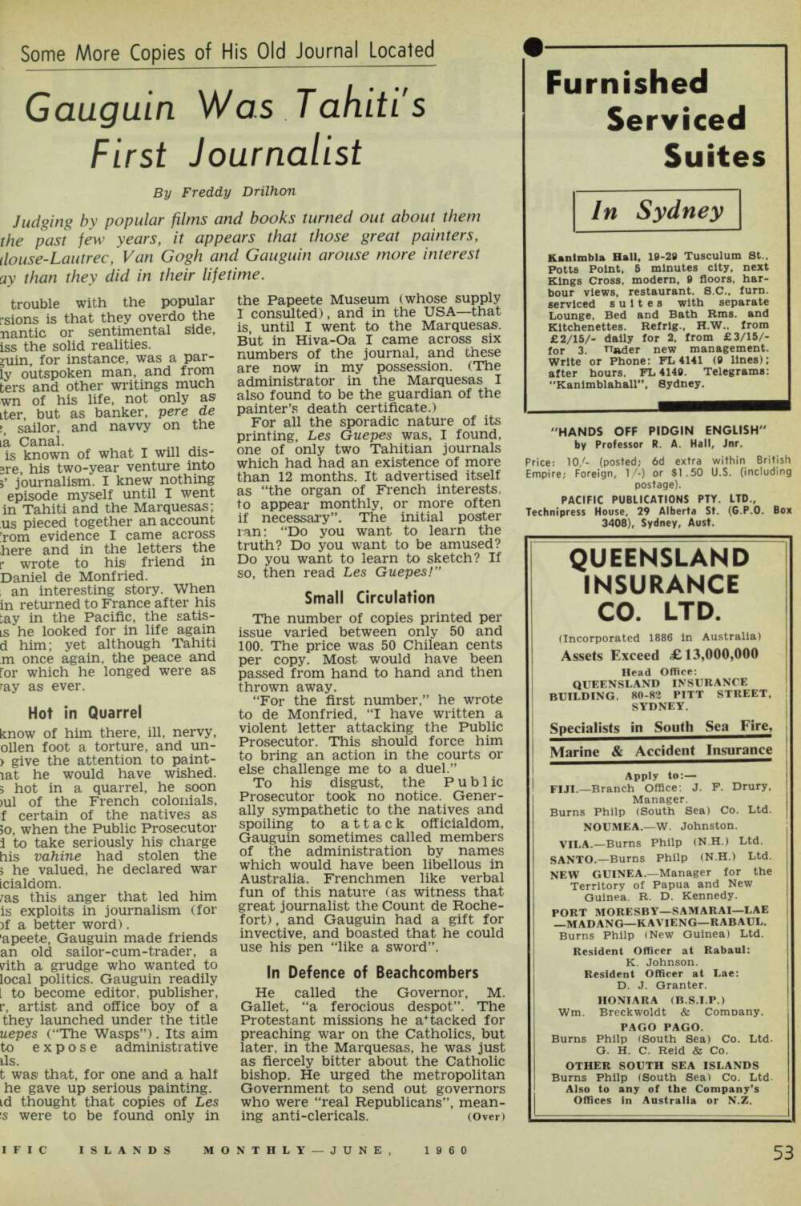
Gauguin Was Tahiti's First Journalist
By Freddy Drilhon
Judging by popular films and books turned out about them the past jew years, it appears that those great painters, douse-Lautrec, Van Gogh and Gauguin arouse more interest ay than they did in their lifetime.
trouble with the popular rsions is that they overdo the nantic or sentimental side, iss the solid realities. ?uin, for instance, was a par ly outspoken man, and from ters and other writings much wn of his life, not only as iter, but as banker, pere de sailor, and navvy on the ia Canal. a . is known of what I will dis sre, his two-year venture into i journalism. I knew nothing episode myself until I went in Tahiti and the Marquesas; us pieced together an account Tom evidence I came across here and in the letters the r wrote to his friend in Daniel de Monfried. an interesting story. When in returned to France after his tay in the Pacific, the satis ls he looked for in life again d him; yet although Tahiti m once again, the peace and for which he longed were as ray as ever.
Hot in Quarrel know of him there, ill, nervy, ollen foot a torture, and un > give the attention to paint lat he would have wished. 5 hot in a quarrel, he soon >ul of the French colonials, f certain of the natives as 50, when the Public Prosecutor i to take seriously his charge his vahine had stolen the > he valued, he declared war icialdom. ras this anger that led him is exploits in journalism (for )f a better word).
'apeete, Gauguin made friends an old sailor-cum-trader, a (dth a grudge who wanted to local politics. Gauguin readily [ to become editor, publisher, r, artist and office boy of a they launched under the title uepes (“The Wasps”). Its aim to expose administrative ils. t was that, for one and a half he gave up serious painting, id thought that copies of Les ’s were to be found only in
the Papeete Museum (whose supply I consulted), and in the USA —that is, until I went to the Marquesas.
But in Hiva-Oa I came across six numbers of the journal, and these are now in my possession. (The administrator in the Marquesas I also found to be the guardian of the painter’s death certificate.) For all the sporadic nature of its printing, Les Guepes was, I found, one of only two Tahitian journals which had had an existence of more than 12 months. It advertised itself as “the organ of French interests, to appear monthly, or more often if necessary”. The initial poster ran: “Do you want to learn the truth? Do you want to be amused?
Do you want to learn to sketch? If so, then read Les Guepes!”
Small Circulation
The number of copies printed per issue varied between only 50 and 100. The price was 50 Chilean cents per copy. Most would have been passed from hand to hand and then thrown away.
“For the first number,” he wrote to de Monfried, “I have written a violent letter attacking the Public Prosecutor. This should force him to bring an action in the courts or else challenge me to a duel.”
To his disgust, the Pub 1 ic Prosecutor took no notice. Gener ally sympathetic to the natives and spoiling to attack officialdom, Gauguin sometimes called members of the administration by names which would have been libellous in Australia. Frenchmen like verbal fun of this nature (as witness that great journalist the Count de Roche fort) , and Gauguin had a gift for invective, and boasted that he could use his pen “like a sword”.
in Defence of Beachcombers
He called the Governor, M.
Gallet, “a ferocious despot”. The Protestant missions he attacked for preaching war on the Catholics, but later, in the Marquesas, he was just as fiercely bitter about the Catholic bishop. He urged the metropolitan Government to send out governors who were “real Republicans”, mean ing anti-clericals. (Over)
n those he fulminated against i at him as a vagabond, in came out with a lyrical de of his fellow beachcombers. >nly dangerous and greedy nds in the Pacific, he said, he missionaries, it the time Les Guepes ceased ition, Gauguin was busy on r sporadic one-man effort, irire (“The Smile”). It was r malicious “Smile” and just ti-government as its pre >r. Its title didn’t prevent it ng advertised as a “serious I”. Intended as a monthly, it its debut in August, 1899, 50 being published per issue, the eing one dollar fifty, Chilean, is in this journal that Gauguin Df one fonc^ionnaire; “X has i another rung of the admin re ladder. Whose boots has n licking this time?” —and he n to insinuate that the man’s as carrying on with somebody L y one readily forgives such rings of bile for the excellent ings which enrich Le Sourire. imber I have before me, that srnber. 1899, bears on i f s cover ticularly striking design, a is animal framed in a border rers and fruit. surprising of all was in’s third venture, a family I entitled, Le Monde pour innual subscription 15 francs, unable to obtain a copy and is only one issue ever saw jht of day, but it certainly ed. In it the painter entered t rancour into designing t but inexpensive robes for aent-conscious Polynesians, acially Gauguin’s ventures into lism did him more harm than tie failed to rouse the popula ,gainst the officials, and in d the government took action t him and he had to pay a r of stiff fines. Also the co r of Les Geupes left him in rch. he same time efforts to sell intings in Paris were unsuc . His old maladies returning, it into hospital in December, md in the following year he to the Marquesas, where he vo years later.
"I Will Show Them!" the beginning, Gauguin had nder the illusion that he could some influence with his pen. ye become a journalist,” he 3e Monfried, “I will show ” And again: “Things have to look up. My credit is grow hey begin to fear and respect his journals sold few copies >e, as he complained, people . them from hand to hand, drst of Tahitian journalists i he was, he was not taken
seriously, nor his pain'ings either, as the destruction by ignorant white men of so much that he carelessly left behind goes to show. Uncom promising, incorruptible, and a genius, he was unable to introduce into his public life that 49 per cent, of hypocrisy which brings success to more worldly men.
That Gauguin had literary as well as artistic genius is evident from his letters from Oceania; also for the arresting contents of his book, Non Noa.
In the Marquesas, Tioka took me climbing to the height where “Koke”,
as the natives called Gauguin, lies buried; death claimed him at 46 years.
“Koke was good to us,” Tioka said. “He was poor, but he gave what he had to men poorer than himself. He was a Frenchman, but a friend, one of the few who have not come here to exploit us.”
Tioka then took me to his hibiscus-shaded home and showed me a pencilled letter the painter had written. “For these pieces of paper,” he said, “people have offered me many francs; but they were Koke’s —I will never sell them.”