It's Food For Princes
pp. 51-54 · Read in the full issue

There's An Export Drive On Beche-De-Mer
It's Food For Princes And Potentates
From J. P. Shortall, in Suva If you’ve done well in the past from the sale of trochus and shells, you might well pause from bewailing fallen prices ik into some other products of which a good deal less is \ beche-de-mer and shark fins.
there is more work in arino* thpm and. there are ultils irbbtalning ere s ome irnnwlpHs r p including cur- 10 ds But 8 at least one oli ed Fiji firm, in the business nast 20-odd years is going P wav about nromoting the of those who want to pro- 3 products and those who pat thpm
advertisements have
□earing in a Fifi-language
er setting out the mlthod ig beche-de-mer, and the formation has been printed t form. ;ly, the Fiji Times jobbing mt was busy manufacturttractive tapa-design carton iting a 15-page recipe book iclosed with the processed i-mer, for the firm of Sing Loong Co., of g Street, Suva. nanager, Mr. Fong Wing ys there are a great many of the sea slug—known tsen in Chinese—but that
in general only two of these are of interest to his firm as exports. In Fiji these are well-known as = walu —which, translated, means “eight teats/’-and which means black . „ It is not very easy to define them for the benefit of people outside Fiji- The sucu walu is black and has the appearance of a large cucumber, with four or more slight projections—they are hardly equiva lent to teats—along the lower edge on either side. The actual number varies with size.
What They Look Like
j n no case should sucu walu be j ess four inches in length after drying, and about seven inches is a f a j r aV erage sample. The larger anc f a tter they are, the better, loaloa is somewhat smaller, and j s comparatively smooth after drying compared with the sucu walu, which has many wrinkles, Brown varieties, or black varieties with the underside all white, are not saleable.
All are found on sandy bottoms in lagoons, usually at no great depth. They must not be speared or cut.
According to Mr. Fong Wing Fook, the correct method of pre paring beche-de-mer for sale is to wash any dirt off them and to plunge them into boiling water as soon as possible after they are gathered. Like any other marine product they will spoil quickly.
Boiling should be continued for about half an hour, with the water fully boiling. Sea water can be used.
Next the beche-de-mer are opened by cutting full length down the back only. The sand and guts are removed cleanly but the main gut tube extending the full length must not be removed. This is important.
It is merely slit and its contents removed. This tube protects the inner surface of the beche-de-mer from the smoke in the drying process.
Use a Copra Drier This can be carried out on a copra smoke-drier, or on netting frames rigged over a fire, or on wire netting rigged on the open side of a petrol drum which has been cut in half lengthways, then laid on its side with a fire in it.
There is no objection to smoky wood being used as fuel, but naturally oil or tar or anything likely to taint the beche-de-mer should not be used. Alternatively, any type of oven where no smoke is involved may be used. (Over)
This Is
IT This is beche-de-mer.
Two samples as received from the fishermen are in the front, centre. On the left is the pro cessed, sliced product, and on the right is the "puffed" form. The granulated form is on the paper at the back, and alongside is one of the attractive tapa pattern cartons designed to help capture the ex port market.
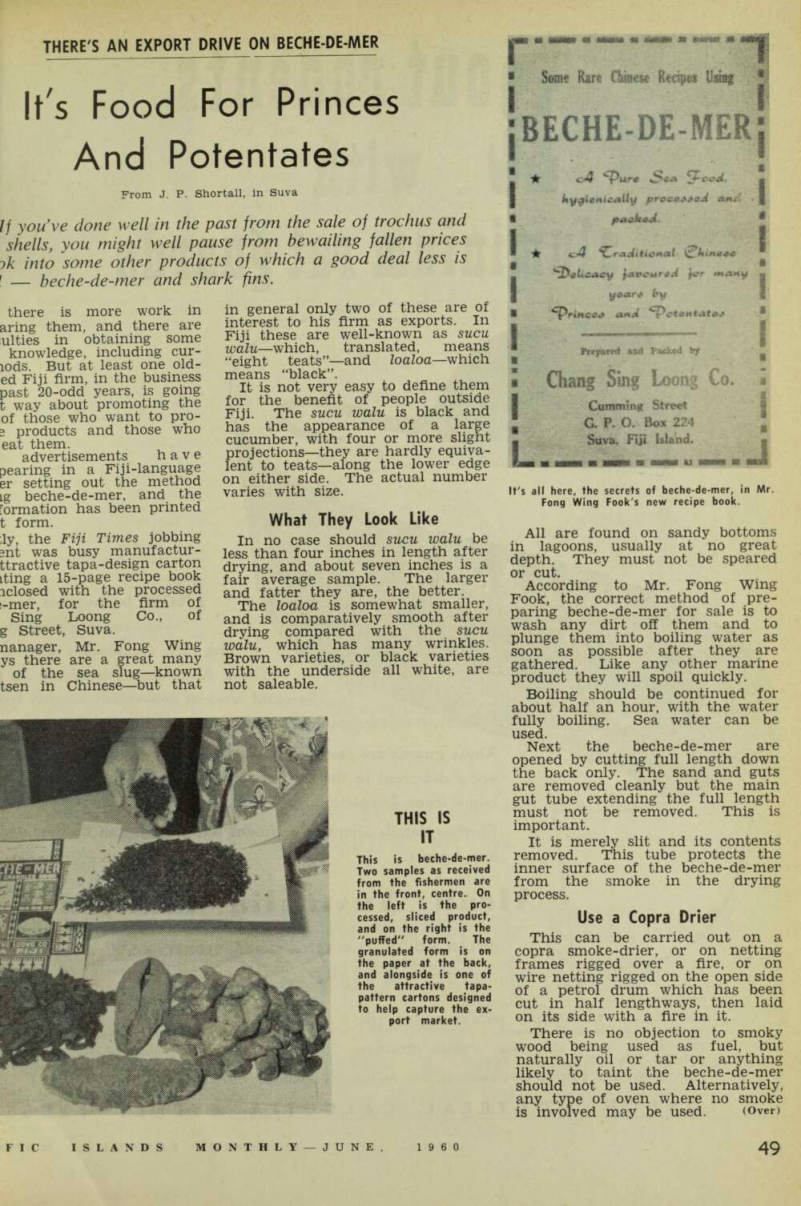
It's all here, the secrets of beche-de-mer, in Mr.
Fong Wing Fook's new recipe book.
nportant point is that the kept at a low level and e kept sufficiently far from ; to prevent any roasting or This would ruin the about 24 hours of continuous le drying can be completed sun, over a further period •al days, care being taken that the beche-de-mer is ?ht out in a shower, properly dry they will be ly solid and not in the bbery. The shipping con should protect the product iling. >rice offered in Suva is on »f 2/- per pound—£F.224 per : large, fat, well-prepared 3-mer will bring up to twice dee if the shipment is graded.
Much Work Yet ;at deal more painstaking nd know-how is involved the produce is ready for from Suva in its attractive some designed for Chinese and others for English * areas, especially the States, In the US the Suva y is starting to build up a i connection. In pre-war >st of the company’s output i the China mainland, but irket is now almost closed, -de-mer qualifies as “third list of the eight rare and Chinese foodstuffs favoured nces and Potentates” —acto Mr. Fong Wing Fook’s >ook. >ook contains such items as e-mer granules with ham licken soup, beche-de-mer 3 and crab or prawns (or id chicken), steamed beche with wild duck or pigeons, [ beche-de-mer with turtle, ” beche-de-mer. »ook has been compiled over rs by Mr. Fong Wing Fook, yes sparkle with pleasure at re mention of the delicacy s forms, and who is himself rt cook.
A number of firms export the raw unprocessed beche-de-mer from the Pacific Islands, but Chang Sing Loong Company claim they are the only people packaging it in finished form ready for the cook in slices, granules, and in “nop” form. * Don't Need Much uon i need The latter is produced by heating slices until they bubble into puffy fingers. This is the most expensive form, partly because, due to its bulkiness, it is costly to ship overseas, but it is also the most delicious form.
Only about an ounce of the finished beche-de-mer product is required per person in the dishes
in which it is used. Thus, while the price is high, it is n<pt confined to the tables of Princes and Potentates today, With beche-de-mer, shark fins are also high on the list of Chinese delicacies. Here again the finished product in no way resembles the original. Only the hair-like sinews go into the kitchen. Skin, cartilage, n( j flesh, are all discarded—sharks have no real bones, At present, it is not possible to obtain sufficient supplies of shark fins i n Fiji to build up a regular export market, but if these could be obtained there would be a very big market for them, and the Suva firm is paying 3/- per lb or £F336 per ton for clean, we JJ d™* The tail fins are not favoured,
Wing Fook with some of the pro [?]k fin material. This sample actually the usable sinews from a great [?]any fins. It's expensive!
as only the outer fringes an usable, but all other fins can h used.
Where the climate is satisfactor they can be sun dried by stringin them up on wires or laying then out on netting suspended above th ground, or a copra drier can t employed. They must be absolute) board-hard for shipment to marke and will be light grey or yellowisl
Send Samples
Those in other Islands areas wist ing to ship either beche-de-mer ■ shark fins to Suva would be advise to send along samples, particular in the case of beche-de-mer, labe ling each kind with the local nan so that the buyers can name tl desirable varieties and warn agair. the undesirable kinds.
Well dried beche-de-mer or sha fins will keep in storage for a lo: time without deterioration, and t finished product, after process! in Suva, will keep for many yea It takes many pounds of sha fins to produce a pound of i finished product, which looks I a tangle of nylon fishing line a involves a great deal of work producing.
The retail price in Suva is £2/1! a lb, which is an indication bt of the cost of producing and how highly it is esteemed by th familiar with its proper use.* If the supply position canl improved Mr. Fong Wing Fi intends bringing out a shark! recipe book!