The Mystery Of The Islands ' Loom
pp. 35-37 · Read in the full issue

Islands ' Loom
By Brett Hilder
, About 10 years ago I was presented with a rare piece of >e matting by Ernie Palmer in the Solomons; it was very thin and translucent,but at the same time it was stiff, as eh it were made with wood fibre. 6
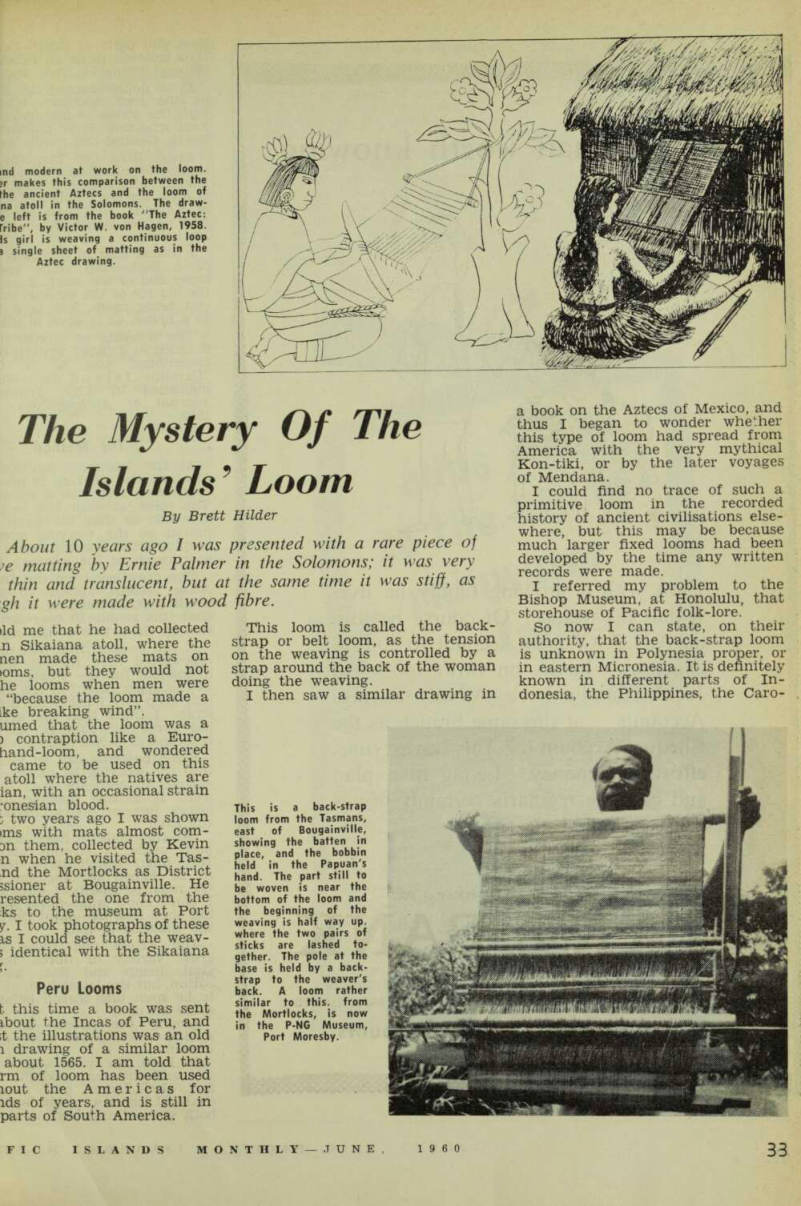
ild me that he had collected n Sikaiana atoll, where the nen made these mats on ►oms, but they would not he looms when men were “because the loom made a ike breaking wind”, umed that the loom was a ) contraption like a Euro hand-loom, and wondered came to be used on this atoll where the natives are ian, with an occasional strain 'oneslan blood. ; two years ago I was shown »ms with mats almost com m them, collected by Kevin n when he visited the Tas nd the Mortlocks as District ssioner at Bougainville. He resented the one from the ks to the museum at Port y. I took photographs of these is I could see that the weav ; identical with the Sikaiana Peru Looms b this time a book was sent ibout the Incas of Peru, and ;t the illustrations was an old i drawing of a similar loom about 1565. I am told that rm of loom has been used lout the Americas for ids of years, and is still in parts of South America.
This loom is called the back strap or belt loom, as the tension on the weaving is controlled by a strap around the back of the woman doing the weaving.
I then saw a similar drawing in
a book on the Aztecs of Mexico, and thus I began to wonder whether this type of loom had spread from America with the very mythical Kon-tiki, or by the later voyages of Mendana.
I could find no trace of such a primitive loom in the recorded history of ancient civilisations else where, but this may be because much larger fixed looms had been developed by the time any written records were made.
I referred my problem to the Bishop Museum, at Honolulu, that storehouse of Pacific folk-lore.
So now I can state, on their authority, that the back-strap loom is unknown in Polynesia proper, or in eastern Micronesia. It is definitely known in different parts of In donesia, the Philippines, the Caro-
and modern at work on the loom. [?]er makes this comparison between the the ancient Aztecs and the loom of na atoll in the Solomons. The draw [?]e left is from the book “The Aztec: [?]ribe", by Victor W. von Hagen, 1958. [?]s girl is weaving a continuous loop a single sheet of matting as in the Aztec drawing.
This is a back-strap loom from the Tasmans, east of Bougainville, showing the batten in place, and the bobbin held in the Papuan's hand. The part still to be woven is near the bottom of the loom and the beginning of the weaving is half way up. where the two pairs of sticks are lashed to gether. The pole at the base is held by a back strap to the weaver's back. A loom rather similar to this, from the Mortlocks, is now in the P-NG Museum, Port Moresby.
lines and parts of South-East Asi?
It is believed to be an extension o cultural influence from Malaysia, It no doubt reached the America by the long northern land rout with the waves of immigrants frot Asia who now form populations c North, Central and South America!
Apart from the Tasmans, Mor{ locks and Sikaiana, the only othf islands where any similar weavii is done are the small outliers nort of Kavieng, New Ireland. Here \ find narrow strips 1 of weaving use for belts.
I believe that in this case, instes of a back-strap being used, tl lower end of the warp is secured the big toe of the weaver, the upp end being made fast to a tree, to a house, as is done in Sikaiaru The weaving of similar belts detailed in a paper written by S.
Riesenberg, and A. H. Gayt( “Caroline Island Belt-Weavini published in the Southwesk Journal of Anthropology, vol| 1952.
The Method
At the Tasmans, Mortlocks I Sikaiana the weaving is made if continuous loop like a roller-tcro The roller at each end is held! a bridle, so that the warp car| moved as the weaving progrei keeping the working area wit! easy reach of the weaver’s hans The drawings from the Inca I Aztec records appear to shod single sheet of weaving, but I sus| that this is due to over-simpliq tion by the artists or the copyisl It can be seen from the drawl reproduced here that it would impossible for the weaver to w at the upper height of the loom! still keep any tension on the ba strap. I think that the writers! the American cultures have b ignorant of this complication. 1 Some patterns can be introdij into the weaving by using coloi strands in both the warp and] weft. It is also possible to ir either fine or coarse material the loom.
All the mats I have seen I been made of strands about i feet long, wtiich have theirel to be joined by knotting to the required length of warp or y I don’t know what fibres are u but they look like plant fibres f the hibiscus to me.
The Aztecs and Incas usee great variety of fibres, inchu sizal, hemp and flax, wool cotton, but the latter had, of cov to be spun into thread before could be used.
Among the Aztecs, as in Pacific, weaving was solely dom women.
In Peru, the men were wea T too, and this may account for fact that larger and more chanical looms were developed tb both vertical and horizontal moi
to those used in Ancient in 1900 BC. e the back-strap loom re in use in South America, nth the larger looms, it has 5d from Mexico. All we have I drawings of the looms and itterns of cloth, and some c spinning whorls: the woven and the sticks which com the looms have all been lost.
m Important Difference
main difference between the an and Western Pacific :rap looms appears to be le former were held at the end to a tree or post, while ter are usually made fast to II of a house. appears to be a very slight ice, but it has a purpose. The and Incas did their weaving kneeling position, while the eople sit on the ground with egs out-stretched and their aced against the wall of the This may be because they :ing on loose sand, instead of arth.
Sikaiana loom consists of ten and the admirable Ernie • has given the native names ne of them: >le held by the back-strap— J. vo pairs of small sticks at ad of weave—TEKAPI. tick in middle of working
Reukomalo.
ettle, bobbin or shuttle — VA. le secured to wall of house — >A. dimension of the finished •e five feet by two. ay last visit to Rabaul I was i loom from the Tasmans by ircher, of Buka, and it was te with an almost finished :e the one illustrated. • examining it carefully I still quite understand the knack d to work it. As will be seen he pictures, all the mats are unfinished, but it is not pos
sible to finish them as a complete loop of material. .
When the weaving reaches afoot or so from the start ° f the weave, there is very little room for the manipulation of the various sticks and the bobbin.
The weaving generally stops about nine inches from where it started, and the loose strands of the warp are then cut across to produce a mat five feet long with the warp ends forming a fringe of four or five inches at each end. These are sometimes plaited to save the weave from unravelling.
There is so much that I do not know about these looi^ s q and the mats woven on them, that I hope some readers will come forward with additional information,
Appeal for Help
we do not know the native names for the loom, the mats or the fibres used, nor the use of the mats except for presentation to honoured visitors, They are lucky people who receive them, and twice blessed are those who get the mats still on the looms, for they can hold in their hands a relic of prehistoric culture older than any organised civilisation.
[?]his ancient loom with the Islands one. [?]ing is by Felipe Huaman Roma de out 1565, from the book "Relm of the Victor W. von Hagen, published by e New American Library, 1957.