The Editors' Maillag
p. 29 · Read in the full issue
Happens To
ronze Eagle?
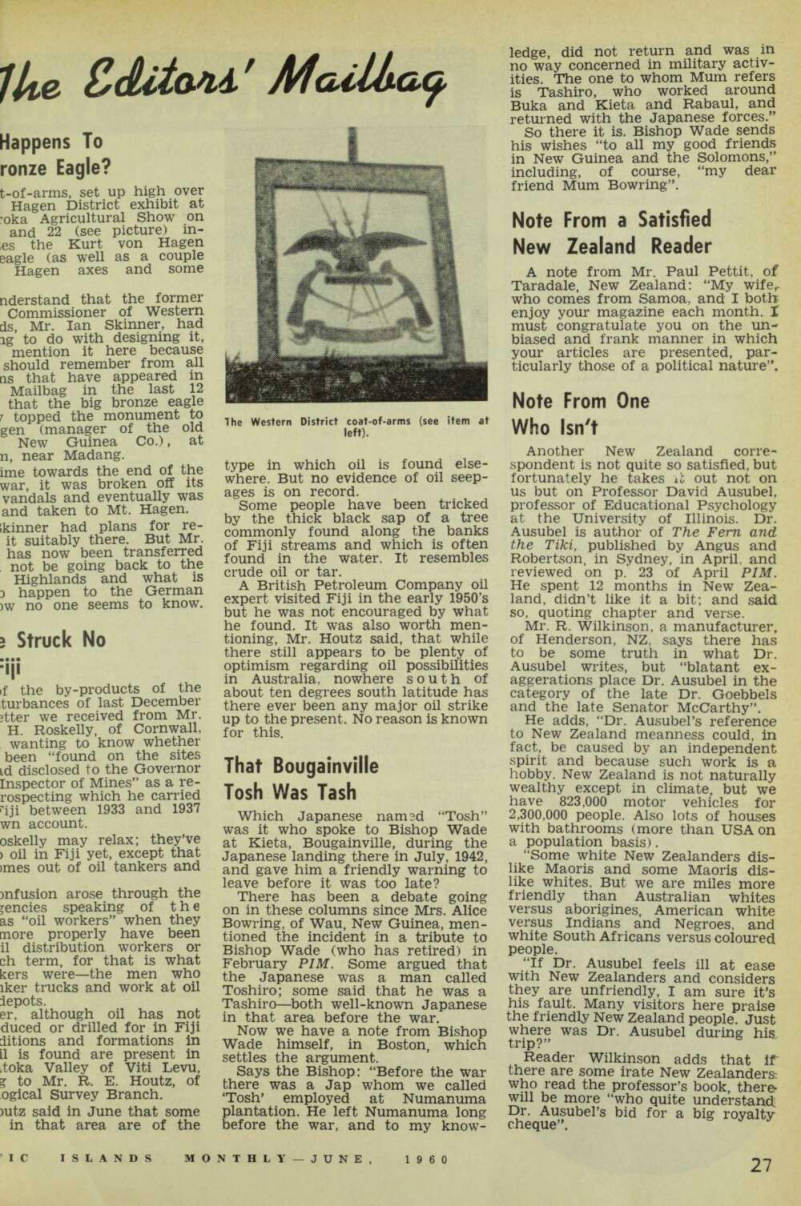
t-of-arms, set up high over Hagen District exhibit at •oka Agricultural Show on and 22 (see picture) m es the Kurt von Hagen eagle (as well as a couple Hagen axes and some nderstand that the former Commissioner of Western ds, Mr. lan Skinner, had ig to do with designing it, mention it here because should remember from all ns that have appeared in Mailbag in the last 12 that the big bronze eagle t topped the monument to gen (manager of the old New Guinea Co.), at n, near Madang. ime towards the end of the war, it was broken off its vandals and eventually was and taken to Mt. Hagen, ikinner had plans for re it suitably there. But Mr. has now been transferred not be going back to the Highlands and what is d happen to the German )w no one seems to know.
j Struck No
■••• •i' if the by-products of the turbances of last December jtter we received from Mr.
H. Roskelly, of Cornwall, wanting to know whether been “found on the sites id disclosed to the Governor Inspector of Mines” as a re rospecting which he carried r iji between 1933 and 1937 wn account. oskelly may relax; they’ve > oil in Fiji yet, except that »mes out of oil tankers and mfusion arose through the ;encies speaking of the as “oil workers” when they more properly have been il distribution workers or ch term, for that is what kers were —the men who iker trucks and work at oil iepots. er, although oil has not duced or drilled for in Fiji litions and formations in il is found are present in ,toka Valley of Viti Levu, g to Mr. R. E. Houtz, of ogical Survey Branch. )utz said in June that some in that area are of the
type in which oil is found else where. But no evidence of oil seep ages is on record.
Some people have been tricked by the thick black sap of a tree commonly found along the banks of Fiji streams and which is often found in the water. It resembles crude oil or tar.
A British Petroleum Company oil expert visited Fiji in the early 1950’s but he was not encouraged by what he found. It was also worth men tioning, Mr. Houtz said, that while there still appears to be plenty of optimism regarding oil possibilities in Australia, nowhere south of about ten degrees south latitude has there ever been any major oil strike up to the present. No reason is known for this.
That Bougainville
Tosh Was Tash
Which Japanese namad “Tosh” was it who spoke to Bishop Wade at Kieta, Bougainville, during the Japanese landing there in July, 1942, and gave him a friendly warning to leave before it was too late?
There has been a debate going on in these columns since Mrs. Alice Bowring, of Wau, New Guinea, men tioned the incident in a tribute to Bishop Wade (who has retired) in February PIM. Some argued that the Japanese was a man called Toshiro; some said that he was a Tashiro—both well-known Japanese in that area before the war.
Now we have a note from Bishop Wade himself, in Boston, which settles the argument.
Says the Bishop: “Before the war there was a Jap whom we called ‘Tosh’ employed at Numanuma plantation. He left Numanuma long before the war, and to my know
ledge, did not return and was in no way concerned in military activ ities. The one to whom Mum refers is Tashiro, who worked around Buka and Kieta and Rabaul, and returned with the Japanese forces.”
So there it is. Bishop Wade sends his wishes “to all my good friends in New Guinea and the Solomons,” including, of course, “my dear friend Mum Bowring”.
Note From a Satisfied
New Zealand Reader
A note from Mr. Paul Pettit, of Taradale, New Zealand: “My wife r who comes from Samoa, and I both; enjoy your magazine each month. I must congratulate you on the un biased and frank manner in which your articles are presented, par ticularly those of a political nature”.
Note From One
Who Isn't
Another New Zealand corre spondent is not quite so satisfied, but fortunately he takes it out not on us but on Professor David Ausubel, professor of Educational Psychology at the University of Illinois. Dr.
Ausubel is author of The Fern and the Tiki, published by Angus and Robertson, in Sydney, in April, and reviewed on p. 23 of April PIM.
He spent 12 months in New Zea land, didn’t like it a bit; and said so, quoting chapter and verse.
Mr. R. Wilkinson, a manufacturer, of Henderson, NZ. says there has to be some truth in what Dr.
Ausubel writes, but “blatant ex aggerations place Dr. Ausubel in the category of the late Dr. Goebbels and the late Senator McCarthy”.
He adds, “Dr. Ausubel’s reference to New Zealand meanness could, in fact, be caused by an independent spirit and because such work is a hobby. New Zealand is not naturally wealthy except in climate, but we have 823,000 motor vehicles for 2,300,000 people. Also lots of houses with bathrooms (more than USA on a population basis).
“Some white New Zealanders dis like Maoris and some Maoris dis like whites. But we are miles more friendly than Australian whites versus aborigines, American white versus Indians and Negroes, and white South Africans versus coloured people.
“If Dr. Ausubel feels ill at ease with New Zealanders and considers they are unfriendly, I am sure it’s his fault. Many visitors here praise the friendly New Zealand people. Just where was Dr. Ausubel during his. trip?”
Reader Wilkinson adds that If there are some irate New Zealanders who read the professor’s book, there will be more “who quite understand.
Dr. Ausubel’s bid for a big royalty cheque”.
The Western District coat-of-arms (see item at left).