Five Hours And It
pp. 23-24 · Read in the full issue
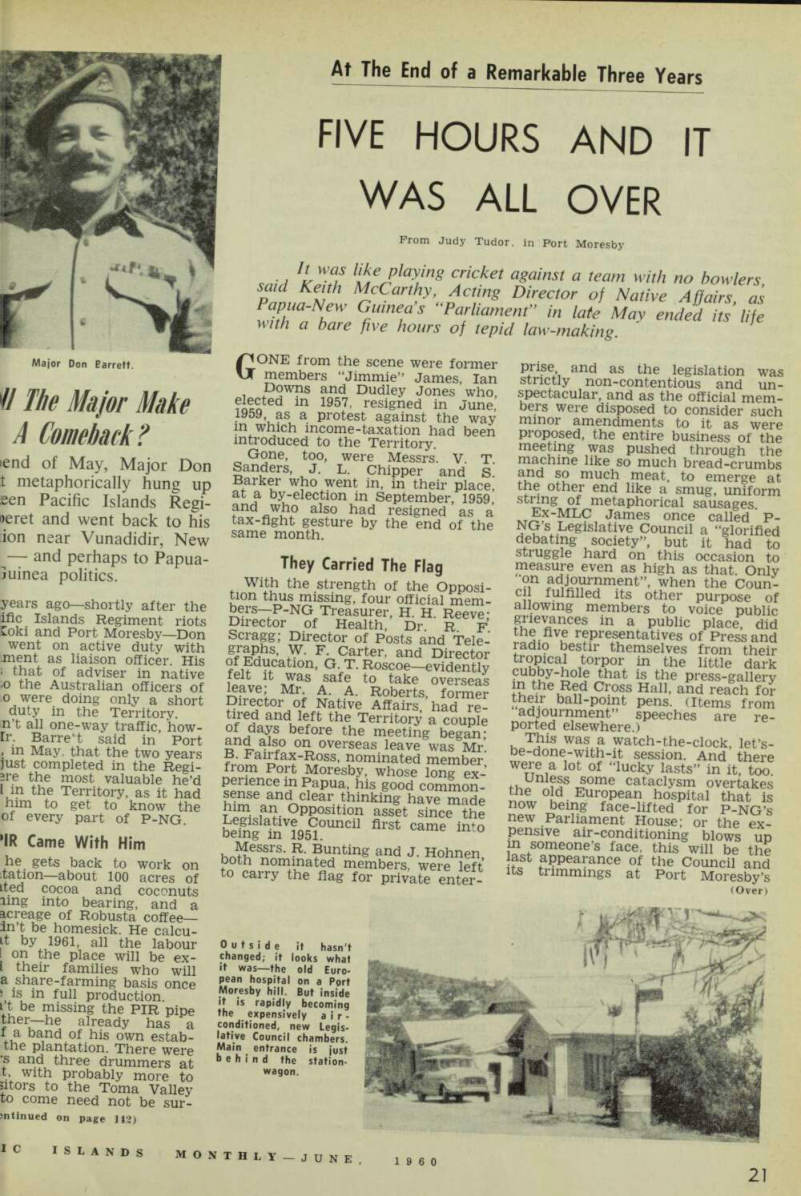
At The End of a Remarkable Three Years
Was All Over
From Judy Tudor, in Port Moresby said l M e r )la ;l ng °I icket T mSt a team with no bowlers, said Keith McCarthy, Acting Director of Native Affairs as widZC Guinea’s “Parliament” in late May ended its’ Hie with a bare five hours of tepid law-making
GONE from the scene were former members “Jimmie” James, lan Downs and Dudley Jones who, elected in 1957, resigned in June, 1959 as a protest against the way in which income-taxation had been introduced to the Territory.
Gone, too, were Messrs. V. T.
Sanders, J. L. Chipper and S Barker who went in, in their place, at a by-election in September, 1959, and who also had resigned as a tax-fight gesture by the end of the same month.
They Carried The Flag
With the strength of the Opposi tion thus missing, four official mem bers-P-NG Treasurer, H. H. Reeve; Director of Health, Dr R F Scragg; Director of Posts and Tele- IF' F * Ca rter. and Director of Education, G. T. Roscoe—evidently felt it was safe to take overseas leave; Mr. A, A. Roberts, former Director of Native Affairs, had re tired and left the Territory a couple of days before the meeting began; and also on overseas leave was Mr.
B. Fairfax-Ross, nominated member from Port Moresby, whose long ex perience in Papua, his good common sense and clear thinking have made a u. °PP osit ion asset since the betas to V 1951 OUnCII firSt Came lnto hr^ eS ;P 3, Bunting and J. Hohnen, both nominated members, were left to carry the flag for private enter -
p . n ? e * and a s the legislation was strictly non-contentious and un spectacular, and as the official mem bers were disposed to consider such minor amendments to it as were proposed, the entire business of the meeting was pushed through the machine like so much bread-crumbs and so much meat, to emerge at the other end like a smug, uniform string of metaphorical sausages Ex-IVILC James once called *P NGs Legislative Council a “glorified debating society”, but it had to struggle hard on this occasion to measure even as high as that. Only ° n adjournment”, when the Coun cil fulfilled its other purpose of allowing members to voice public grievances in a public place, did the five representatives of Press and radm bestir themselves from their u£ lca i , tor P° r in the little dark cubby-hole that is the press-gallery m the Red Cross Hall, and reach for their ball-point pens. (Items from adjournment” speeches are re ported elsewhere.) This was a watch-the-clock, let’s be-done-with-it session. And there were a lot of “lucky lasts” in it, too n T? ome cataclysm overtakes the old European hospital that is now being face-lifted for P-NG’s new Parliament House; or the ex pensive air-conditioning blows un m someone’s face, this will be the last appearance of the Council and its trimmings at Port Moresby’s (Over)
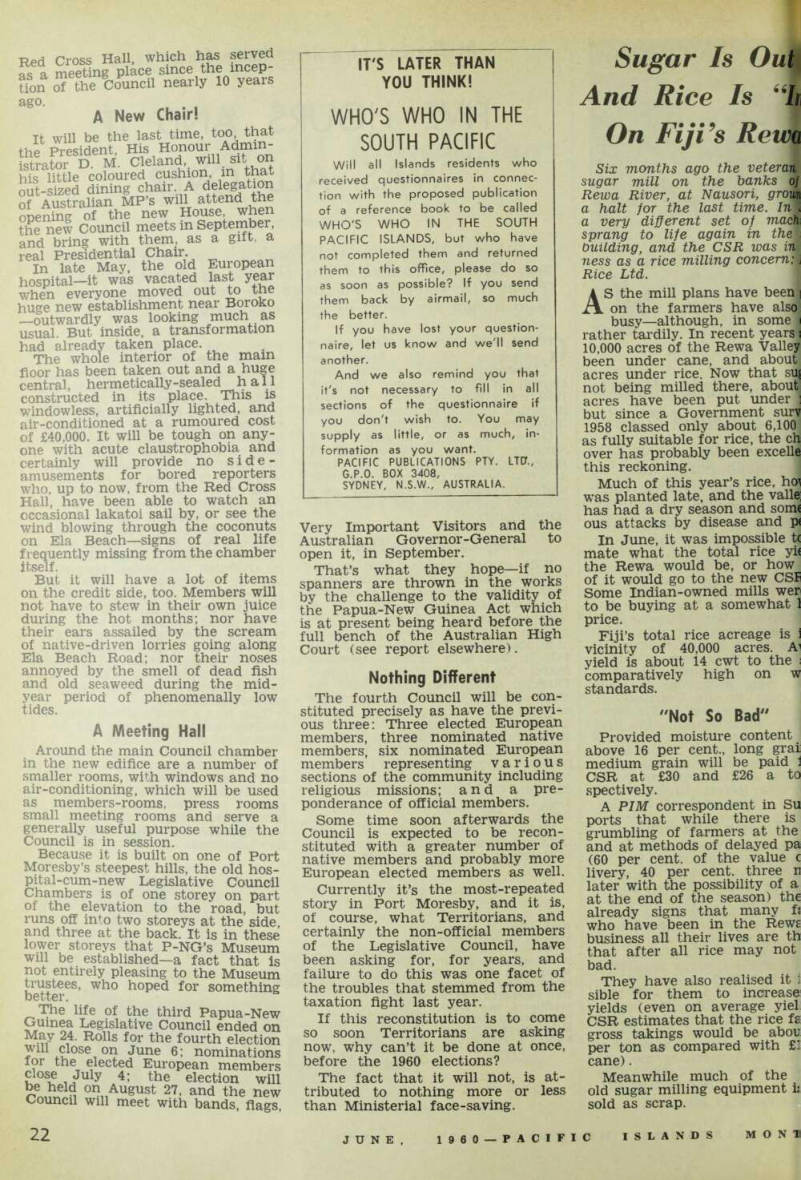
Outside it hasn't changed; it looks what it was—the old Euro pean hospital on a Port Moresby hill. But inside it is rapidly becoming the expensively air conditioned, new Legis lative Council chambers.
Main entrance is just behind the station wagon.
Ped Cross Hall, which has served as a meeting place since the incep don rf the council nearly 10 years ago - • .
A New Chair!
It will be the last time, too that t-hP President His Honour Admin- Ltrator D M. Cleland,. will, sit on his little coloured cushion, in that out-sized dining chair A delegation of Australian MP’s will attend the onening of the new House, when the new Council meets in September, and bring with them, as a gut, a real Presidential Chair.
In late May, the old European hospital—it was vacated last year when everyone moved out to the huge new establishment near Boroko —outwardly was looking much as usual. But inside, a transformation had already taken place.
The whole interior of the main floor has been taken out and a huge central, hermetically-sealed hall constructed in its place. This is windowless, artificially lighted, and air-conditioned at a rumoured cost of £40,000. It will be tough on any one with acute claustrophobia and certainly will provide no side amusements for bored reporters who, up to now, from the Red Cross Hall, have been able to watch an occasional lakatoi sail by, or see the wind blowing through the coconuts on Eia Beach —signs of real life frequently missing from the chamber itself.
But it will have a lot of items on the credit side, too. Members will not have to stew in their own juice during the hot months; nor have their ears assailed by the scream of native-driven lorries going along Ela Beach Road; nor their noses annoyed by the smell of dead fish and old seaweed during the mid year period of phenomenally low tides.
A Meeting Hall Around the main Council chamber in the new edifice are a number of smaller rooms, with windows and no air-conditioning, which will be used as members-rooms, press rooms small meeting rooms and serve a generally useful purpose while the Council is in session.
Because it is built on one of Port Moresby’s steepest hills, the old hos pital-cum-new Legislative Council Chambers is of one storey on part of the elevation to the road, but runs off into two storeys at the side, and three at the back. It is in these lower storeys that P-NG’s Museum will be established—a fact that is not entirely pleasing to the Museum trustees, who hoped for something D6liGr, TTie life of the third Papua-New Guinea Legislative Council ended on May 24. Rolls for the fourth election will close on June 6; nominations for the elected European members v? oS ilr ,/ uly 4; the election will hfto on August 27, and the new Council will meet with bands, flags,
Very Important Visitors and the Australian Governor-General to open it, in September.
That’s what they hope—if no spanners are thrown in the works by the challenge to the validity of the Papua-New Guinea Act which is at present being heard before the full bench of the Australian High Court (see report elsewhere).
Nothing Different
The fourth Council will be con stituted precisely as have the previ ous three; Three elected European members, three nominated native members, six nominated European members representing various sections of the community including religious missions; and a pre ponderance of official members.
Some time soon afterwards the Council is expected to be recon stituted with a greater number of native members and probably more European elected members as well.
Currently it’s the most-repeated story in Port Moresby, and it is, of course, what Territorians, and certainly the non-official members of the Legislative Council, have been asking for, for years, and failure to do this was one facet of the troubles that stemmed from the taxation fight last year.
If this reconstitution is to come so soon Territorians are asking now, why can’t it be done at once, before the 1960 elections?
The fact that it will not, is at tributed to nothing more or less than Ministerial face-saving.