Pacific Shipping And Cruising Yachts
pp. 103-115 · Read in the full issue
A very real danger to navigation which might well be wlooked by ship-masters exists today in the transistor radio.
SSE little sets possess a Mwerful bar magnet in their rrial system and another Ist in the loudspeaker, and tests Jby PIM show that some of the dts can cause a considerable sxss deviation when 6 feet from Vs steering compass. so many of these sets now rculation in the Islands, and temptation for the man at the to slip one into his shirt ± to brighten up his trick at wheel, a considerable danger ) exist from this source, cp masters would be well ad to have a notice posted con ously on the bridge in front of elmsman warning of the danger !:;h sets. have not yet heard of any iie disaster from this cause, jeither have we seen any pub warnings. The deviation will ?with the type of compass, but jsome types of compasses used
in Islands’ vessels the effect will be at a maximum, and there is no doubt at all that these sets con stitute a danger in a good many cases.
• Tall Ship For Moresby:
Russian non-magnetic research schooner Zarya made a call at Port Moresby en route from Wellington, NZ, to Shanghai in April. (See P 109). , There was an earlier report that the wooden three-masted vessel would call at Apia, but when she arrived at Wellington under com mand of 34-year-old Captain Taras Mazhara on March 14, Professor M.
Ivanov, in charge of the scientific team, gave New Guinea as the next Islands’ visit.
Though Wellington reports re ferred to Zarya as of 205 tons, our information from Moscow gives her tonnage as 580 gross l . This would probably be metric but it would still be much more than 205 tons British measurement. A Port Moresby report gave her as 330 tons.
A sleek, trim vessel, with low free board and tidily varnished masts and topmasts, and equipped with radar and radio direction-finder she created a great deal of interest dur ing her week in Wellington, being the largest and most unusual sail ing craft to put in there for many years.
Both anchors and anchor cables appeared to be of non-ferrous metals, as are all the metal deck fittings. As previously reported, the diesel motor is mainly of gunmetal, but there are a few magnetic com ponents, the effect of which is balanced out of the scientific in struments by a system of de gaussing.
A PIM correspondent said that an auxiliary diesel engine could be heard running as the ship lay at her berth in Wellington.
• More Research Cruises;
The research vessel Spencer F.
Baird which has been seen in South Pacific waters on other ex peditions in post-war years, was also out taking magnetic measure ments in April on behalf of the Scripps Institution of Oceanography.
She was to head into the eastern Pacific for several thousand miles west from Cape Mendocino, Cali fornia.
In May a Scripps vessel will be taking ocean soundings west of Lower California in connection with a tuna migration study, and another vessel will proceed from a Cali-
fornian port to five degrees south latitude thence north to Honolulu, taking water samples from a depth of two miles and making geological soundings near Hawaii.
This latter will be known as the Tethys Expedition—tethys being a sea nymph of Grecian mythology.
A third vessel will sail on Limbo Expedition—limbo because she will make no port of call —to take water samples over a period of several weeks at a point roughly midway between Hawaii and the US main land.
In August, Scripps will despatch the 1,900-ton Navy ARS-27 on an oceanographic expedition across the Pacific and Indian Oceans to Mauritius, thence home by way of Indonesia and Australia in the course of a 33,000-mile cruise to be called the Monsoon Expedition.
The object will be sediment
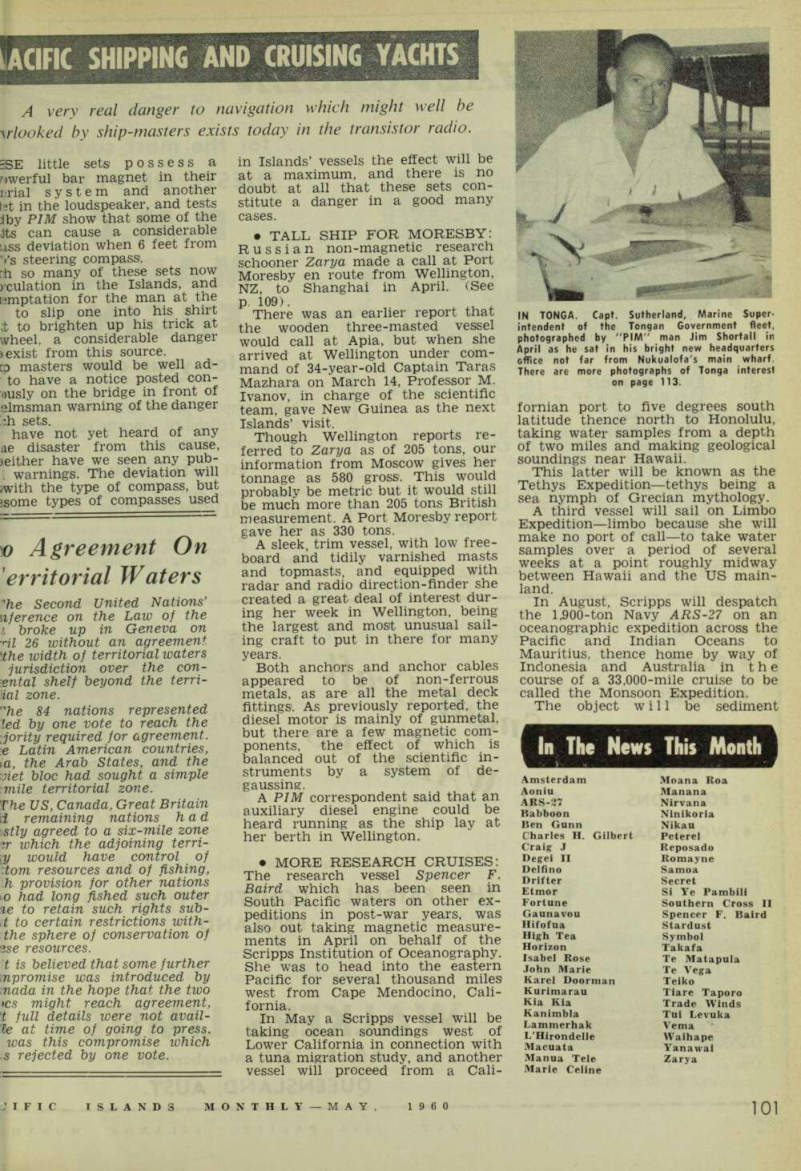
IN TONGA. Capt. Sutherland, Marine Super intendent of the Tongan Government fleet, photographed by "RIM" man Jim Shortall in April as he sat in his bright new headquarters office not far from Nukualofa's main wharf.
There are more photographs of Tonga interest on page 113.
,j in tropical waters and
i.ical and geophysical studies
Indian Ocean. A Russian ■ will also be engaged in the i Ocean study at that time. nnid-September, Scripps vessel vn will be studying the 3an Current in the far m Pacific, and in November, c Sr F. Baird will be busy in ) Caribbean taking sediment ®s. Scripps Institution is an off of the University of Cali and much of its work is per il on behalf of the US Govern-
Dn A Caribbean Reef:
graceful 242-ton steel schooner Te Vega, which operated a Y passenger service between julu and Papeete and made a ;;r voyage to Tonga and Fiji a Cinerama film unit in recent was in serious trouble early aril when she went on a reef -St. Kitts, Leeward Islands, of British West Indies, vselippings from Captain Fred □ebingat, of San Pedro, in * that the schooner is now Ji by Harold A. Miller, of Port > Oregon, in the company name :berian-Pacific Navigation Co. : had only recently returned to Caribbean from a $lOO,OOO re i Amsterdam, and was being Jted on charter-cruise work by nander V. E. B. Nicholson & of Antigua, on the owner’s be as the most luxurious of a ner of vessels similarly operated je Nicholson organisation, the time of the mishap on 6, Te Vega was commanded British ex-submarine captain had recently sailed a 25-ft ; across the Atlantic to the Indies. [3 passenger list included Mr.
Mrs. Miller. There was a crew .6 men, mostly Europeans, •d.
Vega sent out an SOS and the mgers were taken off by a hant vessel. The newsclippings, I April 10, said that efforts to it the schooner had been un issful up to that date, inched in Kiel, Germany, as for Mr. P. H. Macy, of New „ in 1930, Te Vega was one of Ifinest privately owned sailing afloat. Prior to her dismasting Tahiti some years ago, when •still carried topsails, she was id a magnificent sight under all
Tuna Fleets For 1960: In
ions are that Japanese tuna ig operations are to be on a .derably expanded scale in the h Pacific this year. Where last there were four motherships two fleets of longline catcher ;ls each of about 30 craft, this there may be five motherships three catcher fleets each ibering from 40 to 50 vessels,
according to information received from Janan in April from Japan in April. • STILL AFLOAT: PIM receives its shipping information from far and wide and some of its items have necessarily to be accepted from voluntary correspondents on good faith. Occasionally those reports are “off the beam”
One such, which did not appear in this section of PIM, recently reported ‘inSketchy terms that the American Samoan 258-ton vessel Manua Tele had foundered on a voyage between Pago Pago and the Manua Islands, apparently in December.
The facts appear to be that the
ship did go on a reef and was holed, and the passengers were taken off, but the ship was hauled off and was back in service on the Pago Pago- Apia run in April.
Another report said that the Suva built, 126-ton ketch Te Matapula, owned by the Gilbert and Ellice Islands Colony Government, had been destroyed by fire at Tarawa, in December. But the vessel is still very much afloat, although there is a suggestion that from an insurance point of view she has been classed as a “constructive total loss”— which means that it would cost more to restore her to her original con dition than the vessel is worth. (Over)
was beached for full main i:e work at Betio on December sen a portable petrol-driven CDump ignited in the hold, the oreading to the engine room, jernment statement says that ntapula was extensively dam ;but a master mariner who has ibeen aboard her said that to nere appeared to be very little ■ ( ?e. Whatever the facts, the was reported for sale in i, and the GEIC Government own to have been seeking a lement.
Suva, at the end of April, Mr. . Bernacchi, Resident Com [iner of the GEIC, said that the damage to Te Matapula appear slight on a cursory in ;on, it was estimated that it cost possibly £B,OOO to replace narred beams and make other •s. On top of that, the vessel iow due for a general refit and otal cost might run to £lB,OOO.
'atapula could still be fit for -sea voyages, but in the GEIC was required to make long passages as far east as the [lslands and that called for a in first-class condition, vas now felt by the GEIC Gov
ernment that wooden vessels were unsuited to their requirements, and, if approval could be obtained from the UK, another steel vessel like the Colony’s handsome Hongkong-built Ninikoria would be ordered as a re placement. Te Matapula had not been sold at the end of April, but there had been several inquiries and she would be disposed of at a very reasonable figure.
• Keeping Her Busy; Tonga
Copra Board’s new 512-ton Aoviu, never long in port, will be busier still this year. The Board has just secured the New Zealand Govern ment charter to provide sea com munications between Apia and the Tokelau atolls for the remainder of this year.
She cleared Apia on April 21 on the first such voyage, and is scheduled to make others in Sep tember and November. In recent years the Suva-based Kurimarau has been making those voyages, but this year she was out-tendered.
• The Tongan Fleet: Out
siders are apt to think of Tonga as having very few inter-island vessels, but in fact there are 48
detailed report on the loss of the new Tongan longhner "Teiko" [?]with 22 aboard, is given on page 29 of this issue. The report [?]es the “Teiko’s” movements and discusses the possible cause of its marine inquiry into the tragedy was to be held in Nukualofa in See also photograph below.
This is the launch from the missing "Teiko", photographed in Nuku alofa in April. The launch was landed in the Tongan capital be fore the vessel sailed on her ill-fated voyage.
rred craft at present, each to six-monthly survey, times the smallships’ harbour, 3 as Ta’ua, is decidedly crowded ue little auxiliary sailing craft come down to Nukualofa [;;he northern islands. Ta’ua ir, located at Mafanga, about . east of the main wharf, was Illy built by American forces the war. It takes its name, [ means “fortytwo”, from the me Pier 42 of the Americans, eas been improved in recent and has a depth suitable for all Tonga’s smaller vessels, and Hifofua use the main and each night they move a r«ut to a harbour anchorage ar of introducing the rhino oeetle from Vavau. ualofa also has another long oier midway between the main ! and Ta’ua harbour, known as • Pier, which was also built by tmericans but has no great alongside and is not much jtoday, though it is still in good repair. From its end [,lofa’s children spend happy jswimming. 808 ABLE SALE: Though the was not completed when this rritten, it appeared reasonably :i in April that BP’s Suva -128-ton auxiliary ketch xta would change hands dur e month. The Auckland buyer to take the ketch south, □ly with a New Zealand crew, [r up in his spare time, and ually put her on the market ruata, laid up in Suva’s Bay sands for many months past, ■ of a family of rather similar •s built by the Whippy yard after the war. Te Matapula, :oned elsewhere, was the last ■j series.
•Rom Lambs To Cattle:
Suva-registered ex-passenger Delflno, which made several -Pacific voyages with Aus :n lambs last year, has lately irefitting in Hongkong and will icntly be carrying cattle from : alia to Asiatic destinations in 3. •*re was opposition both in Aus and in the United States to export and import of lambs, whether that was the reason idfino’s withdrawal, or whether is more money to be made ie cattle trade, is not known, tie of the Fiji-based crew were iriated to Suva late in March, it appears likely that Chinese [lipino crewmen will take their when the ship re-enters ser
?Eril From The Galley;
tragic death in March of one e engineers in BP’s Vila-based
hands'
7- It is well known that a number of varieties of shallow water nsh common in the tropical Pacific may be perfectly edible in one locality and highly poisonous if caught perhaps only a few miles away. The reason, apparently, lies in the diet of the fish.
It would seem that the only safe course is to check with the local people as to whether the fish are safe, or otherwise to avoid eating lleved exist MS trolling Ttae Ch o C r a wit b h fish of any kind.
p e terel, a small river gunboat armed only two 3-inch guns and a few mac hine guns, to surrender to a j a p ane se cruiser and shore ba tteries as she lay off the British consulate at Shanghai on December 7 ig4l The story is of articular interest in where the then commander hms Peterel, Lieutenant-Com mander s. Polkinghorn, DSC, RNR, master of BP’s Yanawai.
Ttjssa S
that he Is now aged 82 as few would put his age above 65 from
ranees. Knowing him, it is not lit to understand why Peter el ot surrender.
Irouble At Betio: For The
;wo years, work has been pro lg on two new smallship har at Tarawa —at Betio and at ii. Six months ago the Betio :ar work was halted and activ transferred to Bairiki on a ;,y basis. he interim there are signs that not well with the work at Erosion is taking place be nd behind the facing of bags icrete on the harbour approach nkments, suggesting that a deal of costly new work may rto be done to give a lasting
Iiore Money In Tuna: In
n we mentioned that MV a, which for a long time was only passenger link between IPago and Apia, had been con l to a tuna longliner by a of Pago Pago business men ras to change her occupation, now learn that another Pago trading vessel, Isabel Rose— imer US Navy sub-chaser —is lurning to tuna fishing. It was lied that all tuna caught by il-fated Tongan Teiko were to been sold to the Van Camp ■ry at Pago Pago, and only types of fish were to have been in Tonga or elsewhere, mentioned recently, the Jap- Fisheries Agency sets quotas .ts tuna vessels supplying n canneries, and the Japanese supplying the Pago Pago ;ry is only allowed to deliver tons per annum at present— ii the figure has been very re f raised. That is why there are
openings at Pago Pago for Korean vessels and for any other comers, Top grade albacore was bringing $3lO per ton, delivered to the cannery, according to our last re port. Japanese boats fishing far from home reckon that they must ca tch about four tons of fish per (j a y including a reasonable per centage of the favoured albacore tuna, to make a cruise worth while.
Good areas produce twice that amo unt or more,
» Saved By The Bucket
BRIGADE: A. B. Donald Ltd.’s 47yea r-old, two-masted, auxiliary schooner Tiare Taporo was narrowly saV ed from foundering at sea in ear iy March on a voyage from Rarotonga to Penrhyn.
She sprang a plank below the engine-room in rough weather while between Manihiki and Penrhyn. By lon S hours of hard hand-pumping and by the efforts of a bucket brigade, with the passengers—in eluding the new Resident Agent for Penrhyn, Mr. J. J. MacCauley assisting, Capt. Andy Thomson was able to keep his vessel afloat and the wa ter below main engine level as the schooner edged north against head seas, and as an open boat from Penrhyn, called by radio, headed south to take off some of the passengers.
The leak was reported at 3 p.m. stud it W£ts not until th.o following morning that the schooner could enter Penrhyn lagoon, But men from shore were able to relieve the tired pumpers during the night as Tiare Taporo moved up to the atoll and awaited dawn to negotiate the pass, Penrhyn is one of the very few places in the Cook Islands where
the schooner could be safely beached for repairs. Had the mishap occurred elsewhere, this Islands veteran might well have ended her days.
• In The Water; Nzgv Moana
Roa, new vessel for the Auckland- Cook Islands trade, was launched in Scotland on April 14 by Mrs.
G. R. Taking, wife of New Zealand’s acting-High Commissioner in the UK. The delivery voyage is ex pected in October. • BLAME AFFIXED: The master of the Fiji Government vessel Degei II was found mainly re sponsible for the collision which re sulted in the sinking of the small vessel Graunavou outside Suva main passage on the night of September 27 last. The formal inquiry was held in April.
At the time of the collision Degei II was outward bound on the main leads and Gaunavou was in-bound.
The Court found that an in adequate watch was being kept from the Government vessel, particularly in view of the fact that an un identified light had been sighted.
There was evidence that the kero sene navigation lights on the sunken vessel were not up to standard.
The collision seems to have occurred when Degei II made a radical change of course to star board at the last moment. The
[?]asian non-magnetic schooner "Zarya" which called at Port Moresby in April during the of a 40,000-mile magnetic survey cruise from Odessa to Vladivostok.. This photo was taken at Wellington, NZ. See this page and also page 101.
Photo; P. Shortali.
rtnade favourable comment on rompt action taken by the of Degei II to take off the t>f the other vessel. The re ad was not accompanied by suspension of certificate, [mother case the Mate of the teal vessel Tui Levuka had his 3 ate suspended for six months •• result of a stranding on Vatu island last August. He eade a change of course with ► Terming the master, and had rone to sleep. The vessel was r.vely damaged.
W Interesting One: An
Jting vessel which will un ately not now be seen in the ;> this year is the 700-ton, masted steel research vessel which was in Wellington April in the course of a cruise rthe world eastbound. registered in Panama, but :n 1923 for the Hutton family :zh Woolworth heiress Barbara :of the better-known members, iesel-powered vessel is today by Colombia University, New Eand commanded by Captain C. Kohler. :a is an attractive old-type with counter stern and clipper iith an eagle figure-head. On resent cruise she carries a Jfic team of 12, headed by Dr.
INafe, in addition to a crew She sailed from New York stober and has since called at ► da, San Juan, Recife, Cape Mauritius, Fremantle and :de in the course of her ocean mg and sounding and geo- Itic survey cruise. She has ►outh as far as the ice fringe e Indian Ocean, and from sgton she will also be crossing ir South Pacific as she heads ape Horn and home. Once as a three-masted schooner, Ties no sail today and her top have been removed but she an attractive and interesting and may well be seen in the 3 in the course of some future DST AT ROTA: Loaded with vegetables, local beef and ament equipment destined for , MV John Marie, 45-ft, con- NZ tug, owned by Juan Diaz, ■a Island, US Trust Territory, lied late at night on the ii of the pass at Rota, in , and sank outside the reef, :;n ocean. The hull surround ie keel was stove in. per Onicimo Ogo, engineer a Taimanao and deckhand a Castro launched a life-raft, ere later picked up by a rescue
Ourist Visits: Nearly 400
ilian tourists travelling in ibla spent a day and a half in 1 early in April during a from Australian ports to
Jaoan and Hongkong. Kanimbla will be back in October on a similar cruise, calling also at Madang.
The Orient Line has also announced that Oromsay will spend a dav at Rabaul in November during a cruise from Australia to Japan, • TANGLED TRAPS: Native fish trans buoved near the entrance to Simpson Harbour, Rabaul, have been getting in the way of shipping lately. Natives have complained that they have lost traps because ships strayed from the main passage and severed the mooring ropes. So far there have been no reports of damage to the shafts or screws of the ships.
Harbour authorities and native affairs officers recently held discussions with Matupit Island natives, owners of the traps, in an attempt to clear up the situation.
• FOR SCRAP: Tied up at Circular Quay since she returned from Papua a couple of years ago, Bern Shipping Pty. Ltd s MV Etmor, ex Melinga, has been sold to a Syd ney syndicate for scrapping. Of 240 tons nett, and 154 ft length, she was in the Territory for a considerable period on charter to Australasian Petroleum Company, as a supply and transport vessel,
.. Tott .
• Flat-Top S Nng Visit,
HNMS Karel Doorman, a recently modernised Dutch aircraft carrier will visit Netherlands New Guinea ports in May to show the flag. She carries Seahawk jet-fighters and Avenger anti-submarine aircraft, Accompanying her will be two de stroyers of similar type to HNMS Amsterdam, which recently visited Darwin and Fremantle. (Over)
Ill Peaceful Here: When
is were granted for Kdrean vessels to opsrate out of Pago for the Van Camp tuna ;-y, there were some slight fears ciere may be incidents between CDreans and the Japanese who -so operating from that port, nor Coleman, of American said in Auckland recently, •'as pleased to say, how [;hat no such friction had be apparent in the year since the Koreans arrived on the scene, re is almost constant friction ;n Japan and South Korea fishing rights in the waters ;n the two countries, with having set up an arbitrary extending far off-shore inside rthey arrest any Japanese fish issels found operating.
Upport For A Theory:
a tagged and released by the 0 1 u 1 u Biological Laboratory ;:he research vessel Charles H. \t, off San Francisco, on No r 15, 1956, was hooked on i 13 this year by the Japanese [ier Hayatori Maru No. 2 near is Island, 1,000 miles south :f Japan. .> is the longest period so far >ed between tagging of a tuna its recapture, and was the eenth tag to be returned to moratory by commercial fisher -15 and other tags returned have strong support to the theory Ituna caught in the eastern i)f the North Pacific belong to ime colony as those caught in estern part. Formerly it was :ed that there were two or more :es of albacore tuna which did itermingle, and that the de of fishing in one area could no effect on the other area. * THE BAG: Mr. Willie Schutz r ed the distinction in April of
becoming the first Gilberts-born boy to qualify as a Master, Foreign Go ing, in British ships. Mention of his service in British cargo vessels in world trade has been made in these columns on several occasions in recent years.
First qualifying as a marine radio officer, after service in the radio branch of the GEIC Government, Mr. Schutz was uncertificated master of vessels in the Cook Islands trade for a time.
Later, he returned to the Gilberts and was master of the Govern ment’s ketch Kia Kia (since sold).
From there he went to Australia, where he served in coastal vessels for a time, then to UK vessels, from which he obtained his Mate s ticket at Southampton, and now his Master’s ticket from that same port. • FALSE ALARM: At the height of the search for the Tongan tuna longliner Teiko late in March, the ex Tonga Copra Board ketch Aoniu —now the yacht Trade Winds—un wittingly caused a stir.
Bound from Auckland to Nukua lofa, a landfall was made on the south-west coast of Tongatapu in the early hours of March 31 and
the ship lay to until daybreak.
Before getting under way at day light all hands had breakfast as the ship lay drifting.
Ashore, some alert Tongan spotted the drifting vessel well off shore and passed the word to Nukualofa where it was known, through radio contact, what ship this must be.
But for a while rumours that Teiko had been sighted ran wild, until the more knowledgeable ashore easily saw the difference be tween Trade Winds and Teiko and identified the drifting vessel, which was soon under wav and at anchor age in Nukualofa Harbour by 2 p.m.
Nukualofa Haven
Haven for the smaller vessels of the Tonga Government's marine fleet is Nukualofa's Ta'ua Harbour. It is also the haven for visiting yachts.