It’s Still Samoa —If
pp. 88-89 · Read in the full issue
Far From Home
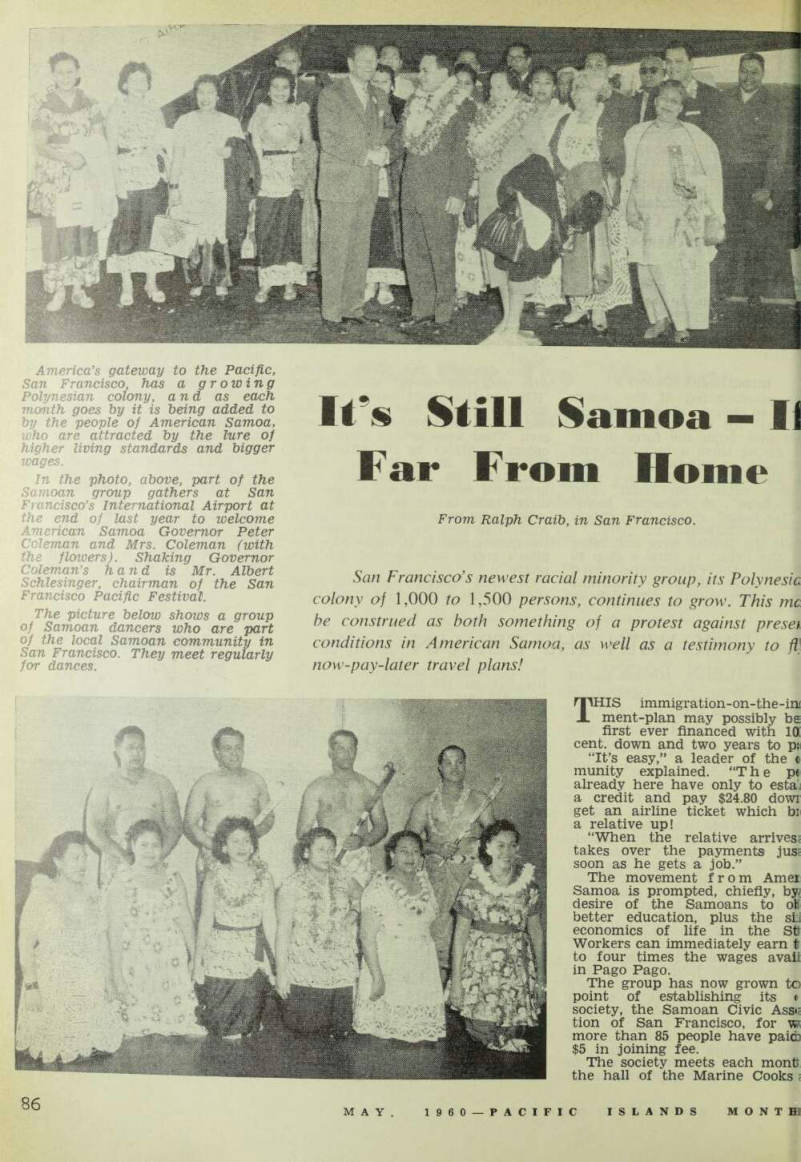
America’s gateway to the Pacific, San Francisco, has a growing Polynesian colony, and as each month goes by it is being added to by the people of American Samoa, who are attracted by the lure of higher living standards and bigger wages.
In the photo, above, part of the Samoan group gathers at San Francisco’s International Airport at the end of last year to welcome American Samoa Governor Peter Coleman and Mrs. Coleman (with the flowers). Shaking Governor Coleman’s hand is Mr. Albert Schlesinger, chairman of the San Francisco Pacific Festival.
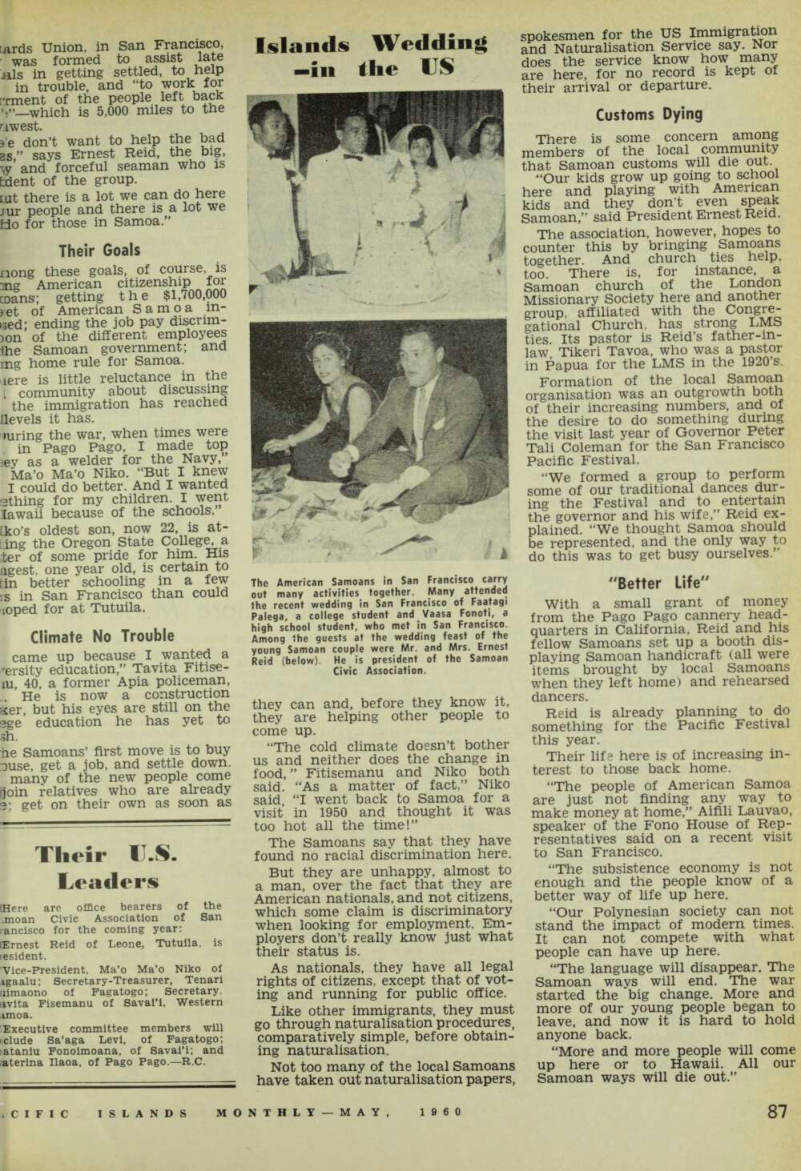
The picture below shows a group of Samoan dancers who are part of the local Samoan community in San Francisco. They meet regularly for dances.
From Ralph Craib, in San Francisco.
San Francisco’s newest racial minority group, its Polynesia colony of 1,000 to 1,500 persons, continues to grow. This me be construed as both something of a protest against presei conditions in American Samoa, as well as a testimony to now-pay-later travel plans!
THIS immigration-on-the-im
ment-plan may possibly be first ever financed with IOC cent, down and two years to pit “It’s easy,” a leader of the « munity explained. “The p* already here have only to esta'j a credit and pay $24.80 dowr get an airline ticket which bn a relative up!
“When the relative arrives? takes over the payments jus? soon as he gets a job.”
The movement from Amen Samoa is prompted, chiefly, by* desire of the Samoans to oW better education, plus the si;i economics of life in the Sti Workers can immediately earn t to four times the wages avaii in Pago Pago.
The group has now grown to point of establishing its • society, the Samoan Civic Ass*? tion of San Francisco, for w more than 85 people have paid* $5 in joining fee.
The society meets each montt. the hall of the Marine Cooks ?
tjirds Union, in San Francisco, was formed to assist late ills in getting settled, to help in trouble, and “to work for [rment of the people left back V>—which is 5,000 miles to the nwest. 3 e don’t want to help the bad as ” says Ernest Reid, the big, \y and forceful seaman who is fcdent of the group, nit there is a lot we can do here jut people and there is a lot we Mo for those in Samoa.”
Their Goals
nong these goals, of course, is mg American citizenship for
coans; getting the $1,700,000
ret of American Samoa in >;;ed: ending the job pay discnm 3on of the different employees
Ihe Samoan government; and
mg home rule for Samoa.
Mere is little reluctance in the [ community about discussing the immigration has reached llevels it has. •uring the war, when times were . in Pago Pago, I made top sey as a welder for the Navy, Ma’o Ma’o Niko. “But I knew I could do better. And I wanted sthing for my children. I went la wail because of the schools.’
Iko’s oldest son, now 22, is at i ing the Oregon State College, a cter of some pride for him. His ugest, one year old, is certain to iin better schooling in a few >s in San Francisco than could toped for at Tutuila.
Climate No Trouble
came up because I wanted a 'ersity education,” Tavita Fitis-e -tu, 40, a former Apia policeman, He is now a construction ker, but his eyes are still on the ‘;ge education he has yet to oh. he Samoans’ first move is to buy nuse, get a job, and settle down. many of the new people come [join relatives who are already get on their own as soon as
they can and, before they know it, they are helping other people to come up.
“The cold climate doesn’t bother us and neither does the change in food, ” Fitisemanu and Niko both said. “As a matter of fact,” Niko said “I went back to Samoa for a visit in 1950 and thought it was too hot all the time!”
The Samoans say that they have found no racial discrimination here.
But they are unhappy, almost to a man, over the fact that they are American nationals, and not citizens, which some claim is discriminatory when looking for employment. Em ployers don’t really know just what their status is.
As nationals, they have all legal rights of citizens, except that of vot ing and running for public office.
Like other immigrants-, they must go through naturalisation procedures, comparatively simple, before obtain ing naturalisation.
Not too many of the local Samoans have taken out naturalisation papers,
spokesmen, for the US Immigration and Naturalisation Service say. Nor does the service know how many are here, for no record is kept of their arrival or departure.
Customs Dying
There is some concern among members of the local community that Samoan customs will die out.
“Our kids grow up going to school here and playing with American kids and they don’t even speak Samoan,” said President Ernest Reid.
The association, however, hopes to counter this by bringing Samoans together. And church ties help, too. There is, for instance, a Samoan church of the London Missionary Society here and another group, affiliated with the Congre gational Church, has strong LMS ties. Its pastor is Reid’s father-in law Tikeri Tavoa, who was a pastor in Papua for the LMS in the 1920’5.
Formation of the local Samoan organisation was an outgrowth both of their increasing numbers, and of the desire to do something during the visit last year of Governor Peter Tali Coleman for the San Francisco Pacific Festival.
“We formed a group to perform some of our traditional dances dur ing the Festival and to entertain the governor and his wife,” Reid ex plained. ‘‘We thought Samoa should be represented, and the only way to do this was to get busy ourselves.”
"Better Life"
With a small grant of money from the Pago Pago cannery head quarters in California, Reid and his fellow Samoans set up a booth dis playing Samoan handicraft (all were items brought by local Samoans when they left home) and rehearsed dancers.
Reid is already planning to do something for the Pacific Festival this year.
Their life here is of increasing in terest to those back home.
“The people of American Samoa are just not finding any way to make money at home,” Aifili Lauvao, speaker of the Fono House of Rep resentatives said on a recent visit to San Francisco.
“The subsistence economy is not enough and the people know of a better way of life up here.
“Our Polynesian society can not stand the impact of modern times.
It can not compete with what people can have up here.
“The language will disappear. The Samoan ways will end. The war started the big change. More and more of our young people began to leave, and now it is hard to hold anyone back.
“More and more people will come up here or to Hawaii. All our Samoan ways will die out.”