The Day The 'Malabar'
pp. 86-101 · Read in the full issue
Was Wrecked
By Captain Brett Hilder
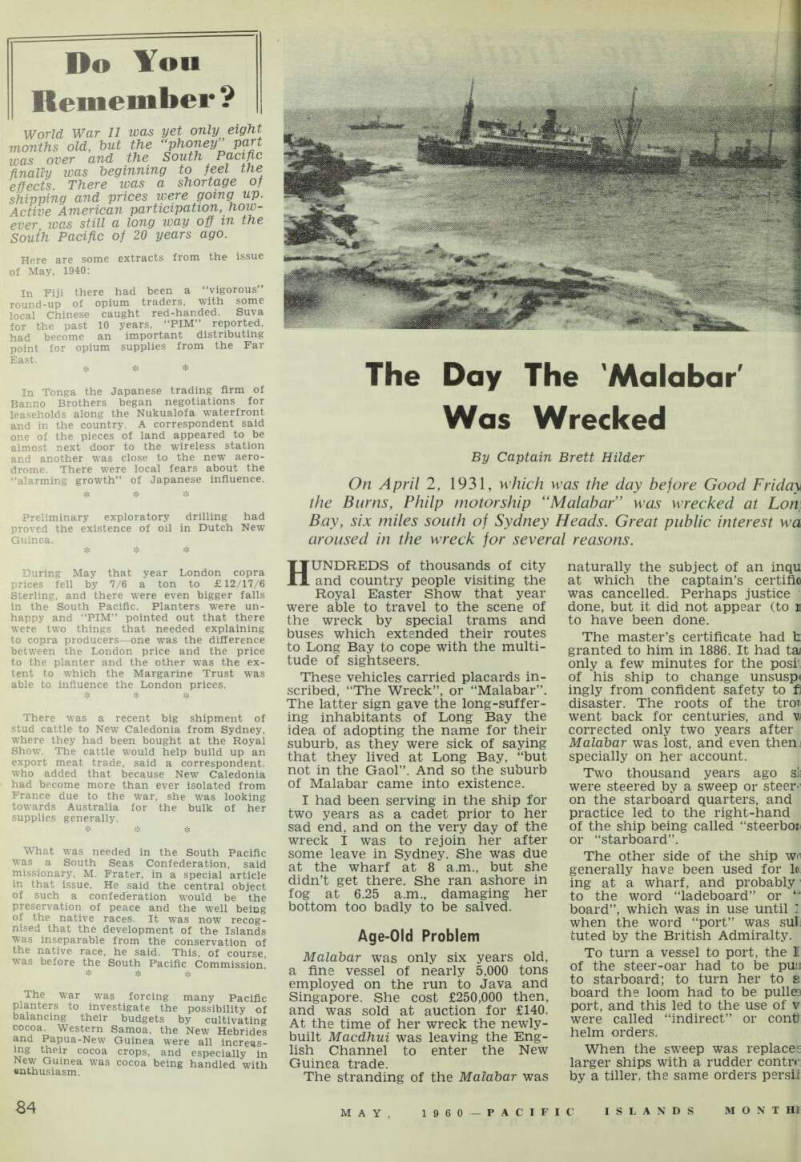
On April 2, 1931, which was the day before Good Friday the Burns, Philp motorship “Malabar” was wrecked at Lon Bay, six miles south of Sydney Heads. Great public interest wa aroused in the wreck for several reasons.
HUNDREDS of thousands of city and country people visiting the Royal Easter Show that year were able to travel to the scene of the wreck by special trams and buses which extended their routes to Long Bay to cope with the multi tude of sightseers.
These vehicles carried placards in scribed, “The Wreck”, or “Malabar”, The latter sign gave the long-suffer ing inhabitants of Long Bay the idea of adopting the name for their suburb, as they were sick of saying that they lived at Long Bay, “but not in the Gaol”. And so the suburb of Malabar came into existence.
I had been serving in the ship for two years as a cadet prior to her sad end, and on the very day of the wreck i was to rejoin her after some leave in Sydney. She was due at the wharf at 8 a.m., but she didn’t get there. She ran ashore in fog at 6.25 a.m., damaging her bottom too badly to be salved.
Age-Old Problem
Malabar was only six years old, a fine vessel of nearly 5,000 tons employed on the run to Java and Singapore. She cost £250,000 then, and was sold at auction for £l4O.
At the time of her wreck the newly built Macdhui was leaving the Eng lish Channel to enter the New Guinea trade.
The stranding of the Malabar was
naturally the subject of an inqu at which the captain’s certifio was cancelled. Perhaps justice : done, but it did not appear (to x to have been done.
The master’s certificate had b granted to him in 1886. It had tat only a few minutes for the posit of his ship to change unsusp< ingly from confident safety to fl disaster. The roots of the troii went back for centuries 1 , and v? corrected only two years after Malabar was lost, and even them specially on her account.
Two thousand years ago sje were steered by a sweep or steer-’ on the starboard quarters, and practice led to the right-hand of the ship being called “steerbos* or “starboard”.
The other side of the ship wn generally have been used for IoJ ing at a wharf, and probably l to the word “ladeboard” or “ board”, which was in use until I when the word “port” was sub tuted by the British Admiralty.
To turn a vessel to port, the I r of the steer-oar had to be pu:i to starboard; to turn her to s board the loom had to be pullee port, and this led to the use of v were called “indirect” or contt helm orders.
When the sweep was replaces larger ships with a rudder contrn by a tiller, the same orders persii
ae tiller had to be moved in the isite direction to the turning ; desired. The same still applies arf-boats steered by an oar, and jig boats fitted with a rudder tiller.
Inconsistent Orders
ae inconsistency of the orders ~not so obvious while ships were ir sail, for they were generally >;d over from the force of the giving them a high side and w side, or windward and lee sides. The orders used were efore often “up helm” and [■n helm”, or “weather helm” ■“lee helm”, rather than “star id” and “larboard” or “port”. :iile the British were still using ± the helm” to turn a ship to ooard, the Americans and •'al other up-start maritime ons were using direct helm
orders like “left wheel”, “right wheel”. ..
This included the Malay sailors, who used the words “Kanan” and “Kiri” in the direct sense for right and left turns. And the Malabar had Malay quartermasters as helms men. They were always given their orders in Malay by the officers, as the Malays in those days spoke practically no English, and were uncertain about the use of the in direct helm orders in English.
When we were being piloted in an Australian port we always stood by the quartermaster to make sure the pilot’s orders were carried out cor rectly.
On that fateful April day that the Malabar was approaching Syd
ney from Melbourne, she was under the command of Captain Leslie, who spoke no Malay, being a retired Sydney pilot, and aged 71.
Our normal captain was on leave in Sydney while the ship went down to Melbourne and back. After pass ing Botany Bay, just before 6.40 a.m., the ship’s course was taking her within a mile of each rocky headland on the usual course to avoid the southerly current..
Thick Fog
The captain appeared on the bridge and took over from the chief officer, who pointed out a line of smoke haze in the distance ahead.
Then he and the cadet on watch
(Continued on page 97)
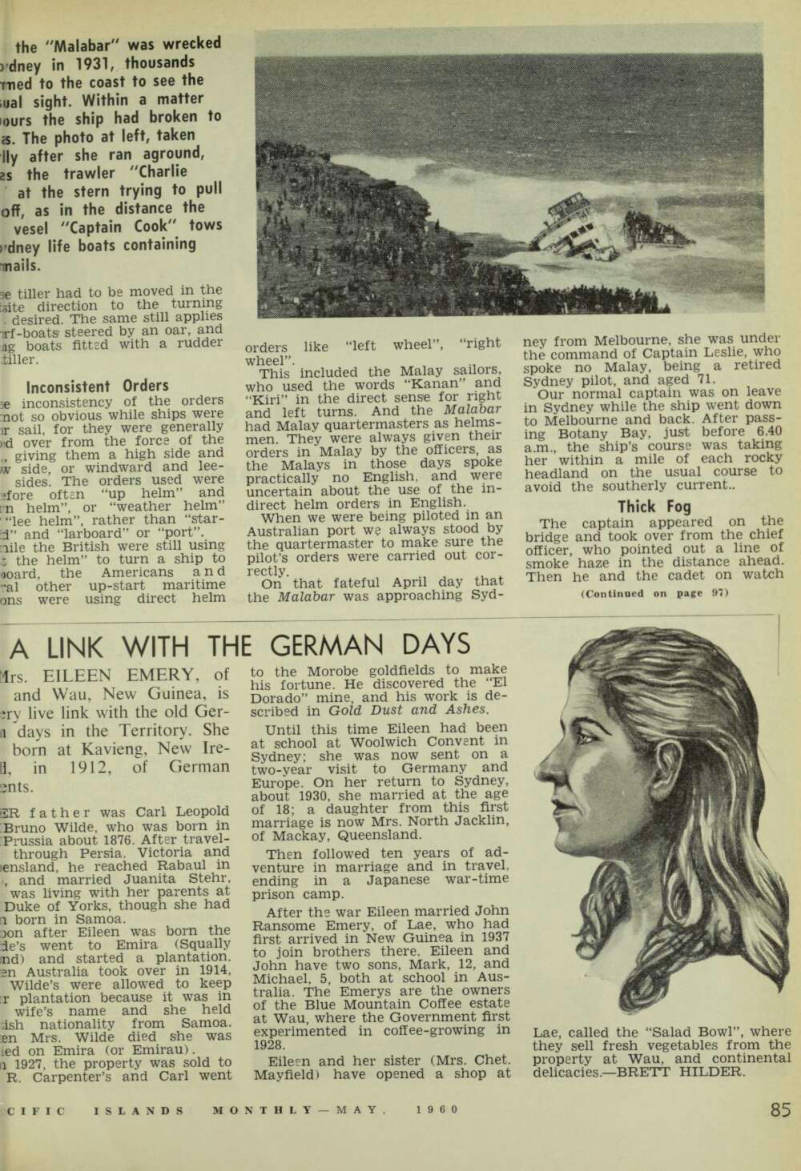
the "Malabar" was wrecked [?]dney in 1931, thousands med to the coast to see the sual sight. Within a matter [?]ours the ship had broken to is. The photo at left, taken [?]lly after she ran aground, [?]es the trawler "Charlie at the stern trying to pull off, as in the distance the vesel "Captain Cook" tows [?]dney life boats containing mails.
below to get washed and ied for the arrival at Sydney Jis at 7.30 a.m. :is left only the captain on the ,je and the quartermaster at the ;1, which was in the wheelhouse ue bridge. The line of smoke was Iheavy output from Bunnerong jrhouse, and it was turning into fog as it sank over the coast- It is a frequent hazard in this in fine weather, with a light breeze. soon as the ship entered the Ithe captain ordered “port five sees”, which was heard by the ! officer in his cabin, le order meant to alter course degrees to starboard, to keep ship a safer distance off the :fc. The captain was peering into ;fog to decide whether he should ice speed, or be clear again in 'w minutes; so he did not see h way the wheel was turned, could he see which way the was swinging in the fog. iie quartermaster, may Allah ive him, not only turned the 3\ to port, but put on five iees of helm, and kept it there, vould be done in the Navy, -ven minutes later the bow was degrees to port as the ship ran on ledges of rock at the base Iliranda Point. ue engines were put full speed :n, but without any effect on ;ship.
The tide was full, and the sea was calm, which made rescue work easy when the boats were lowered.
Within an hour it was obvious that the ship was too badly damaged to be refloated '
Rescue Easy
The passengers were landed on the beach at Long Bay, where residents took them into their homes for breakfast.
Three horses which were stabled on deck were put over the side and swum ashore; some cages of small birds were opened and they flew to A a vfln effort to tow the ship off was made by the steam trawler Charlie Cam, and the pilot vessel Captain Cook arrived to assist,
Most of the crew were sent off and the Captain Cook towed some of the boats, containing the mails and some passengers baggage, around into Sydney Harbour. The ship was finally abandoned at 11 a.m. The last boat was waiting alongside for the last two men to come up out of the engine-room, while the ship’s papers and instru ments, and a few personal things were lowered down with lines. xhe was hsting over to star board while the stern was dropping d r into the sea , and it appeared p oSS ibie that the ship might either roll over on her side, or slip stern deep water.
That night a storm worked up and the ship broke up into three
By the morning only the Ji part of the ship was visible, at in two pieces. 3 e inquiry (which I attended) jirt was baffled by the evid ji the helm orders given. The legal man kept demanding captain, “Did you give a ird helm order?” To which tied, “No”. n they demanded, “Did you order to alter course to star ”, he replied, “Yes, I said r ive degrees’ ”.
IMalay quartermaster gave a . mess of evidence, knowing s had done the wrong thing, idence had to be disregarded :ig of no use to anyone, ever, the ship had run :d, with the rocky coast on »le of her track and the wide i on the other, and the captain ht reduced speed in fog as re fby the rules. sad to see him found mt after the blow of losing 3e the heavy pall of smoke rnnnerong was partly to blame, al fault lay in the stupidity old English helm orders. • were altered to direct helm two years later, due to ~e from an international con ji. Now when they say “port am” they mean to turn the 0 port: when they say “star- Ithe helm” the ship is turned [■board. 3T the old rules, even men of rears at sea would make an ♦nal mistake, and Heaven nows how many ships besides T alabar were lost by some
1 error.