Sydneysider
pp. 63-69 · Read in the full issue


Goes Walkabout
From Gibraltar To Scotland, From Winter To Spring
LONDON: For the time being, anyway, this is my Euro :an swan-song. Within a few days we leave for what Australian ivel writer Mr. Frank Clune might call Assorted Aspects of sia. This Walkabout is a summing up of something like „000 miles of Europe, from Gibraltar to Scotland; from mter into spring and from something like summer back again \o winter.
EFT you in Torremolinos, in outhern Spain, where people cere bathing in the sea in lary, and where the lavandera <y got that last 100 kilos of 'wood that I bought, because it :nly became too hot to light iin the evening. v at the Italian Itier j thousand miles and one slip :clutch later, we drove through azard and zero visibility, the ir’s snow scraped into six ft above us, into an Italian er town north of Turin, e Yvonne, or—in fits of Pel sation —Young Girls’ Club; or :ording to the official docu —Ford Zephyr car No. YGC3SB, ■un ignominiously onto a flat rail car for a 14 kilometre sey through the centre of the ivia the Mt. Cenis tunnel. the other side was France, jpring again. This is the High T country, where France is ft to Switzerland, and the snow s run south from Mt. Blanc, scenery is magnificent, and on Darticular day the sun shone— now-smothered peaks, rushing
streams, a blue lake and roadside banks covered with wild violets.
Back here in London, getting towards the end of April, we are still see-sawing between spring and something even colder. The calendar says spring, the temperature outside something else again. Fortunately Nature seems to go by the book.
Crocuses have come and gone; the daffodils are on their last scraggy legs. Tulips are starting to bloom in open ground; trees everywhere are putting on new outfits of leaves; and down in Cornwall, the rhodo dendrons are in flower.
Only the weather spoils the pic ture; and it is still impossible to venture out without an overcoat.
Personal Contacts
Mean Everything
It is unfortunate that the run-of the-mill tourist, without personal contacts in a foreign country, bases his judgment on the treatment he gets from hotel staff, taxi drivers and shop assistants.
A snarling London shop-girl (and they come in dozen lots here), and you condemn the whole British race.
An Italian hotel that charges the equivalent of six bob for a thermos
of coffee, and the Italians are out.
A Paris taxi-driver abuses you—so down with the French (Contrari wise, a Scots clerk is courteous and friendly, and you love Scotland.) When I was in France, in 1955, I came away with the conviction that the French were the crustiest bunch of cross-grained individualists who ever ruined a good country.
This time? Not once was I ticked off by a taxi driver for a fancied inadequacy of fare. Nor did I have to fling myself in front of the wheels to induce one to stop. The woman who sells trinkets at the top of the Eiffel Tower was actually amiable (and thus encouraged, I bought a key-ring replica of Mr.
Eiffel’s life-work which I did not want).
Is the Better France
Due to de Gaulle?
Frenchmen whom you stopped in the street to ask directions did not treat you like a leper begging for alms, but gave a sympathetic ear while you murdered their favourite language, struggled with road-maps with you, or ran off to get a buddie who had at least seven words of English to his credit. (But the rot hasn’t gone to unseemly lengths— the Paris gendarme on traffic duty has not lost his air of savage effici
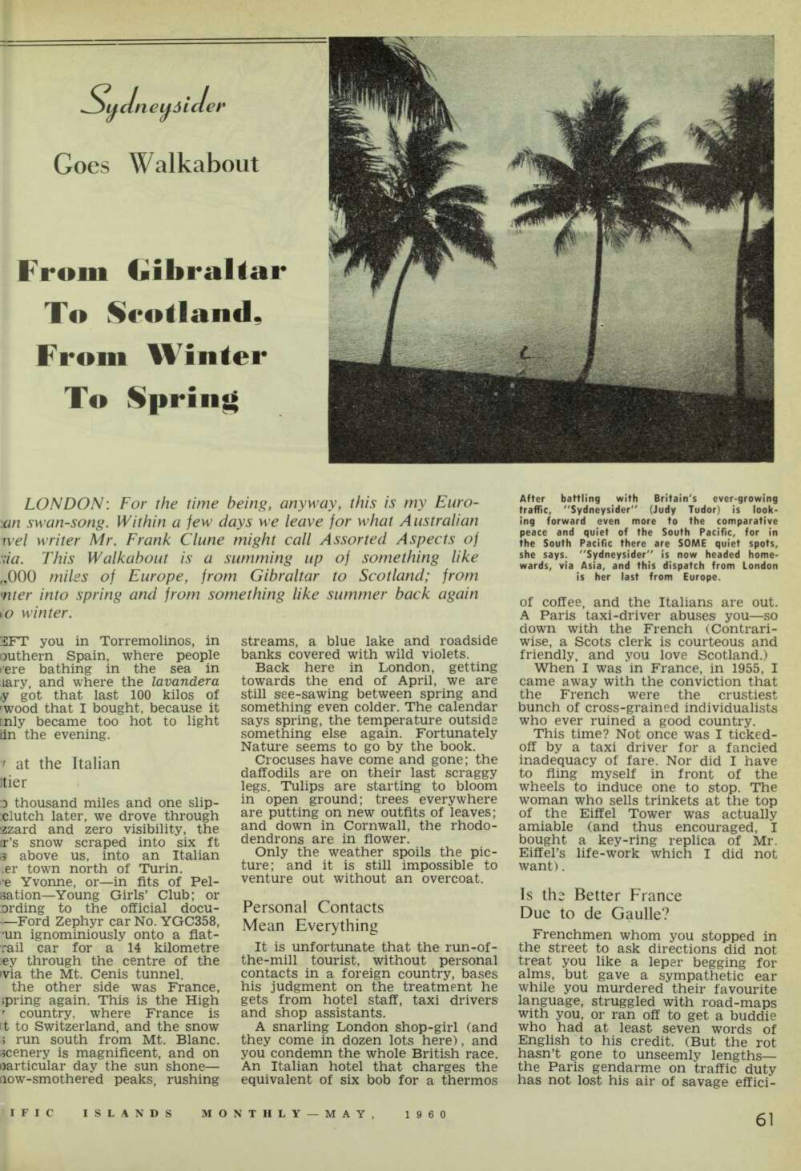
After battling with Britain's ever-growing traffic, "Sydneysider” (Judy Tudor) is look ing forward even more to the comparative peace and quiet of the South Pacific, for in the South Pacific there are SOME quiet spots, she says. "Sydneysider” is now headed home wards, via Asia, and this dispatch from London is her last from Europe.
;; nor does he show any inclina to emulate the Courteous ash Bobby.) rtiy this metamorphosis? Is it ithat it’s the tourist off-season? as it something else to be at hted to That Man? iis easy to imagine a new spirit £ad in France and to credit it e Gaulle; but no imagination at as needed to see the very real it that is being made to win (people back to the Church.
Tadoxically, considering France’s rd, the outward signs of re al manifest themselves to far ;ter extent there than they do tllegedly priest-ridden Italy and m. The wayside shrine, the £ge cross, the life-sized crucifix, part of the French scene recent vintage are the newly dted notice boards that list the ss of masses at the local church. >?e are prominently displayed at rroadside just before you enter ■; villages or towns.
French Churches
Packed te big churches and cathedrals aris are thronged day and night, r while we were there the public toition of the body of Saint lent de Paul (it was the 300th rversary of his death) filled le Dame with a continuous :un of people. i.ently they knelt to pray or past the high altar where St. lent lay, magnificent in lace, ied by the top of his silver Eet, and flanked by a Nun of the od, also embalmed and said to t been one of his disciples, went the round myself. The re us significance of it is beyond hut scientifically it was interest- Although St. Vincent was 84 ■s old when he died, the art [he embalmer had imprisoned ver the pinkness of youth on Saint’s cheeks. Unlined, un- Ikled, he slept serenely on, his half-turned to the worshippers, [years after his soul had pre ubly ascended to heaven. ,ie Presbyterian in me is upper ; at times like these, but when jestioned a guide as to whether sas really St. Vincent de Paul, inly an effigy, he was shocked hurt. I murmured something it St. Vincent’s youthful appear and he pulled himself up to [full height and hissed in the [per considered appropriate to iches and cathedrals: “Madame, :>n’t you heard of Egyptian mies?” iy resemblance between St. ient de Paul and an unwrapped ttian mummy is just coincidental, a side-aisle in Notre Dame ”t seem the place to argue about
Ttqlv ic Not Thean V - * s . INOt Lnedp
Any More
Hotel keepers in Italy and France have now departed from tradition sufficiently to provide the guest with a microscopic sample of soap as a sort of welcome-mat, but there departure from tradition ceases.
Anyone who wanders into a recognised tourist hotel must be prepared to part with everything short of his hide.
Until a few years ago, Italy was regarded as one of the cheaper countries in Europe. That was then; let’s move over to now.
The cost of living in a four-star hotel in Italy is now slightly over
twice as much as staying in a similar establishment in the United Kingdom, and in the places that quite frankly live on tourism—such as Florence everything else is jacked up to match, A slice these high prices can be blamed on Government taxes that have been worked out on the theory that the post-war influx of American tourists will continue for ever - The American abroad, how ever, likes value for money and if there is anything calculated to make hjrn do without Culture it is the blatant reefing from him of his dollars.
Florence will remain for me the horrible example of culture-at-a~
’ Take away from it its glorious und you are left with a grubby, oeval city, with narrow, tortu ctreets completely unsuited to traffic of any sort and par xly unsuited to the Italian in." it boils, seethes, screams and i;ens to burst wide open at the with a mass of honking, un i:*d cars and motor-scooters j.urn the city into a maelstrom j.se that outrivals even Rome.
Ihe Italians really had tourist they would seal Florence off zone of silence and forbid vehicles to go within 10 miles The Golden Tourist Geese then absorb culture in 14th ~y peace; stroll by the Arno its “cute bridges”), without jient risk of being mown down ElO-ton truck; or examine the as and narrow streets without deafened and numbed by the iual roar of revving motors, iler these circumstances it be worth the price of ad m. cost of hotel living in France surprise; but the soap is an ation; and the thrice-cursed in parquet flooring a continu »urce of amazement.
Hotel Squeaks
.All
sself-respecting French builder ics anything but a parquet ;and this is fitted together in peculiar way so that the whole springs gloriously free from :oundation. The result is that step produces a squeak of dimension. These range from : sighing, like the working of :>oner in a slight sea; to a full ii crashing about like a team ants walking in six feet of :3 cornflakes. is the retiring of Madame and .eur each night in the room diately above yours holds more ts normal entertainment value, lark, squark, squark go the boards as Monsieur bounds off ie lavatory; squeak, squeak, k goes Madame, as she trots 3 wardrobe, back to her suit and seven times round the i going-to-bed antics of any Ih couple would make a fascin study for a time-and-motion t, but at last, long last, it is rer. With a last squark from oor and a gentle sighing from afters, they are comfortably in nd all is peace, i, too, sink into oblivion, only ne-to with a start at dawn as me is decanted from her bed begins galloping around her to the accompaniment of the ling cornflakes. ;re are numerous rational ex tions to account for these rumblings and creakings, but I to my view that the average
French husband chases his wife out of bed at this ungodly hour to go through a series of physical jerks
and running-on-the-spot.
The UK Roads Are
Improving
One day last week I drove the full length of route AI from London to Edinburgh. About 40 per cent, of this route is under reconstruc tion and within a year or so there should be a complete three or four lane highway linking the two cities.
Even under present circumstances, AI makes for reasonably comfortable driving.
The same can’t be said of coming down the west coast, which I did
a few days later. The slightly over 200 miles from Lancaster to London that looked, on paper, like a morn ing’s drive, developed into a day long battle.
It was raining steadily and the first 5 miles of cutting across the industrial Midlands took just under four hours; the last 100, to the out skirts of London, with the help of about 60 miles of the 6-lane motor way, MI, under two hours. The 22 miles from the end of MI. across London to SW3, another two. (Pre sident de Gaulle was State-visiting us and this froze the whole West End into a panting, seething pack of vehicles for three days), The volume and size of transport traffic in this country is fantastic, and the loads these trucks carry
the imagination, and even nonsense.
I;:hose first 75 miles that morn rwe passed two articulated its, each 52 feet long, each i.ng a two-engined plane sawn coieces and placed sideways In ins so that three feet of fuse overhung the side towards the ,l of the road. This meant that «r approaching nor overtaking s could negotiate it except in 3avourable conditions, of which, ).idlands roads, there is virtually uddition to this menace to navi ji, we were sometimes stuck in ).6ng processions of transports ey wound their way in and out irawling cities that have now a so far in all directions that [merge and mingle, passed literally hundreds of and diesel tankers; trailers mg bulldozers, ships’ propellers, boilers, parts of barges, road of linked mechanical devices rtiousands of plain lorries haul upwards of 10 tons of in minate goods, told that 75 per cent, of all is now transported by road t UK. I can believe it.
Transport Driver Is
;a Gentleman
sibly more and better Mi’s will the problem, but even this unlikely. The only factor that rthe situation from utter chaos is the fact that the British oort driver is still a gentleman T there is any way for him to you safely round him, he will problem in the UK is basic; many people with too many vehicles. One of these days, taldn’t be surprised, the whole will sink out of sight from jieer weight of it all, and there s only a dieseline bubble rising the cold North Sea to show X marked the spot.