'Teiko' Tragedy?
pp. 31-34 · Read in the full issue
Tonga’s Shipping Disaster Analysed
What Caused The
By PIM’s Shipping Roundsman
Those who have closely followed the enterprise and initia of Tonga over the past several years mainly through the ye of Prime Minister Prince Tungi in progressing towards i establishment of a tuna fishing industry, can well appreciate [feelings not only of Prince Tungi but of the whole popula of Tonga at the loss of the longliner “Teiko” in March at very commencement of her career and the moment when [first fruits of the project were about to be realised.
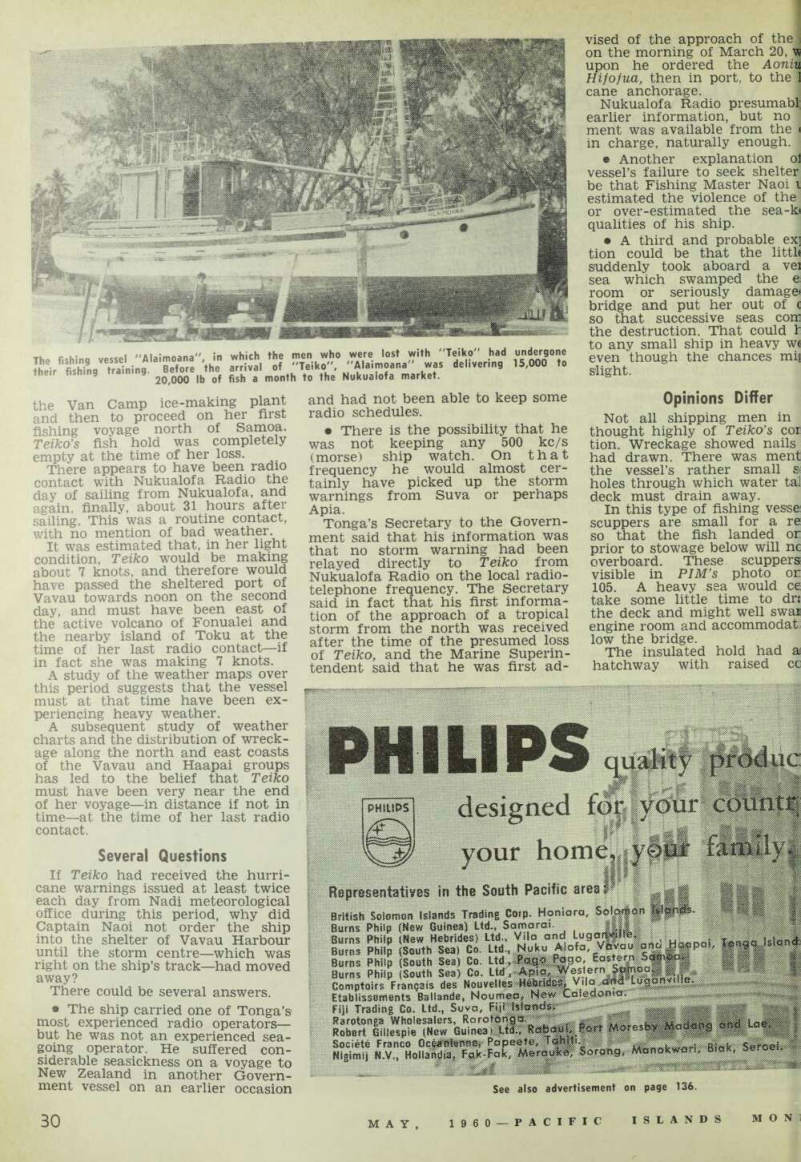
' Tonga mourned the loss of t 22 seamen, 19 of whom were mgans, one a Tongan-born , and two Japanese. But fto the personal loss was the ;.iat these men represented a •.rained over several years in fishing \Alaimoana (ex Perlin ). them went their Japanese Jtor, Fishing Master Isamu -de was brought from Japan T, and he returned there to >se the construction of Teiko ) command her during her career.
Ee were the obvious losses, but were others. use Teiko was not officered by iith certificates acceptable to of London, there were diffi in obtaining insurance cover vessel. is understood to have cost not Em £50,000 delivered, vessel had insurance cover for livery voyage from Japan, but .id expired. At the time of the gotiations with interests other iioyds were said to be proceed- Ed it was expected that cover :be obtained.
Inquiry in Tonga
Ee was also an apparently re ireport that an undertaking whereby the Tonga Govern vas to arrange life insurance • extent of £lO,OOO for each of □ Japanese, and this had not :oi done.
Ee is little doubt that Teiko ; replaced, but until she is ;d a $lO,OOO American ice ; machine, still in the final stage, will be largely unused, and a small motor launch was put ashore from Teiko she sailed on her fateful are virtually all that re :of the costly tuna fishing xgisterial inquiry into the loss :o was to take place in April hadn’t taken place by early
May), but the Secretary of the Gov ernment, Mr. W. Miller, told PIM that he did not think that its pro ceedings would be open to the public.
There is no Press in Tonga. For this reason the people are totally unaccustomed to any written critic ism of the Government and, gener ally speaking, resent it even if well founded. The Tongans are extremely loyal to their Government and leaders.
Thus there is a strong tendency in that Kingdom for any events of an embarrassing nature to be with held by Government and people, at so far as the outside world is concerned.
No Criticism
There is no suggestion here that the Tonga Government is open to any criticism in connection with Teiko, but it could be that all the facts may never be known to the general public.
The Secretary to the Government was not prepared to supply answers to all the questions l asked by PIM pending the marine inquiry, but the
ones he didn’t answer were few, and the measure of co-operation was very considerable.
From his and other information it is possible to piece together the following account of the loss of the Teiko, which varies in some re spects from earlier reports.
No Lifeboat
Teiko, a scaled-up version of a standard type of wooden, single screw, long-line tuna fishing vessel of which there are many hundreds of similar type in service, left the Japanese shipyard on January 28 and arrived at Nukualofa via Pago Pago on March 1.
Like all vessels of her type, Teiko carried no lifeboat, the explanation being that there is no place for lifeboat stowage which would not interfere with the handling of the fishing gear.
The only life-saving equipment consisted of rafts, on which some men could perch precariously while others clung to hand ropes as they floated alongside, and also life jackets.
A launch with an inboard engine —perhaps required by the insurance underwriters for the delivery voyage, was landed at Nukualofa, and now sits on the grass near Yellow Pier.
Her Route With Fishing Master Isamu Naoi in overall command, and with Manase Latu as navigating master, Teiko sailed about 9 a.m. on March 17 for Pago Pago, where repairs were to be carried out to a broken shaft (which had no connection with the propulsion of the ship).
Following its repair the ship was to take aboard chipped ice from
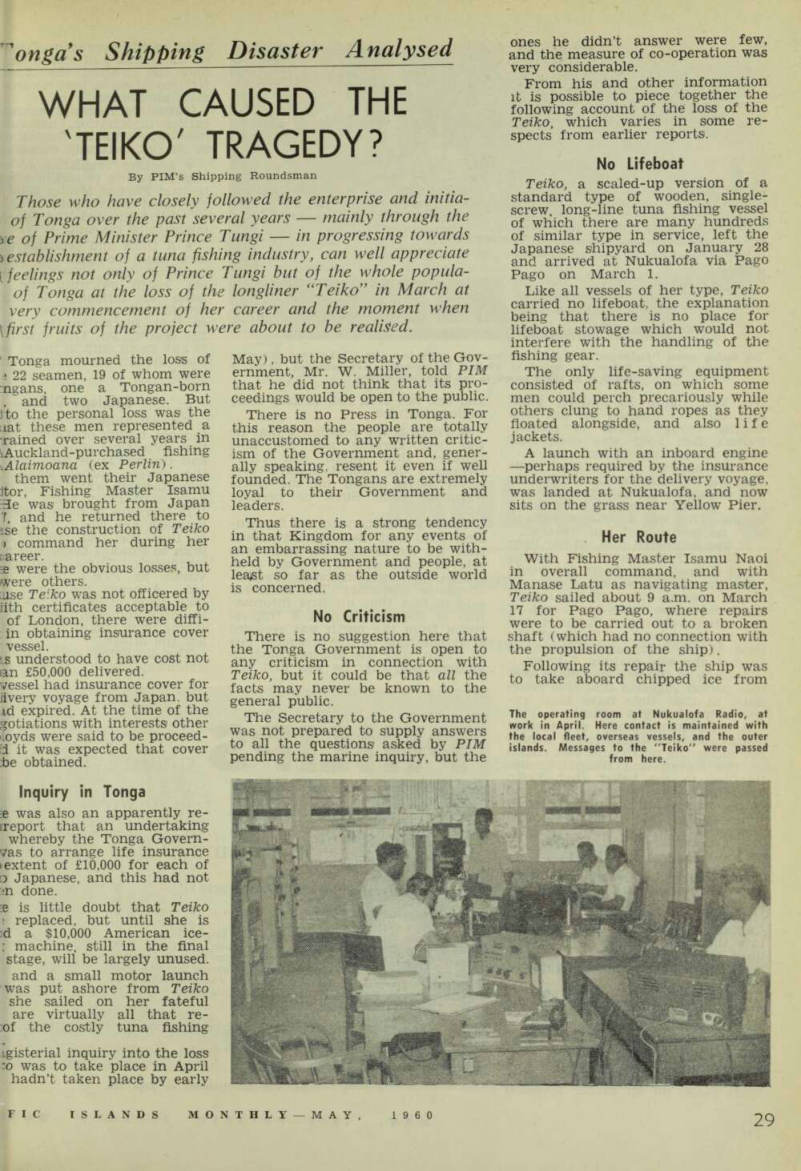
The operating room at Nukualofa Radio, at work in April. Here contact is maintained with the local fleet, overseas vessels, and the outer islands. Messages to the "Teiko" were passed from here.
the Van Camp ice-making plant and then to proceed on her first fishing voyage north of Samoa.
Teiko’s fish hold was completely empty at the time of her loss.
There appears to have been radio contact with Nukualofa Radio the day of sailing from Nukualofa, and again, finally, about 31 hours after sailing. This was a routine contact, with no mention of bad weather.
It was estimated that, in her light condition, Teiko would be making about 7 knots, and therefore would have passed the sheltered port of Vavau towards noon on the second day, and must have been east of the active volcano of Fonualei and the nearby island of Toku at the time of her last radio contact —if in fact she was making 7 knots.
A study of the weather maps over this period suggests that the vessel must at that time have been ex periencing heavy weather.
A subsequent study of weather charts and the distribution of wreck age along the north and east coasts of the Vavau and Haapai groups has led to the belief that Teiko must have been very near the end of her voyage—in distance if not in time —at the time of her last radio contact.
Several Questions
If Teiko had received the hurri cane warnings issued at least twice each day from Nadi meteorological office during this period, why did Captain Naoi not order the ship into the shelter of Vavau Harbour until the storm centre—which was right on the ship’s track —had moved away?
There could be several answers. • The ship carried one of Tonga’s most experienced radio operators— but he was not an experienced sea going operator. He suffered con siderable seasickness on a voyage to New Zealand in another Govern ment vessel on an earlier occasion
and had not been able to keep some radio schedules. • There is the possibility that he was not keeping any 500 kc/s (morse) ship watch. On that frequency he would almost cer tainly have picked up the storm warnings from Suva or perhaps Apia.
Tonga’s Secretary to the Govern ment said that his information was that no storm warning had been relayed directly to Teiko from Nukualofa Radio on the local radio telephone frequency. The Secretary said in fact that his first informa tion of the approach of a tropical storm from the north was received after the time of the presumed loss of Teiko, and the Marine Superin tendent said that he was first ad
vised of the approach of thej on the morning of March 20, w upon he ordered the Aoniu Hifofua, then in port, to the 1 cane anchorage.
Nukualofa Radio presumably earlier information, but no ment was available from the « in charge, naturally enough. • ® Another explanation oi vessel’s failure to seek shelter be that Fishing Master Naoi v estimated the violence of the or over-estimated the sea-k» qualities of his ship. • A third and probable exj tion could be that the little suddenly took aboard a vei sea which swamped the ei room or seriously damage* bridge and put her out of c so that successive seas com the destruction. That could k to any small ship in heavy we even though the chances mis slight.
Opinions Differ
Not all shipping men in thought highly of Teiko’s cor tion. Wreckage showed nails had drawn. There was mentl the vessel’s rather small &; holes through which water tal. deck must drain away.
In this type of fishing vesse: scuppers are small for a re so that the fish landed or prior to stowage below will no overboard. These scuppers visible in PlM’s photo or 105. A heavy sea would ce take some little time to dn the deck and might well swan engine room and accommodate low the bridge.
The insulated hold had af hatchway with raised co
The fishing vessel "Alaimoana", in which the men who were lost with "Teiko" had undergone their fishing training Before the arrival of "Teiko", "Ala.moana" was delivenng 15,000 to 20,000 lb of fish a month to the Nukualofa market.
7 was an inner insulated plug satch-cover and an outer one match-cover with a lip. Both items were included in wreck 3,er found. They indicated that certainly penetrated to rih hold. e of the wreckage provided e vidence that the hull of the fhad broken up. Items found [ portions of superstructure, fittings, or fishing gear. possible that the hull might ji afloat though waterlogged, . Joyita in her 38-day drift raorth of Samoa to north of n 1955? was the cork Insulation in is fish holds which mainly her afloat. :o had similar insulation. But engine is considerably larger heavier in proportion to the if the vessel than the twin as in Joyita, according to the authorities, and they do not ithat Teiko could possibly re- Bfloat. ijrtheless, inquiries were being vwith the marine architects in about this.
Could It Drift? ugh the wind-blown, surface lg wreckage moved south, it ±>able the hull, much deeper )e water, would drift like in a west-southwesterly direc- Ilong the line of the general it drift in this region. Joyita ced 14 miles per day in her ihat speed the hull of Teiko, !*at, would have been in the iroup of Fiji by the end of the week in April and perhaps /here near the New Hebrides /V Caledonia by the time this rs in print. uoden vessel like Joyita, Teiko probably represent a poor irch radar target and might iike Joyita, have been missed ;:areful air search, taps the most puzzling s of the disaster was the fact ne vessel was not missed until (ten days after she apparently f“r fate. ualofa Radio maintains radio on the voice distress fre 'T and the morse distress :ncy continuously from 6 a.m. :?.m. Tonga time. Thus in the •of an emergency between 10 ind 6 a.m. there would be no :iore contact. ;ever, Teiko, unlike most is ships, was equipped with a :z/s transmitter. Suva, Pago and possibly Apia, maintain uous watch on that frequency, most large overseas vessels, possibility of a distress call heard by someone on this :ncy would be good—if there me for such a call, evidence suggests there was r as stated in Nukualofa that
Tongan vessels equipped with radio are not bound to check in with Nukualofa Radio at fixed times.
The coast station does keep a particular watch for them at fixed times, normally morning and evening, but a ship may not check in unless the master wishes to do so.
Thus there was no alarm when Teiko failed to check in.
She was due at Pago Pago about the morning of March 20. Arrangements had been made for her call there, and it appears to have been assumed in Nukualofa that she had arrived. As far as could be learned by PIM , it was not until March 29 that an’ inquiry came in the form of a note from Tutuila Radio (Pago
Pago) seeking information as to when Teiko was due.
If Teiko had her constructional weaknesses, they were no different to those possessed by the hundreds of similar Japanese vessels which year by year operate far from home,
Competent Master
According to Mr. Takayaus Suzuki, a representative of the Japanese agents for the Tongan Government in Japan, speaking when he passed through Suva in March en route to Tonga, the Teiko had caused great interest at her building yard, where she was looked on more as a yacht because of the high standard of her accommodation. The
Tongan Government had insisted on the best °LS a h e n r d a bee selected timbers had been used he Fishing Master Naoi,.aged l 49 , vgs master* of Japan. Pre-war he held what is known in Japan as a Second Class Master’s Certificate, which permitted him to command vessels of up to 2,500 tons gross on deep sea voyages. During the war, when fishing vessels were taken over by the Japanese Navy he was in command of about 20 tuna long liners engaged as supply ships to the Philippines New Guinea, and the Solomons. He held officer’s rank.
Tongan's Experience
Manase, the Tongan navigating captain, held an unrestricted Tongan
including experU
.the fishery training vessel Aiaimoana.
There was some evidence, how ever, that Naoi and Manase had dis agreed over the handling of the ship when serving together in Alai moana and their relations were said to be not the best.
For that reason it has been sug gested by some that Naoi might have taken an undue risk in opposi tion to the wiser counsel of Manase.
Manase was a man probaty his early thirties.
Teiko was subject to Japj Maritime Board survey before e: ing service and was put tin stability and other tests by Board’s surveyors.
Naoi had been overseer foi construction of the vessel on To behalf.
All-in-all, fantastic stories those associated with the lo; Joyita to the contrary, there ap to be no reason to suppose tha disaster was other than the < result of storm damage, wh through sheer misfortune or « of seamanship.
There seemed to be no evil that Teiko had run agroun Toku or Fonalei.
Probably the facts will nev : known.
In the weather conditions a time, it is extremely doi whether any lives could have saved even if immediate news c disaster had been received.
Still, such a possibility mui considered, and while there is r to suppose that disaster c quickly, there does appear t much to say for maintenant regular routine radio contact small ships, for insistence that give position, course, and spe: each contact, and for some s to be taken when they fail toi their radio schedules.
There are difficulties, of c Radio communication is some impossible, so failure of a vesi check in for one or two sche is not normally considered a, ing.
Thus there will almost alway; lag between loss of radio co and drastic and costly search a and in that interval men maj die.
This is one of the normal ris a seamen’s life.
Risks may be reduced by th of the right life-saving equij —inflatable dinghies and fooi emergency transmitters, neith which were possessed by Ten far as could be discovered.