Sugar Industry?
pp. 25-148 · Read in the full issue
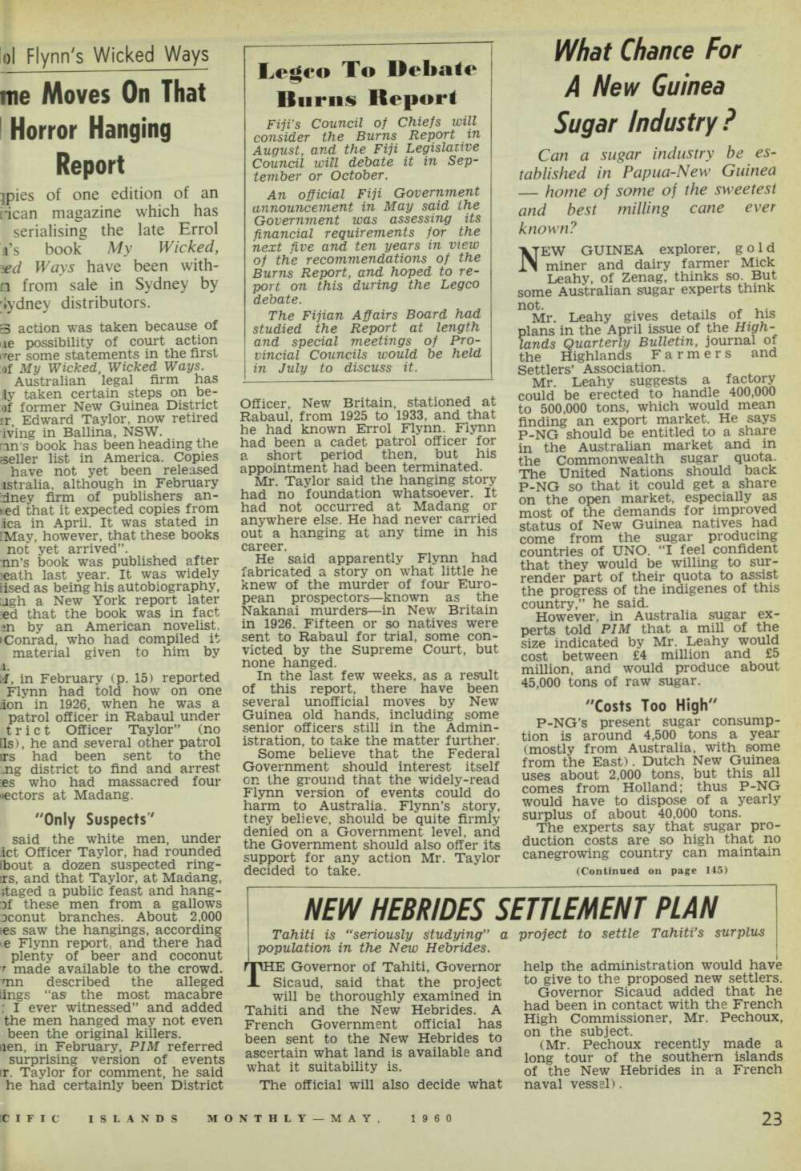
What Chance For A New Guinea Sugar Industry?
Can a sugar industry be es
tablished in Papua-New Guinea
home of some of the sweetest and best milling cane ever
known?
NEW GUINEA explorer, gold miner and dairy farmer Mick Leahy, of Zenag, thinks so. But some Australian sugar experts think Mr. Leahy gives details of his plans in the April issue of the High lands Quarterly Bulletin, journal of the Highlands Farmers and Settlers’ Association.
Mr. Leahy suggests a factory could be erected to handle 400,000 to 500,000 tons, which would mean finding an export market. He says P-NG should be entitled to a share in the Australian market and in the Commonwealth sugar quota.
The United Nations should back P-NG so that it could get a share on the open market, especially as most of the demands for improved status of New Guinea natives had come from the sugar producing countries of UNO. “I feel confident that they would be willing to sur render part of their quota to assist the progress of the indigenes of this country,” he said.
However, in Australia sugar ex perts told PIM that a mill of the size indicated by Mr. Leahy would cost between £4 million and £5 million, and would produce about 45,000 tons of raw sugar.
"Costs Too High"
P-NG’s present sugar consump tion is around 4,500 tons a year (mostly from Australia, with some from the East). Dutch New Guinea uses about 2,000 tons, but this all comes from Holland; thus P-NG would have to dispose of a yearly surplus of about 40,000 tons.
The experts say that sugar pro duction costs are so high that no canegrowing country can maintain
(Continued on page 145)
the industry by exports only, especi ally as there is over-production in all countries. Export quotas are fixed under the International Sugar Agreement.
Of the estimated 50,000,000 tons of sugar produced, about 10,000 000 tons are exportable by all pro
ducers. Half of this goes from one country to another under the ISA and the British Commonwealth Sugar Agreement—and half (5,000,000 tons) goes on the free world market at a low price, usually dictated by Cuba’s open market price (a little over 3 cents per lb in recent times).
The idea that P-NG might receive a share of the Australian market would be “furiously opposed” by Queensland, which virtually controls the Commonwealth industry, using European labour, according to main land opinion. With over-production already a bogey (Australian pro ducers’ official figures showed 2,000,000 tons of cane surplus to crushing requirements in 1959), the political effect “would be dynamite” if the Federal Government tried to induce Queensland to allow native grown and harvested sugar to com petitively enter the domestic market.
No Help Likely
It is unlikely that British Com monwealth sugar-exporting countries would welcome P-NG as a separate newcomer, apart from Australia, into the tightly restricted quota field.
And it would be even less likely that the vociferous, assorted countries that beat the drum in UNO about New Guinea’s “backwardness” would give up part of their quotas.
It’s one thing to spout in UNO’s comfortable chambers in New York but quite another to make a national sacrifice back home.
Most experts also argue that a sugar mill in the Highlands, as Mr.
Leahy suggests, wouldn’t work be cause of transport costs to the point of shipment.
That’s the opinion on Mr. Leahy’s scheme, which could be right. It’s certainly not a bright picture for
P-Ng.
The Germans were interested in sugar in New Guinea as far back as 1911, and in the early 1930’5, under Australian administration, there were many plans afoot to establish the industry in northern Papua, but none was successful.
Current revival of interest was probably triggered by an Indian delegate to UNO, Mr. Rasgotra, who
said in July last year that the pos sibility of sugar production should be explored. The matter was men- Honed again in the Trusteeships Council’s report and was followed up in the Australian Parliament last October, when Mr. E. G. Whitlam (now deputy leader of the Opposi tion) asked what action the Gov ernment had taken about establish ing a sugar industry. .
Typically, Territories Minister Hasluck replied that comment on the suggestion would be made in Australia’s next report to th e Trusteeship Council—that is, he had nothing helpful to say.