Papua-New Guinea Sorts
pp. 23-149 · Read in the full issue
This Is Only a Beginning Papua-New Guinea Sorts Out Its Air Services
Some concentrated behind-the-scenes activity
is going on in Australia in an effort to sort out Papua-New Guinea's future airline system. It looks like being several months before the picture is clarified and new services operating.
This situation has developed following a Federal Government announcement in April that: • Qantas will leave Papua-New Guinea to con centrate on expanding international operations. • Trans Australia Airlines and Ansett-ANA will operate competitive services between Australia and Papua-New Guinea. • Trans Australia Airlines will take over internal operations in Papua-New Guinea, and the service to Hollandia, NNG, and to the British Solomon Islands.
The Cabinet announcement confirmed PlM’s report of February, which had also pointed out that even when the Cabinet’s decision was announced it would be many months before the new services would begin operating and that the pattern “may then be different from the one that Cabinet first approves”.
Present plans are for both TAA and Ansett to use DC6B’s on the trunk service between the Aus tralian mainland and Port Moresby.
Qantas, which has been operating this service as a monopoly since 1945, has recently been using Super Constellations and had planned to use Electras but was prevented from doing so pending the Cabinet decision. This use of the DC6B’s will in fact be a retrograde step for NG passengers.
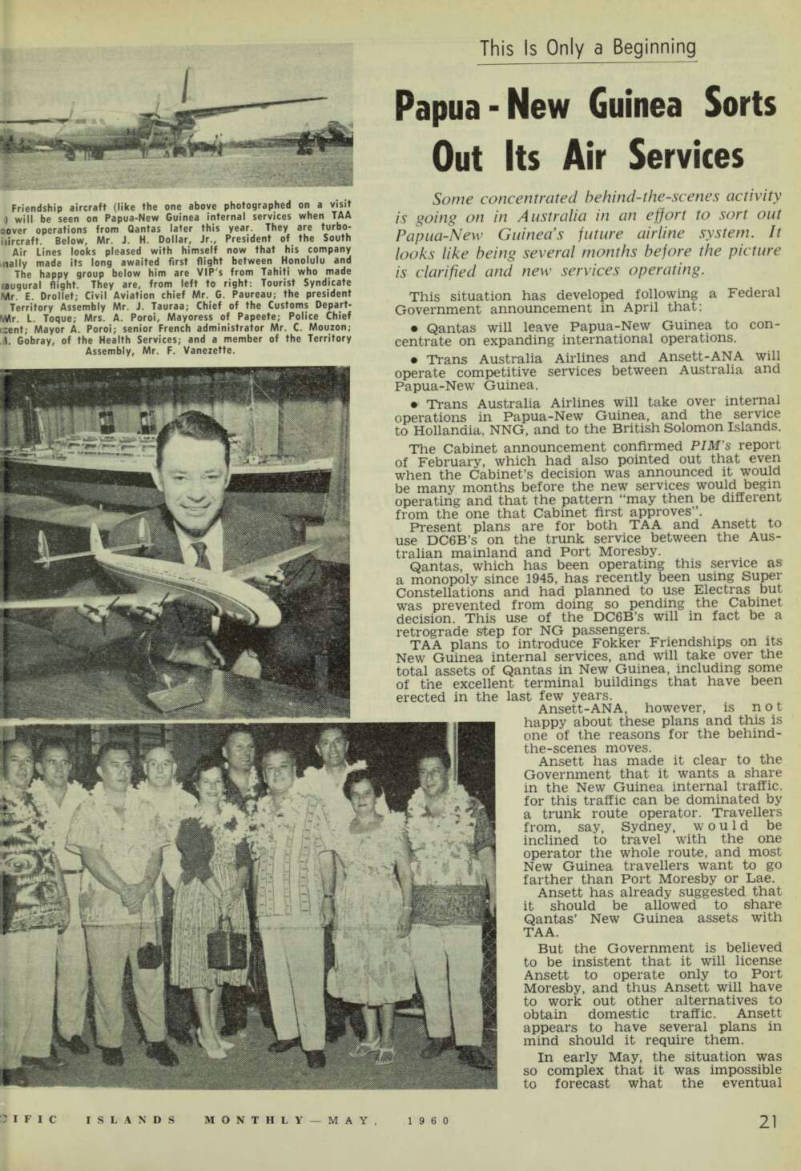
TAA plans to introduce Fokker Friendships on its New Guinea internal services, and will take over the total assets of Qantas in New Guinea, including some of the excellent terminal buildings that have been erected in the last few years.
Ansett-ANA, however, is not happy about these plans and this is one of the reasons for the behind the-scenes moves.
Ansett has made it clear to the Government that it wants a share in the New Guinea internal traffic, for this traffic can be dominated by a trunk route operator. Travellers from, say, Sydney, would be inclined to travel with the one operator the whole route, and most New Guinea travellers want to go farther than Port Moresby or Lae.
Ansett has already suggested that it should be allowed to share Qantas’ New Guinea assets with
Taa.
But the Government is believed to be insistent that it will license Ansett to operate only to Port Moresby, and thus Ansett will have to work out other alternatives to obtain domestic traffic. Ansett appears to have several plans in mind should it require them.
In early May, the situation was so complex that it was impossible to forecast what the eventual
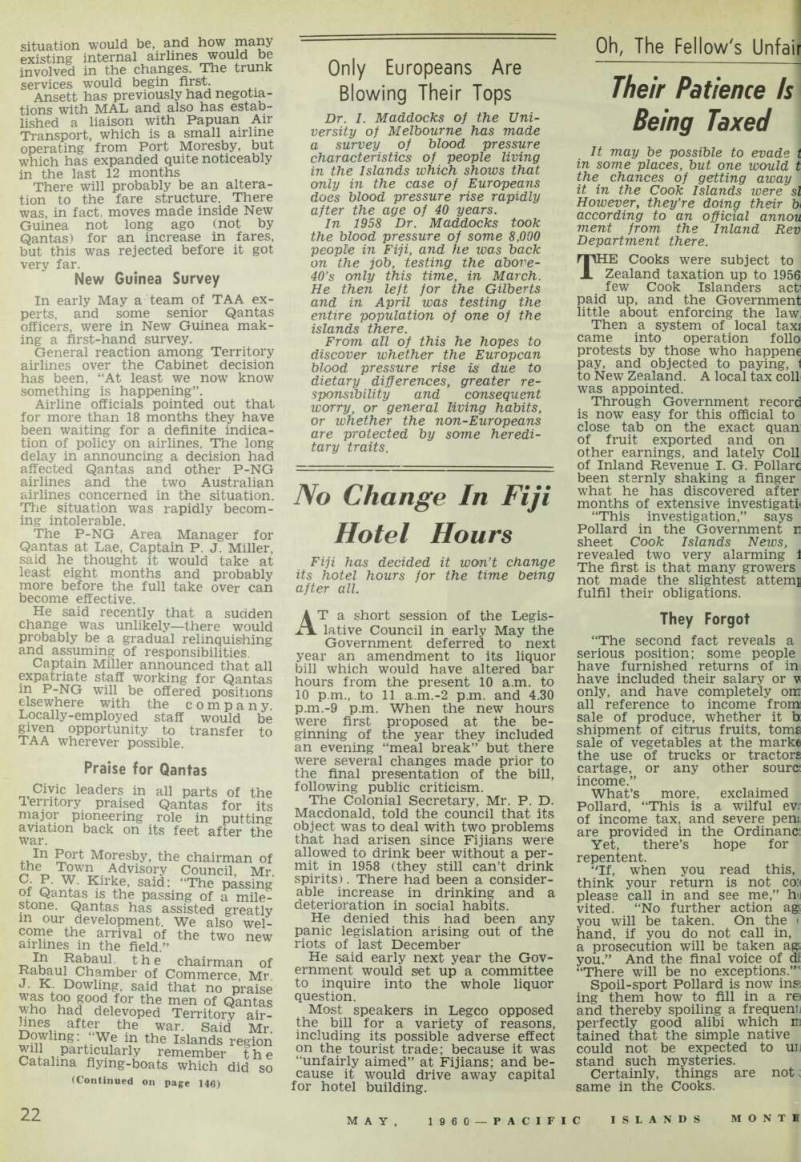
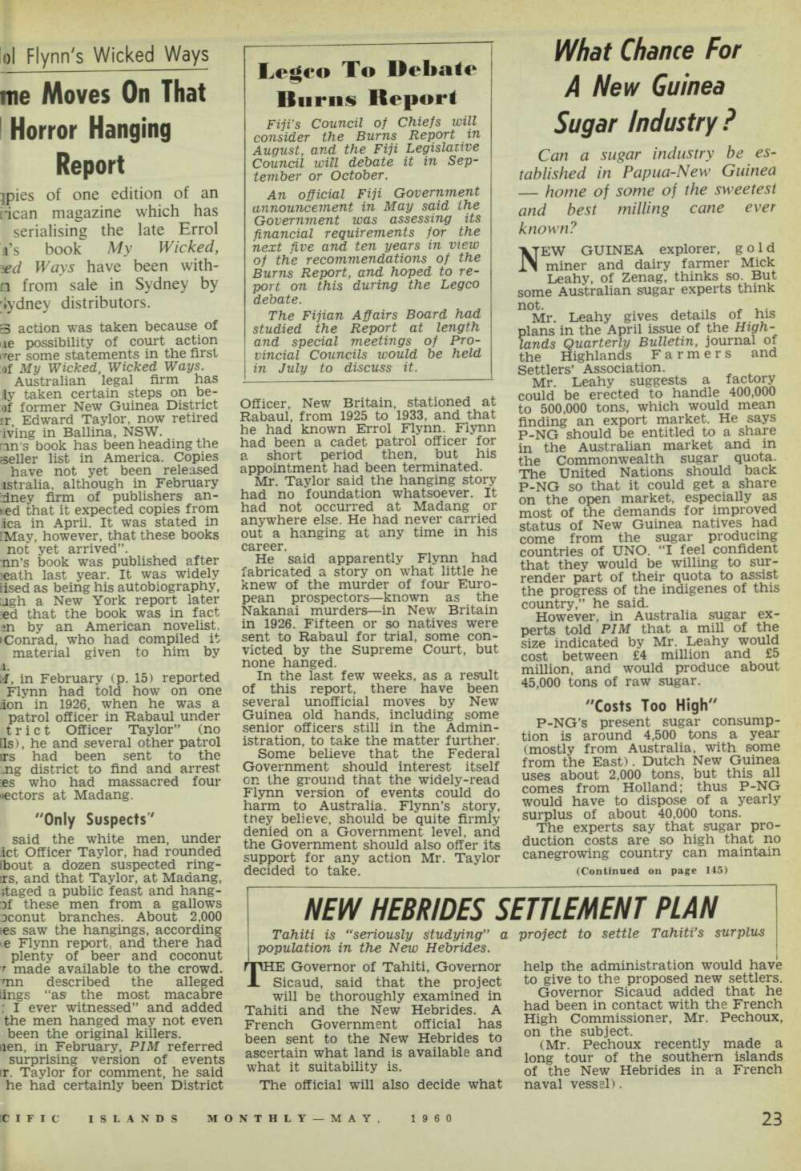
Friendship aircraft (like the one above photographed on a visit will be seen on Papua-New Guinea internal services when TAA cover operations from Qantas later this year. They are antia ircraft Below, Mr. J. H. Dollar, Jr., President of the South Air Lines looks pleased with himself now that his company nally made its long awaited first flight between Honolulu and The happy group below him are VlP's from Tahiti who made [?] eaugural flight. They are, from left to right: Tourist Syndicate Mr. E. Drollet; Civil Aviation chief Mr. G. Paureau; the president Territory Assembly Mr. J. Tauraa; Chief of the Customs Depart- Mr. L. Toque; Mrs. A. Poroi, Mayoress of Papeete; Police Chief cent; Mayor A. Poroi; senior French administrator Mr. C. Mouzon; [?]. Gobray, of the Health Services; and a member of the Territory Assembly, Mr. F. Vanezette.
situation would be, and how many existing internal airlines would be involved in the changes. The trunk services would begin first.
Ansett has previously had negotia tions with MAL and also has estab lished a liaison with Papuan Air Transport, which is a small airline operating from Port Moresby, but which has expanded quite noticeably in the last 12 months There will probably be an altera tion to the fare structure. There was, in fact, moves made inside New Guinea not long ago (not by Qantas) for an increase in fares, but this was rejected before it got very far.
New Guinea Survey In early May a team of TAA ex perts, and some senior Qantas officers, were in New Guinea mak ing a first-hand survey.
General reaction among Territory airlines over the Cabinet decision has been, “At least we now know something is happening”.
Airline officials pointed out that for more than 18 months they have been waiting for a definite indica tion of policy on airlines. The long delay in announcing a decision had affected Qantas and other P-NG airlines and the two Australian airlines concerned in the situation.
The situation was rapidly becom ing intolerable.
The P-NG Area Manager for Qantas at Lae, Captain P. J. Miller, said he thought it would take at least eight months and probably more before the full take over can become effective.
He said recently that a sudden change was unlikely—there would probably be a gradual relinquishing and assuming of responsibilities.
Captain Miller announced that all expatriate staff working for Qantas in P-NG will be offered positions elsewhere with the company.
Locally-employed staff would be given opportunity to transfer to TAA wherever possible.
Praise for Qantas Civic leaders in all parts of the 1 erntory praised Qantas for its major pioneering role in putting aviation back on its feet after the war.
In P, or t Moresby, the chairman of Town Advisory Council, Mr.
SJv T Klr^ e ’ said: "The passing of Qantas is the passing of a mile stone. Qantas has assisted greatly m our development. We also wel come the arrival of the two new airlines in the field.”
If 1 the chairman of Rabaul Chamber of Commerce, Mr J. K Dowling, said that no praise was too good for the men of Qantas who had delevoped Territory air lines after the war. Said Mr Dowhng: “We in the Islands region will particularly remember the Catalina flying-boats which did so
(Continued on page 146)
much to bring closer the out stations.”
But there was another type of re action, too. • In Port Moresby, businessmen claimed that airlines represented such big business that “competition” on the Australian to Papua-New Guinea service might not exist in the true sense of the word. “I wouldn’t be surprised to see com petition degenerate into conniv ance.” one man said. • In Rabaul, there was pleasure at the thought that TAA might bring in modern Fokker Friendship
aircraft to replace Douglas DC3s, but there was some fear that such a move would cut down frequencies in services. Mr. Dowling, who was quoted earlier, said: “We rely a lot on our mails here, and we wouldn’t like to see them reduced.”
The decision to remove Qantas from New Guinea was bad news for Australia’s international airline which, for the first time since it was launched in western Queens land in 1920 (as Queensland and Northern Territory Aerial Services) will become entirely international.
The plans to remove it from New Guinea had been made some time ago, but Qantas fought them. It pointed out to the Government that New Guinea had developed into a very valuable training ground for Qantas pilots since the reservoir of pilots trained in the war had dried up. Most senior Qantas pilots to day have had extensive New Guinea flying experience.
Qantas will now have to find new training methods at greater expense.
The New Guinea services also allowed Qantas to spread its costs better and to use its aircraft— par ticularly its Super Constellations.
Qantas also pointed out that it was planning eventually to run trunk routes from Port Moresby down through the Solomons con necting with Fiji, and it would be far cheaper to have its own instal lations at the New Guinea end rather than charter them from
someone else. But all this fe deaf ears.
TAA and Ansett have als® aware of the costs angle. And! been suggested that one ol reasons why the Governmeil willing to introduce Austj domestic airlines into New Q was to show the United Natioil New Guinea was not rej merely as some kind of a C but as an integral part of thq tralian mainland, like Tasma Meanwhile, the future 1 bright for both TAA and An| New Guinea. Papua-New Gi airlines have been taking creasing number of passena the last few years.
During 1958-59, 29,859 pass and 666 tons of freight I carried into the crease over the previous I figure of 2,013 passengers a tons of freight.
Over the same period, ir traffic had increased by 2 64,056, and freight tonnage tons to 4,304 tons. These figm exclusive of charter oper which are extensive.
TAl's Services
Other South Pacific airlii velopments during April were TAl’s new round-the-wor service from Paris (with Air flying the final Los Angele; leg) commenced on May
[ Nadi, Bora Bora and Hono ihe Pacific. *e of a late start, the in flight by-passed Sydney, was due on May 4, and D:ct from Darwin to Fiji. [Sydney weekly call by TAl’s Tliner was on May 11, when [ passengers for Pacific area ire lifted, including a party inti. The connection from ira to Papeete is at present ussociated RAI, with multi [ Bermuda flying-boats, serre Sebire, newly-appointed mager in Sydney, said in Jt DCS Intercontinental Jets • used on the Paris-Noumea commencing in September, would continue from Noumea sete, using the new airport htil it was ready to take jet i in January next year, and 3)s Angeles. The connecting ince service uses Boeing itinental Jets.
TEAL Talks ►.ebire said that a French mission would visit New i at the end of May. It would ; the talks about Pacific air initiated in Paris by NZ llinister Nash on his way to jimonwealth Conference last tf the items on the agenda the future operations of n its Coral route to Tahiti, iintained by Solent flying- Thich are near the end of >eful life. while TEAL has announced relopments.
May 1 it will introduce r class —in place of its Elass —on its trans-Tasman Thus it will be the first n the South Pacific to Intro momy class travel, following FA agreement earlier this JIM, April, p. 138). Under -cement, airlines can carry ses, first class and one lower ■ther tourist or economy. ie July, TEAL will begin a *ll ington-Sydney direct ser ing Electras. There will be lights weekly to start, and nces will be made daily if services warrant it.
May 6, TEAL’s Hibiscus services (Auckland-Nadi) ;pped up from three return 0 four a week. For the first ie of these return services 1 from Harewood Airport, lurch, in the South Island. will resume its direct Auck iisbane services in June, and ;rate them for five months icason (compared with three r) with a return flight each SPAL to Tahiti •ril, South Pacific Air Lines, olulu, a subsidiary of the •ompany, finally commenced
a weekly air service between Honolulu and Tahiti. The service, using Super Constellations, takes eight hours 45 minutes and takes 2,500 miles off the normal route.
Teams of VlP’s from Tahiti and America made the inaugural flights.
The service runs to Bora Bora but will go to Papeete when the new airport gets into operation.
South Pacific Air Lines 1 holds the only American rights at the moment, but Pan American has an applicam to operate from the Pacific West Coast, and expects this to be granted in time for it to commence in January which will give SPAL some competition. «, e .
Noumea Service
In addition, TAI are now operating (see above) and Qantas will eventually go through there.
Trans Ocean Airlines has suspended most of its operations
while it tries to find money for refinancing. Its 14 Stratocruisers have been grounded and all but 50 of 1,800 employees laid off. on May 13, Qantas will replace its Super Constellations on the sydney-Noumea service with Electras, thus reducing flying time by a further U hours. The service will be fortnightly, compared with TAl’s weekly service, Netherlands New Guinea is recon gtructing the Mokmer airport, Biak, tQ acco mmodate jets in time for the rst KLM dcB in October. NNG ig spending £A 85,000 extending the preS ent 7,100 feet west runway by nearly 1,800 feet and the east run way by about 2,800 feet, giving it a total length of about 11,700 ft.
There will be new technical equip ment installed, including a Visual Glide Path system, and new radio beacon. All the work should be corn pleted by June next year.