Dutch
pp. 19-152 · Read in the full issue
New Guinea
Moves
Political and military decisions
involving Netherlands New
Guinea made world news in April, with the promise of more developments before the year is out.
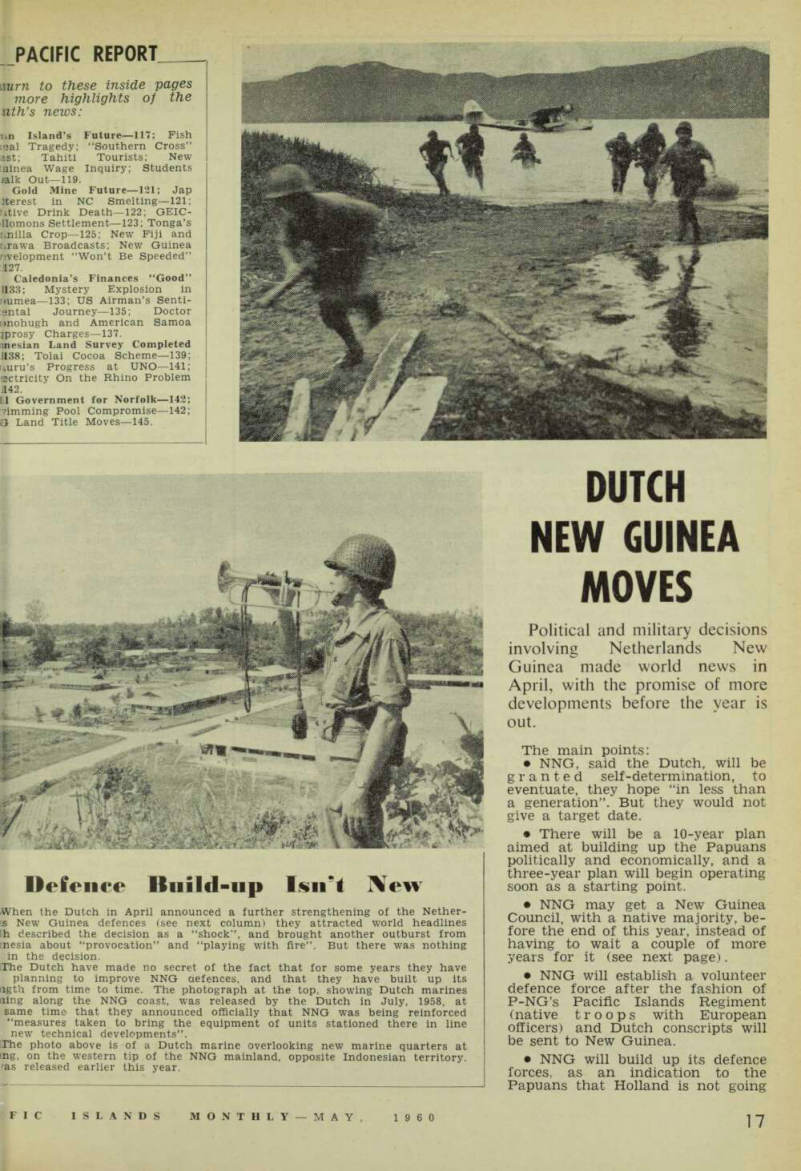
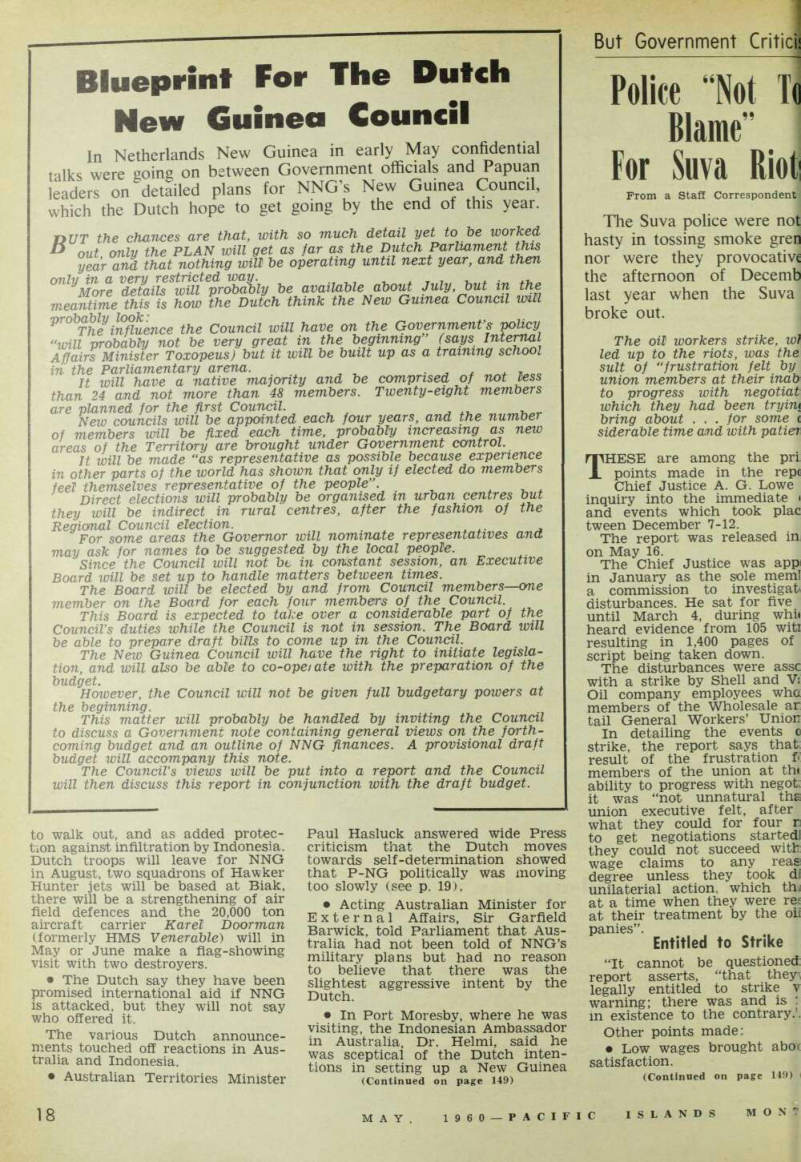
The main points: • NNG, said the Dutch, will be granted self-determination, to eventuate, they hope “in less than a generation”. But they would not give a target date. • There will be a 10-year plan aimed at building up the Papuans politically and economically, and a three-year plan will begin operating soon as a starting point. • NNG may get a New Guinea Council, with a native majority, be fore the end of this year, instead of having to wait a couple of more years for it (see next page). • NNG will establish a volunteer defence force after the fashion of P-NG’s Pacific Islands Regiment (native troops with European officers) and Dutch conscripts will be sent to New Guinea. • NNG will build up its defence forces, as an indication to the Papuans that Holland is not going
to walk out, and as added protec tion against infiltration by Indonesia.
Dutch troops will leave for NNG in August, two squadrons of Hawker Hunter jets will be based at Biak, there will be a strengthening of air field defences and the 20,000 ton aircraft carrier Karel Doorman (formerly HMS Venerable ) will in May or June make a flag-showing visit with two destroyers. • The Dutch say they have been promised international aid if NNG is attacked, but they will not say who offered it.
The various Dutch announce ments touched off reactions in Aus tralia and Indonesia. • Australian Territories Minister
Paul Hasluck answered wide Press criticism that the Dutch moves towards self-determination showed that P-NG politically was moving too slowly (see p. 19). • Acting Australian Minister for External Affairs, Sir Garfield Barwick, told Parliament that Aus tralia had not been told of NNG’s military plans but had no reason to believe that there was the slightest aggressive intent by the Dutch. • In Port Moresby, where he was visiting, the Indonesian Ambassador in Australia, Dr. Helmi, said he was sceptical of the Dutch inten tions in setting up a New Guinea
(Continued on page 14D)
Council. He added that Indonesia was not in favour of a unified New Guinea —east and west.
The announcements on self de termination were made in the Dutch Parliament by the Minister of the Interior, Mr. Toxopeus, and the Secretary for State for Internal Affairs, Dr. Th. Bot.
Mr. Toxopeus said it was highly undesirable to mention a “fatal period” of a target date for self determination. The Papuans would have a say in fixing it, and thus in the meantime they would have to have a Parliament as a forum— hence the New Guinea Council.
The Government had a working programme, but did not know the minute details. However, it definitely had a limited period in mind for its plans, “which was much shorter than one generation of man”.
Nobody knew if the estimate was accurate, for the goal was economic as well as political.
“The Netherlands can do it,” Mr.
Toxopeus said.
Dr. Bot told Parliament the Gov
eminent had a 10-year period in mind, to be divided into shorter periods, in which there would be systematic political, administrative, economic and cultural development in NNG. During this period the idea of self-determination “would come more clearly into perspective”.
The questions of whether the Papuans should choose a Mel anesian federation or union was for the Papuans, and for the future, “but should not be excluded”.
Mr. Bot said a three-year plan now being developed in NNG would serve as a starting point for the programme, and the natives them selves would probably soon help to plan the programme.
Major details of the plan were: (1) Exploration of the uncon trolled parts of NNG, to take four years from January, 1961. (2) Systematic introduction of the population into administration matters, through more councils. (3) Economic development, especi ally of research centres, land re clamation, and the promotion of the small farm for the Papuan family unit (combining food and cash crops), and the promotion of pri vate investment, especially in the agricultural field, so as to create employment. (4) Education, including adult education.
In addition, a training institute is to be established at short notice at Biak to train natives “who are or will be holding seats in repre sentative bodies”. The training will mostly be “in the ideas underlying a regional council”.
The Biak-Noemfoor regional council was established last year and plans are afoot for another one in Japen Island, another in the Vogelkop area and another at Fak- Fak.
(Continued in column 1, page 150)
(Continued from page 149)
The Dutch Parliament later agreed to spend 143 million guilders (£16,825,000) on Dutch New Guinea in 1960.
The flag showing trip of the Karel Doorman (with a crew of 1,300 men) will be part of a cruise to South East Asian ports.
The carrier, which was completely modernised between 1955-58 will bring with her the two squadrons of Hawker Hunters to be based in
Nng.
"Obsolete Fighters"
NNG has only Martin Mariner aircraft, but when three of these crashed not long ago the others were grounded, with the result that NNG’s present air defences depend on a couple of obsolete fighters.
There are three destroyers already patrolling the NNG coast, and the two destroyers accompany ing the Karel Doorman will tem porarily bring the number to five.
The troop reinforcement will probably be placed at strategic points around Dutch New Guinea. The Dutch say there are “growing” attempts at infiltration by Indonesia, and one incident occurred near Fak-Fak last October.
The first Papuan volunteers for the newly organised volunteer corps will enter barracks this year or the beginning of next. They will not serve for longer than three or four years, and thus NNG hopes eventu al 15 ', to build up a strong nucleus m^f ined mer V T ? e cor P s is also meant as part of the Papuans’ education towards independence.