Pacific Commerce and Produce
pp. 159-160 · Read in the full issue
Mines Ltd. Gets To Good Start
ffficial listing was granted by
ney Stock Exchange at the :of March to shares of Pacific )id Mines Ltd., formed late
to develop gold-bearing
s on Misima Island, in Eas-
Papua.
ea first field report to share uolders, Mr. G. W. Noe (Chair nan) states that intensive search ihe Co.’s 22 square-miles ex vg prospecting area has resulted me discovery of an extensive : lode system carrying promis >'old values. It is located to the i-west of former mining areas jssfully worked before the war. nee December 1, when the Co. nenc:d operations on Misima, matic trenching of some 60 has been completed. Detailed ng to delineate lode structure iis in progress. . A. G. Palmer, consulting en tr, returned to Sydney in March a month’s visit to the area, : recommended the installation 3pilot plant to evaluate deposits. ;e investing public has taken a :iful interest in PI Mines activ ;and the £5 shares early in April quoted on ’Change at: Buyer, 16; Seller, £B/7/6.
st. Farmers Want
riffs Against P-NG
two occasions recently, com plaints have been put before Tariff Boards in Australia £ Papua-New Guinea com ities competing with mainland acts. ‘Sydney, the Australian Primary fleers’ Union was on the war about passionfruit juice and coming down from the Terri mainly from Goroka, and sub ;d evidence in support of their i that Customs duty thereon Id be increased to 15/- per n. At present, the Government 's processors to bring in 25,000 sis of P-NG passionfruit juice any excess quantity is dutiable ;3 per gallon (if in less than one n containers) and 8/3 (other - . H. W. Cottee, joint managing (tor of Cottees Ltd., which lies the bulk of the passionfruit essing trade, asked the Board
to lift all restrictions on the pro duct. His view was that Australian growers should cone rn themselves solely with the fresh fruit market, and let P-NG supply the processing trade.
In Brisbane, at a vegetable oil in dustries hearing of the Tariff Board, Queensland Dairymen’s Organisa tion president protested against coconut oil (and copra for crushing) from New Guinea and the Pacific Islands being allowed in practically duty free. A major part of the oil is used in table margarine, and he claimed that the Australian States’ margarine quotas, totalling 15 872 tons, were costing the dairying in dustry £1,698,000 annually.
World Copra Price
Fell £9 in March
World market price for copra dropped £9 Stg. during March —to £Bl Stg. per ton c.i.f., UK/Continental ports.
Two factors caused the drop: a con siderable surplus of unsold shipments afloat, mainly from the Philippines and, secondly. Unilever’s purchase of 170 000 tons of Antarctic whale oil at £72/10/- Stg. per ton (same price as paid for 150,000 tons last year).
P-NG Final Pay-Out Makes 1959 Copra Over £9O P-NG Copra Marketing Board Chairman lan McDonald announced on April 4 that final price payment of £2O/5/3 Aust. per ton for copra delivered between July 1 and December 31, 1959, will be made dur ing April.
Thus the average 1959 copra prices, per ton, were:
Territory production appears buoyant; the Board’s January-March intake was 26.000 tons, compared with 24,500 tons in 1959.
Quality Goods Will
Hold Australia's P-NG Trade
Australian exports faced strong com petition from foreign products in Papua and New Guinea. Mr. A. H. Waddington, export manager of Swallow’s Biscuits Pty , Ltd., Melbourne, said on his recent return from these Territories.
Since import restrictions were lifted in these markets, products from all sources had gone in. However, Papua and New Guinea offered lucrative markets for Aus tralian exports and there was no reason why Australian exporters could not retain their share of these if they offered quality goods at competitive prices, and gave good service to importers.
Bulk Oil Terminal
For Rarotonga
Standard-Vacuum Oil Company is to go ahead with the establishment of a bulk oil terminal at Rarotonga, Cook Is., it
was learnt in Auckland in March. No details of how the bulk supplies are to be delivered to that island, which has no berthage for overseas tankers, were im mediately available.
The tanks are to be established in the vicinity of Avatiu Harbour, close to A. B.
Donald and Company’s main store.
NNG Total Trade Drops:
Oil Production Down
Mainly because of a steady drop in production and export of crude oil, from 485,624 tons (valued at £ A 3,030.164) in 1958 to 244,975 tons ( £ A 1.614,058), total export trade of Netherlands New Guinea declined from £A2,846,129 to £A2.797,117 in 1959.
Native produce exports rose 13,608 tons in 1959 valued at £A1,141,176, due mainly to the higher proceeds of copra (£380,729), nutmeg (£A387,364), crocodile skins ( £ A 154.9761, and timber (£A50,482i. Ex ports of cocoa, a newcomer, totalled 249 tons valued at £A6,529.
In 1959, as in the previous year, Aus tralia (£804,976) and Japan (£A606,352) were major outlets for export products from NNG, the bulk of these exports being crude oil.
Manihiki Lagoon Still
Closed to Divers
The lagoon at Manihiki atoll. Northern Cooks, has again been declared closed to mother-of-pearl shell divers in the interests of conserving the shell beds.
North Reserve on Penrhyn atoll is de clared open to diving machines during 1960, but the South Reserve of the lagoon is open only to divers not using breathing equipment.
Since the closing of Manihiki lagoon at the end of 1955, production of shell at Penrhyn has increased, though exact figures for 1959 have not yet been issued.
Exports from Penryhn in 1957 amounted
Jan. -June July-Dee.
Average Hot-air £88 14 0 £92 15 3 £90 14 7
Fms .
87 14 0 91 5 3 89 9 7 Smoke 87 1 6 90 5 3 88 13 4
to 27 tons and in 1958 increased to 97 tons. The high price of copra and the low price of shell have not encouraged maximum exploitation of Penryhn lagoon.
Bali Plantations Ltd.
Buys Two More
For £36,000, Maru and Koli plantations, adjoining on the south coast of New Britain, P-NG, have been bought by Bali Plantations, Ltd., floated last year to take over the name estate in Witu Islands.
The new acquisitions produce about 300 tons of copra per annum. Production on Bali itself has been slightly below esti mates, but on Londolovit (on Lihir Island, bought by the company in August, 1959) production has exceeded expectations.
Cocoa is being planted on both Bali and Londolovit under a vigorous programme.
The company is paying an interim 5 per cent, dividend, in line with the directors’ indications of a return of not less than a 10 per cent, basis.
New Finds of Copper, Zinc
In South-West Viti Levu
In a report just issued by the Fiji Geo logical Department, new discoveries of copper, zinc and other metals made in Momi-Lomawai area of south-western Viti Levu (the main island) are described.
Commenting on the finds, Mr. J. N.
Guest, Fiji’s chief geologist, said “It is clear that further prospecting for base metals, gold, silver and manganese is warranted and should attract the atten tion of mining companies .
Dylup Plantations Ltd.
Has a Good Year
After making a first tax provision of £7,500, Dylup Plantations. Ltd., P-NG, copra and cocoa planters, showed a net profit of £52,320 for the year ended January 31—£4,281 up on 1958-59. Divi dend remains at 20 per cent.
Copra output was 1,240 tons, but cocoa decreased slightly to 159 tons; new cocoa trees ngS dUring year rose by 35,000 £30,000 will be spent in improve iSg in 1960-61. P tati ° n ’ Pl&nt and build '
Easier Now for US to
Invest in N. Caledonia
signed 1 *8 T niake PO introductkm
Search for Iron Ore
On Woodlark Is.
Woodlark Island, Eastern Papua, once the centre of a gold boom, will be pros pected for iron ore by Mr. Reg Neate, a P NG planter, under the terms of a two-year licence covering seven square miles at Suloga Point. It is the first prospecting licence for iron ore issued in P-NG.
Mr. Neate is reported to have the back ing of a large Australian engineering con cern.
Gold petered out on Woodlark just be fore World War II and there has been no mining of any sort there since. Iron ore deposits have been known for years to exist on the island and, indeed, recent private visits by Japanese businessmen were said to be linked with its possible develop ment.
Despite Drought, P-NG
Rubber Co/s Profits Up
At annual meetings during the month of two Papuan Rubber companies (both subsidiaries of Steamships Trading Co., Ltd.), Kerema Rubber, Ltd., and Rubber lands, Ltd., increased profits were dis closed.
Kerema showed £25,449 profit for year ended December 31, 1959, and is paying 12V 2 per cent, dividend. Higher production of sheet rubber (422.070 lb output), coupled with increased prices, raised profit by nearly £lO.OOO. 1960, too, should be a satisfactory year, since part of 650 acres of untapped rubber trees will be brought into production.
Rubberlands production suffered through drought conditions—7,632 lb down on I<T5B.
Reduced estate costs and the general higher prices prevailing for all grades of rubber, however, resulted in £13,895 profit for the year to December 31, last. Divi dend is 10 per cent.
Chairman of both concerns, Mr. E. V.
Crisp stated that the changed method of collecting local revenue (i.e. imposition of 4 /~ in the £ company income tax on profits, and abolition of export duty) will
not make any serious difference to I profits in the future.
Steamships Trading Co.
Buys A. H. Bunting Ltd.
The Samarai and Popondetta bran of the long established merchant ' shipping firm of A. H. Bunting, ] have been bought by Steamships Tra Co., Ltd., Port Moresby. The change become effective on July 1.
Mr. R. F. Bunting, son of the late Arthur Bunting who founded the con 50 years ago, announced he would centrate now on his New Guinea inte; —Buntings, of Lae (where it took the Aust.-West Pacific Line agency cently) and of Goroka (as mercha agents, and planters).
Two ARC Partners Provide
Money for lehi Drilling
To provide funds to drill the new well, 12 miles north-west of oil-less J kewa well, Papua, two of the three p ners in Australasian Petroleum Co.
Ltd., will take up 1,600,000 special ; preferred participating £1 shares at The other partner, Vacuum Oil Co.
Ltd., will not take part in this ver “because of other commitments in its pansion plans”.
By making available £BOO,OOO each, Search, Ltd., and BP Exploration, Ltd.,, get a preferred dividend of 25 per cen oil is found, until double their mi (£3,200,000) has been paid to them; til after the pref. dividend will continui 18 per cent. In addition, the shares rank for any ordinary dividend thg declared.
Part of the deal is that the three p ners will not pay calls outstanding APC’s last capital issue.
Shareholders interests now in APC the associate Island Exploration Co.
Ltd, will be: BP Exploration 43.7 cent.; Vacuum Oil 41.3 per cent.; ano Search 15 per cent.
Drilling at lehu is expected to comm in July and should be concluded February next year.
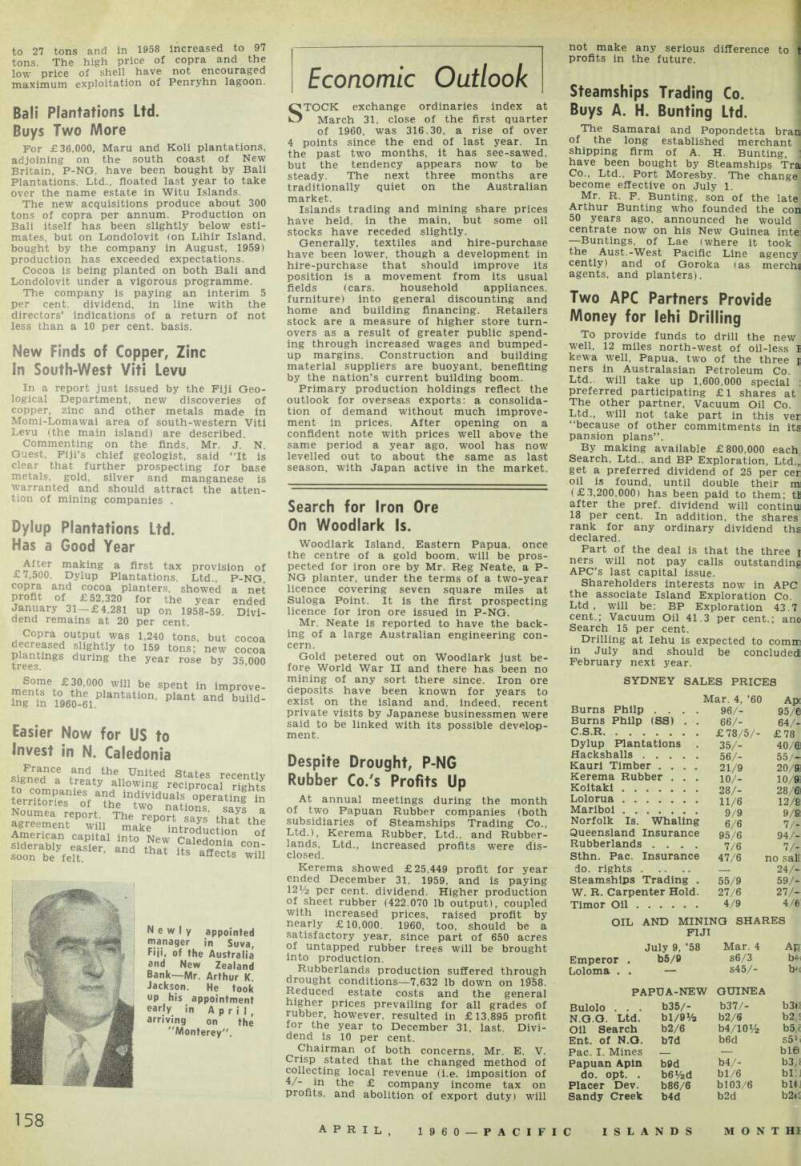
Newly appointed manager in Suva, Fiji, of the Australia and New Zealand Bank—Mr. Arthur K.
Jackson. He took up his appointment early in April, arriving on the
“Monterey".
Sydney Sales Prices
Mar. 4, ’60 Apt Burns Phllp ... 96/- 95/6 Burns Phllp (S3) . . 66/- 64/-
C.S.R
£78/5/- £78 Dylup Plantations , 35/- 40/0 Hackshalls 56/- 55/- Kauri Timber ... 21/9 20/ffl Kerema Rubber . . . 10/- 10/90 Koltakl 28/- 28/0 Lolorua 11/6 12/fi Maribol 9/9 9 /a Norfolk Is. Whaling 6/6 7/- Queensland Insurance 95/6 94/- Rubberlands ... 7/6 7/- Sthn. Pac. Insurance 47/6 no sail do. rights 24/- Steamships Trading . 55/9 59/- W. R. Carpenter Hold. 27/6 27/- Timor Oil 4/9 4/6
Oil And Mining Shares
Fiji
July 9. ’58 Mar. 4 Ap Emperor . b5/W s6/3 b4< Loloma . . — s45/b<<
Papua-New
Guinea
Bulolo . . . b35/> b37/b3«f N.O.O. Ltd. bl/flVa b2/6 b2,i Oil Search b2/6 b4/10V 2 b5,c Ent. of N.Q. b7d b6d sS 1 .
Pac. I. Mines — — bl© Papuan Apln bed b4/b3,i do. opt. . beVad bl/6 bl! J Placer Dev. b86/6 bl03/6 bltJ Sandy Creek b4d b2d b2d