Last Voyage of the 'Wanderer'
pp. 82-83 · Read in the full issue
By Mrs. E. St Julian, in Suva
Captain John Webster, who has been in the news lately because of the visit to the South Pacific of Mr. Alan Lennox-Boyd, was my grandfather. He was with his friend Benjamin Boyd aboard Boyd’s yacht Wanderer when Boyd was killed by the natives of Guadalcanar (which was how grandpa spelt it).
GRANDPA was born in 1818 in Scotland and died as a result of an accident in Auckland in 1912. He was brilliant at school, and aways top in drawing.
He sailed down the Firth of Clyde as a passenger in the barque Portland in August, 1838. Portland was taking immigrants to Australia, and in Australia grandpa did much pioneering work.
In 1839 and 1840 he drove cattle 2,000 miles from Sydney to Adelaide, a journey of great danger at that time. He discovered and named the Edward River.
Tried New Zealand In April, 1841, he sailed for New Zealand to visit his eldest brother, who had started a timber mill at Hokianga, and grandpa helped his brother until the Maori wars broke out m 1845. Then grandpa volunteered to fight under the noted Ngapuhi chief, Tamati Wake Nene, the friend of the English. 4 n, Nen £ s was the first signature to the Treaty of Waitangi. The natives had been much opposed to signing, but Nene addressed them with great eloquence and changed the aspect of things
In 1862 Sir George Grey, Lt.- Governor, on behalf of Queen Victoria, presented a silver and gold jug to Nene as a token of esteem for his loyalty during the Hone Heke wars. In later years this jug was always referred to as a cup.
Unfortunately, the beautiful jug at the time caused great jealousy among the tribes, so Nene presented it to grandpa to keep. He kept it in his lovely home at Opononi, which was always a resort of Governors and distinguished people.
At these times the jug was filled with a good port, and everyone drank to the Queen.
Fired a Salute I remember that grandpa, until he was too old, himself always fired a Royal Salute on the arrival of any vice-regal party. He used a cannon mounted just inside the fence near the front gate, which was on Opononi beach.
My brother, sister and I would spend our Christmas holidays frbm school in these surroundings, and what happy days they were!
After grandpa died, my fatlu looked after that cup until tM Auckland War Memorial Museu: was completed. The family the gave it to the museum for sa;j custody The correct home for it shouj be Waitangi House, but fire always a danger in an old woode building. It was displayed ; Waitangi during Queen Elizabeth visit in 1953.
Many a time I enjoyed cleanin that cup for my dad.
After this Maori war (the of the forties was conducted witi great chivalry) grandpa went t Auckland and acted as agent fl Brown and Campbell, and toward the end of 1849 or early 18£ grandpa went to California, He sailed from the Golden Gatt for the South Seas in June, 182. with his friend Capt. Benjamr Boyd. The voyage extended ovj five months and many of its stirrirj incidents grandpa reproduced in of his beautiful water colours.
The Fatal Trip Capt. Boyd was several years oldb than grandpa, yet they had a gres
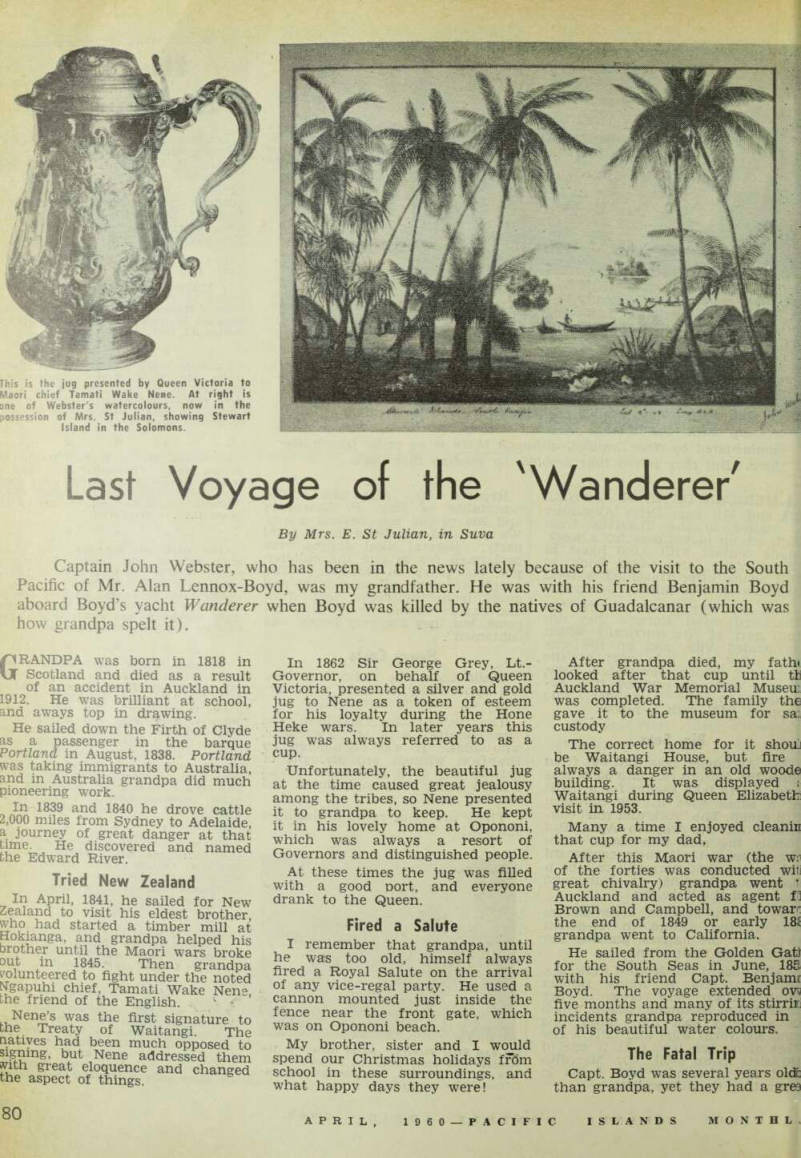
This is the jug presented by Queen Victoria to Maori chief Tamati Wake Nene. At right is one of Webster's watercolours, now in the possession of Mrs. St Julian, showing Stewart Island in the Solomons.
»oect and affection for each er. They arrived in Guadalcanar jut October 12, 1851, and I nember grandpa telling me of ± fateful morning Capt. Boyd up very early to go ashore to cot pigeons.
Grandpa has awakened just as dingy was pulling away from anchored Wanderer. He called to Boyd, who called back and sghed. It seems that they were h excellent shots, but grandpa Jl had more luck and Boyd cited to get even, i was fun that ended in tragedy.
When Capt. Boyd did not return breakfast grandpa became xious and took a search party to ± for him. They discovered proof this having been murdered and ving been dragged into the bush natives. ’There was never any doubt of this grandpa’s mind. He took no ;;ice of the rumours that reached dney later saying that Capt. Boyd 5S still alive and being held by : natives.
No Proof of Cannibalism really do think that grandpa .night his friend had been eaten, I don’t think he had sufficient •of. If he was not certain of .it, wno in the world could be?
Slaving failed to find any trace Capt, Boyd, grandpa reluctantly sail for Australia where, as srybody knows, additional
calamity befell him. The Wanderer was wrecked.
Grandpa published in Sydney in 1858 an account of this disastrous voyage in a small, now rare volume, The Last Cruise of the Wanderer.
I wish a British movie magnate would produce this historical story.
After the Guadalcanar tragedy, grandpa visited the Old Country to see his mother, and in England at the request of Queen Victoria he showed his watercolours to the Queen at Buckingham Palace. From all accounts, Benjamin Boyd had been a great friend of the Royal family. Grandpa also met some of Boyd’s relations.
Grandpa returned to New Zealand in 1855, and engaged in the timber trade on the Hokianga River.
He must have been nearly 40 when he married Emily Russell, daughter of one of the oldest settlers on the river.
She died before I was born and the last two or three years of grandpa’s life were spent next door to my dad’s home in Devonport.
Wonderful Stories
I often played cribbage with him and spent many hours listening to his exciting experiences. I was in my early teens and old enough to appreciate his stories.
The collection of 16 paintings of Wanderer cruise he left to his two eldest sons, George and my dad, John Groom. My sister and I were given the honour of dividing them.
Uncle George never married and he gave his eight to the Auckland museum, three of which were repro duced in PIM in 1957.
I have three of the paintings, two of the Solomons and one of the Wanderer leaving Hawaii. My sister has three also, including the fas cinating picture of the Battle of Guadalcanar.
Grandpa had enjoyed good health all his life and had all his faculties until he died. He slipped and broke his thigh while alighting from a bus right outside our place.
I will always remember him with love and affection.
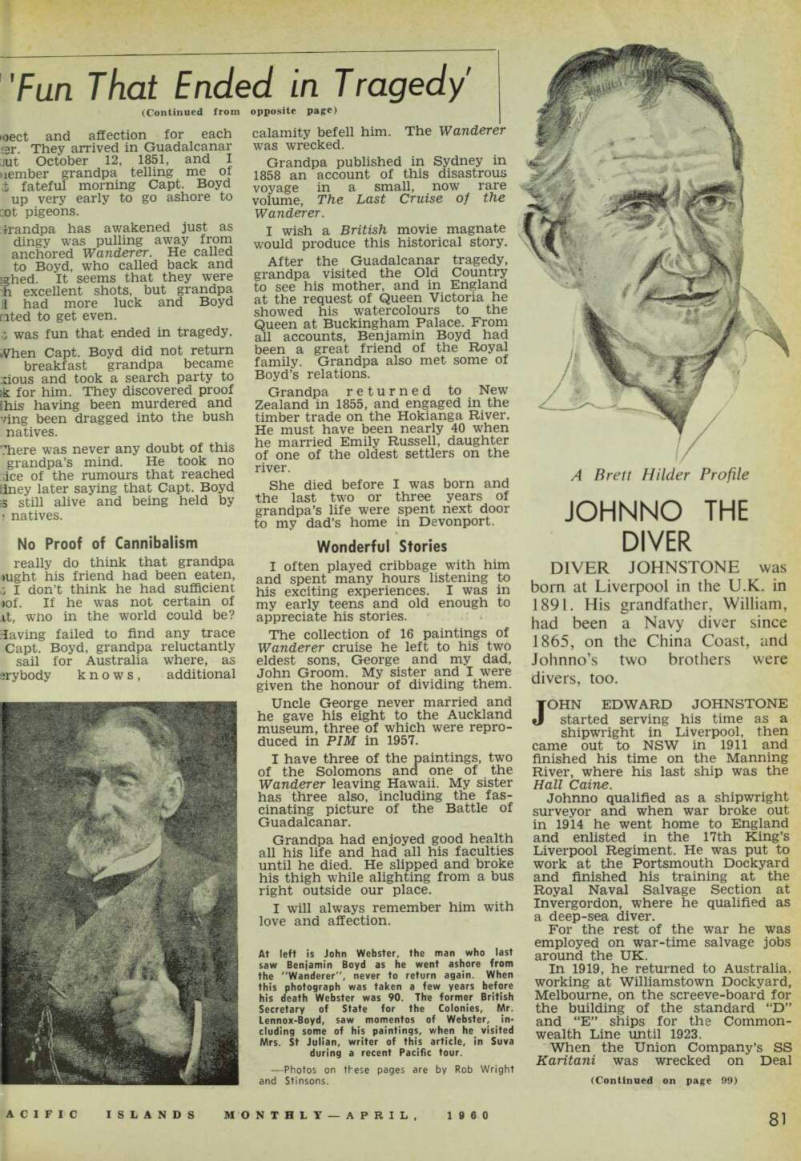
At left is John Webster, the man who last saw Benjamin Boyd as he went ashore from the "Wanderer", never to return again. When this photograph was taken a few years before his death Webster was 90. The former British Secretary of State for the Colonies, Mr.
Lennox-Boyd, saw mementos of Webster, in cluding some of his paintings, when he visited Mrs. St Julian, writer of this article, in Suva during a recent Pacific tour. —Photos on these pages are by Rob Wright and Stinsons.