Sydneysider Goes Walkabout
pp. 67-73 · Read in the full issue


Spain’s The Place To Live
TORREMOLINOS, SPAIN: I hadn’t been here a week before I had built at least seven metaphorical houses, all com bining the best of Spanish and New World architecture, and commanding assorted, excellent views of Mediterranean or mountains, or both.
d ND with me, a subconscious in \ terest in real estate and the local building techniques is a ure and dangerous sign of being :n rapport.
I have never had a yen for a piece f land in England, France, Ger nany or Italy; I’d need consider ate inducement to live for any :;ngth of time in any of them. But can think of worse fates than hav [ig to live on the sunny coast of [pain. And for no particular reason.
The climate is good; but no better ban that of the NSW coast. The tabulous, Mediterranean beaches of he travel brochures are just a joke d an Australian. Some of the habits f the peasantry are a lot more primitive than those of the Stone- Age New Guinea Highlanders.
The people are happy, good latured, good mannered, but in a vay, a lot like Polynesians who have Iheir own occasional and peculiar vays of driving Westerners up the vail. ust About Everybody
Jkes Spain
The lack of social advancement, he poverty of a large proportion of the people, the political system may also be disturbing elements, if 7ou happen to be troubled by such hings.
But taking it all round, I’ve met ’ew people who “didn’t like Spain”; and many, like myself, who would ie happy to stay, find a spot in the ;un, put their feet up and leave the lard work to the donkeys.
But if you can’t build a castle n Spain, you can always rent a villa, and this can be an experience well worth the price of admission.
Villas large ones, all marble doors, sun terraces, tiled swimming
pools, big gardens—come very cheap in Spain in the winter months, but cheap as they are, they still are not as cheap as a good hotel in the same off-season.
It was a better economic proposi tion for our party of three to stay at a local hotel—each with a lavish room, private bathroom and glassed in sun lounge with three meals a day—than it is to hire this villa,
with maid Trinnie; the black beast in the kitchen that masquerades as a stove; and the lavandera who comes each week to do the laundry and eat us out of house and home.
But if we had not made the ex periment, I should never have learned why Spaniards eat lunch at 3 p.m. and dinner at 11 (it takes that long to get it cooked on the equipment provided); I should never have had the experience of wading through the fish-guts and squid at the local market, twice weekly, to buy what’s probably the best sole in the world.
I should never have seen the in side of a Spanish butcher shop, where the strangest looking organs stare you in the face, and where the carcases hang from hooks at eye level and bear a strange, chewed appearance where the butcher hacks tiny bits off here and there to please the whim of the frugal Spanish housewife.
Nor should I have met Antonio, Trinnie’s amigo, who assists the butcher who is a bull-fight fan, and is clued-up on the noble art himself. (Is that where the meat in last night’s stew came from?).
There are, of course, entries on the other side of the ledger.
But the Domestic Cross Is So Heavy Probably if an autopsy were currently performed on your Sydneysider I’d be found to have cocina engraved into one side of my heart; lavandera into the other.
These seem to have been the two heaviest Spanish crosses I’ve had to bear.
The cocina (stove) according to Jose Manuel, who let us this villa, works on the slow combustion prin ciple. It’s slow alright; but of com bustion there is often nil. It con sumes a black substance that Trinnie calls carbon; Jose Manuel
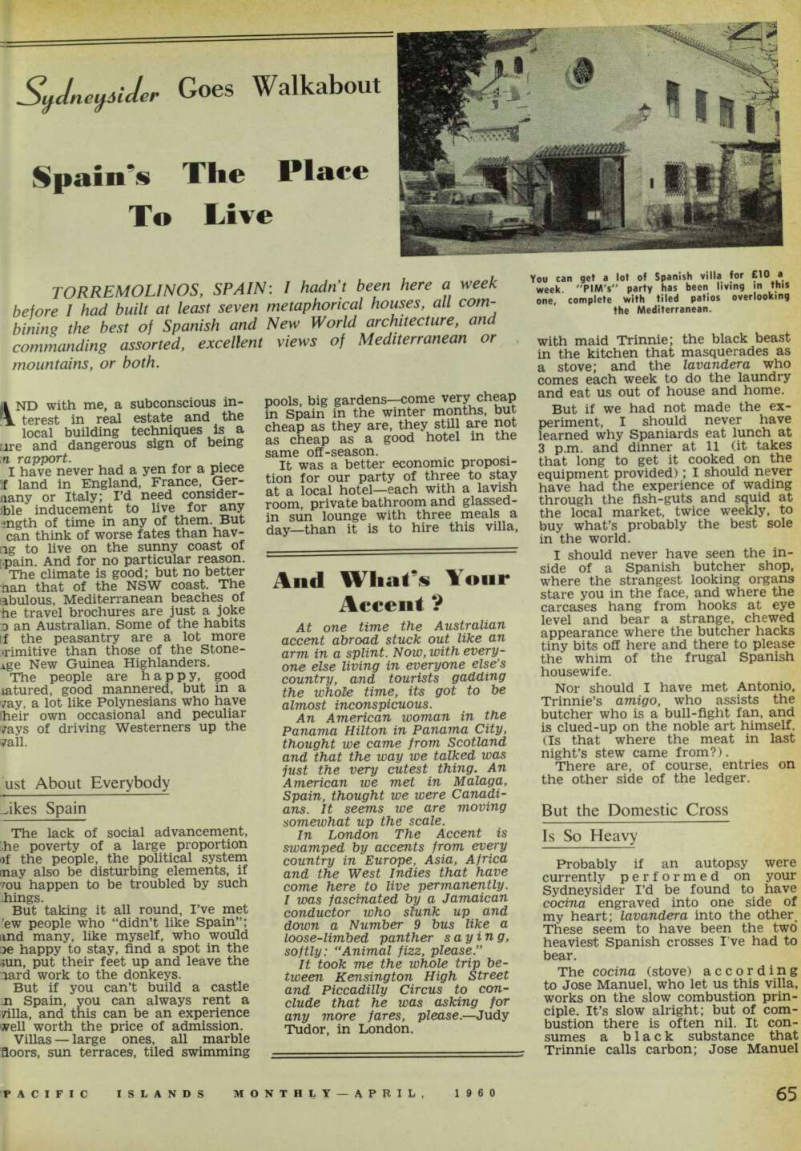
You can get a lot of Spanish villa for £lO a week. "PlM's" party has been living in this one, complete with tiled patios overlooking the Mediterranean.
I;:hracite; and the rest of us some mg a bit more picturesquely Aus- Ilian. It looks like black stone. ’The lavandera is another story. c e is dark, buxom and not bad iking. At first we were told that e would cost “about” 25 pesetas - day and would “eat at your mse”. By the time she had made r appearance, this had been liked up to “50 or 60” pesetas per w , but she certainly eats at our Luse.
On the first day she came around E3O, swooning with hunger. After ting revived with a plate of corn ykes and milk, three slices of toast ;th the trimmings, and a pint of flee, she was able to stagger off ».;o the laundry, clutching the jmdry-basket, two bars of green Sbon, and a big bottle of some :.ing that smells like peroxide and used as a bleach.
Ihy Buxom Wenches xe Buxom *An hour later she was back in the ,:chen, chatting with Trinnie and siting for her lunch (soup, cold =eat, two fried eggs, salad, cake id coffee). She had, we were in xmed decided to soak the clothes sat day; next day she would re irn to spend the whole day with rinse the clothes and hang them [Not on our sacred oath she auldn’t! Even an Australian worm 11 turn. But it took three phrase ioks, a dictionary and the com ned Anglo-Spanish efforts of Jose sanuel and Yours Truly before we it the idea across that 50 pesetas :irth of washing required no more an four hours’ labour, plus one reakfast and one lunch. No more, i) less But we still have to restock the mtry, after each week’s visitation.
When it comes to woman power irsus the machine, I’m all for the Itter. My own modest washing ;achine in Sydney will accomplish iree times more than any Spanish ivandera, six times faster and 10 mes more efficiently. What’s more, doesn’t eat breakfast or lunch; asn’t got a donkey or a pig for horn we must keep the pea shells id potato skins; nor a family that saved from the brink of starva :on only by our bread scraps and .eat from the soup pot. ot a Country For
ophisticates
The Spanish do their own sorts ; things very well; it is when they y to follow the footsteps of more iphisticated countries that the re fits are unexpected and frequently ightful. In no department is this iore so than in their cooking. It as the standard fare at tourist
hotels that finally drove us to villa life. . The fish that comes out of the sea hereabouts is excellent, yet it is frequently served fried to a dry crisp. The markets and shops are full of fruit and vegetables, but what happens to the vegetables thereafter is a mystery. Perhaps they are considered fit only for peasants; certainly they rarely appear on tourist hotel menus, which have a deadly monotony that you can soon learn off by heart like a litany: (1) Soup or hors d’oeuvres; (2) Fish —good, indifferent or terrible, according to the luck of the game and the temperament of the chef, with octopus easily avoided if you are so minded (it looks like onion
rings, fried in batter); (3) the mam course of either thin pieces of fried meat and chip potatoes: or baby lamb and ditto; (4) a despondent piece of fruit-filled pastry optimistic ally called a flan; or a piece of fruit. (You take the fruit).
The baby lamb needs a chapter to itself; this animal presumably having been delivered by Caesarian section, two months premature. A leg is as large as a normal lamb chop; and the forequarters, from which we take our chops, like some thing you’ve ripped out of a book of matches. This dish is regarded as a national delicacy, yet at each of my encounters with it, I felt as guilty as though surprised in some indecent act of cannibalism.
It takes four waiters to serve this
sal. The headwaiter, who kiwws me of the key words in English, /write it down; No. 2 who carries * order to the kitchen; No. 3 to sch it out and leave it on a serv •; table to freeze; and, finally, No. who will, at some stage, shift it to your icy cold plate.
The things a Spaniard can do to flee are bad, but what he can do tea is terrible. Served in glasses [±h lemon (Madrid), or in big cups ;bh goats’ milk (around the ncante coast), it is invariably a old, amber liquid that might have «n produced by soaking a bale of /y in an irrigation ditch. -But vino is cheap and good, uere’s a thin red wine from the irth; or the sweet muscatel of alaga that was famous even in se days of the Moors; or, from Tez, the famous sherry, dry, □dium or sweet, to please all Hates. ne Mediterranean Is
Busy Place
■ k But man doesn’t live by bread and no alone. Past our door, along )th the lateen-sailed fishing boats id the diesel-powered trawlers orking out of Malaga, pass the tips of the world making for or ming from the Strait of Gibraltar; & O and Orient liners; Mr. ciassis’ giant tankers; warships; merican, Italian, Greek and oanish passenger ships cruising □se inshore to give their customers iclose look at Spain. lOverhead occasionally screams a ;»sse of three American jets from >eir base further up the coast; or trainee from the Spanish base a w miles away doing his bumps and □ps. [lnland are the ancient mountain iwns like Cordoba, Honda and ranada, where Moor built on □man remains and Spanish over •e top of both. Or Sevilla, with its mares decorated with orange trees nd its magnificent cathedral en >wed with all the wealth of the 3W World when Spain was at the ;ak of its power. [Nearer at home, within half an our’s ride are the hill villages, addled together, whitewashed, aversed by streets a few feet wide, tat haven’t changed in centuries iid look as though they never will. ustralian Gums Greet
Spanish Spring
After the spring rains the whole »untry looks as though a million vanderas have been at work, reen crops and pasture spread ght up the valleys where two onths ago it was brown and nrren. The land round the olive ees has been freshly ploughed; the aves are unfurling on the figs and
late oranges are being harvested from laden groves The snow is melting on the ranges bevond and the dry river beds of a few weeks ago are running bankers, the Australian gum trees that line their banks are standing up to their ankles in water.
The sun is warm, and down on the beaches the tourists are breaking out their Bikinis and acquiring their first sunburn.
We pack a basket and take to the hills, squeezing through the villages like a royal procession, bowing and
waving to the women sitting work ing at their embroidery m the door ways; taking pictures of the donkey men who laughingly point to their patched pants and say they have better ones at home, Just off the road, under the olive trees, we make our picnic and are usually left in magnificent silence and solitude but occasionally a couple of young goat-herders will appear to share our lunch and to watch the traditional boiling of the billy. They howl with laughter when we come to the time when you sink
Life appears fairly untroubled in Spain apart from the black beast of a kitchen stove which "Sydneysider" complains about.
But on a broader canvas the situa tion is not quite so light-hearted.
R. W. Robson looks at world poli tics in the accompanying article.
?e tea leaves” by bashing the side the billy with its lid, or a stick. r )W crazy can an Inglesi get?
Into this Spanish idyll came a ♦Lef, unscheduled visit to London. is getting on towards spring there, o. Purple, white, pink and yellow ocus poke their heads up above Ee grass in the parks. Daffodils oom in window boxes, and with lips and iris (at a bob a piece), >t in the flower stalls. The shops eb full of spring fashions. But from sere on in, it’s patchy. /Within five minutes of arrival I is put sharply back in place. No, adam, it was impossible to get a itch cleaned in less than three *eks. No madam, it didn’t matter nere I was going in a week—it is just impossible to get it done :oner in this country—everything ;ok time, since they were so beaten t during the war! imdon Again—Where There Still a War On Observing— but strictly to myself Ithat they were probably still suf iring the after-effects of Water ;d, too, I bought myself a small j- worth of alarm clock to see ;e over the time till England re vers from her war disabilities. [For reasons of expediency I took er a young relative’s flatlet in W 8 nd this was my first experience of Bus-and-Bed-Sitting-Room Lon on.
'This area is populated partly by ’erseas students and lower-income racket tourists but mostly by de iched or semi-detached English imales of advancing years who tend their time feeding sixpences to meters in order to dry their Dollies on clothes-horses in front of te gas fire; or shoving four pennies to the telephone in the hall, press g button A, and having fascinating mversations, in high-nosed voices lat rattle the light fixtures, with iseen audiences all the way be tween W 1 and NWI2.
As a diversion to both pastimes, icy take matched pairs of poodles •r walks on leashes in order that ie poodles can relieve themselves i the pavements.
The statistics that say that there *e a few million surplus women in iritain surely don’t lie.