Of Bipi
pp. 51-54 · Read in the full issue

Host, The Seulpfor Of Bipi
KOSI, the sculptor, lives on Bipi Island, off the western *nd of Manus, New Guinea, where he is the leader of a native school of wood-carving.
lIS work, and that of his pupils, takes most of the prizes for carving at the annual show at Esngau, the district Administrative ire of Manus. Bipi Island is also wn as Sisi Liu. i;osi’s work shows a natural blend originality and ancient tradition, it of some of the other carvers ;w strong influences from the
nan Catholic Mission, especially
sards Christmas time. ’osi was born about 1910, the son : ?apoi, and his brother Kawas is present Luluai at Bipi. Kosi rried Siwa, and had two sons, s first was killed as a boy by Japanese, while the second is ;wn-up and married. As a young Kosi learnt the craft and lore woodcarving from the old master mahoun, who died about 1920, er handing on the traditions of craft.
Business Manager
have not been able to get any ormation about ancient or even pieces of carving; the specimens iave seen have all been done in last five years.
"he wood used for carving has in either coastal callophyllum or harder kwila. The former has idish and creamy tints while the ,:er is more like teak, of a khaki our and with carving qualities aewhere between cast iron and ;ive wrought iron. It also stains
the hands brown, which does not matter to Melanesians, when I first met Kosi, a couple 0 f years ago, he was accompanied by friend Daikai, who acted as his business manager. Daikai is now sai( j to he working in Rabaul, where he is probably managing some white master’s home with great effici ency f ro m behind the scenes. He (Over)
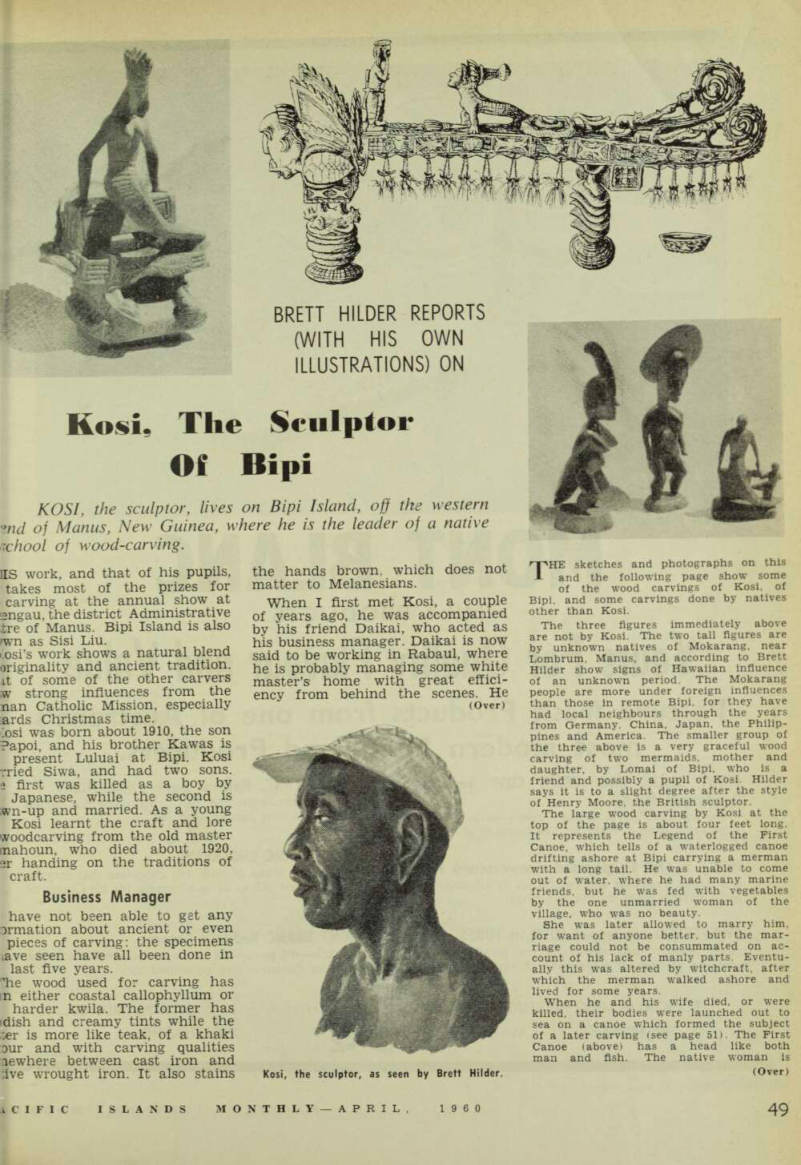
THE sketches and photographs on this and the following page show some of the wood carvings of Kosi. of Bipi. and some carvings done by natives other than Kosi.
The three figures immediately above are not by Kosi. The two tall figures are by unknown natives of Mokarang, near Lombrum, Manus, and according to Brett Hilder show signs of Hawaiian influence of an unknown period. The Mokarang people are more under foreign influences than those in remote Bipi, for they have had local neighbours through the years from Germany. China, Japan, the Philip pines and America. The smaller group of the three above is a very graceful wood carving of two mermaids, mother and daughter, by Lomai of Bipi, who is a friend and possibly a pupil of Kosi. Hilder says it is to a slight degree after the style of Henry Moore, the British sculptor.
The large wood carving by Kosi at the top of the page is about four feet long.
It represents the Legend of the First Canoe, which tells of a waterlogged canoe drifting ashore at Bipi carrying a merman with a long tail. He was unable to come out of water, where he had many marine friends, but he was fed with vegetables by the one unmarried woman of the village, who was no beauty.
She was later allowed to marry him, for want of anyone better, but the mar riage could not be consummated on ac count of his lack of manly parts. Eventu ally this was altered by witchcraft, after which the merman walked ashore and lived for some years.
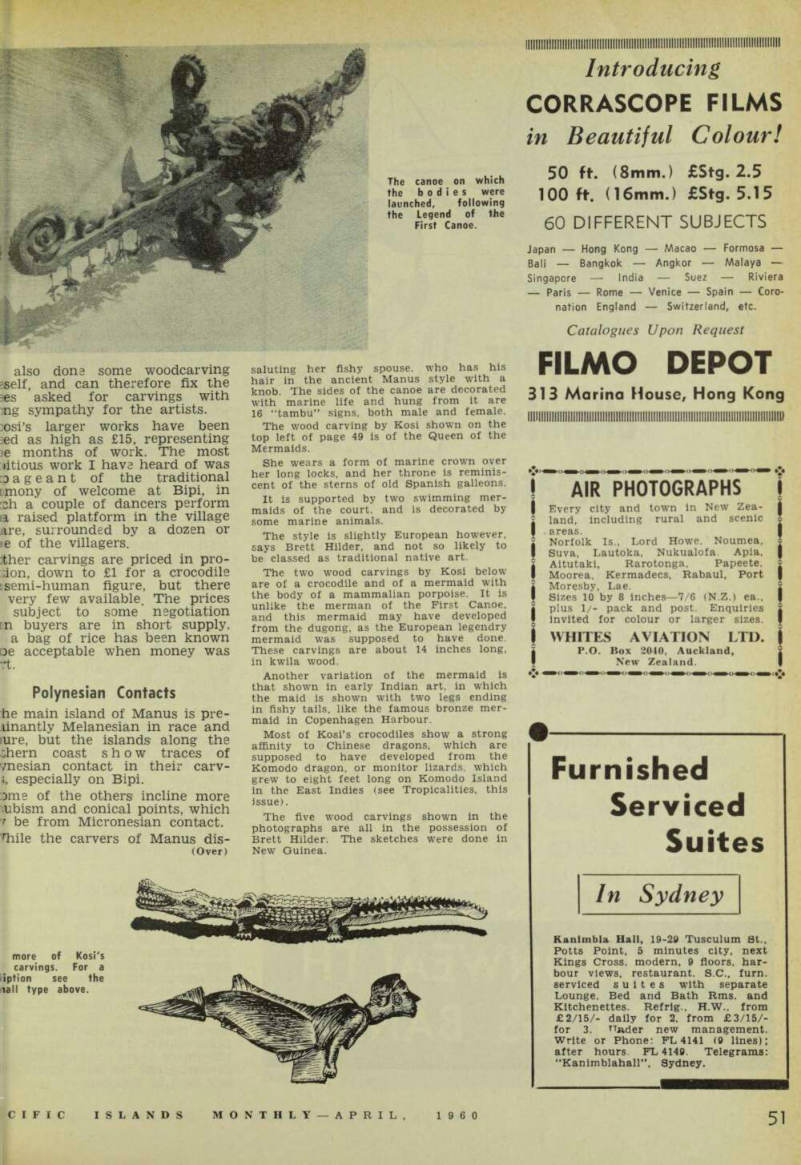
When he and his wife died, or were killed, their bodies were launched out to sea on a canoe which formed the subject of a later carving (see page 51). The First Canoe (above) has a head like both man and fish. The native woman is (Over)
Brett Hilder Reports
(With His Own
Illustrations) On
Kosi, the sculptor, as seen by Brett Hilder.
also done some woodcarving self, and can therefore fix the es asked for carvings with ng sympathy for the artists, xjsi’s larger works have been =ed as high as £l5, representing )e months of work. The most utious work I have heard of was [pageant of the traditional tmony of welcome at Bipi, in :eh a couple of dancers perform a raised platform in the village are, surrounded by a dozen or >e of the villagers. :ther carvings are priced in pro don, down to £1 for a crocodile s semi-human figure, but there very few available. The prices subject to some negotiation tn buyers are in short supply, a bag of rice has been known □e acceptable when money was ~t.
Polynesian Contacts
he main island of Manus is pre jiinantly Melanesian in race and lure, but the islands along the ihern coast show traces of ynesian contact in their carv especially on Bipi. ;pme of the others incline more cubism and conical points, which 'r be from Micronesian contact, fiiile the carvers of Manus dis (Over)
saluting her fishy spouse, who has his hair in the ancient Manus style with a knob. The sides of the canoe are decorated with marine life and hung from it are 16 “tambu” signs, both male and female.
The wood carving by Kosi shown on the top left of page 49 is of the Queen of the Mermaids.
She wears a form of marine crown over her long locks, and her throne is reminis cent of the sterns of old Spanish galleons.
It is supported by two swimming mer maids of the court, and is decorated by some marine animals.
The style is slightly European however, says Brett Hilder, and not so likely to be classed as traditional native art.
The two wood carvings by Kosi below are of a crocodile and of a mermaid with the body of a mammalian porpoise. It is unlike the merman of the First Canoe, and this mermaid may have developed from the dugong, as the European legendry mermaid was supposed to have done.
These carvings are about 14 inches long, in kwila wood.
Another variation of the mermaid is that shown in early Indian art, in which the maid is shown with two legs ending in fishy tails, like the famous bronze mer maid in Copenhagen Harbour.
Most of Kosi’s crocodiles show a strong affinity to Chinese dragons, which are supposed to have developed from the Komodo dragon, or monitor lizards, which grew to eight feet long on Komodo Island in the East Indies (see Tropicalities, this issue).
The five wood carvings shown in the photographs are all in the possession of Brett Hilder. The sketches were done in New Guinea.
The canoe on which the bodies were launched, following the Legend of the First Canoe.
more of Kosi's carvings. For a [?]iption see the [?]all type above.
trict cannot rival the Malagj carvers of New Ireland, nor the oi pouring of art from the Sepik Rr district, they do appear to sh more freedom and originality. T may lead to their undoing, if tl absorb too much from Europe sources, and lose their nat traditions'.
If we describe art as the mir of social culture, we must remem that mirrors can play some trie As the native artists become m sophisticated, the sated artists our civilisation have jumped bi to the “primitif” style of art, better express the basic forces life.
Indeed it is this pre-occupat with cruder styles which has p duced the present world-wide terest in native forms of art, hi ever crude they may appear to If we could understand the u which produces the great volume art in the Sepik, compared with absence of art in some distr nearby, we might be able to unc stand more about the human anir For he is the only species, aj from a few Bower birds, y spends so much energy on art.
Story of a Drift?
The Bipi legend of the F Canoe, as shown by two of the il. trations, may be the story o< Polynesian survivor in a large ca which drifted to Bipi in the I ago.
The story that he was unable leave the water because he hadi legs to walk on, may have cove up the fact that he was too af: to walk ashore. The spiral end! the canoes reveal a Polyne;: source, possibly from the Trobrii Islands, away to the south-east..
The canoe with the twin t suggests the larger double hu canoes of central Polynesia, w; the blunt bow might have an from the canoe being broken ot the bow, or at least ha v: lost its ornamental prow.
In any case, the legend appe to be the most important in mythology of Bipi Island, and i deserves to be recorded.