‘Australia Should Help
p. 43 · Read in the full issue
An Australian's Plea to Australians
‘Australia Should Help Fiji Out Of Trouble ’
Australia should take a larger interest in Fijian affairs, Rev. L. D. ullerton of Suva, told a large theatre and radio audience in Sydney March Australia should, he said, be prepared to give Fiji d to help the Colony follow the terms of the Bums Report. Australia mid give Fiji an interest free loan. Mr. Fullerton is Chairman of the Vi-lndian District of the Methodist Mission in Fiji, and has been a the Colony 17 He is an Australian and while on leave in \ustralia in the last few months has been doing a good job in making mstralians more aware of the problems of Fiji.
his Australian broadcast in March, Mr. Fullerton said that vhat happened in Fiji was of tiiderable interest to Australia, ne Burns Report had been a re i.ic appraisal of the Colony’s ire, and fostered no false optim- It faced frankly the possibility growing unemployment in Fiji a decline in the standard of ig. Fiji’s problems were serious, iviting Australians to take a =er and intelligent interest in an affairs, he said Australia, as irew in stature as a nation, had accept responsibility to extend ilping hand to the little countries •:by, and Australia’s associations i Fiji and many other Pacific fitories had anyhow been close.
“Don't Forget Fiji"
r:t would be a pity if Fiji’s needs is forgotten because of the claims 3ig needy neighbours, in whose □lems we have rightly become [rested,” he said, t is nothing short of amazing the British taxpayer, even e the war, has contributed so h financially to the welfare of ittle British Colony like Fiji. =ely the whole conception of the omonwealth means that Aus la can take some of the respon lity that England has shouldered, IFiji, too, moves onto her own lonhood.” ;e said there must also be busi es men in Australia who were pared to take the risk of invest money in Fiji, not in the ex tation of getting high profits but ;a contribution to the develop ;it of the community in return reasonable profits.
Ir. Fullerton made these points: In the Suva riots of December re was no evidence of deep bed anti-European or racial feel , although the riots did show an ii-European flavour. The rioting lid not be blamed on agitators— 7as an expression of an economy it was badly out of gear. Too ny people were compelled to live
on a wage that was “woefully in adequate”. • The Burns Report put the aver age income of Fiji at £F7O per per son a year, and it had shown no increase over the last 10 years. Aus tralia’s national income on the other hand averaged £5OO per head. • As a minister, he had continu ally marvelled at the patience of his people in making ends meet, but in the last couple of years he had felt their patience was wearing thin.
There had been a continual rumble of complaint about the apparent in justice of the European wage scale being so much higher. • The dilemma that faced Fiji was that at the present stage of development the economy could not stand significant wage increases. • The winds that blew over the rest of the world blew over Fiji too. What was happening in many of the underdeveloped countries of the world was “intoxicating news” for the Fijians. • There was a great surge forward in education in Fiji at pre sent and a surprising number of
students were also leaving Fiji for overseas study. • More potential leaders were coming to light in all racial groups, and amongst the Fijians leadership in the future would be more and more determined by ability rather than rank.
Speaking of race relationships, Mr.
Fullerton said that, everything con sidered, the different grpups got on remarkably well, but Fiji was not at the moment an integrated com munity. There were far too many “coconut curtains” separating the people.
“We could have real racial tension in Fiji. I do not personally expect serious racial bitterness. It is more likely, I believe, that our different racial groups will be a source of strength in our future development,” said Mr. Fullerton. “The Christian church has no more urgent task than to exercise the ministry of re conciliation”.
Mr. Fullerton said Australians got on well with other people but to him it was a tragedy that the Australian immigration policy did not reflect this. In the eyes of the non-European world, her immigra tion laws discriminated against a man purely because he was not white.
“It is salutary for us to remember that many Asian and Pacific people link Australia with South Africa in their minds. Our immigration policy to them is a policy of apartheid. It is time that there was a far stronger Christian conscience about this issue.
I have heard no defence of our im migration policy that is not basically selfish.”
He advocated a quota system to allow non-Europeans to enter Aus tralia.
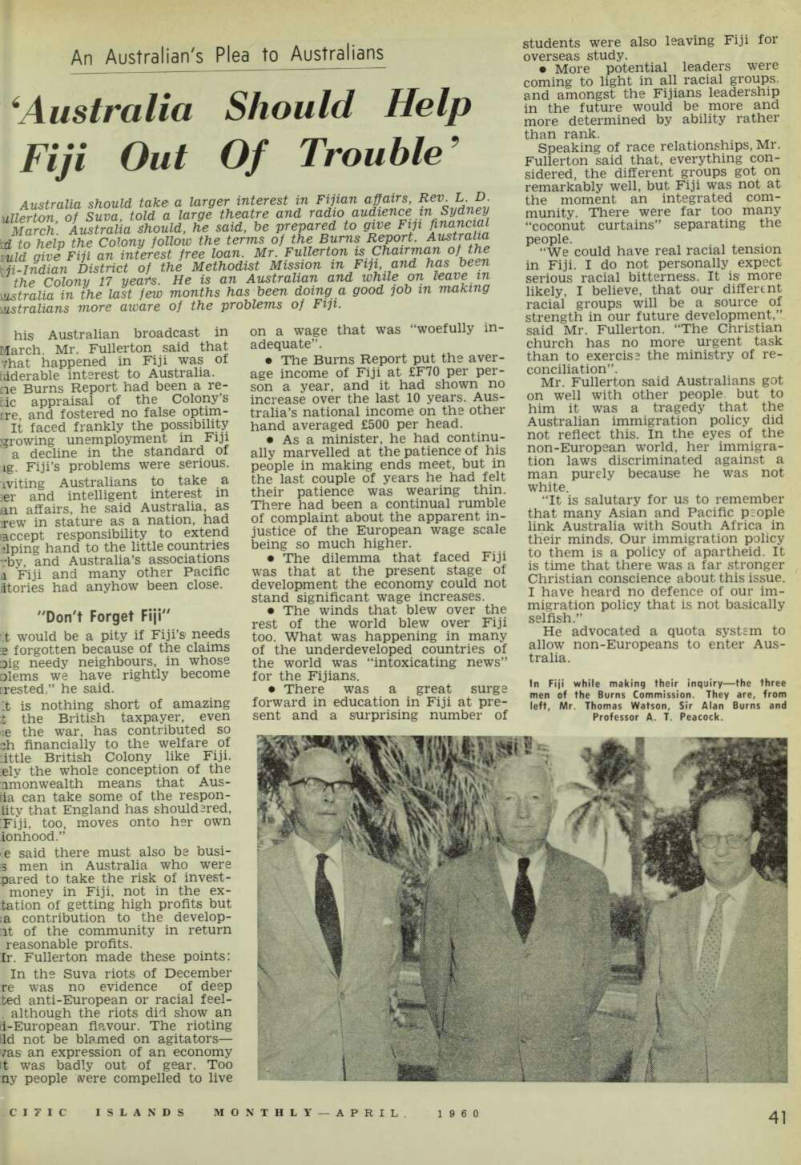
In Fiji while making their inquiry—the three men of the Burns Commission. They are, from left, Mr. Thomas Watson, Sir Alan Burns and Professor A. T. Peacock.