Cpmentary
pp. 27-28 · Read in the full issue
o Alternative To Burns an But Chaos
Unless the four communities of Fiji Indians, Fijians, uropeans and Chinese, in their order of numerical importance ■ face up to their major problems (too many people in relation non-usage of available land ) and deal with them competently, sey could meet economic and political disaster within 10 years.
IE Report of the Burns Com mission, published in mid- March, described the Colony’s Jtion fairly and impartially, and nes for the communities a plan [hich they can cope with it. If do not adopt the plan, and •; it work, they will have only i.selves to thank for whatever ortunes come upon them, jere appears to be no alternative lie plan, except chaos. Nonethe it is in some ways bitter )cine for the people of Fiji. )e Colony’s troubles have been >-ed by three major factors; and oresent generation of Fiji people not responsible for any of them, factors are — i The peculiar systems of land :;rship (especially the mataqaU im) through which too much has been held unavailable for i The phenomenal growth of Introduced Indian community.
The failure of British Colonial le (either its head office or its personnel—no one knows) to ;jnise the seriousness of the de oing problems and to deal with ,i firmly and effectively.
Appeal for Fijians' Help
ne Burns Report is late. We can hope it is not too late. It is [product of highly-skilled men, ;e logical—and ruthless—con :ons are based not only on a □ugh scientific examination of facts and on lengthy experience denial problems, but also on an :,rently sincere wish to apply necessarily drastic remedies a minimum of injustice and I ship. hether we like it or not, there among the Report’s recom dations certain proposals which of the Fijian native people a ;jure of discipline and sacrifice :h is not asked of the other :ons. something like the Burns Re had been made and acted upon ears ago Fiji would not now be d with its present embarrass
ments. The same remedies probably would have been called for in 1940 as in 1960; but there then would not have been the same unbalance of population, and the essential re forms might have been introduced more slowly and painlessly.
Now, because population unbal ance and the system of land ownership have created peculiar economic and social troubles which are rapidly worsening, there is need for a degree of haste in the re adjustment of the Fijians’ social and economic structure that will — quite naturally—be sharply resented by the Fijian native people.
Nonetheless, the Fijians’ funda mental land rights and privileges are carefully guarded and preserved in this plan. The new proposed pressures upon the Fijians are mostly social in character, and are designed mainly to hasten the pro cesses of change from a communal to an individualist system. Those changes are coming, anyway—noth ing can stop them.
It is in the Colony’s interest that the changes be shaped, guided and controlled. In this, it is vital that the Government has the goodwill and co-operation of the Fijians'’ leaders.
And part of the changes that are upon us lies in the fact that the native leaders of the future are not necessarily the chiefs.
Plan Cannot Be Altered Much The Burns Report had been care fully constructed, designed to Secure a certain result. Any extensive modi fication of it will almost certainly distort its structure and destroy its effectiveness.
The gravest threats to it will, of course, come from ignorance (so many people cannot see the wood for the trees); from inexperience (the Fijian problem must be ex amined against a wide background of colonial history, which naturally is lacking in Fiji); and selfishness (for all sorts of people who think their private pockets and petty privileges will be threatened will
fight against the plan, irrespective of who ultimately gets hurt, so long as they escape).
The plan means sacrifice in some directions, hard work generally. If it is not accepted, the outlook will be dismal. If it is accepted, two or three years must elapse before its effects will be felt. But it could open the way to the kind of com fortable, happy country that Fiji should be, with its rich natural re sources, and the good classes of people provided by its diverse com munities.
The Next Steps The plan can—and should be— implemented by a wise and strong Governor, assisted by the type of first-c lass administrative official that is provided—though not always —by the British Colonial Office. But they will have no enviable task. . .
As this writer sees it, the following will be the steps to be taken: 1. The fullest possible discussion of the plan by the Legislative Council —with the Governor laying stress 1 upon the urgency of the situa tion, and the fact that the main structure of the plan cannot be altered. 2. Special measures to explain to the Fijian native people why it is necessary to make these changes in the administration of native affairs and in the supervision of the Fijian lands system—with emphasis on the facts that the Fijians’ fundamental land rights are being strictly guarded and preserved, and that it is land usage and not land ownership that is under review. 3. Streamlining of local govern ment and revision of native lands control to be undertaken within the shortest possible time. 4. The creation of a Natural Re sources Council and the appoint ment of a top-ranking Development Commissioner at the earlest practic able moment, so that there may be effective co-ordination of the scores of activities—administrative, political, economic, industrial, edu cational, social —which must be en couraged and stimulated if the plan is to be implemented.
Streamlining
Through that Council the Gov ernor may secure the benefit of the experience, skill and influence of the leading men of the non-official classes of all races which, in cidentally, he must have, if the plan is to succeed.
There is little doubt that a section of Fiji public opinion will demand, as an alternative to the Burns Re port, that Fiji shall thrust aside as much as possible of Colonial Office control, and be allowed to fight its own way out of the entanglements which now threaten to smother it.
It is significant that the Burns
Report leaves that angle severely alone.
If Fiii had only one or two com munities there might have been something to be said in favour of thatidea But under present con ditions it is impossible.
It would mean a supreme Parlia ment of some kind, elected on a common roll almost certainly a place of loud demagoguery, of racial antagonisms, a policy of Have-Nots against Haves. Heaven save Fiji from such a fate!
The job can be done in a peaceful and just way, at this stage of Fiji’s social growth, only under the pre sent system of government— always provided that the British Colonial Office can produce men wise and skilful enough to do it.—RWR. ☆ ■ ☆ ☆
Charity Should Begin
At Home
r ERE have been some recent sug gestions, reported elsewhere in this issue, that the Colombo Plan aid scheme should be extended to some other territories, including Fiji and New Guinea.
Whether or not that kind of aid need or even could be extended und r the Colombo Plan doesn’t matter—the point is that Australia should be spending some of the millions of that Plan on those just as needy, requiring just as much goodwill, a little closer to her own doors. • Fiji is as much Australia’s re sponsibility as Britain’s, and now is the right time to extend her a helping hand when she most needs it. • Up to the end of last year, £4 million had been spent on the education of Asian students at Aus tralian schools and universities, yet while that money is being spent there are in New Guinea a group of people who should benefit from some type of Commonwealth-sponsored education scheme but don’t. These
are the mixed race —the Euronesians —who are forgotten.
There have been all sorts of promises made to do something for the Euronesians, but nothing happens, and meanwhile their wages are low and they cannot yet obtain Australian naturalisation.
What are the feelings of the hard working, loyal, presentable and capable members of this race when they hear that Australia has poured £4 million into the secondary educa tion of Asian people who are not even Australian protected citizens as they are?
One of their spokesmen, Mr. Harry Spanner, puts it surprisingly mildly when he says, “We think that
charity should begin as clos home as possible”.
It certainly should. ☆ ☆ il
The Dilemma Over
Netherlands N. Gume
THERE can be no doubt following the Hollandia coi ence (see p. 19) that the E have meant it when they hinted in the past that they going to push Netherlands Guinea towards self-governmei fast as they possibly can. Ps New Guinea has not been nean anxious to proceed with any se and now the dilemma which the; tralian territory is to find hi. in is becoming obvious to evei casual observer.
What will happen as the; halves of New Guinea prc towards self-government at a so much out of step that it is a', ludicrous? Certainly it can bes the Dutch are planning to pro far too swiftly. But it can aI:J said that political progress Papua-New Guinea is far too and that is where the trouble lie. P-NG can help itself by li ling the recomposition of its II lative Council in a bold fashioi the end of this year.
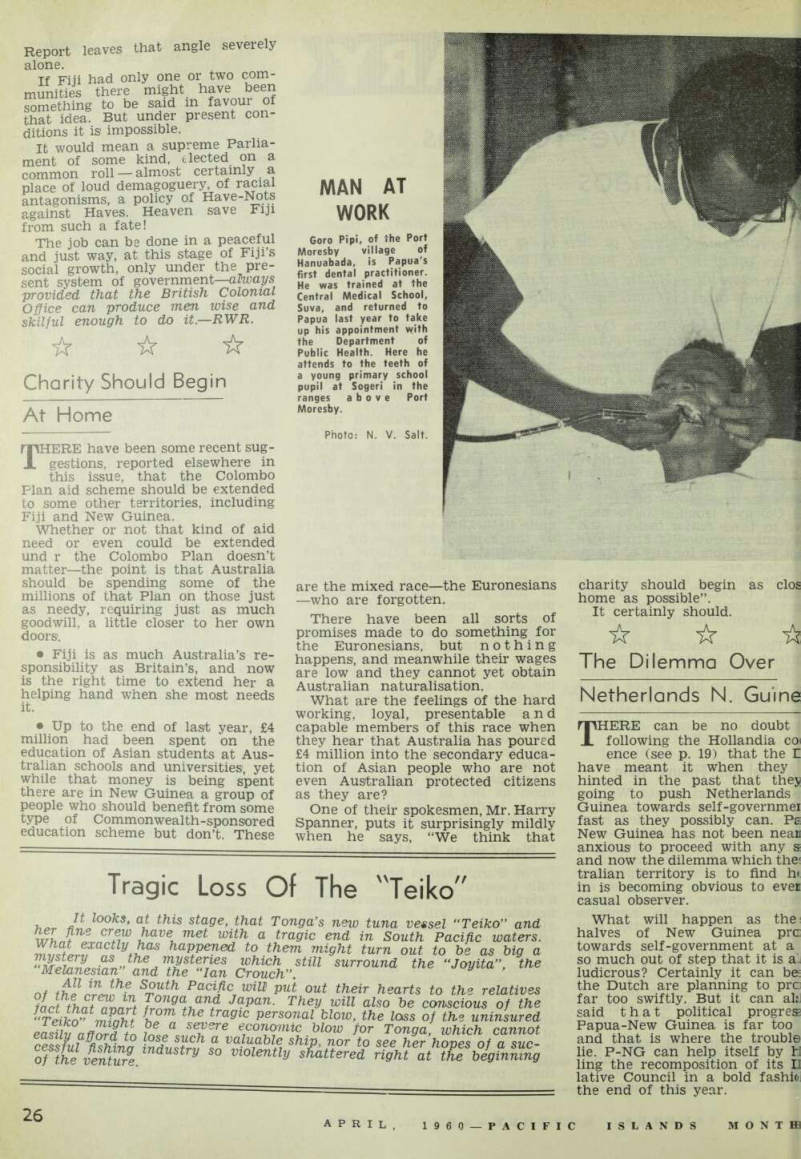
Man At
Work
Goro Pipi, of the Port Moresby village of Hanuabada, is Papua's first dental practitioner.
He was trained at the Central Medical School, Suva, and returned to Papua last year to take up his appointment with the Department of Public Health. Here he attends to the teeth of a young primary school pupil at Sogeri in the ranges above Port Moresby.
Photo: N. V. Salt.