Important Fiji Administration And Land Reforms
pp. 23-33 · Read in the full issue
Will Clear The Way For Progress
If this had been war-time, and Fiji had been an infantry company, and Sir Alan Burns, GCAAG, had been the sergeant* and if this had been an address to a gathering of confused troops instead of the extremely courteous language of an II Report, this I think is about what Sergeant-major Burns would have said to the harassed Fiji company: f'Yes you've gone and got yourselves into a lovely mess. You've been sitting around in the sun and scratching your v, instead of facing up to your problems and doing the obvious things. You've got all the remedies in your own hands ,we got no new weapons for you. I can only tell you what to do. And what you've got to do is pull up your bloody and dig and do a bit of thinking and then dig some more. You've got all you need here, but you've got to work, and use your brains, and learn how to use what you've got. >He might have added some pungent remarks on the failure of the company's past leadership; but, being a wise and set sergeant-major, he probably would not. That is my summary of the long-awaited Burns Report. In other words, no is called for. If Fiji wants to get itself out of trouble, it must think more clearly, plan more efficiently and work.
From R. W. Robson, Publisher of the “Pacific Islands Monthly”
LONDON, March 22 The Burns Report is a thoroughly practical, down-to rth diagnosis of the Colony’s embarrassments and a blue int of the measures to be taken to meet and surmount them.
EE Report makes it clear that ihe whole policy and plan of iidministration and development to be changed in the light of zs since the Cession of 1874 — is which are racial, economic >.ch of what now is recommended Id have been done long ago.
Report is brutally candid, in sis, about the failure of the Fiji eminent (in other words, the =sh Colonial Office operating ugh its local Governors) to deal changing conditions. . the fundamental question of Iher Fiji’s resources are suf nt to provide Fiji’s population ne next 50 years with a good Hard of living, the Report is definite. Fiji’s resources, pro • handled, are sufficient. It is :ed out that Jamaica is com :ble in most respects with Fiji, Jamaica supports li millions, gainst Fiji’s estimated 375,000. it. if Fiji is to effectively feed care for its rapidly growing llation, the Administration must markedly in certain ►tions —in purpose, shape, char ■ and capacity. Land must be e available—and the land must fficiently used.
The Whole Plan ie Burns Report pulls no Ihes. Actually, it says little that ally new to us—but what it does ; to say, in one comprehensive, ;ess, logical summary, what ns of people have been saying hundred different ways in the itwo or three decades, se Commissioners believe and ;st certainly they are right— if their recommendations are ied as part of a complete plan, the whole plan implemented,
Fiji need have little to fear in the future: but they strongly and urgently warn the Government against accepting some of the recom mendations, and rejecting others.
There are two very important matters which the Report quite pointedly refuses to deal with. One is the capacity of the Fiji Govern ment, under the existing system, to carry out the blue-print of admin istrative reform and development set out in this Report. The other is the future relationship between the two largest communities in Fiji.
I refer to these matters in a special commentary on p. 25.
Where the Problem Lies
This part of the introduction to the Report, showing the why and the how of it, is worth quoting in full: We have approached the task of mak ing recommendations designed to overcome the obstacles to the economic development of the Colony with the view of maintain ing the present living standards in the Colony and, if possible, improving them.
That we have been led to recommend many changes in policy will be clear from this list of obstacles: The rapid rate of population growth.
The unequal distribution of land.
The existing dual administration—Central Government and Fijian Administration — which, among other things, results in a heavy financial burden on the com munity.
The policy of the Fijian Administration, which preserves the communal organisa tion of the Fijian people and retards their progress.
Government extravagance in the past which has resulted in liquidating financial reserves, and in the failure of the public to realise that government services cost money.
The development of social services to the neglect of important economic services such as communications.
The lack of an agricultural policy designed to suit the economic potentialities of the Colony.
The policy of perfectionism, which appears to have delayed progress in the past.
The apparent lack of a sense of urgency in dealing with the problem of adapting administration to the needs of economic development.
If that is not a very severe con demnation of the last half-dozen Governors of Fiji, and of Colonial Office policy regarding Fiji, I do not know what is.
In the Report itself there are no less than 124 recommendations and conclusions, which represent the backbone or structure of the blue print. Nearly every one, in its way, is of special interest or significance to some part of Fiji’s population.
This is how these various recom mendations fit into the over-all plan of administrative reform and de velopment.
The rate of population increase is embarrassing, and should be dis couraged in some degree. Steps already taken by the Government to encourage “family planning” should be enlarged through special clinics, married persons should be provided with free contraceptives, immigration should be controlled, and Government should lead the way in training and employing local personnel, rather than going over seas for skilled employees.
The Report flatly rejects any plan for deportation of any sections of the established communities.
Fijians 7 Way of Life There must be far-reaching re forms of the system of governing the Fijians, so as to (a) change the Fijian way of life from a communal to an individualistic system and (b) make Fijian-owned lands available for use by all communities.
This is the most important section of the report.
There is no suggestion that Fijian land rights, as established under Cession, should be challenged; but it
is regarded as vital that the use of land— especially that not needed bv Fijian communities —should be available to all races, on tenures sufficiently secure to allow the occupiers to obtain financial help
for development.
The Fiijan Administration, as it has developed side by side over recent decades with the Central Government Administration, is strongly condemned; and a whole series of recommendations provides for the gradual merging of the now separate Fijian Administration with the Central Administration in a well-designed system of local gov ernment.
Similarly, there is a series of re commendations designed to reform the system under which Fijian owned lands are controlled and ad ministered by a Fijian authority, so that land-control and land-avail ability may be brought into line with modern needs.
The Report is frankly critical (to put it mildly) of the failure of the Native Land Trust Board to delineate native reserves, and of the apparent inability of the Fijian land admin istrative machinery to co-operate with the productive and technical departments (especially Agriculture) of the Central Government.
A further series of carefully planned recommendations is de signed to remove these difficulties and anomalies, without interfering with the Fijians’ fundamental rights.
Here are some of the more significant of these recommenda tions; What are known as Schedule A and B Crown lands (about 200,000 acres) should not be transferred to the Native Lands Trust Board, as planned recently by the Government, but should remain as Crown land, held in trust for the Colony as a whole.
The Fijians’ right to ownership of all Fiji land, except Crown land (300 000 acres) and alienated freehold (420,000 acres) is not challenged. This leaves 314 million acres in Fijian hands.
The right of freeholders to their lands cannot be disputed.
The mataqali (family group) should continue to be the Fijian land-owning unit but, in order to allow loans for de velopment, each mataqali should be capable of registration as a corporate body.
Various reforms of the Native Land Trust Board are suggested, to enable the Board to come under the “cognizance” of the Legislature in regard to its policy and general conduct of its business.
The policy of setting aside native land reserves is questioned, but a change is not suggested until a change is favoured by Fiji public opinion; Fijians should not be allowed to occupy lands outside the reserves unless they lease the land and pay rent; heads of vanua or yavusa should no longer receive any part of the rentals due to mataqali; the functions of
the Native Land Trust Board should not be enlarged; owners of unused land of all descriptions (communally or privately owned) should be heavily taxed; landlord and tenant legislation should be enacted.
After criticising strongly the failure of the Native Land authorities to get on with the job of finalising reserves, the Report recommends; “A clear directive to those responsible that the finalising of all re serves within the Colony must be com pleted within two years, and that after completion no further reserves should be established.”
Fumbling Inadequacies
Some of the strongest language in the Report is used in respect of the failure of the Government to finalise the question of native reserves. It is called “inordinate and unnecessary delay” and it is pointed out that, 20 years ago, Governor Richards said that the work of “demarcating and settling the reserves should be completed in about two years”.
The Report attributes “much of the anxiety and uncertainty about land, most of the sense of frustra tion among farmers,” to these failures and delays.
The implication is that the Gov ernment, despite its eagerness to get on with the job, has been frustrated and baffled by the fumbling in adequacies of the Fijian native ad ministrative machinery, especially that section dealing with lands.
Hence the determination of the Commission that that machinery shall be reformed and streamlined, as part of the Central Government organisation.
The series of recommendations for merging the Fijian Affairs Depart ment with the local government machinery is all part of the same plan.
In so many words the Fijian community should no longer be treated, administratively, as some thing separate and sacrosanct. It now is to become increasingly a part of the Fiji community; and the problem of Fiji’s economic future will be as much a problem for the Fijians as it is now for the Europeans, the Chinese or the Indians.
Not Enough Agrarian Planning
Some sections of the Fijians will not like this plan to whittle away their special privileges, and there may be much howling. But there is no escape from the problem, and from the responsibilities it places upon all the communities.
The Report emphasises that “there should be an overall long term land use and agrarian development policy”, and then proceeds to show the failures and shortcomings of the past, and the immediate possibilities.
It is here that the Report dicates, In forthright manner disappointment at the failure o: Government to make the Agricu Department the instrument it st have been for agrarian develop] and better land use.
It quotes figures to show tha more money, as well as effort planning, had been allocate* medical and education acti 1 than to agriculture alth obviously social services cannc built up unless the country v supports them earns money their maintenance.
The Report examines in cons able detail the possibilities— vided that land and finance be available—of improving existin, dustries and establishing new For example: Sugar. It is emphasised that industry is limited by the world ♦ system. But it is urged that Indians should be encouragedl taught to combine mixed far and animal husbandry with cane-growing. It is also sugg that the same value of cane be taken from smaller areas, ¥ more scentific methods of ture and cane-selection. But ah too many Indians are crowd edl the cane-farms and, as no cane is needed, they must e.i their activities into other farnr Coconuts. The Report dej the fact that there has been soc new planting and recommeri series of measures to encourage activities in this direction.
Cattle. A series of recommj tions is made with a view to e lishing cattle-ranching, and! couraging small farmers to de both beef cattle and dairying..
Cocoa and Coffee. Recommr
(Continued on page 29)
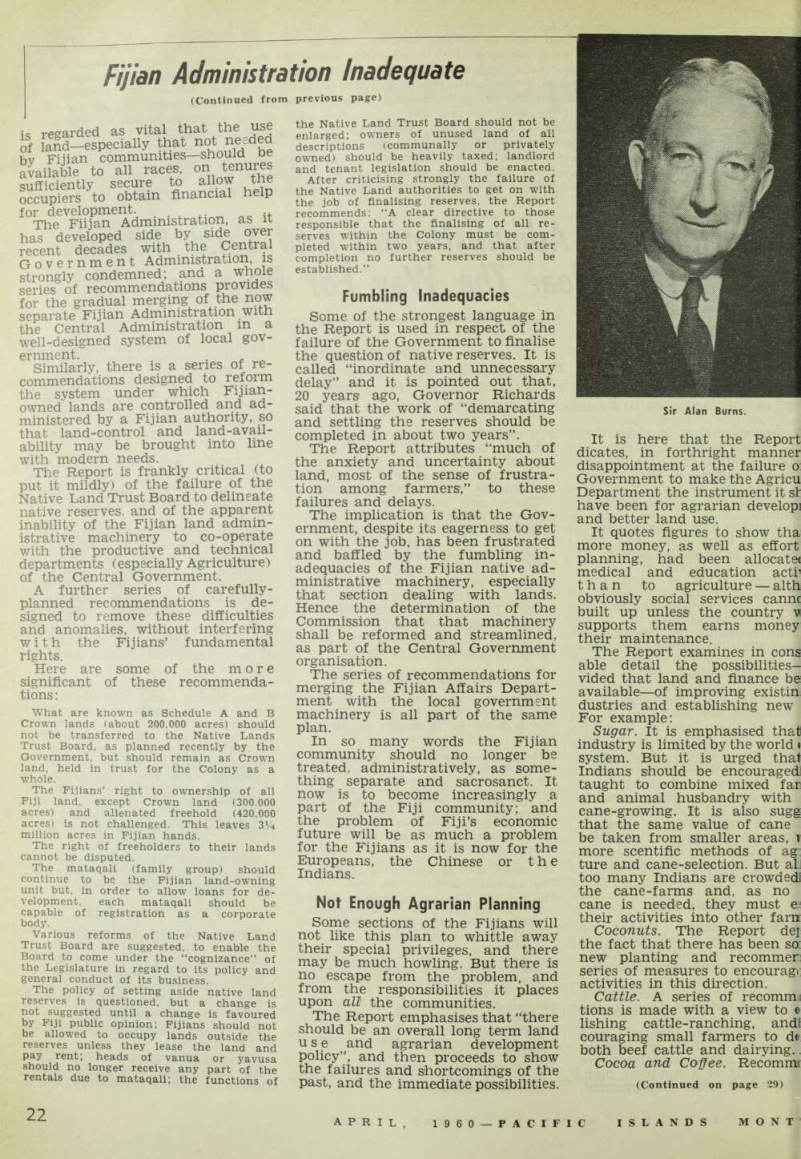
Sir Alan Burns.
. to help establish these crops [based on the belief—supported xientific and expert data —that will succeed in Fiji.
Copra Position
I'pra Production. The Report ments adversely on the fact so much of the money saved Jthe Fijians in a special fund . their copra deliveries has been jit on housing, and so little on stations and equipment. It ngly urges that Fijians be per sed to spend more of this money rood driers, so that the quality iijian native copra may be im =ed. \nanas. The increasing tend to grow bananas on poor, hilly on a shifting cultivation ::m, is criticised. Banana-grow near the port of shipment, under e scientific conditions, to avoid )e, should be encouraged. :ce. The Report expresses nishment at the inefficiency of :ji rice-growing (despite the fact the Colony in 1958 imported ; tons, worth £323,000) and ugly urges measures to stimulate industry, both generally, and in *ort of the CSR Co.’s new Rewa me (under which it guarantees [per ton, for up to 3,000 tons, 960, 1961 and 1962). datoes. This crop is discussed at :th. The Report finds no reason ;the comparative failure of this istry—under care and guidance, nould be quite important. The :3rt comments favourably on the ipects of growing maize, ground „ pulses, tobacco, is at about this stage that the :Drt breaks off to again criticise haphazard character of the cultural development policy ;h the Fiji Government has fol >d for so many years; “Unless ething more than lip service and »yed action is paid to recom :dations made regarding agrarian lopment, and unless facilities this development are accorded east parity with those for social ices, it is clear that the time not be far distant when the utry will be unable to afford the sr.”
More Land Than Estimated .1 the subject of the land area liable for utilisation in Fiji, the :ort is most interesting, using its conclusions on the able soil survey made recently Messrs. A. C. S. Wright and I. T. ford, the Commission says that
“there is a larger area potentially suitable for farming than was pre viously estimated”. This may be shown thus, in acres: For Productive Farming Forest Useless Formerly 1,293,000 624,000 2,040,000 Now . . 2,519,000 1,166,000 380,000* * Now called “catchment protective forest”.
But the Report warns that “these new facts must be interpreted with care—it does not mean that there are available vast areas of contigu ously uniform land”.
But, under the right conditions of approach and control, there is much more land available in Fiji than was supposed.
Timber—Vast Neglected Industry
The Report expresses great sur prise that the use and development of the extensive forests of Fiji have lagged so far behind other develop ment; and says, “timber is one of the principal natural resources of Fiji and could contribute much to the economy of the country”.
A series of recommendations out lines plans for development of this great natural wealth through Gov ernment help in finance, in land tenure and in taxation help, and through afforestation. Quoting the Report: “About 28 per cent, of the land area of Fiji is suitable for sustained timber production. Here lies a vast natural and potentially valuable asset which if developed could be one of the major, if not the largest, industries in the country, and we urge that all possible steps should be taken to make it so.”
The timber always has been there.
New Guinea, Solomons, New Hebrides, have developed overseas timber markets. Why has nothing been done in Fiji? Echo answers, why?
A system of encouraging Fijian participation in sawmilling com panies is recommended, and long term timber concessions should re place the present licensing system.
“All possible steps should be taken to develop timber production,” says the Report.
There are innumerable minor re commendations, seemingly discon nected, but all fitting into the over all plan for a new basic economic structure in Fiji. They include— Better communications, such as a new wharf in Suva; better high ways to the north and south of Viti Levu, from Suva; more feeder roads; subsidy of shipping services between Suva and the outer islands.
There is emphasis on more tech nical education —more especially in regard to solving the problem of Fijian teen-age boys idle in the villages—and on the teaching of English in the primary schools, and in providing Fijians with university opportunities. But there is to be no increased expenditure on general education or on health and medical services.
The need for more individual sav ing is pointed out, and there is to be greater encouragement of both the Co-operative Societies and the Credit Union system.
The canning of fruits (pineapples), fish, meat, is discussed, as interest ing possibilities.
Planning of Pilot Industries It is recommended that the Colonial Development Corporation should investigate and participate in the following pilot industries: The establishment of a tea in dustry. Probable cost, £150,000.
Large-scale agricultural develop ment scheme on a 2,000 acre area in Vanua Levu—coconuts, cocoa, live stock —the establishment to be a demonstration centre for Fijian farmers in the Nav o n u Valley.
Probable cost, £150,000.
A cattle-ranch to be established for demonstration purposes on a property carrying from 1,000 to 2,000 head, in a suitable area. Probable cost, £lOO,OOO.
A fish-canning project—probably in Levuka area.
A sawmilling project, perhaps in association with private enterprise.
Development Commissioner
One of the most important re commendationsI—provided 1 —provided it is given effect to —is the appointment of a Natural Resources Council “to keep under review and advise the Gov ernor, through the Development Commissioner, on the policy and legislation affecting land utilisa tion, and the conservation and im provement of natural resources; to ensure co-ordination of activities as between departments; and to satisfy itself that the policy is bsing adequately implemented”.
It is to be non-statutory, and ad visory—six members ex-officio, and six nominated non-officials.
The Report recommends that the man in charge of this section, the Development Commissioner, should be very carefully selected, should be appointed for ten years, should be of equal status with the Financial Secretary, and should be responsible directly to the Governor and the Legislature on all matters pertain ing to the development of natural resources.
In other words, this high official would be responsible for the imple mentation of the plan set forth in detail in the Burns Report, and which is- expected to produce, in the
2,ssed Colony, a new outlook and T itless new opportunities—a new ren and a new earth, if you like
gphrase better.
'iiere are interesting comments tourism. me Report, quite rightly, points fthat an unknown —but possibly ilderable proportion of the sey left in the Colony by tourists vas £861,000 in 1958) is not profit \ the Colony, as much of the trials used in the tourist traffic ! food, and liquors and souvenirs petroO is imported from other iitries. owever, the Report strongly sup es the attempts to build up Jism, and recommends subsidy f tax concessions in various direc ts to assist enterprise—especially mcial help for small hotels and “publicity”.
Notable Angles
nere are numerous little sections ;h have their peculiar interest, le place of the Indian com dty in Fiji is not discussed. It >ly is accepted that the Indians there, and must be provided for. poor record of this Indian com lity in World War 11, compared l the Fijians’ fine record, is de oed as “unfortunate”, tie lack of individualism and pri enterprise generally among jins is remarked upon. There are isands of shops kept by Indians Chinese —scarcely one by a an.
T qualified lawyers, doctors and i.ists there are only two among the ans, 58 among the Indians, 74 tng Europeans. :ie effect of kerekere (the taking me’s property by one’s relations) tng Fijians is commented upon, Having a paralysing effect upon widual enterprise, le Commission underlines its it debt to Professor O. H, K. :te, of Australia, for his masterly ;£ in 1958-9, The Fijian People— nomic Problems and Prospects Prof. Spate’s views on the ns Report, see p. 33). ne Report does not attach much ortance to the criticism of the :»nial Office system of administra —expensive officials, expensively :oduced, being given frequent ipical leave” —a source of heavy to the Government. The Report i.ores “irresponsible criticism” of Civil Service. This is one place ire the Commission could have ;s better by examining the facts, here is a piquant reference to Carpenter group, under the ding of “Marketing”. The sug iion is that Carpenter’s are a bit lopolistic—they practically con the price paid in the Colony for •a, and their retail operations ion such a scale that they affect les. The Commission’s thinking ns to be a little confused.
Carpenter’s now are a very powerful organisation, but they do not wield monopolistic power in either buying or selling—they are kept in check (especially in the re tail field) by very strong competi tion.
And the planters are not com pelled to sell their copra to Car penter’s—they are quite free to go where they get the best price. One may assume that the three worthy Commissioners have a prejudice against Big Business.
The acceptance of the Commis sion’s recommendations would mean a special new expenditure of be
tween £lO millions and £l5 millions, spread over the next few years. The Commission calculates that this can be taken care of by special loans and Development Fund ad vances.
The Fiji Standing Finance Com mittee has made available £2,200 this year to send two further students to the UK to take a course in public and social administration.
One Fijian and one Indian student will be selected. Two Fijians have completed the year’s course and one other is at present taking the course.