At Hollandia Meeting
pp. 21-145 · Read in the full issue
Politics Key Question At Hollandia Meeting
By Stuart Inder
The spectre of Indonesia overshadowed the Netherlands Guinea Papua-New Guinea Administrative Conference in ollandia in March. Also there, just in the background, was e thought that 1960 politically could well be a crisis year for le two Territories.
3 conference was the second n NNG-P-NG co-operation—the :irst was held in Canberra in oer, 1958. The third will be held ■NG next year. :e Hollandia conference agreed much had been done, and it plans for more work yet. :e result will be a greater ex £?e of officials between the two • cries; with the comparative lie of the past expanding to a m, and this year there will be oubt in either territory that the parts of New Guinea are tak [lose interest in each other. :e exchange will be on all levels, more natives particularly will part, and the visits will be ;r than before. Teachers and ;nts will play a big part.
Political Future :t the carefully worded official mmique said nothing of the important developments of the ;;rence—the discussions on the ical future of the territories, i.ere was, in fact, little that I be put down on paper. Much ue exchange on political views done informally. It was obvious • officially Australia was not pre ii to agree with the Dutch view that the whole political ;rn of the two Territories had
to be more closely connected and speeded up. Time, insisted the Dutch, was getting short.
The main task of the Dutch at the conference seemed to be one of convincing the Australians that they really did not have 30 or 40 years before the New Guineans would be clammering to control their own affairs. It would come sooner than that, perhaps 10-15 years, and Australia should get off the fence and work with the Nether lands politically so that the two Territories could advance at the same pace together.
A Target Date?
The main stumbling block which has prevented Australia from accepting that viewpoint in the past has been the former External Affairs Minister, Mr. Casey. But since he has been elevated to the peerage and is not now in command, the Dutch appear hopeful that there will be a change of heart, and certainly are working hard at breaking down the Australian viewpoint. They have hinted that Australia’s attitude can create vast problems for herself.
What would happen, for instance, if sometime soon Netherlands New Guinea announced to the world a
(Continued on page 143)
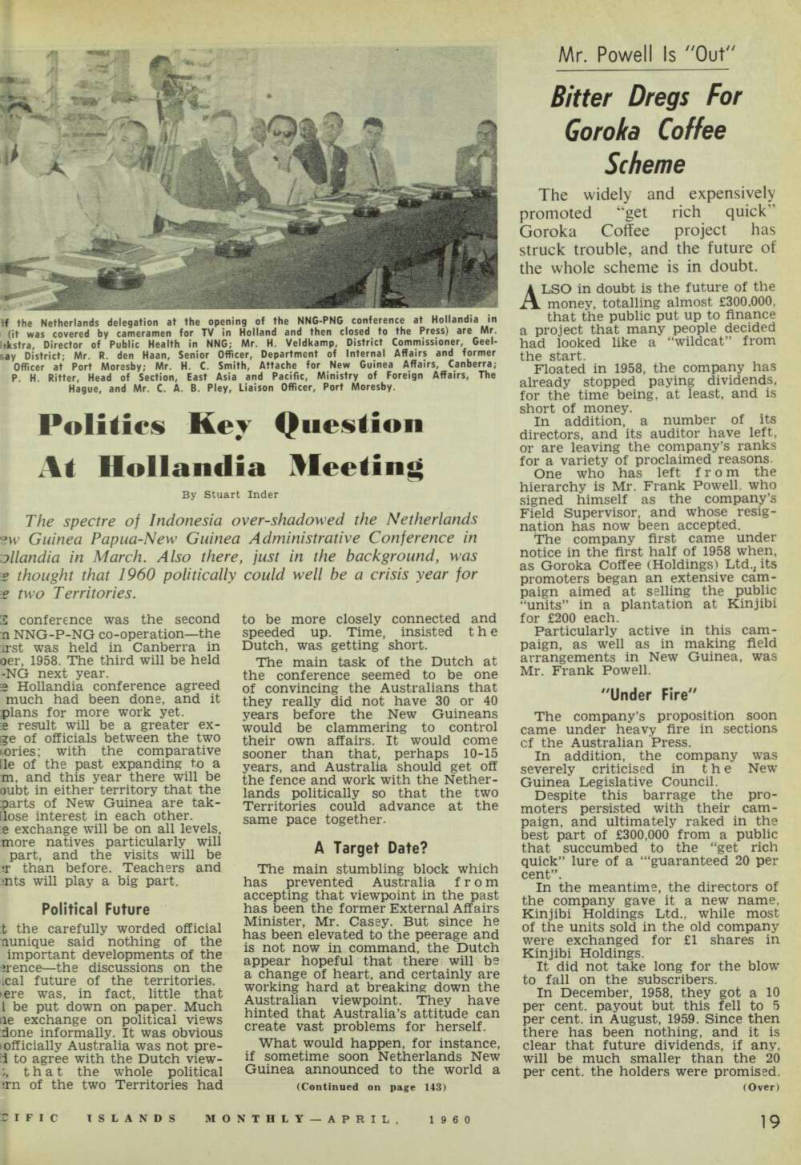
[?]f the Netherlands delegation at the opening of the NNG-PNG conference at Hollandia in (it was covered by cameramen for TV in Holland and then closed to the Press) are Mr. [?]kstra, Director of Public Health in NNG; Mr. H. Veldkamp, District Commissioner, Geel [?]ay District; Mr. R. den Haan, Senior Officer, Department of Internal Affairs and former Officer at Port Moresby; Mr. H. C. Smith, Attache for New Guinea Affairs, Canberra; P. H. Ritter, Head of Section, East Asia and Pacific, Ministry of Foreign Affairs, The Hague, and Mr. C. A. B. Pley, Liaison Officer, Port Moresby.
tt date for self-determination :;s side of the border—say, set 10 to 15 years ahead? ;e Dutch, unlik? many Aus ,in leaders, are not convinced it would be a bad thing for a »e elite to develop as a result swift move towards self-gov i.ent. elite, they believe, is inevit -an elite can help passify the iibals just as easily as anybody It announcement of an early *t date in NNG would cause irrassment on the Australian :of the border. would precipitate much earlier expected, strong pressure from native people for similar con sation, and they would get ,y of support in UNO and else ie from the Afro-Asian bloc.
P-NG Legco Plans ere is some evidence that some :ie thinking on the Australian of the border might be a lot ir to the Dutch viewpoint than in the Netherlands suspects, e are some who believe that 10 5 years might be a lot more istic than 30 to 40 years. But it made clear at the Hollandia
conference that Australia will not vet go as far as the Dutch want her go There are to be some moves by Australia in the near future, but these are the result of pressures from within Papua-New Guinea and not from without.
There will be a recomposition of the Papua-New Guinea Legislative Council, which completes its term this year and is due for re-election.
Recomposition might be necessary anyhow depending on the result of the forthcoming High Court hearing in Sydney on the validity of P-NG income tax and other New Guinea machinery.
In any case there does not seem to be any doubt that the native
people will be given a greater role in the Legislative Council for 1960-63 and there could be increased Euro pean representation, although the majority will certainly still be in Government hands, This, the Dutch believe, might not be going far enough. They be lieve that the closer administrative liaison which will be established this year as a result of the Hollandia decisions will acquaint many more people on both sides of the border with the common problem and the fact that the two Territories must work as one, both politically and militarily.
But this would be a slow process, and the Dutch insist that there is probably not time enough.