Speckled Band
pp. 131-149 · Read in the full issue


Health. It has no committee or .er means of administrative liaison ;h the public.
Fhe suggestion for appointment an administering committee ne late last year from Port Dresby Town Advisory Council, ich appointed a sub-committee make investigations and recom mdations.
Mr. Cleland said in reply recently at the request had been refused sause it would conflict with itutory law and would cut across 3 authority of the Administration, rhe chairman of the Council, Mr.
P. W. Kirke, described the answer a “red herring”.
Fhe council has decided not to op the matter, and has referred to the special sub-committee for rther consideration.
Members of the council said after e meeting that under present cir mstances it was probably quite ae that the proposal would con ct with statutory law and cut :ross Administration authority, lat was not the point, however.
Said one member: “When we ask r a hospital committee we natur ly infer that the machinery of [ministration will be changed lere necessary to permit the >pointment of a committee.
“Mr. Cleland gives no reason at I against a hospital committee as ch. In effect, his letter merely plains why we haven’t got a mmittee at present.”
anno In Big Coal
eal With NZ
Banno Trading Co. Ltd. associ ;ed with the well known Japanese anno firm in the mining and im irting business in Fiji, was about i sign a contract with the New ?aland Government in February, hereby Banno will take 50,000
tons of Paparoa coal of a grade not much used in New Zealand. Banno will also be granted licences to im port certain kinds of Japanese goods into New Zealand up to half the value of the coal purchased.
The coal, which will be used by Japanese steel mills, is a good cok ing grade. Last year steel mill representatives visited New Zealand, examined the deposits and the port facilities, and arranged for sample shipments. The subsequent report on the tests was highly satisfactory.
Banno have a number of time chartered vessels of several nation alities currently operating to Fiji via South East Asia ports and load ing ore for Japan. These vessels will in future apparently load coal in New Zealand as well as ore in Fiji.
Last year Banno brought an agri cultural scientist from Japan to look into the possibilities of the sugar industry and other potential crops for the Rewa Valley of Fiji.
Later one or more representatives of a Japanese bank arrived, but no public announcement has been made of any plans as yet.
The Mystery of the
Speckled Band
“Make 1960 Museum Year,” said the Chairman of Trustees of the Papua-New Guinea Museum, Mr.
Justice A. Mann, late last year; and already the new year has started off with a first-class museum mystery.
Mr. Mann’s “Museum Year sug gestion was part of his plan to en courage Territory people to donate articles of interest as museum ex hibits.
The present mystery concerns one of the exhibits, a native armband, which Mrs. A. Lumley, of the Trobriand Islands presented to the museum in January.
The bracelet is stored in an Ad ministration safe pending the com pletion and opening of the new museum building.
Mrs. Lumley Says:
That the bracelet is one of two worn by hereditary Trobriand chiefs, and was presented to her more than 20 years ago by Chief Touawala after she had helped avert a crisis in his tribe.
Elliott Elijah. A Trobri
And Islander, Says;
The hereditary armbands of chiefs are mystical and sacred and would never under any circumstances be given to any one but a succeeding chief.
Elijah, who is a Department of Education teacher living at Port Moresby, said recently that he could freely understand how Chief Touawala would give a valuable gift to any person who helped his tribe. <° ve «->
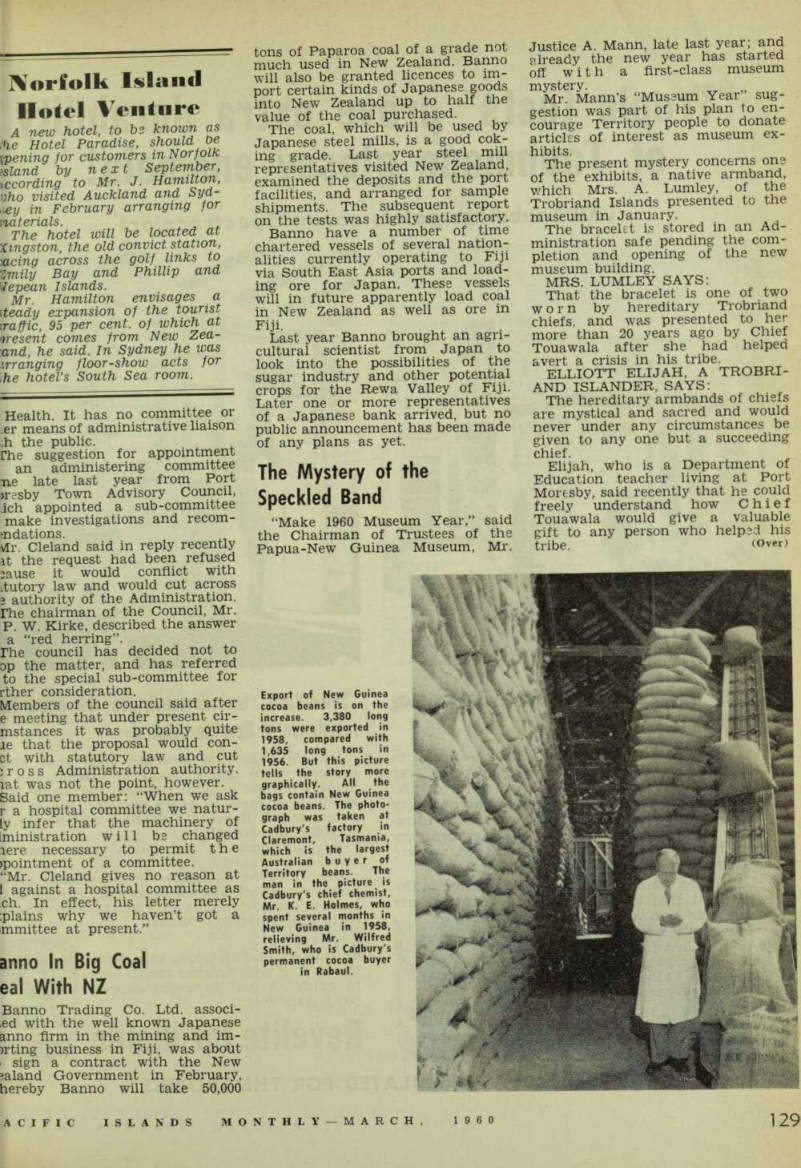
Export of New Guinea cocoa beans is on the increase. 3,380 long tons were exported in 1958, compared with 1,635 long tons in 1956. But this picture tells the story more graphically. All the bags contain New Guinea cocoa beans. The photo graph was taken at Cadbury's factory in Claremont, Tasmania, which is the largest Australian buyer of Territory beans. The man in the picture is Cadbury's chief chemist, Mr. K. E. Holmes, who spent several months in New Guinea in 1958, relieving Mr. Wilfred Smith, who is Cadbury's permanent cocoa buyer in Rabaul.
could not believe, however, lany chief would give away one jie sacred armbands.
t/as A Good Year
Ihe Cooks
Est year was a prosperous one [;he Cook Islands, according to Deputy Resident Commissioner, L. K. Pitt. J -. Pitt said that the year had been :ed by citrus exports reaching • highest level for nearly 20 s, and by a record high price generally speaking, an m sed interest in copra making, my people throughout the group during the year, built them es substantial new homes, or :e substantial improvements to :,ing homes, and many more now waiting to take advant of the Government’s Housing ii Scheme as soon as it is legally ible for them to do so. ii the health side, said Mr. Pitt, territory was spared any seri epidemics, and TB, while still :ajor problem, is being steadily .ght under control and is no ier the major killer that it was jw years ago. In the field of i welfare great progress had i made during 1959. joking ahead, Mr. Pitt said that new central fruit packing shed lich has been years in reaching pletion—will come into use at commencement of the 1960 is season. The new Islands el Moana Roa will come into ice before the end of the year, art will be made on an urgently led new general hospital at otonga. ereora College, established in re ; years, will for the first time e pupils reaching Fifth Form idard and the college will see the mencement of a full school ificate course. rovided that these islands are :ed hurricanes, there was the jpect of another prosperous year advancement in 1960, Mr. Pitt L
;y Are Going Ahead
Hi The "Tessyfon"
he Fiji Housing Authority has irded a contract for the con iction of the first 19 houses at ivuni Street, Lautoka, in the new tsing scheme, to Narain Con iction Co. Ltd. The contract ;e is £44,768, completion within months. he houses are of the duplex type, ilar to those erected at the waqa settlement near Suva, and ; them are intended for low erne residents. he Authority also proposes to ct an experimental group of nine ises made from treated local .ber, at a substantially lower cost ,n houses so far built.
It is also intended to design a group of ctesiphon houses suitable for residence. A number of demon stration concrete plaster houses of this dome-shaped type have been erected in Fijj over the past several years. There is one at the Raiwaqa housing settlement in use as an office.
Intended for the lowest income group, these buildings require no painting or maintenance, are ex tremely strong and weather-proof, and easily built at low cost. The cost is claimed to be far lower than that of any other building of com parable durability, in fact the only factor that is causing some reluct ance in their adoption is their un usual shape. It is this shape which gives them their great strength and
utter simplicity of construction.
The concrete plaster may, of course, be painted or overgrown with creeper if desired. . , The ctesiphon (pronounced tessy fon) is looked on as a potential re placement for the basic native type of house, or, in larger form, as suit able for a hall or warehouse or small church. It is particularly promising in areas where basic housing is urgently required and the finance is restricted. Such a house can apparently be erected at consider ably lower cost than a traditional Fijian bure and would outlast a bure many times and face any hurricane.
Its shape, and the fact that its fl(Dor is combined in a single unit with its concrete body makes it an ideal choice in hurricane-prone areas.
■en Up For lost;
::htsman Arrives
searded Rarotonga-born sailor, nes Moore, 43, now of Wellington, =ed his 30-ft yacht Drifter into Qkland on March 6, four months >r he had been given up as lost sea. ( PIM, shipping section, Feb iry) loore left Rarotonga in the yacht l6, saying he was going '“Gisborne or possibly Welling ” and then went missing. There ; an air search in the second [k in October after the British ighter Cornwall, between Auck d and Wellington, had inter red a garbled distress call which hided the word “drift” in some n Auckland, Moore said that four I a half weeks after leaving -otonga he had reached Cook ait, a few miles from Welling ., where he was headed. But he Id not fix his position and spent -e than two months trying to find lllington Harbour. Since then he II been lost until he sighted North oe, on the northernmost point New Zealand, at the beginning March. loore’s daily diet for two months i been one large cup of un ished weevily rice and a pint of n water. He had two handfuls of > left on arrival in Auckland.
Jntil a downpour a few weeks viously gave him plenty of rain ter, Moore distilled sea water by ling it in a pressure cooker, le added that he spent most of time simply reading and steer , expecting to sight land every 7 or so.
ok Is. Schooner
Trouble
V. B. Donald Limited’s Raro iga-based schooner Tiare Taporo, :th-bound for Penrhyn atoll with ; new Resident Agent, Mr. J. icCauley, included in the passenger ;, was in trouble 40 miles south-
west of Penrhyn on March 2 (local date). , Captain Andy Thomson, veteran American-born skipper of the Cooks, reported by radio that the 47-year old 173-ton, two-masted, wooden schooner was making water in heavy weather and that all hands had formed a bucket brigade to assist the vessel’s pumps. Cause of the leak was not stated.
A further message 12 hours later reported that the atoll was in sight and that shore boats were arriving alongside to take off the passengers, but that the schooner would not be able to enter the lagoon until day break the following morning, when she arrived safely. Fortunately, Penrhyn is one of the very few places in the Cooks where a vessel the size of Tiare Taporo can be beached on an inside beach for re pairs if necessary.
Tiare Taporo returned to the Cook Islands trade last year after an ex
tensive overhaul and following some years in French Polynesia service.
Some Fiji Indian
Schools Criticised
Many unaided Indian secondary schools in Fiji are adopting the wrong policy and their usefulness is suffering as a result, according to Mr. J. G. Rodger, Director of Educa tion in Fiji.
Opening the Suva Sangam High School in February, Mr. Rodger said that the unaided schools were in many cases employing teachers from India who had a poor knowledge of spoken English and were poor teachers of English, whereas there were many Fiji-born Indian teachers who had received their training in New Zealand or Australia who were better qualified and available for these posts.
The schools were also in many cases accepting primary pupils whose level of education was much too low. As a result there was a high percentage of failures in these secondary schools, and the percent age was increasing. Where Govern ment and aided schools were not allowed to accept pupils of less than 160 marks in their entrance exam ination, some unaided Indian schools were accepting pupils much below this rating.
Mr. Rodger said, in urging that more of these schools pool their re sources, that in some cases it was difficult to avoid the conclusion that they were more interested in fee income than in providing education.
He urged parents not to waste their money in sending insufficiently qualified primary pupils to secondary schools. (Over)
The 30 foot yacht "Drifter", which turned up on March 6 after be ing missing for four months and given up for lost. This photograph was taken at Rarotonga before Moore's de parture. —D. C. Berry.
On The Job
In Vila
Photographed by a Royal Australian Air Force photographer in Vila in February were these New Hebrides police. They are, from left to right, Constable Tatu, Constable Graham, Assistant Superintendent C. Hayes, Gendarme Auclain and Constable John.
itr. Roger said that there were r 1,100 Form 111 places a year liable in Government or aided ools, which was more than ugh for the 664 children who ned the desirable level of 200 rks or more in the 1959 examin ers, and there were almost ugh places for the 1,270 pupils 3 had gained the minimum eptable level of 160 marks.
)re Fiji Police—And
rhaps More Again
Tie Fiji Commissioner of Police seeking a substantial increase in i Colony’s police force to deal h the disturbing increase in ne and hooliganism.
Tie finance for the full plan pro led by the Commissioner has not been granted, but the Govern nt has made provision for an im diate interim increase of 50 men i for doubling the strength of s Special Constabulary from 300 600 men.
L sum of £2,500 has also been mted for the immediate extension the police VHF radio network. [Tie present strength of the force, duding the Special Constabulary, 539 officers and men. )ffences against property have bi ased in Suva from 385 in 1956 to 78 last year. Cases of disorderly laviour increased from 180 to 287.
>w Citrus Industry
r Rarotonga
Harotonga is likely to have a small w industry in operation this year i citrus juice extraction plant, following a visit to the Cooks last ir by a company representative, i big juice and essence manu ;turing firm of W. Gregg & Co. 1, Dunedin, NZ, is understood to ve decided to go ahead with the ablishment of a Rarotonga factory the near future.
It is believed that the factory will handle only citrus fruit at first, but the range of its activities may be extended later.
Fifty years ago large quantities
of lime juice were exported regularly from Rarotonga—until the suppliers began to lace it rather too liberally with water and killed the industry. That was followed by a disease which killed the lime trees or most of them.
Since then small quantities of orange juice have been shipped to New Zealand fairly regularly but only as a side line and never as a well organised industry. The in dustry now intended is expected to develop to something much bigger and might become a valuable means of using the fruit at present wasted through shipping difficulties or irregularities, especially fruit from the outer islands.
The arrival of the new Moana Roa later this year is not expected to greatly aid shipments from these outer Islands.
It has never paid the present Maui Pomare to uplift small quant ities of fruit at those places, and it is even less likely to pay the much larger ship to do so. It seems likely in fact that with the arrival of the
Islands
Wedding
Recent Islands wed ding at the Rabaul Memorial Church: Rev.
Bray (who officiated), Mr. James Seeto, Mr.
Michael Seeto and his bride, formerly Betty Leong of Sydney, and Miss Lydia Tam the bridesmaid.
Photo: Larry Chin.
Illy fitted to the sets, or en- Jl in the same carton with them, : ruling seems equivalent to ing extra duty for the un >sary nickel fittings on the set
Debate Was
jut "Security"
“feeling of insecurity” is a se that has been heard more
more frequently in Papua-New
>ea these days. What it means ,;ly depends a lot on the cir itances in which it is used, istralian Territories Minister Hasluck doesn’t like bearing ohrase at all, but he heard little (during a tour of the Territory le end of last year, and later inented on the fact that with y people the phrase has no vertheless he said (P7M, Jan ) there was some genuine doubt i what was going to happen to Territory in the future, and to 3 people who felt insecure he d say that Australia was not g to walk out of New Guinea, .ralia was there to stay, it if the Minister thought this the end of it, he would have a little insecure after reading Hansard reports of the February ting of the P-NG Legislative ncil. i unofficial member representing planters, Mr. B. Fairfax Ross, an of wide Territory experience respected as a straight-shooter i incidentally the Legco’s most ng debater) told the Council ; a feeling of insecurity existed, something should be done to y it. ncertainly, said Mr. Fairfax s, could be put in a simple stion. “What is going to happen Europeans here when the Terri
' attains self-government?”
[any Europeans whose future was . to the future of P-NG wanted answer to that question now. ‘ answer they sought was noth less than a statement of Com
iwealth policy. .
!e suggested it would be fair to to the native people: “When are competent to administer the ritory we are pledged to give you -government if you seek it, and will do so, but because in the ence of this land thousands of dead lie in your fields, because our trusteeship hundreds of our pie have grown old in your up iging, because generations of itralians have contributed lions of pounds to your advance nt, and because from worthless igle thousands of acres of your d have been turned to orderly iduction, a condition of your f-government will be that our aonals will remain on terms and h title no less favourable than ;y now hold.”
Mr. Fairfax Ross said Australia would continue to put millions more r»nnnH<s into the country than it in ultimate goodwill. It would be fair to take a little of that goodwill now to dispel a feeling of insecurity. sa f wfto d the at Mi e JgJSf
STsho'Sfbe ?a°u V » e th’e
?^^e a people°att’ain self-government
a condition would be that all pnvate interests of nationals would be maintained “as heretofore”.
The reply come from Assistant Administrator Dr. John Gunther, no mpflm debater himself mean d^ u a^ e ™ s aid - Mr Fairfax
Ross’ demand f or nn a rp 9°Yf c rnn^he statement was . Th movement towards determination was by evolution. When the time came for determination it was then that they could know what pro visions could be negotiated. us and to retain your
assets .
Said Dr. Gunther; 1 ask Mr.
Fairfax Ross, and others who think with him, to look at any country where the die has been cast and see if he can find if those condi
gs that are unpopular to the mass been acceptable to the emerg nationalistic leader grou p. ere this group is a determined only bloodshed has intervened ween the metropolitan power s rmatum and the eventual accept- Ee of terms. ]The present tragic situation in ica, and what happened in South )t Asia, are stark reminders that up to us to make our continued sence wanted. We have seen jionalistic movements that have uted the British to stay, and this be our lot. But I’m sure threats I cajolings between now and the • of determination will only put [pie on their political mettle.
What is this so-called security? iy did it start? Who started it? -here any situation in this Tern y today that is different from, , ten years ago, when this word ecurity was never heard? Has 7 nationalist party emerged to eaten the position of the ex riate? Has the cry, the equivalent “Merdika”, been heard? Is there nmon talk of exploitation?
I would say there has been the •y reverse! There has been steady ogress in all fields, and the very ;tern of that progress must surely nent good relations.”
Dr. Gunther asked whether this rd “insecurity” was not coined d used during New Guinea’s con
troversy over income tax. It was used and used until some came to believe in it, he said.
“I have no desire to reopen this unfortunate controversy but I have a desire to see this word in security’ dropped from use, since I think the true facts are that there is no reason for any feeling of in security. I have no doubt the con tinuing thought of insecurity will beget insecurity.” Al Dr. Gunther added that he thought the continuing challenge to the Minister would do nothing but harm.
He failed to see how any statement by the Minister today would really affect the political situation two or more generations away. What was wanted was less talking and more application to the job of developing the Territory.
Crime On The Increase
In Western Samoa
Statistics just released by the Government show that during 1959 there was a remarkable increase in criminal offences in Western Samoa.
The number of such offences was U p by 44 per cent, and the number of police cases by almost 50 per cant.
Offences against peace and order showed the largest increase.
Including traffic offences the total number of offences reported was 10,133, compared to only some 7,000 in 1958. Police cases dealt with by the courts were 8,577 as against 5,754 in 1958.
The following are the number of offences, with 1958 figures in
parentheses:
Breaches of the peace 591 (478), drunkenness 141 (65), stone throw ing 119 (44), failure to pay gun licences 130 (63), assault causing bodily injury 50 (39), common assault 439 (503), rape 4 (9), theft 483 (602), burglary 19 (32).
The increase in drunkenness is attributed mainly to the large in crease in home brewing all over the islands. The police have raided hundreds of places where home brewing was suspected. During the last two months of 1959 not less than 232 were raided by the police
154 of these raids resulted in rt prosecutions. Home brewing according to the police, carried n nearly every village in Western 10a and drunkenness has the 3t of increasing other classes of le. he failure to pay gun licences ue to the restrictions placed by Government on pigeon shooting, :n owners of guns resented pay licences while not being able to their guns. r andering pigs causing damage plantations proved a great jance and police shot 433 idering pigs in Upolu and Savaii. i spite of all the laudable efforts the Police Department home ving has not decreased to a great jnt. The Department is handi ped by insufficient staff.
rt Moresby Will
rease Power Supply
lanberra’s approval of £A850,000 the first stage of a scheme to st Port Moresby’s hydro-electric /er supply was announced in ly March by the Administrator Papua-New Guinea, Brigadier M. Cleland. ■his first stage—the construction a dam 80 feet high—is only part the long-range plan to fully elop the Laloki River’s hydro ;tric potential, he said. ’enders for the dam, which will e two years to build, are to be led in August. it present Port Moresby’s power ids are met by a diesel power tion in the town and one hydro tion at Rouna Falls on the oki.
Irigadier Cleland said the whole erne when completed would raise i present total power output of 30 kilowatts to almost 44,000
kilowatts.
Future plans envisaged the con struction of another three hydro power stations.
No over-all total cost of the scheme was announced.
Brig. Cleland’s news brought the usual comments from “the other side” of the Territory—along the lines of, “Port Moresby gets all the money again!”
Port Moresby’s present Rouna hydro scheme is a paying pro position, and money from it subsides most other Territory electricity undertakings, nearly all of which are packaged power units.
There have been big schemes afoot for supplying hydro power to other parts of the Territory—particularly the Lae-Madang area, from a
scheme which the experts think could be installed around the junction of the Markham and Ramu Valleys. (See PIM October, ’59, p. 47). , But nothing has happened yet, and Territory people everywhere, including Port Moresby, complain bitterly about the high cost of electricity. .
It was always obvious that a dam would have to be built on the Rouna scheme before the scheme could be properly consolidated. There is enough water to provide for the future but it could never be properly exploited without a dam.
The scheme has been making use of a pond as a temporary measure.
A-Bomb Rumour Won't
Be Exploded
The argument debated in Noumea about whether France will use one of its Pacific Islands to test an A-bomb is not yet finished.
Deputy Mr. Maurice Lenormands news-sheet Avenir Caledonien re ported the rumour in December, quoting French newspaper sources, and soon received a denial from Paris signed by Mr. Soustelle, Minister in Charge of Overseas Territories. (PIM, January, Feb ruary) . New Caledonia’s Governor, Mr. Pechoux, dropped a strong hint at the time that there were heavy penalties for newspapers who spread rumours.
In a radio broadcast in Noumea in February, in which Mr. Pechoux denied a rumour passed on by Mr.
Lenormand about the future of the New Hebrides (see page 23), Mr.
Pechoux again alluded to the fact that the A-bomb report had been unfounded.
However, immediately following this broadcast, listeners heard an international news session, one of
SYDNEY. These four Tahitians from the French Naval vessel "La Confiance" visited the poly [?]n Association when the vessel was in Sydney recently They are, from left, Achille Stergios, John Urima, Maurice Gilbert and Gordien Cadousteau.
-Tele-Photos.
IN NOUMEA. Mr. Sydney Clark, American author of travel books, has been visiting the South Pacific in the last month or two collecting facts for another of his books in the "All The Best" series. Here he is in Noumea, being shown some of the points of interest by Mr. Jean Brock.
Photo: Fred Dunn.
iiterns ol which quoted the |h Army Minister as saying France would consider the cgm of building an H-bomb, ana ' explosion of such a bomb only take place in the Pacific. «e, he said would have to find island, although no definite had been considered.
E Leftist roneo press in New konia, referring to a denial by
cJovernor about the possibilities
ii increase in the miltary force *w Caledonia, also has been say- Lhat the French Army has just lit considerable areas of land the town of Bourail, and that neks similar to those in Noumea shortly to be built there. The i has also added that a high iary commander in the Pacific be based in Noumea.
JS Petition in Harvey
der-Hamac Matter
petition by Francis Knibbs achern, the former chairman of iac Holdings Ltd. of P-NG and two sons, Leonard Francis achern, and Colyn Francis achern, for the liquidation ot /ev Trinder (NSW) Ltd. will e before the NSW Equity Court iis cross action follows the ication last month by Harvey tder (NSW) Ltd. to P-NG reme Court for liquidation of iac Holdings Ltd., which con ; hotel, trading, and plantation Idiaries and which now is un to meet creditors’ demands, le McEacherns, in their petition, aled that they own almost 49 cent, of Harvey Trmder’s A s shares. The Co.’s nominal tal is £lOO,OOO, with a paid-up ;tal of £24,684 “A” shares and )0 “B” shares. wo of the three petitioners, ncis McEachern (67) and nard McEachern (40), both m mce brokers, are defendants m ise listed for hearing on April 14 Sydney’s Central Court, involving charges of alleged fraudulent ropriation of £41,220, when they e directors of Harvey Trinder ;w) Ltd. r . he case was set down for March but has been put over to the 11 date.
estock "Better Housed"
an NG Workers
Many farmers in Australia house lr livestock better than unskilled ive workers are housed in ma,” a veteran missionary said Port Moresby in February. :e is the Reverend Percy Chat ter of the London Missionary lety, who made the statement in ience before the Native Employ nt Board, which is inquiring into aspects of native employment in Territory.
Apart from a few rare excep
tions, the standard of housing for native employees is at the same level here as it was in the nineteen twenties,” Mr. Chatterton said.
“I believe there is growing resent ment among skilled native workers as they compare their own accom modation with that of even the least skilled European workers.
Mr. Chatterton said native em ployees in some cases were being intimidated by threats of dismissal into accepting conditions of work which were frequently illegal.
“I am giving evidence because I have spent 35 years here, know two Papuan languages and have an ex ceptional opportunity of knowing what Papuans are thinking,’ he added.
Was He Trying To Make The
Minister Squirm?
When Mr. J. L. Chipper, of Rabaul, elected to replace one of the “walkout” MLCs on the P-NG Legislative Council, was sworn in on September 29 last, he in turn formally resigned. In a scathing resignation speech he censured the Administration on a dozen separate counts.
During his December visit to P-NG Territories Minister Paul Hasluck told Mr. Chipper he would examine the speech and deal with the points raised.
Mr. Hasluck’s lengthy reply was received by Mr. Chipper early in
*:ch. Among points the Minister xes; His use of the word “locusts” oide during a Canberra dis :;ion in 1958), to describe those 0 were gathering what they had sown, did not apply to Mr. ipper or to any other European -private enterprise of his kind.
The Land Development Board conducting a survey of the iritories’ land needs, but because survey and soil analysis staff irtages it is taking longer than iicipated.
Controls have been placed on oortation of methylated spirits 1 other spirituous liquors to help re the native drinking problem, e question is being further con ned by the Administration. 1 Public service morale is not low, iditions are excellent. He is istantly endeavouring to find d leaders from within the vice. , , , • Delay in producing a workable tive Labour Ordinance arose m the Government’s efforts to as wide opinion as possible from our employers. > Instilling a sense of respon ility into the indigenous popula a is not one solely for the ministration the obligation is o on every employer of native our and on everyone in contact h natives. , * An official inquiry failed to istantiate that Police Force rale was low. . , > The Tax Bill, as introduced, s workable —the 100 amendments ,de were mostly to taxpayers’ vantage, as the result of repre itations made to Legco and
rritory organisations.
> Without specific cases, it was t possible to answer charges of itile waste of public moneys”, per work has been considerably luced, especially for field staff, rhe Minister’s letter ended with barb in its tail; “Why did you ike that speech? Simply to make squirm and relieve your own lings? Or to bring about improve mts in the Territory . . ?”
übstantial" Bonus for
NG Copra Planters
Uopra trading results for the riod July 22 to December 31, >9, should be available shortly, lowing which a fairly substantial a 1 price payment for copra de ered during that half-year can anticipated, promised Mr. lan chairman of P-NG pra Marketing Board on March 1. [n his review of the copra market ring February, he indicated that ere appears to be a slight increase round in copra production in the ,cific. P-NG production is being lintained at around 7,200 to 7,300 is per month; BSl’s 1959 output se to 27,000 tons, a 15 per cent.
increase on 1958; increases have been recorded in Fiji and Fr.
Polynesia, with Tonga remaining steady. New Hebrides, usually about 33,000 tons per annum, will not reach that level this year because the December hurricane destroyed some 30 per cent, of the area under
production. .
The European copra market m February continued quiet, with practically no business being done in the regular sense, commented Mr. McDonald, although there was fair volume of re-selling to Philip pine dealers for March shipment.
None of the tenders for surplus US Government coconut oil (7,000 short tons) on February 16 was accepted. It is believed bids were exceptionally low to test just how anxious the US is to carry out its disposal programme. Next tender is in six weeks’ time.
Meanwhile, the market is wait ing for the Antarctic whale oil con tracts to be concluded, both buyers and sellers of oil being unwilling to commit themselves for anything more than is immediately necessary until whale oil prices are known.
From all accounts, it appears that 1960 will not be a year of abundant supplies for oilseeds and vegetables oils other than coconut oil. There is no doubt that if coconut oil prices went lower there would be a much greater consumption of it, provided supplies were available.
High Court Action
Expected Soon
The Australian High Court action on the validity of the Papua- New Guinea Income Tax ordinance is expected to be heard in Sydney during the sessions beginning in
March. No date had been fixed in early March.
The Income Tax Ordinance came into force in July last year, bring ing income tax to the Territory for the first time.
They Received A
National Distinction
On the now lonely beaches of Manus Island, one-time Australian defence base for the South Pacific, two smiling Japanese set off the other day with cigarettes and liquor in their hands and glints in their eyes.
They were deck-hands from a salvage team clearing war-time wreckage from Lorengau, but they felt there should be more in life than mere deck-handing.
They met up with a couple of the local native women and prepared for a cosy chat, but the expedition came to grief in Manus District Court several days later.
After a brief hearing, the Jap anese achieved the distinction of being the first of their race to go behind bars in New Guinea since the Japanese surrender in the Pacific War.
They pleaded guilty to charges of supplying liquor to natives, and each received a sentence of two months.
They were still smiling when the sentence was handed out.
“Thank you, thank you, thank you very much,” they said bowing from the waist.
Commented a bystander: “They’ve probably got the right idea there.
You can be sure the work in jail won’t be as hard as clearing salvage.”