Pacific Report
pp. 119-139 · Read in the full issue



The month’s round-up of news and pictures of people and events, from PIM correspondents in the South Pacific.
The P-NG Multi-
Racial Problem
A church leader and a business leader in Papua-New Guinea have made two significant statements concerning multi-racial communities existing in the Territory, The businessman is Mr. George Clarke, a director and senior executive of Burns Philp (New Guinea) Bimited; and the church leader is the Rev. Wesley Button, chairman of the Methodist Overseas Mission in New Britain.
Mr. Clarke discussed the present, and Mr. Button looked to the future.
Mr. Clarke said that Rabaul in
particular was a town where several races of people lived together, where there had been some serious problems, and where there still were a few problems.
He continued: “But I want to make it quite clear that the problems are leaving us today.
“I believe Rabaul can be held up as an example of a centre in which there is greater racial tolerance than anywhere else in Papua-New Guinea, and greater than many other similar States in the world.
“In sport and in commerce in this town over a period of over 20 years I have seen the increasing tolerance and co-operation noticeable between the races.
“If the town maintains such a common level of interest it will re main happy and prosperous”.
Mr. Clarke’s statement was made shortly before he left Rabaul to take up a new executive position with his company in Port Moresby.
The Rev. Wesley Button’s state ment on inter-racial development was made at a meeting of the Rabaul Parents and Citizens Association, of which he is chairman.
Mr. Button told the meeting that the time was fast approaching when the Government would have to make a definite decision one way or the other on fully-integrated schools.
Education of children was not simply a matter of going to a school and learning material facts, he said.
Mr. Button continued: “True education means learning to live, and if children are going to grow up in a multi-racial world it is obvious they should be educated in a multi-racial school. (Over)
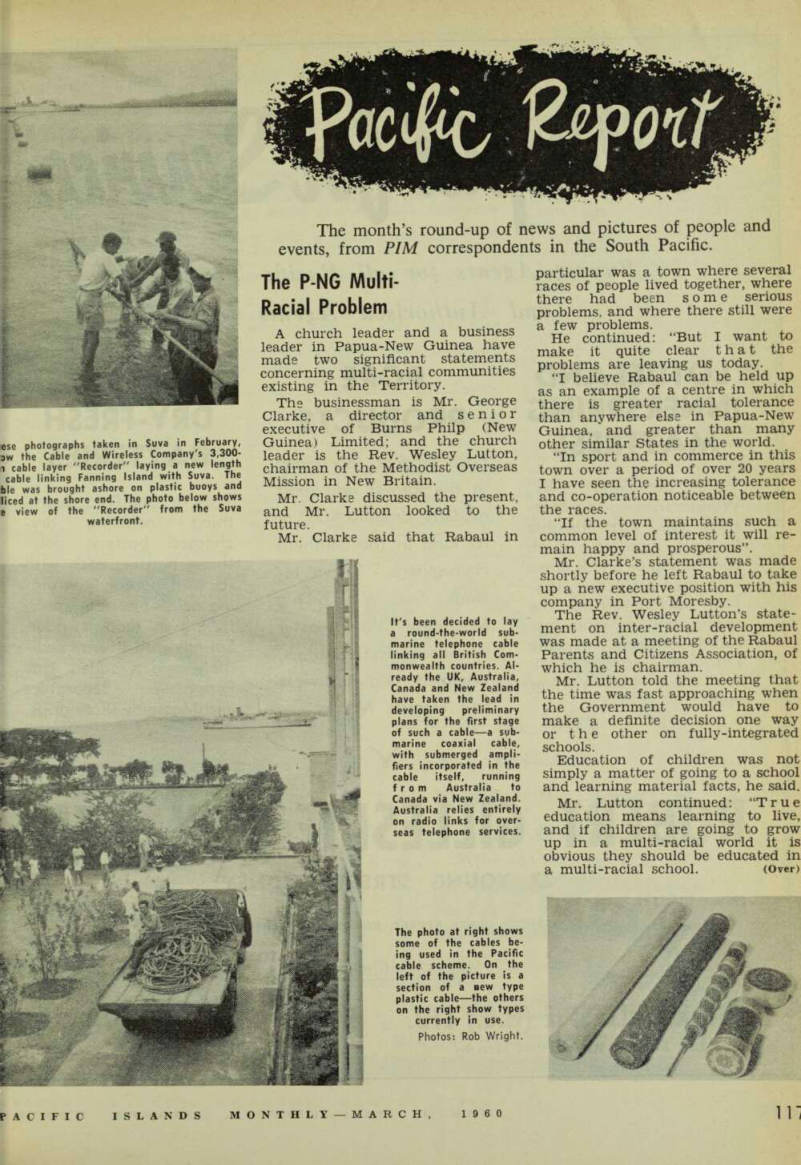
It's been decided to lay a round-the-world sub marine telephone cable linking all British Com monwealth countries. Al ready the UK, Australia, Canada and New Zealand have taken the lead in
developing preliminary
plans for the first stage of such a cable —a sub marine coaxial cable, with submerged ampli fiers incorporated in the cable itself, running from Australia to Canada via New Zealand.
Australia relies entirely on radio links for over seas telephone services.
The photo at right shows some of the cables be ing used in the Pacific cable scheme. On the left of the picture is a section of a new type plastic cable —the others on the right show types currently in use.
Photos: Rob Wright.
t helps them to learn to live if 7 are taught with children from urent cultures. The principle in ed here is deeper and more basic i a mere racial problem.”
una Airport Land
tlement
he longest court case on record American Samoa, litigation con ling 550 acres of land taken over extensions to Tafuna Inter ional Airport, recently ended in jo Pago, when Chief Justice hur A. Morrow handed down a page judgment. he land was owned by 17 families 3 felt that the valuation set by Government was inadequate, der Judge Morrow’s ruling the nations have been set at from 5 to $3BO per acre depending the nature and development of ; area concerned. The govern nt must also pay 6 per cent, in est on this valuation from the le of taking over several years ). n all, the land taken over will it the government about $140,000. to February, about half the gants had accepted the new ing and had collected their pay ints.
iwa Valley Shows Interest
Processed Bananas
the possibility that the Rewa 11 ey farmers of Fiji might switch flr interest from an unwanted 2jar mill with poor outlook to a ied-banana industry of much [ghter prospect seemed very real February, following a public jeting at Nausori. [f the market for dried bananas
is as good in America and elsewhere as has been stated by Mr. B.
Proweller, of Suva, who made in vestigations last year, such an in dustry, employing the capital already subscribed for the proposed new sugar mill, plus other capital which would undoubtedly be forthcoming with this change of plans, would seem to be a perfect answer in the
rehabilitation of at least part of the former sugar lands of the Rewa Valley.
There is no doubt that much of this area is ideally suited to banana growing, nor does there seem to be much doubt that a dried banana industry would be far more satis factory to Fiji growers than a fresh fruit export industry.
It cannot be denied that experi ence has shown that Fiji simply cannot deliver a consistently high quality banana to the overseas fresh fruit consumer. New Zealand is apparently Fiji’s only possible fresh fruit consumer. New Zealand does not need Fiji bananas; all that she needs can be obtained from other sources.
The dried-fruit trade would handle the Fiji fruit before it deteriorated.
There would be an end to the con stant war between the growers, the export inspectors, and the overseas importers and consumers. Fiji growers would know that they had an assured market for their produce right at home.
Dried bananas can be stock-piled for a considerable period. Thus, the overseas buyers need not be faced with the effects of hurricanes and floods to anything like the same ex tent as applies to fresh fruit.
Export shipments could be evened out so that a certain reserve of dried fruit would always be on hand
atisfy overseas export contracts imes of poor harvest.
J this, of course, rests on the fence of a good long-term over , market for the dried fruit, 3h Mr. Proweller has insisted 5 exist—and he seems to have documentary evidence from sntial buyers to prove it. ;r. Proweller told a PIM repre ;ative last year that he did not i to organise the formation of nnpany himself. He holds certain snt rights on the drying of anas. !e claims that only his system proved to be satisfactory in uring that weevils do not infect dried fruit. It was the appear :e of weevils some time after ing and sealing in packets which ed the Western Samoa industry, I it has also killed the industry other places.
Ir. Proweller wants to see the in itry operated by the producers, o would pay him a royalty on ry pound of dried fruit exported, would ensure that the processing s performed correctly, and he aid find the overseas markets.
Jndoubtedly there are certain ficulties associated with the fact it the whole success of the in stry might rest on Mr. Proweller’s icess, which has not been ex isively demonstrated to the com ite satisfaction of all possible in jtors.
What might be the situation, for ample, if, after a great deal of >ney had been invested in a fae ry, the produce did by some ance develop weevils?
A. small-scale pilot project would em to be essential for perhaps a ar or more. But someone would tve to find the capital for the lot project.
If the success of the processing
and marketing can in fact be as sured this industry could give a new look to agriculture in Fiji.
There is evidence already that the Fijian growers are keenly in terested, and Indian farmers and others associated with the proposed new sugar mill have also indicated that they are ready to look into it.
Trusteeship Representative
Takes a Look at NG
A member of the United Nations Trusteeship Council strongly denied in New Guinea in February that the council lacked information about New Guinea or the problems of New Guinea. .. , The speaker was the United Kingdom representative on the Council, Sir Andrew Cohen, who was making an official tour of the New Guinea Trusteeship Territory.
He said that the main purpose of the tour had been to inspect the Trusteeship Territory and then to discuss matters which Australia and Great Britain had in common as administering members of the
Trusteeship Council. He never theless stressed that actual inspec tions of the area such as he was making were invaluable.
He made the same point to native leaders when he addressed them during various stages of his tour.
At Rabaul he told members of Rabaul Native Local Government Council that he was impressed with what he knew of the council system and with the way in which he had seen it operating at Rabaul.
Sir Andrew declined to give an overall outline of his impressions of the Trusteeship Territory and its development on the grounds that he had not been in it long enough, and that the main reason of his visit was to discuss matters of mutual concern on a general plane between Australia and the United Kingdom.
Sir Andrew’s travelling tour occupied seven days, after which he spent several days in discussion with senior Administration officers at Port Moresby.
Sir Andrew was formerly Assistant Secretary of State in the British
lonial Office, and for five years was Governor of Uganda. footnote: At Rabaul he heard tive councillors discuss damage ng caused to their gardens by -s. He told them: “This sort of k is not new to me. I have heard from councillors in Africa. The ly difference is that you are rried by pigs—they are worried by phants.”
ie Old Army Huts
re Going
k building with an interesting story was removed piecemeal rough the side door of another ilding in Rabaul, New Britain, gently, and carted to a North »ast plantation where it will be me a produce store.
The building is one of the fast sappearing army-style prefab sated huts, which originally came Dm Australia to Manus Island dur g the Pacific War.
The Returned Servicemen’s Club Rabaul bought the building in 49, and for 10 years it was the lib’s premises in Central Avenue.
But the affairs of the club •ospered, and the hut finally be ,me a Cinderella building standing side the walls and under the very cf of a fine new club building. >ee PIM, January, p. 140].
Recently the committee of the ub called tenders for the build tg, with the successful bidder to irry it away as soon as possible. went to Mr. Allan Reilly, of okaiya Plantation —himself a mem- Dr of the club—and was carried it the side door of the new build ig during the last week of January.
Said a member of the committee:
“It’s been a good old building, and has seen many good times. We are sorry to see it go, but it must make way for progress.”
Chatham Islands in
More Trouble
Because of shipping difficulties, high transport costs, and un economic prices in New Zealand for Chatham Islands sheep—which have a high reputation in New Zea land—the Chatham farmers are fac ing a severe depression, according to Secretary of NZ Island Terri tories, Mr. J. M. McEwan, who re cently visited the group.
Last month PIM reported that mainland capital was not interested in any Chatham Islands projects.
The Government investigated the possibility of establishing a mutton boiling-down works, a meat cannery, or a freezing works, and found the outlook poor for each of these pro jects.
Now, according to the Minister, there is a very real possibility that the Chathams farmers will be forced to slaughter hundreds, if not thousands, of their sheep and toss their carcases into the sea. It is not considered advisable to turn the sheep loose onto tussuck country to fend for themselves, and the practice
d result in an excess of sheep 3 disposed of later. ie Minister said that because of freight rates in New Zealand 3 and the necessity of meeting problem somehow, inquiries had made with Japanese interests •ansport sheep to the mainland per head, but it had not been ible to reach an agreement with mese shipowners on this basis, ie Government is now setting up ;w sub-committee to go further the shipping problem to try to ,nise transport at rates which allow the sheep to be marketed itably in New Zealand.
n They're Fishing
■h Electricity
'hat yesterday seemed fantastic sense is today commonplace in ly fields of life. Certain it is j in the world of tomorrow, ific populations are going t 9 have jay more and more attention to ing as a food source. Thus de pments in this field are —or aid be —of particular interest to nds administrations, fter years of experimentation a man doctor has apparently jtered the technique of catching with the aid of electricity. He t discovered that if the positive . negative conductors from a rce of direct current were in ;ed in a tank containing fish, the
fish would always head towards the positive electrode.
This seemed to hold possibilities in inducing fish to congregate in a certain area while they were trapped or otherwise caught.
Next move was to wire up a net trawl so that fish approaching its mouth as it was drawn along would be attracted into the back end of the net and so caught. But there were technical difficulties. If the two electrodes —such as the wire round the mouth of the trawl net and the other wire at the rear end —were more than a short distance apart a considerable amount of elec tricity was called for. This involved heavy generators and danger to fishermen from electrocution.
Next it was found that short pulses of current would do the trick, and this reduced the electricity re quirements, but there was still the problem of inducing the fish to come near enough to the net to fall under its attractive influence.
Now it appears that the system has at last been perfected to the stage where the equipment is ready
Tiger sharks, like this one at Madang, are voracious scavengers, and one of the fiercest sharks in the sea.
NG AND THE COOKS GO SHARK FISHING The two Tiger sharks in these pictures together weight 1,469 Ib— which is a lot of shark. The one on the left-12 ft. long and 930 Ib —was caught in the Cook Islands, at Rarotonga, and the fellow strung up in grand style below—l2 ft. long and 539 Ib—was captured at Madang, New Guinea. Mr. Ron Powell caught the Cook Islands monster while out fishing for flying fish, with a nylon fishnet off the reef at Nikao. The shark wrapped itself in the net, and the fisherman tied two lines around its tail and towed it back to Avarua with the shark putting up a good fight all the way. Even though it was tied to the main wharf all night it still put up a fight in the morning when it was polled up on the slipway (left). Its stomach contents gave a clue to what Tiger sharks like to eat—or Cook Islands' Tiger sharks, anyhow. There were two rusty salmon tins, a small log of wood, a turtle back, some cellulose paper, a rusty fish hook, several small fish and a nylon fish net with a fish caught in it. The Madang shark was caught by Mr. Tom Huxley, who went shark fishing off the coast from his plantation with the aid of a dead goat on a hook.
Mr. Huxley finished the shark off with his shot-gun, and the stomach was found to contain only the remains of the goat and nothing else.
In Madang they think it might be the same shark that has made several attacks on native children along that coast, mauling one boy.
Photos: Marie Powell (Rarotonga) and S. Diczbalis (Madang).
Jbe marketed. It is only of use ere there are shoals of fish of shallow water or surface-feedvessel is fitted with iig powerful suction pump whose juth is a 3-ft diameter metal je projecting a few feet below the 11. Near the entrance to this [jiel is a bright electric light. The nt attracts the fish into the gen ii vicinity. The electric pulsator 11 the suction pump do the rest.
Wo nets are called for. No gear is :t through fouling reefs and scks. No telegraph cables are maged.
What is more, by varying the :ed of pulsations and the voltage y specified size of fish can be at icted, and the undersize fish re
tted! A .
}n the basis of extensive tests the North Sea it appears that * invention could well revolutionise a type of fishing where com ritively dense shoals of small fish 5 involved, greatly reducing the inpower and equipment costs.
g Time Coming For
nerican Samoa
Pago Pago does not often go gay, t there’s a big time coming in »ril, when, on the 27th and 28th, aerican Samoa will celebrate Flag iy.
For technical reasons the date of e celebrations has been advanced im April 17; it was on that date 1900 that the American flag was 'icially raised in this territory [lowing the signing of a Trip tite Treaty between Britain, Ger any, and the US in the previous ar. Under that Treaty Tutuila id its neighbouring islands east ird came under full American ntrol. The US had possessed k val coaling-station rights at Pago igo from 1872.
Under US Navy administration itil July 1, 1951, this territory is >w administered by the Depart ent of the Interior whose secre ry, Mr. Fred Seaton, is scheduled be present at this year’s celebra- Dns. „ .
Amongst other events will be merican Samoa’s first beauty con st.
rince Tungi Still
ooking Ahead
A coconut processing industry is •recast for Tonga’s not too distant iture.
Prince Tungi, Tonga’s Prime [inister, returning from a trip irough Asia to as far west as eylon, said in Suva at the end of anuary that Tonga would probably b entering the coconut processing eld before very long.
He had been much impressed with hat he had seen in the big coconut
producing countries of his tour, in the matter of utilisation of all the by-products of the coconut, and also in the matter of developing more productive strains of coconut palms.
Prince Tungi mentioned specifically that he was interested in production of fibre and desiccated coconut A. button existing in Honolulu, in which the hard coconut shell was used, was also a possibility. Prmce would not or deny reports that the Tonga Government might soon order another larger ship for the carriage of Tongan cargoes to and from overseas markets.
.Last year Prince Tungi that the Copra Boards Aomu had shown a substantial profit in her first year of operations,
They Want 3
Uac - ta D ftarf l
nOSpildl DOdlQ
The Administrator of Papua-New Q U i nea M r . d. M. Cleland, has re fusecj a request that Port Moresby General Hospital should be admin istered by a hospital board and a mana g er operating on similar lines . AiiefvQiian hosnitals to Australian nospitais.
The hospital is at present admin istered directly by the Department
new ship the outer islands will n to make more use of the local int island shipping to get their prod to Rarotonga on the first leg of journey to the New Zealand marl Freight rates on cargo from * Zealand to the outer islands i vice versa would thus be increaj but the money saved by sending Moana Roa only to islands wt payable cargoes are offering, mi be diverted in some way to s sidising these increased freights i at the same time it would proi work and encouragement for local small-ship owners.
The Twist Smokers
Don't Like It
Because the former growers twist tobacco, widely smoked Fiji, are receiving better indi ment from a Suva tobacco ; cigarette factory to transfer tl efforts to another grade of toba the price of twist has risen in Suva market.
A large part of the twist ! through the Suva market is gr< in the Sigatoka area of Viti L< A couple of years ago one of two recently established cigar firms launched an experimental i ject to see whether a satisfad grade of Virginia leaf could be i duced in Fiji. Seed beds were est lished and the seedlings were fan out to local growers, the cured ! eventually being purchased f] them by the factory.
The project is still in the exp mental stage but is evidently hai some success and could develop j a useful new small primary indus But the twist smokers —and tl are a great many of them—d like it a bit. They have recently to pay as high as £1 per pound, pending on supplies which is ir than double the earlier price.
Lower Air Fares
At Last? Paris Meeting
The International Air Transj Association was scheduled to n in Paris in late February to diso the vexed question of internatio air fares. The results will hav lot of interest for the Pacific.
The meeting follows a sira meeting held in Honolulu last tober during which fares in Euf between Europe and the Mio East and across the South Atlaj were agreed. But the Honolulu mj ing failed to agree on fares betw Europe, the Far East, Africa Australasia, within Australs across the Pacific and the No Atlantic. These were the routes be discussed in Paris.
The Honolulu conference foil ered largely because of a BC proposal that economy-class far' which have proved so popular'
ie North Atlantic—should be ex jnded to cover other routes nanimous agreement, which ecessary to implement lATA pro
osals was not reached. . .
Since then, however, Permission as been granted to BOAC by the
►ritish Government to p tr .oJuce
iwer fares on cabotage routes (those etween the UK and British Tern- Dries and colonies 1 ), routes that are .ot subject to lATA jurisdiction, dthough reduced cabotage fares an be applied only for travel over , whole route, and not over its com ment stages, BOAC will neverthe sss have a marked advantage over ts competitors, and the Pans Con erence may force lATA to agree to conomy fares on these routes. This /ould mean reduction not only ot nd-to-end fares but over mter nediate stages.
A year ago, a jet surcharge fare vrs agreed for certain routes, lotably the North Atlantic and s acific. This agreement was due to sxpire at the end of February and
ilready North Atlantic pperators
lave decided to scrap this excess are as from March 1. So the Pans conference will have to resolve the iiture of the jet surcharge on other ■outes and, if it is abandoned, the mestion of jet/turboprop differential nay have to be considered once igain. , , .
Another matter for debate in Paris is the number of classes on international routes. The economy fare has tended to encourage a two- Dlass structure —first class and economy— and has led to a reduc tion of tourist class popularity.
The 1960-61 traffic year begins on April 1, and as it is unlikely that
decisions made at Paris can be im plemented by that date, the exist ing fare structure may be extended for a further month or two.
Fiji Customs Makes
Every Post a Winner
The Fiji Customs Department has lately ruled that the leather or plastic protective carrying cases which go with the popular little transistor portable radios are to be classed as a separate item for duty purposes “because the radios worked and were complete radio receiving sets without a carrying case”. The cases are being charged at a dif ferent rate,
Does the case, with all its holes and apertures for knobs and dials, “work” in any other function but enclosing the particular set for which it was designed? Could it be used as a purse or handbag, for example? It certainly could not be sold as such.
The subject received an airing in Fiji’s newspaper in February, but the Commissioner of Customs had the last word, ensuring that reams of extra documentation will be re quired for the importation of the cases as a separate customs item.
The ruling might be logical if the cases were imported entirely separated from the radios, as an extra, but where the cases are