Pacific Shipping And Cruising Yachts
pp. 103-119 · Read in the full issue
Danger from possible mines still exists in many Islands areas as an aftermath of World War 11, though the danger to rurface navigation is not considered serious.
■IE annual summary of Notices to Mariners shows areas unsafe for anchoring, diving, dredging, wling, cable-laying, and sub rine-bottoming in the vicinity of; -NG. —Port Moresby, Milne Bay, vieng, Buka Passage, Bougain e Strait. •Sl.—Shortland Is., southern laita.
Tew Hebrides.—A round the Ithern shores of Espiritu Santo 1 nearby islands; Undine Bay at Ite.
Tew Caledonia.—Along the south ;t coast of NC and at the ex me northwest.
'iji—At 23 points round Viti Levu, 1 at points on the north and th coast of Vanua Levu. x & E.—At Funafuti, Ellice inds, and at Butaritari in the berts. 7onga. The approaches to kualofa, Tonga.
JS Trust Territory. —At Mili i Wotje atolls, Marshalls, and at ik, in the Carolines, danger areas o exist.
To mined areas are known to exist the South Pacific east of Tonga. * FORBIDDEN ZONES; Although ;re has been no testing of nuclear nbs in the British Line Islands ,ce April 28, 1958 (at an altitude around 50,000 ft. off the south st coast of Christmas) both
Malden—where the first British H bomb was fired on May 16, 1957 — and Christmas, and their territorial waters still are forbidden zones.
“Special precautions will be taken to prevent the entry of unauthorised persons” says the Admiralty Notice still in force. GEIC Government vessels and an occasional overseas copra ship require to call at Christmas, but no commercial vessels ever need call at Malden. The curious yachtsman bound from Honolulu to Papeete or vice versa, however, should be aware of these restrictions.
• Hazards And Aids: Among
other Notices of recent date, or still in force, is one issued last year con cerning a spherical object, a pos sible mine, sighted floating about 75 miles due south of Aneityum, New Hebrides.
Captain W. Wilding, of MV Bulolo, has advised the authorities that a possible aid to navigation—an old lighthouse and a wreck said in official publications to exist on Lihou Reef in the Coral Sea—in actual fact no longer exist.
The Madang Harbour Master has notified the existence of a danger ous wreck a mile west-south-west of the Coast Watchers’ Light.
The master of MV Nankin has noted that a wreck at the south-east end of Rossel Is. is wrongly charted by about U miles.
There have been alterations to navigation lights at Tutuba, New Hebrides, and at Niu Aunofo, Tonga tapu. New lights have just been established at Mait Is., off New Ire land, and at Cape L’Averdy, on Bougainville, and one light has been replaced by another 3i miles away at Tutuba Is., in the New Hebrides.
• Listen Then Listen
AGAIN. Under existing regulations when a ship is circled by an air craft which then flies off at low altitude in a certain direction, and repeats this performance, it is a sign that the ship must head in that direction and keep a sharp lookout for someone in distress.
Now, if a vessel in the Hawaii region is circled by a Coast-guard aircraft which is varying the sound of its engines, that is a signal for shipmasters to make contact im mediately on the R/T international distress frequency of 2182 kc/s to see what it’s all about.
In some parts of the South Pacific, where 2182 kc/s is still not
enforced, it would be advisable for smallship masters to set watch im mediately on the R/T frequency normally used in that area —or to listen on 2182 kc/s and reply on the normal local frequency. • MARK—AND LEARN: There is a message for Islands shipmasters in a recent NZ Notice which reads in part as follows: “Recently a small craft struck a charted reef five miles from the mainland and quickly sank. An attempt was made to send a distress message by R/T which resulted in a main coast station clearly receiving the following message repeated twice on 2182 kc/s: Mayday anyone receiving me?
Essential information such as name of vessel and position was omitted —hence there was no possibility of giving any assistance. Fortunately, it was learned later, the sea was smooth and the survivors managed to row ashore in a dinghy.” (Over)
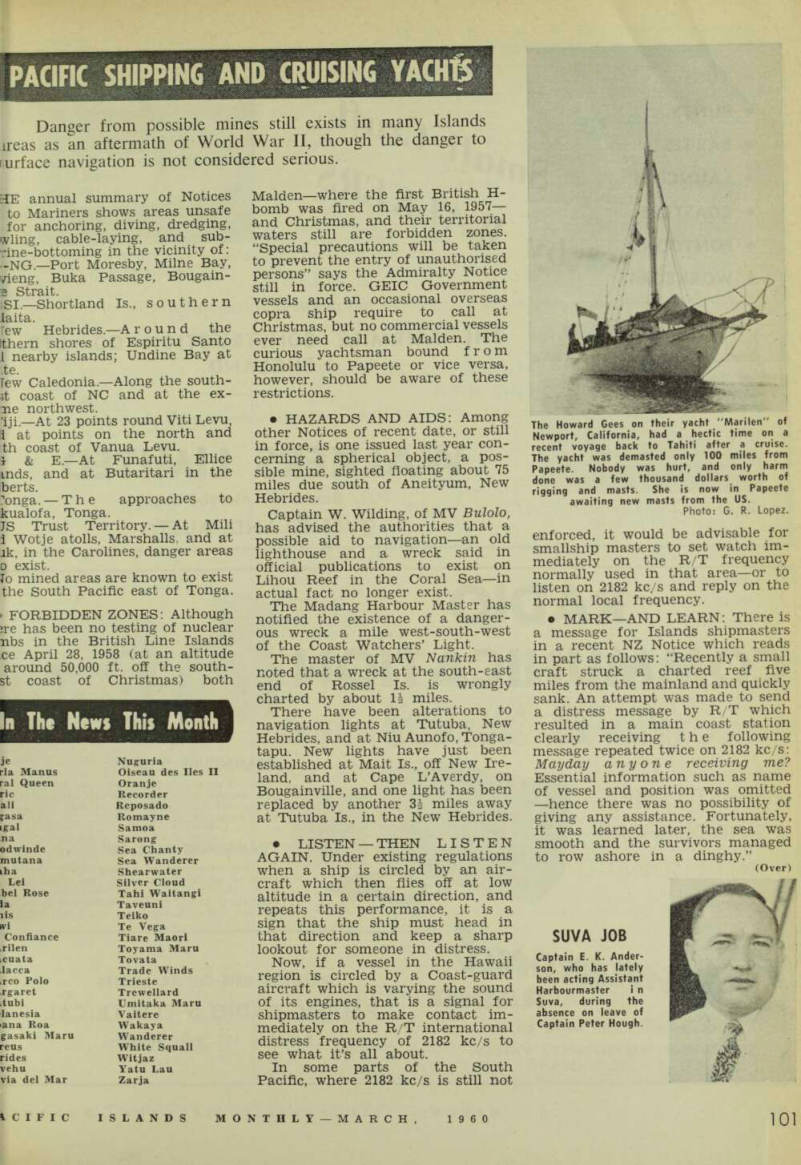
The Howard Gees on their yacht "Marilen" of Newport, California, had a hectic time on a recent voyage back to Tahiti after a cruise.
The yacht was demasted only 100 miles from Papeete. Nobody was hurt, and only harm done was a few thousand dollars worth of rigging and masts. She is now in Papeete awaiting new masts from the US.
Photo; G. R. Lopez.
Suva Job
Captain E. K. Ander son, who has lately been acting Assistant Harbourmaster in Suva, during the absence on leave of Captain Peter Hough.
Automatic Distress
Less likely to for- Ithe correct procedure when send distress calls is a device lately sed by the Japanese Maritime sty Board. Stowed so that it will jt free as the ship sinks, or irnatively so that it may be red overboard, is a buoy enclos an automatic distress trans fer. When launched, it projects -ft rod antenna and proceeds to jismit identification signals until ibatteries eventually go flat, he idea is not new. The sono y used in submarine hunting, said to have been adapted by :RNZAF in Fiji for air-sea rescue ik, is a similar idea, and an auto ;ic transmitter stowed in the tail non of an aircraft which will rate following a crash has been :d in US. The Japanese device specially adapted for ship dis ;s use, especially for those not ipped with radio, or whose radio ■ut of operation.
P-NG TANKER; In one of the ;t interesting examples of ship ping ever to be carried out in »ua-New Guinea, the steel cargo sel Duali is at present being con ned into a tanker at Rabaul. he will carry bulk fuel and oil n Rabaul to coastal centres, do away with the laborious system nan-handling drums which is the al method today. Some small ds had deck tanks or hold tanks ailed, but Duali is being con ted to a true tanker with proper aping equipment, valves, piping L safety systems. ►esigned in Sydney, the con sion is being carried out in jaul under the direct supervision the owners, G. and M. Shipping. ; Co. will be remembered for the air job that it did last year when British Solomon Islands motor sel Coral Queen was holed on a f during her delivery voyage, gest job of its type to be carried in Rabaul for at least 10 years, mabled Coral Queen to proceed Australia for further work and vey before going into service. )uali is one of the best known I newest of cargo ships operating of Rabaul. She was originally Australian Shipping Board vessel, I was brought to Rabaul by G. i M. Shipping.
• Check That Gear: In Tlie
)k Islands, where safety regula is have always been lax —though lewhat improved in very recent ,rs—there will be a stir in April en, for the first time, marine sur ors from Wellington are to drop and look over the local fleet, ween now and then, there is ;ly to be some scurrying round tailing buoyancy tanks in work ,ts which are, in some cases, serv double purpose as life-boats, in iting up life-belts, checking over je pumps, etc.
The problem of keeping life-saving gear in a state of readiness is a very real one in the Islands. Where large numbers of deck passengers are carried or where it is difficult to keep unauthorised persons from coming aboard at ports of call, lifeboat rations are looted and life-belts constantly stolen or taken from their racks and used as pillows, damaged, or lost. Because this is so, it is felt that the authorities everywhere in the Islands should place more emphasis on the carriage of fool-proof automatic distress transmitters by these vessels. There may be no legal machinery for enforcing their adoption, but their ad-
vantages should be constantly stressed and the importation of suit able sets encouraged in every way.
'■pwir q a A/nr* dtt't T->Tc-c , rnD^Tvj r r• Tories Department is to be disbanded are correct> MV Moana Roa, now building in a British shipyard, could technically have a new owner by the time she goes into service. That owner presumably would be the Marine Department, which has operated a passenger vessel between, Bluff and Stewart Is. for many years,, and which also administers the re serve cable ship Matai and some smaller fry. A new vessel for the Stewart Is. service is at present
Udine in Auckland, largest ship be built there for many years.
Dther departments, however, are
0 interested in small and :re is a probability that the Hml y Department will operate a big w vehicular ferry on the NZ er-islands service—so at present »re is no certainty about the itrol of Moana Roa in the event Island Territories disbanding.
Mr. Fred Evans, chief engineer in mi Pomare, which Moana Roa U replace, flew to UK in February d is now standing by the vessel.
L ptain Hare is expected to follow len the ship is nearing completion the middle of the year. Mean lile in January, he too £ pre nt command north to the Cooks 1 voyage number 315, following rich, she paid off her crew and was i annual survey in February arch.
• New Fishing Trend; Auck
nd fishermen reported in February iat a Japanese stern-trawler of 300-3,000 tons was operating west ■ the North Island well beyond the iree-mile limit but on grounds hich have long been trawled by uckland fishermen. A similar jssel was seen there also last year.
The vessel was not breaking inter ational law or NZ law as it stands t present, but the significance of lese activities seems to have been verlooked by the NZ public. This ; believed to be the first evidence f Japanese trawling activities in is South Pacific. By trawling is leant net fishing for types of fish rhich remain in the same general rea throughout their life cycle as ottom feeders, and therefore can be Doked on as belonging to the con inental shelf on or above which hey are feeding.
In the past, except for some aiding of trochus reefs, the Jap mese have confined their activities o tuna long-line fishing. Tuna nigrate far and wide and are true iceanic fish, not associated with my one locality during their life
cycle. In no sense can tuna b co sidered as belonging to any par ticular continental shell.
Little if any trawling is done in the islands, if only for the reason that the waters are mostly too deep. However, there may be a few potential trawling grounds off the larger rivers of New Guinea a Sii and for that reason, any trawling activities foreigners—even beyond the tnree mile limit—should be of c°ncern to the local authorities Certainly for New Zealand there should be more interest in Australia’s stand m favour of national control of fisheries out to the 100 fathom line at least—and that may be far be yond the three-mile limit. .
Description of the vessel sighted near NZ tallys fairly ctosely with that of the fisheries training ship Umitaka Maru, which called at Wellington a year ago, in which case
the present activities may n<pt be on a commercial basis but simply a testing of potential new grounds.
No one can blame Japan for her drive and enterprise in seeking and exploiting unused fishery resources all over the world, but countries with bottom-based resources at their front doors had better look lively if they want them for themselves.
• She May Be Famous;
South Pacific Trading Company’s Rarotonga-based two-masted schooner Tiare Maori, 168-tons, may be the subject of a forthcoming new series of Cook Is. pictorial stamps She has been suggested as one of the acceptable subjects.
Tiare Maori is already famous as the paddle steamer Henrietta of the film Around the World in 80 Days.
It was after the production of that film that owner Walter S. Johnson purchased her and refitted her as a schooner, with a modern staysail rig and a foremast yard for Trade Wind work. She is one of the few surviving schooners in the South Pacific, Donald’s Vaitere, 181-tons, based at Papeete, being perhaps the finest. Tiare Maori was immobilised at Rarotonga with engine trouble for a couple of weeks in January.
She had earlier grounded in Avatm Harbour for a short period. (Over)
"Moana Roa" In Uk
This is how the New Zealand Island Territories Department's new m.v. "Moana Roa looked in January in its British shipyard. T he photograph was taken by a 'TIM" reader. The Moana Roa" is expected to be launched by about mid- March, according to a late report from At right is Chief Engineer Fred Evans of NZGS "Maui Pomare", who has now joined "Moana Roa" at the Grangemouth Dockyard.
„ •, FIRE AVERTED: A cocoa ca 2P l he J oc , aI vessel Firt got wet the hold, during heavy weather cently, on the way to Lae, NG. Dr out, it was reloaded on Thorsl for overseas; but combustion set found nearly red hot , e - h 9 ld - The c °c°a was quickly i loaded again. *
• They’Ve Had It: T
storied ex-sub-chaser T ova (which wus to have been renan Mac II had she been reco missioned as a barge) and ■ less-stoned Komaiwai, both of Su apparently made their last m. to a breaking-up berth in Janua Following the lifting off of tb superstructures by crane at 1 wnari, the wooden vessels were be dismantled by Whippy’s boi yard. Tovata was laid up by R. Carpenter & Co. last March a purchased for possible conversi to a barge at a low price last Ji by Mr, A. S. R. Macalist Carpenters Komaiwai was laid ' m mid-1959. • ADRIPT: Fijian Affairs E payment’s Suva-built 84-t wooden motor vessel Yatu Lau v adrift with a disabled engine j two days early in February in t Eastern Lau Group of Fiji s was bound from Moala Vanua-i-Colo. In response to a ci tor assistance, she was taken tow by Mr. T. Hurley’s 39-b Melanesia. By then, Yatu Lau hi blown to within 200 miles Tongatapu from where she w towed 245 miles back to Suva, wi a call at Moala to land sor passengers.
• In The Big Ones: Jol
Figgess, son of Rev. H. W. Figges chaplain of the Mission to Seame Suva, looked in to that port i January as one of the cadets : the Shaw Savill liner Don Following navigation studies at tl well known Southampton Scho of Navigation, he had just joine this ship as a budding Britis Merchant Service officer.
• In For Repairs: The 1£
years-old, 7,264-ton Ha in Liu British freighter Trewellard, wit a full cargo of sugar from Fiji fc the UK, spent two weeks in Ameri can Samoa in January awaiting sc engine part which had been flow; to Fiji for repair then flown bad to Pago Pago.
Also bound for the Pago Pag slipway in January-February wa the Cook Is. 128-ton ketch Taveum Some time ago, this D. C. Brow) vessel exchanged her Crossley moto: for a new BL3 Gardner which neces sitated a change of propeller. N< lathe capable of drilling out the bos; of the new propeller existed ii Papeete, where the engine was in stalled—hence the trip to Pago Pago She might have to go even furthei west to get the job done. Undei
jnand of Captain Archie Picker »of Fiji, the ketch made calls almerston and Pukapuka as she >ed towards Samoa.
Ifishing Tragedy: There
;a fishing tragedy off American oa recently which was a warn :that long-line tuna fishing has perils as well as its profits, nee Curry, 52, operating with irs from a small launch, was ng out a Japanese-style tuna -line when a hook pierced his nb behind a tendon. He was oped overboard by the drag of gear and, before the launch d be stopped and put about, was ed under and drowned, panese activities out of Pago 3 have stimulated some interest ;ocal men, and the former inter :id passenger vessel Samoa, com ely remodelled, under the owner , of a group of business men, to start long-line tuna fishing at the end of February. Like the gan operations, this will be ched with considerable interest.
The Name That Would
I* STICK: Soon after the Amen i ex-sub-chaser Isabel Rose ved at Pago Pago in 1955, she renamed Fagasa by the Goy or at the invitation of the iers. It seems, however, that leone forgot to paint the new tie on the hull and people e gone right on calling her bel Rose— to the confusion compilers of registers and those •rested in Islands shipping. Our irmation is that everyone had ter just quietly forget all about name Fagasa, at least until the iers paint it on their ship. The uments, we understand, still show • original double-barrelled name Isabel Rose.
. For Sale Again: The Auck
d-built 207-ton wooden vessel Lei, well remembered in Fiji a unit of the fleet of the un icessful South Seas Marine Pro mts, purchased by the Royal NZ vy in 1951 as a fleet tender, was lin put up for sale by the Navy February. She has been used for ; carriage of naval stores and initions in Auckland area since ng south from Fiji. > GONE FOREIGN: The hand ne streamlined French-built 500i steel supply-ship Oiseau des s-11, owned by the Makatea osphate company in French lynesia and used for the carriage stores and company personnel :ween Makatea and Papeete, made sail at Suva in February, en route Vila on her first voyage west of ihiti since she was delivered from ance in 1956. Her owners have tablished a new manganese min ? project on the west coast of ate, across the island from Vila, is not known whether the present yage was occasioned by the recent irricanes which damaged the new
b-e there or -er
SSr:asms
SlPgi
first visit there. • STILL SEEKING: The circumstances under which the GEIC Government 126-ton ketch Te Matapula moe incf v»v firp in December were 2M unknown To P/M laS S Feb- ?uarv Capfain G. Douglas, the marine superintendent, went to Suva in January to look over the some-
ssglfSi
lipi
t 0 sail for Nukualofa, Vavau, Pago Pago and Honolulu in March, vmv The • . I^™^ p l °s t S d SL into the woodmans axe Dit deep uiwj t planking of MV Nereus at Rabaul recently, bringing to an end another ship as well. Once a pretty 64 looter
pped for sail, Nereus was con red beyond economic repair had been out of survey for more i a year. -iginally named Himau, she was : in a Sydney yard 26 years ago.
Bernard Chan, of Rabaul, paid )00 for her soon after the war n new shipping was urgently led in Rabaul as copra once e came into production. Later, was bought by Mr. Bert Wick 1, of Rabaul, and became one of few vessels to visit the Driand Is., Papua, regularly. A ial permit was required because lealth and immigration regula s affecting the Trobriands. ickham, a colourful and at times :entious character, took his re isibilities in the Trobriands to rt and undoubtedly did much to > the islanders. On more than occasion he used Nereus to bring for sick natives, and often helped n with medical supplies at his . expense. ereus became one of the best wn ships in the area, and the ives preferred to do all their lings in shell with Wickham, s was amply demonstrated one when another smallship master red into the area, creating a ngular situation in which feel -5 ran high. The newcomer with er after a series of small in aits in which, it is reported, his lace was overturned and his gear ipered with. ereus figured in a spectacular dent some months later when :kham claimed that an un itified powerful motor fishing >el tried to ram him at night. The d crept up without lights, he said, I moved away when he waved a i from the forward deck, ater, Wickham had a run of bad his second ship, MV Nuguria, k at sea (no lives lost), and •eus was becoming more ex isive to keep in survey. Sub uently, a Rabaul man acquired
the ship, out of survey, and just recently she was broken up for scrap.
• Ready For Work; Tonga’S
new 114-ton longliner Teiko left Japan on January 28 for Pago Pago, where she was due about February 22 to exchange her Japanese crew for Tongans. An arrangement had been made whereby the Japanese were to transfer to Japanese vessels based at Pago Pago. From there Teiko was to proceed to Nukualofa, perhaps after slipping for routine bottom examination.
• For N. Hebrides: Mv
Nevehu, a 60-ft K class scow, especi ally modified for general cargo work in the New Hebrides, was officially launched at Bjarne Hal vorsen Ltd.’s boatsheds, North Syd new, on February 8. Built for W. S.
Tait & Co. Pty., Ltd., Sydney, for eventual use by Maison Barrau, of Santo, she is the 11th vessel of this type built for Pacific Islands trade by Halvorsen’s since the war.
Present at the ceremony was Mr.
C. E. Tait and his son, Mr. Bob Tait, Mr. Bjarne Halvorsen, Mr.
Paul Mercier (of A & P Mercier Societe, Noumea) and the crew Messrs. W. R. Womersley, W.
Goddard, C. McDonnell, E. Onslow and C. Southwell.
Because of the special working conditions in the New Hebrides, careful attention has been given to the anchor handling gear. The windlass is operated by an electric motor, powered by a Ruston auxiliary 110-volt, 5 kilowatt generator in the engine room, which also powers the electric cargo winch. Main power unit is a 6L3 Gardner diesel, rated 114 bhp and giving a working speed of Ih to 8 knots when laden.
The crew’s quarters are in the deck house aft, which feature a gas stove and refrigerator and berth/ settees with vinyl-covered foam rubber mattresses. A fresh water shower is also provided.
Nevehu is the native name for a tree widely spread throughout the New Hebrides and is considered symbolic of the Group. The English name for the tree is not known, though it is called “Bourao” or “Purao” by the French.
• Papeete Calls By Dutch:
The Nederland Line Royal Dutch Mail motor-vessel Oranje (20 600 tons) will make the first of a regular series of calls at Papeete, Tahiti, in Oct. this year. Quarterly calls will be scheduled for 1961 on the Sydney- Europe service. At present, the other Nederland Line vessel, Johan Van Oldenbameveldt (20,300 tons) visits Papeete every three months. Sydney agent is the Royal Interocean Lines office.
• New Cableship Base?:
When Cable & Wireless Co.’s cable layer Recorder, 3,349 tons, called at Suva in February to renew the shore ends of three transocean telegraph cables, Captain P. B.
Henderson reported that Suva might become the base for a cable ship within the next few years.
There is certain to be a lot of
wonga Government's 114-ton tuna longliner "Teiko", photographed on her way from Japan to Nukualofa in February. See below. —Photo courtesy Tonga Government.
Top photo shows Mr. C. E. Tait, with his son Mr. R. C. Tait, on board the m.v. "Nevehu" at her launching in Sydney in February. Below, she is seen on her final trials. See story at left.
ship activity out of Suva mg the laying of the trans- Ific telephone cable which has been approved by the various amonwealth governments. Up J 1 a few years ago, a reserve i»ly of cable was kept at Suva x special “swimming baths” at > entrance to Walu Bay—cable is .illy stored under water—but jgh the roofed-over concrete a still exists it is no longer in i completion of her work near ei, Recorder was to take sound south of Fiji in connection i the projected telephone cable. ;; was a continuation of work iied out last June.
FREE PORT: First free port ihe Pacific Islands area came operation at Naha, Okinawa, Ikyu group on February 20. free-port area consists of a warehouses occupying a part ;he port area of this American tary-controlled capital of nawa.
Sale Or Charter; It
eared fairly certain late Feb ry that the 225-ton steel twin w NZ coaster Inaha, now stered at Vila, would be heading th from Auckland for the New •rides probably via Brisbane, in •eh. Under command of Captain i Barnett, part owner, Inaha have cargo for Vila and will a be for sale or charter. The i cargo presents the owners i the opportunity to “display j wares” in what they consider potential shipping market, •tain Barnett was partner with other shareholder, Mr. L. iham, of Auckland, in an earlier sel. He has also served in on SS Co. Islands vessels.
Watch Those Dracones;
two past occasions reference has n made in these columns to a Dping development in the UK ch could have great interest in :ain Islands areas. This is the ible oil barge which has been »n the name of dracone. These ges now seem to have clearly ved their worth and are going ) operation in increasing num s. The experimental work was ried out jointly by Esso roleum Co. and Dracone relopments Ltd., and the actual duction has been done by P.
Cow Ltd., of Southhampton. ►nly one model is believed in duction so far —100-ft long and b in diameter, carrying 9,000 lons of oil. The material used nylon coated with synthetic her. The towline used is 100 tioms of nylon and, even in the ghest open-sea conditions, the cone is reported to tow with the atest of ease and with very low irer requirements in the matter a tug. Several have lately been t to West Africa for river use. lie towing vessel carries a small itoon on deck, fitted with a
simple type of wide-drummed winch onto which the dracone is wound when empty. Then the whole rig is hoisted aboard the tug for return to the filling station.
There must be many places in the Islands where dracones would provide a relatively cheap answer to the bulk oil problem.
Th£ dracone has presented navigation authorities with the necessity of bringing out some new regulations, as this form of barge obviously cannot carry orthodox navigation lights. By day, the towing vessel will exhibit a black ?n g th? d rpa? ie of < ° the f dracone^must L mrv a bLck fIS The tug will exhibit formal towing lights at night, and an all-round white light
will be displayed from the float at the rear of the tow.
Price of the first dracones was said to be about £2,000, but this may fall as more are produced.
• Not Quite So Deep: After
allowing for certain instrument errors, it was found that the US Navy’s bathyscaphe Trieste actually reached a depth of 35,800-ft—about 2,000-ft less that the depth recorded by the instruments during the January 23 dive into Challenger Deep of the Marianas Trench. The corrected depth agrees more closely with that determined by soundings from the Russian oceanographic vessel Witjaz during the course of her Pacific cruise in 1958. (Over)
Zarja Located: That
ee-masted 580-ton Russian ooner Zarja, world’s only non gnetic vessel, has finally been tted. She dropped into Mel irne for engine repairs to her imetal diesel on February 9 and ; there again in a few days for oart, Wellington, an unstated n Guinea port, China, Japan, i Vladivostock. Melbourne re ts indicated a team of nine mtists aboard to handle the gnetic survey research work ng carried out. (See PIM tober, 1959, p. 103). ► SPOT OF BOTHER: When the -ton fisheries training ship yama Maru sprang a serious k 170 miles north-east of Imyra atoll on February 13 she ised something of a stir. The lerican Standard Oil Co.’s small 25-ton tanker M. E. Lombardi nt to her aid. An RAF plane m Christmas Is. and the US astguard cutter Basswood from nolulu were also despatched, th aid supplied by the tanker the rn-tube leak was repaired and i training ship with her 40-man ;w was able to proceed to molulu under her own power. yama Maru belongs to the fiectural government of Toyama, fir only ship. The 108-ft steel jsel was built in 1952.
• Another Aust.-P-Ng
NK; A new shipping service be een Australia and Borneo, to irt in April, will call regularly at rt Moresby, Rabaul, Lae and idang. Austasia Line Ltd., of agapore, will use two sister ships, Vs Malacca and Matubi (each 100-tons d.w.), on the run from lelaide, Melbourne, Sydney, isbane, P-NG, Nth. Borneo and rawak, Malacca will inaugurate the twice from Adelaide on April 27,
and Matubi will follow six weeks later. Each can carry more than 4,000-tons of refrigerated and general cargo and each is fitted with modern handling gear.
Australian agent is the Blue Star Line (Aust.) Pty. Ltd. and in P-NG bookings will be handled by the New Guinea Company Ltd.
• Still Hard And Fast; The
ten-year-old 6,589-ton Sawayama Risen KK freighter Nagasaki Maru, ashore on Helen Reef, north of Dutch New Guinea, since December 5, was still very much ashore in mid-February and the outlook for her underwriters did not seem to be particularly bright, according to a Tokyo report.
The owners said on February 12 that several attempts had been made to salvage the vessel and her cargo; however, due to stormy weather, the vessel has been driven farther aground and the original salvage plan has had frequently to be revised. The decisions of the salvage company have been pro longed due to the vessel’s difficult position and the geographical isola tion of the reef.
The present idea, the owners said, was to blast the reef and excavate a channel over 2 000 yards towards an inside bay. But the owners have a feeling that the vessel may be come a total loss. A considerable quantity of cargo had been jet tisoned, and jettisoning was still in progress at that time. The vessel was on the New Zealand run.
A fairly large consignment of mail for New Zealand from Hongkong, China, and the USSR, was safely transferred to Ngato Maru No. 5, returned to Japan, and eventually reshipped from there in the Nitto Line vessel Showa Maru.
• La Con Fiance Visits Nz:
Under command of Commander Gerard d’Antin de Vaillac, the French Navy’s escort vessel La Con fiance, 1,450 tons displacement, of the Noumea station, paid a visit to New Zealand waters in February- March on a flag-showing visit. La Confiance, launched 1942 as HMS Mayolxi for the Royal Navy, became the French Navy’s Tonkinois a year later, and received her present name in 1953 prior to replacing the well remembered Dumont d’Urville on the Noumea station.
• New Pilot Vessel For
APIA: Apia is to have a new pilot vessel, which will be built to an overseas design in the Apia Marine Yard. This was announced by the W. Samoan Minister of Marine (Mr. E. F. Paul) who said that the proposed vessel would be 55 feet long, with a beam of 14 feet and a draught of 4 feet 6 inches. It would be powered by one 6-cylinder Gardner diesel engine of 114 hp.
Mr. Paul said that Cabinet had approved the acceptance of the de
photograph from Captain Brett Hilder shows [?]auxiliary ketch "Avalon" ex-"Taipan", of RAN, as she was beached on Iririki Island [?]la Harbour not long before the December [?]ame blew her into 60 feet of water ("PIM" [?]ary p. 107). Only the top of the mast protruding from the sea in January and the [?]alian Army soon attended to that by blow up the "Avalon" so as to clear the channel.
Captain Hilder: "I had more than I paid [?]er out of her in teak —which is what she made of —so I have no regrets." The les had been removed before Captain Hilder bought her.
sign submitted by a Scottish fi
Messrs, Millers Ltd., who had b
designing wooden vessels for n than 200 years. The proposal build the vessel in Apia, under
supervision of the Harbourmas
would reduce construction costs less than half the cost of a sim vessel built overseas, said Mr. P The cost of construction was e mated at £8,275.
News of Cruising Yacl
• SARONG, of Sydney, almost round world, reached Auckland from Rarotr on February 30 and was to continue oi Sydney at the end of the month, yacht arrived at Rarotonga from Par on January 29. With owner E. J. l were three crewmen, one a Dane, others Australians. • KIWI, of Auckland, in Islands p last year, arrived back in NZ waters e February. With owner Tom Bott and c panions was John Guzzwell, of TREK who joined at Sydney, having presum left his own yacht at Honolulu for present. • NERIDES, of Auckland, which cru Polynesia last year, has changed hs locally. • MARGARET, 25-ft. cutter owned Brian Small; SILVER CLOUD, a cutte about 30-ft.; WANDERER with ' Buchanan and companions; WHI SQUALL and the Norgroves; and the o seas yachts JANIS, KOCHAB ROMAYNE, are all lined up for March-April departure from Auckland Polynesia and points beyond. In addi SHEARWATER and the Auckland 1 WAKAYA in which Ted Hayes cruised to the Islands in the past, ar clear for Brisbane. The yacht-cum-trai ketch TRADE WINDS, with Athol Ru: of Auckland in command, is listed ft March departure for Tonga, Samoa, Hawaii. Brian Neill’s big motor cn REPOSADO is also straining at her li with rumours of a departure for Que land or the Bahamas mooted. This v< is still on offer. • HAMUTANA, the 88-ft. steel m cruiser in which the John Gallagher fai cleared Auckland on Christmas Day Queensland waters via Lord Howe, retui home February 8, five days out of Syd • MARCO POLO and Aksel Pede; were reported at Los Angeles e February, bound Denmark via Pana Pedersen sailed from Auckland in yacht, which was earlier sailed round world by Armit and Loe, in July, 1958, has had various crewmen since then, yacht was almost lost in French Polynei waters when it went on a reef at one st
The "Novia del Mar" mentioned on page [?]
AFFJE, of San Francisco, a 60-ft.
Doner, was scheduled to sail for Auck- IJ via Islands ports in February.
SEA WANDERER and Edward Allcard, ,ch sailed from UK for the Pacific via li several years ago, is still working as ;harter-boat for Commander V. E. B. holson and Sons at English Harbour, igua. The 36-ft. ketch is one of about it so employed. Commander Nicholson chased the former Tahiti-based ooner TE VEGA as a unit of his own t. » GLINA, 60-ft. Adelaide yacht, cleared t port for NZ and Islands ports on iruary 14. First port was expected to Russell. , TAHI WAITANGI, 58-ft. ketch manned 76-year-old retired sea captain Percy London, sailed from Sydney for NZ on truary 1. Two years ago Captain idon broke his arm while on a similar age and was forced to put back. The eh is 67 years old, but has lately been ed with automatic pilot, D/F, and other od cons". Both Captain London and ;ht (originally a cutter) belong to New iland.
> Los Angeles-Papeete Race: A
ond post-war Los Angeles-Papeete race mooted for this year, probably to co ide with the July celebrations at Tahiti, tails of likely entrants will be given ;e the race seems certain to take place, anwhile, yachtsmen interested in enter- I could obtain details from the Trans cific Yacht Club, 210 West 7th St., Los geles 14, California. The previous event, 1956 was won by JADA on corrected ic; fastest time was made by NOVIA L MAR. The race started at 2000 GMT June 6 and NOVIA DEL MAR crossed ! finishing line on July 7 at 21.01.08 IT. JADA with a handicap of 2 days 2 irs 12 minutes 8 seconds crossed the line the same day at 23.47.04 GMT. NOVIA L MAR was scratch boat.
Inly previous Los Angeles-Papeete race s in about 1923 and was won by IRINER in an elapsed time of 20 day? h hours. > CARLA MANUS, 66 ft. aux. schooner, II known in New Guinea where she was led for a year or so by Mr. J. Thurston.
Rabaul, was sold recently through ptain W. L. Kennedy, Sydney ship per, to Mr. John G. Wotherspoon, of alon Beach, Sydney. She is being pre
pared now for a trans-Pacific cruise to Cali fornia, via Islands ports, with Mrs. Wother spoon, their 10-years-old son, and a small crew. • SEA CHANTY, of Canada, now at Whangarei, NZ, has been sold by Roy Kempel to one of his sailing mates and the trio has now separated. The yacht will remain in NZ waters for an indefinite period. • GOODWINDE of England, 51%-ft. x HVz-fi. x 8-ft. cutter, with owner Dr.
Keith Laws, Lindsay Gillies, John Hunter, Michael Denny, and Henry Strasburger aboard, cleared Balboa in early January for the Galapagos, Rapa, Pitcairn, Tahiti, and presumably other places to the west ward. • FINGAL of Penzance, England, a 33ft. x 10-ft. x 5U ft. sloop, with owner Des McLeod and Dean Van Trease and Dwight Lawton aboard, also cleared Balboa early
January for New Zealand via Polynesian ports. • A CATAMARAN, 35 ft. long, with white twin hulls, each carrying a small cabin and another built between the hulls, was being prepared at Port Moresby, Papua, in late February, for a trans pacific voyage to Canada by French owner Henry Maizonnier. A former lieutenant in the wartime Marquis, he bought the craft at Darwin and sailed it to Moresby in 1957. Later, he went on to Samarai, but tangled with a cyclone and returned to Port Moresby with damaged sails. The catamaran now sports a new nylon set for the 32Vz ft. mast. With Robert Burke (27), marine and aircraft engineer, of Brisbane, and Keith Bolton, a 22-years-old English man, Maizonnier plans to sail to Thursday Is., inside the Great Barrier Reef to Bris bane (to fit radio gear for the Pacific trip), and then via Central Pacific ports and Tahiti to Vancouver.
"Marco Polo", reported at Los Angeles early February, bound for Denmark.
[?]ese photographs taken in Suva in February, [?]ow the Cable and Wireless Company's 3,300- [?] cable layer "Recorder" laying a new length cable linking Fanning Island with Suva. The [?]ble was brought ashore on plastic buoys and [?]liced at the shore end. The photo below shows [?]e view of the "Recorder" from the Suva waterfront.