The Month’S New Reading
pp. 90-99 · Read in the full issue
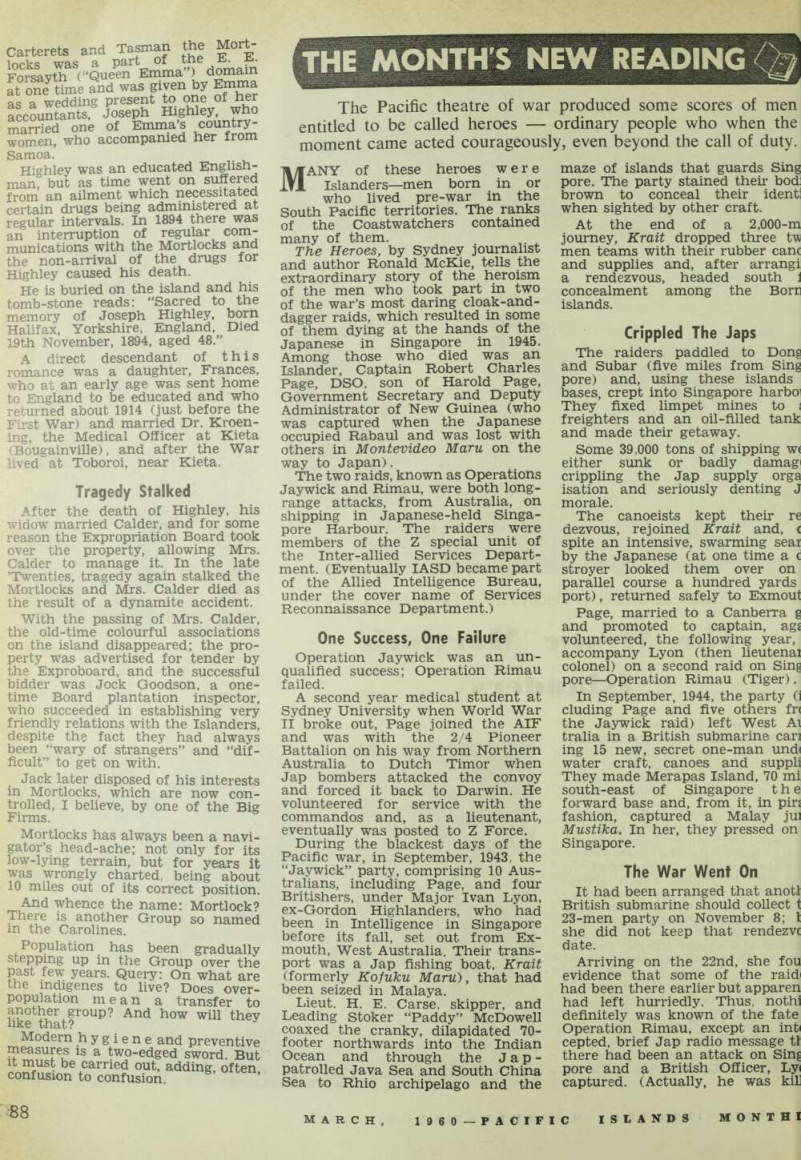


The Pacific theatre of war produced some scores of men entitled to be called heroes ordinary people who when the moment came acted courageously, even beyond the call of duty.
MANY of these heroes were Islanders—men born in or who lived pre-war in the South Pacific territories. The ranks of the Coastwatchers contained many of them.
The Heroes , by Sydney journalist and author Ronald McKie, tells the extraordinary story of the heroism of the men who took part in two of the war’s most daring cloak-and dagger raids, which resulted in some of them dying at the hands of the Japanese in Singapore in 1945.
Among those who died was an Islander, Captain Robert Charles Page, DSO, son of Harold Page, Government Secretary and Deputy Administrator of New Guinea (who was captured when the Japanese occupied Rabaul and was lost with others in Montevideo Maru on the way to Japan).
The two raids, known as Operations Jaywick and Rimau, were both long range attacks, from Australia, on shipping in Japanese-held Singa pore Harbour. The raiders were members of the Z special unit of the Inter-allied Services Depart ment. (Eventually lASD became part of the Allied Intelligence Bureau, under the cover name of Services Reconnaissance Department.)
One Success, One Failure
Operation Jaywick was an un qualified success; Operation Rimau failed.
A second year medical student at Sydney University when World War II broke out, Page joined the AIF and was with the 2/4 Pioneer Battalion on his way from Northern Australia to Dutch Timor when Jap bombers attacked the convoy and forced it back to Darwin. He volunteered for service with the commandos and, as a lieutenant, eventually was posted to Z Force.
During the blackest days of the Pacific war, in September, 1943, the “Jaywick” party, comprising 10 Aus tralians, including Page, and four Britishers, under Major Ivan Lyon, ex-Gordon Highlanders, who had been in Intelligence in Singapore before its fall, set out from Ex mouth, West Australia. Their trans port was a Jap fishing boat, Krait (formerly Kofuku Maru), that had been seized in Malaya.
Lieut. H. E. Carse, skipper, and Leading Stoker “Paddy” McDowell coaxed the cranky, dilapidated 70footer northwards into the Indian Ocean and through the Ja p patrolled Java Sea and South China Sea to Rhio archipelago and the
maze of islands that guards Sing pore. The party stained their bodi brown to conceal their identi when sighted by other craft.
At the end of a 2,000-m journey, Krait dropped three tw men teams with their rubber canc and supplies and, after arrangi a rendezvous, headed south 1 concealment among the Born islands.
Crippled The Japs
The raiders paddled to Dong and Subar (five miles from Sing pore) and, using these islands bases, crept into Singapore harboi They fixed limpet mines to i freighters and an oil-filled tank and made their getaway.
Some 39,000 tons of shipping w( either sunk or badly damag< crippling the Jap supply orga isation and seriously denting J morale.
The canoeists kept their re dezvous, rejoined Krait and, c spite an intensive, swarming sear by the Japanese (at one time a c stroyer looked them over on parallel course a hundred yards port), returned safely to Exmout Page, married to a Canberra g and promoted to captain, ag£ volunteered, the following year, accompany Lyon (then lieutenai colonel) on a second raid on Sing pore—Operation Rimau (Tiger).
In September, 1944, the party (i eluding Page and five others fr< the Jaywick raid) left West Ai tralia in a British submarine can ing 15 new, secret one-man und( water craft, canoes and suppli They made Merapas Island, 70 mi south-east of Singapore the forward base and, from it, in pin fashion, captured a Malay jui Mustika. In her, they pressed on Singapore.
The War Went On It had been arranged that anoti British submarine should collect t 23-men party on November 8; t she did not keep that rendezve date.
Arriving on the 22nd, she fou evidence that some of the raid* had been there earlier but apparen had left hurriedly. Thus, nothi definitely was known of the fate Operation Rimau, except an int( cepted, brief Jap radio message ti there had been an attack on Sing pore and a British Officer, Ly< captured. (Actually, he was kill
a skirmish with a Jap patrol). >After the Pacific war ended, Aus ulian and British Army in- Estigators learned the story. With sight of Singapore, a Malay [lice patrol launch went out to Eard Mustika —they were at anchor, [•parently, and, in the melee that [lowed, the launch was fired on, ink, and two of the three police- E=n killed. The third swam away id escaped, to give the alarm.
With their secrecy gone, they up Mustika and her cargo of iderwater craft and took to the moes in an endeavour to scatter id escape through the Thousand lands archipelago to rendezvous ith the submarine on November 8.
IBut it did not turn out that way. ae Japanese hunted them down th a battalion of battle-trained Dops and flotillas of patrol boats, tme were killed in various small tions; 10, including Page, were ptured.
Held in prisons, but well treated ice the Japs did not regard them usual prisoners of war, they were urt-martialled seven months later i charges of espionage and murder he evidence was presented that ey killed the Malay police patrol lile flying the Rising Sun flag on eir junk). Judged guilty, they jre ceremonially executed.
Japanese Impressed
It transpired that the Japanese, ipressed with the raiders’ bravery, garded them as heroes compar ile in every way with their own >tables of military tradition.
Engaged in writing The Heroes, maid McKie pieced together the itline of Operation Rimau, but it ill would have been a shadowy itline except for an extraordinary incidence. Most of what was lown to the Allies about the out me of Rimau had stemmed from e researches and the pen of Dlonel Cyril Wild, of the War •imes Commission, who examined number of Japanese documents nnected with the raid, the cap re, and the court-martial. Wild is killed in a 1946 plane crash in angkong; but his reports several nes mentioned a Japanese inter eter named Furuta.
At a dead-end in his search for ithenticated material on Rimau, cKie talked with a fellow press an in Sydney who suggested he rite about Furuta to the Associ ed Press office in Tokyo, Back me a letter with the amazing iws that, among all the millions Japan, Furuta had been located.
It appears that the AP chief had lephoned the Japan Veterans’ ssociation and they had written ick that it would be practically ipossible to find Furuta without me more solid clue than that he is once an Army interpreter in ngapore. As fortune would have it, girl member of the AP staff saw
the note and recalled that her former English teacher, a man named Furuta, had been in Singap ore .
Then ensued lengthy correspondence between McKie and Hiroyuki Furuta during which it became quite evident that this Japanese, who was Director of Public Relations of the Japanese Red Cross from 1948 to 1953, had been a civilian interpreter in Singapore when the Rimau raiders were interrogated in prison. He had apparently befriended them and developed an admiration for Page.
From Furuta, McKie learned the story from the Japanese side about
Operation Rimau, the search and the capture: the details of the court martial; and the bravery of the men who resolutely refused to plead for mercy; and of the effect of their bearing on the top-ranking Japanese at Singapore. Even the Japanese C-in-C, General Itagaki, addressing his staff, acknowledged their bravery and courage.
A month after Page and his corn panions were executed, the atom bomb burst over Hiroshima; nine days later Japan surrendered, McKie graphically and movingly reconstructs the two raids and their aftermath and tells the fascinating story with clarity and precision.
iis piece of war history will be absorbing interest not only to eiders in the Islands particularly, t also to men and women every tere.
THE HEROES. Published by Angus i Robertson, Ltd. Australian price, -.)
First Class
inadian Novel
[UGH MACLENNAN, who was a Canadian Rhodes Scholar, is be ing described these days as a .nadian novelist of increasing iture, and we don’t wonder if atch That Ends The Night is a nple of his work. It’s the first of 5 we’ve read. [t tells the story of a marriage tween George and Catherine swart, begun after a false start d threatened as its height by the ;urn of a former husband and by therine’s rheumatic heart, which s always been with her. And it Is the story very well, through a •ies of flash-backs, rhe characters are influenced ry strongly by the great financial pression of the early ‘Thirties— -5 time between the two wars when Bre appeared to be no point to ything much, and those who Bntually found a point often found b wrong one. In that, the book doubt has something of the auto graphy in it one certainly jpects that the author would have d to live the five years with Dr. ?bee’s fantastic school, Waterloo, d its characters, to be able to ite about them!
Little Dr. Bigbee, who in reality d no doctorate, taught a full ledule at the school, “with such thusiasm that the masters in the ims next to his were unable to ich because his voice boomed rough the paper-thin partitions d drowned them out. He liked ys and had an uncanny under mding of them, and at least ,r e e-q uarters of the boys •rshipped him. He played cricket,
rolled the pitch himself, watered the rinks and was busy every in stant of the day. For recreation he cycled, and I can still see him peddling on his English cycle, which he rode very tall in the saddle, sing ing sea chantys out of tune. He would have been a great school master if he had possessed an education, or even if he enjoyed reading. But he was too busy, so he said, even to read the newspapers”.
Among the others who will re main in the mind after the book is put down are the gentle Reverend Martell and his loving and under standing wife. Mr. Martell likes an occasional drink of rum but he was a good man for all that. As his wife explains one day to the boy they adopted, “Since our little girl died, Mr. Martell and I have just had each other and a few friends in the Church —I mean I’ve just had that, for Mr. Martell knows just about everybody in Halifax, or at least he talks to them as if he does. I’m afraid some of the people in the Church don’t altogether approve of Mr. Martell, and I can well understand why they don’t.
But he’s a good, good man, Jerome, and you will find out just how good he is.”
Perhaps one day the meek shall inherit the earth, but author MacLennan seems to say that the time is not yet.
(Watch That Ends The Night
Published by Heinemann. Australian price, 20/-.)
Battleship That Stood
For An Era
WHEN a shell fired from the Ger man battleship Bismarck hit the magazine of the battleship HMS Hood during an engagement off the coast of Greenland in May, 1941, the Hood blew up, and sank in two minutes, with a loss of 94 officers and 1,321 ratings. There were only three survivors.
The effect of that news when it was broadcast was out of all pro
portion to the loss of one British ship, however large and important she might have been. For 20 years the Hood had represented to millions of people, the whole spirit of the Royal Navy. For so long, she had been not only the largest ship in the British Fleet, but in the world.
The greatest and most graceful ship of her time, perhaps of any time, she was the last of the Leviathans— those mighty ships, whose move ments on the high seas had deter mined policy since the last quarter of the nineteenth century. A gen eration of British seamen had been trained in her. To millions of people she had represented British sea power and imperial might. With her passed not only a ship, but a whole era, swept away on the winds of the world.
Yet the Hood was lost in the 1920’s just as much as in the Denmark Strait in 1941. Defects in her de sign, to which attention had been called many years before, were never rectified.
First of all, in the immediate post war years, there had been the re luctance to spend large sums on capital ships. Secondly, the tide of events had caught up with her, so that it was never possible to take Britain’s largest warship out of com mission long enough to carry out the major alterations she required.
For nearly a quarter of a century the Hood was the most famous ship in the world —a living legend. But one cannot make war with legends, and the fact remains that she was unable to withstand the punishment inflicted by the Bismarck’s 15-inch shells.
The Mighty Hood, by Ernie Brad ford, tells the story of the life and death of the Royal Navy’s proudest ship, but it is more than just a biography of one ship. It tells of this whole era —the era described by the young Evelyn Waugh, by Noel Coward, Michael Arlen, Scott Fitz gerald and Ernest Hemingway, the era of goodwill cruises to the Dominions, of the stupidities and unrealism of the Washington Treaty
Masta Ben
and Buka
aich limited Naval power (on [,per but not in practice as Britain :,s to find to her cost), an era when large section of the Press and Iblic saw every British Army officer a Colonel Blimp and every Ad iral as a ludicrous kind of Program”, both of them equally mt on preserving an absurd old shioned institution known as the ritish Empire. [The termination of the Anglo [panese Alliance was hardly rticed in the British Press of that lie, yet it lead ultimately to the merican-Japanese rivalry in the .icific which contributed in no jiall measure to World War 11.
Even when the Hood was first mmissioned in May, 1920, the ture of the capital ship was un rtain. Torpedoes, zeppelins and "craft now constituted a threat to a power such as had never existed Ifore. As early as 1918 there were any who maintained that the cap- J ship was doomed and that war re of the future would be deter ged by airborne missiles. It was t until the close of World War II at the death of the heavy ship ls finally announced. [n any case, Hood had been de ;ned before the lessons of Jut id, and went down the ways more an two years afterwards in igust, 1918. It was a few years -er before experts were to draw ;ention to the fact that the Hood ffered from some of the same de ;ts which had accounted for the ;s of the battle cruisers Inde xable, Queen Mary and In icible. rhis is a book worth having, rais ; points of view worth debating.
THE MIGHTY HOOD. Published by Ider and Stoughton, Ltd. Australian ce, 24/3.)
imitive Man
War
HE Mambas were an African unit, lead by European officers, who in Burma during the war md more to fight than the Jap ese. rheir officers were a weird lot; ) CO a fierce disciplinarian who night nothing of tieing one of j black members of the unit to a e and birching him; and some the others annoyed at being >ted to the unit, and even more -red of a fight than the troops unselves. rhe troops were unhappy because old tribal enmities, and because the inroads that white civilisation i made on them. More affected in most by civilisation was young briel Mataza, who had been ex led from a Catholic mission tool and who was now confused the world he found himself in. >eorge Brendon’s novel, The arm Of Mambas, puts all this
together to make a readable if a weird, and in some respects an un satisfactory, story. He certainly knows his Africans, and he has met all the officer types.
He is particularly readable on the subject of the effects of civilisation on the primitive—especially when he deals with the primitive attitude to religion. Not only readers with a knowledge of Africa but those who understand the clash of cultures everywhere, will find much of in terest.
But Mr. Brendon appears to be so determined to get all his know ledge into one novel that the end is confusion —and what isn’t confused is a little far-fetched. This is a first novel, and he may do better. (THE CHARM OF MAMBAS. Published by William Heinemann, Ltd. Australian price, 20/-.)
One For Mariners
And Landlubbers
CAPTAN Joshua Slocum’s Sailing Alone Around The World is still one of the most fascinating of sea books for either mariner or landlubber, although it is now 60 years since it was first published. It told the story of how the 9-ton yawl. Spray, of Boston, flying the US flag, made the first lone-handed voyage around the world—46 000 miles in three years and two months.
It’s now about nine years since Cap tain Slocum’s son, Captain Victor, gave the old Captain’s many ad mirers a further treat with his own book, The Life and Voyages of Cap tain Joshua Slocum, which told of the Spray’s exploits and many others, too, involving America’s best known sailor.
That book of Victor Slocum’s is now produced in a cheaper edition for the Mariners’ Library (as Sail ing Alone has been) and anyone who didn’t get the earlier edition should get this one.
It’s first-class reading for those who like adventure, for those who appreciate character, and an honest man.
For Pacific readers there is a fascinating tale of “Bully” Hayes, whom Captain Slocum met, and a story about the vicissitudes suffered by a certain Mr. Moncton in his attempts to sail from Sydney to New Guinea. The old hands will recognise the misspelled Moncton as C. A. W. Monckton, who later be came famous as a New Guinea re sid e n t magistrate. In Captain Slocum’s day he was a trader and miner.
Victor Slocum also recalls the story of the time when the Spray arrived in Cooktown, in Queensland, and a local reception committee volunteered to show him “the very spot where Captain Cook was murdered”. The Captain was some what disturbed by the 4,000-mile error, which was the distance from Hawaii, but was soon relieved when an informative youth told him in an aside, “ ‘E wasn’t killed ’ere at all, ’e was killed in Hafrica—a lion ate ’im!”
(Life And Voyages Op Capt.
JOSHUA LOCUM. Published by Rupert Hart-Davis Ltd. Australian price, 15/6.)
A Ballet Dancer
Gets Her Chance
THIS is one for the younger teen agers, before they get around to rock ’n roll. Fourteen-years old Drina Adams (whose real name is Andrina Adamo, and whose mother was a famous English dancer) gets her heart’s wish when she goes to study at Dominick Ballet School in London. Then, in her holidays, she visits her Italian grandmother and at Genoa get the unexpected oppor tunity of dancing with the Dominick Ballet Company itself.
Jean Estoril has published three earlier Drina books in the series, and this one is calculated to make even the most gawky young reader try to pirouette around the dining room or flutter a la Dying Swan.
(Drina Dances In Italy. Published
by Hodder and Stoughton, Ltd. Australian price, 15/6.)
You've Time to
Think When Fishing
DR. A. A. LUCE, author of Fishing and Thinking, is a retired pro fessor of philosophy and his book is primarily a description of angling for salmon and trout on the streams, rivers and lakes of Ireland.
The thinking part ranges from fish ing problems to the weightier matters about which all men think at times. The book is a blend of narrative, reflection and speculation, revealing Luce’s keen awareness of the world of nature, his interest in
nan beings and his knowledge of
rer-boats.
HSHING AND THINKING. Published lodder and Stoughton, Ltd. Australian 24/3.)
>afs New in Paper Backs
UEASY TERMS, by Peter Cheyney. A mother makes a will to keep her !• shapely daughters out of trouble, non-marrying clauses; but it doesn’t out that way. Then the step-father Ihot. Slim Callaghan, British-type *te eye, steps in and, as usual, shows jcopners that it wasn’t all done with
»Rs.‘ (Great Pan).
I ALL RIGHT JACK, by Alan Hackney, le who chuckled at “Private’s Progress” lie same author will guffaw at its si when Stanley Windrush, out of the 7, becomes an unskilled worker with ilent for trouble. It allows witty ;r Hackney to poke fun, sometimes >e sometimes barbed, at Big Business, ie Unionism and the Foreign Office.
Sat Pan).
[E HORSE SOLDIERS, by Harold lair. In literature, the American War Is America’s most popular war. historical novel (just made into a licolour film) is a fictional re tment of one of the colourful episodes tat conflict. It traces the skirmishes fortunes of Marlowe’s (in reality, it Grierson’s) Brigade in a daring 600 raid through Rebel Mississippi to the single railroad that was lifeline he Southern forces still holding out.
Sat Pan).
Pphires On Wednesday, By
olm Gair. Into the already over tied profession of private investigator s Mark Raeburn, tall, dark, ex-Argyll Sutherland Highlanders, ex opolitan Police. This thriller covers Irst case, to find Madame Palatine’s iire-studded collar that went missing her brother took off for the States, t, Raeburn overcomes the normal lational hazards of Pis: innumerable ss of whisky, bashings, murders, fast with screaming tyres, and spoilt sleek g ladies who like their men tough tender. (GREAT PAN).
LITING ON GOD, by Simone Weil. A ition of essays by a young French sophy teacher, who died in England 943. Something of a mystic, she «sed an insight that gave her writings exceptional originality of thought.
ITANA, black).
EL IN THE SUN, by Niven Busch, int of the best-seller, said to be lon fact. Full of colour and action.
Us the life story of half-breed Pearl az, “well-shaped but only what you’d it from French twice transplanted well seasoned up with Texas sun”, exploits and loves became a legend ie lawless days of America’s South
(Great Pan).
LDIERS THREE, by Humphrey Slater, oldier under escort, facing court la! for shooting his senior NCO when jlatoon was under fire; a raw young »ral; and a war-weary sergeant of »st. Lost behind enemy lines, in ce, they wander and flounder. The ner knew it would be easy to escape le knew too that if he did the other would never make the beaches. He », and the nightmare journey to the and back to Eastbourne on a irk motor-launch is hazardously uplished, only to find the sergeant ting to type. (GREAT PAN).
NY BUYS A WOMAN, by Arthur Id. An Australian outback homestead
housekeeper is horribly slain and her small daughter vanishes. Detective In spector Napoleon Bonaparte, of Queensland (“Bony” to his thousands of reader-fans) trails the killer through Lake Eyre country and supplies the answers. (GREAT PAN).
THREE ACT PLAY, by Agatha Christie, is another by the Queen of Crime which should please her fans. Somebody knocked off the local vicar. Hercule P*oirot gets involved in the loose ends. (FONTANA, yellow).
DESIREE, by Annemarie Sellnko, is another edition of the story of Napoleon’s great loves, which has already been trans lated into 11 languages and made into a film. More than a million copies have been sold, and no doubt this handy-sized volume will push sales into the second million. (PAN MAJOR).
The Sledge Patrol, By David
Howarth, is another of the war stories that are only now being told. This one is about an armed German natrol on the north-east coast of Greenland, given the job of setting up weather stations, and how a Danish patrol had to hunt them out. Illustrated. (FONTANA, yellow).
The Crime Conductor, By Philip
McDonald, tells of how Sigsbee, a great theatrical entrepreneur, is found dead in his bath—and just about anybody could have murdered him. Who done It comes clear in the end, despite a maze of false trails expertly laid. (FONTANA, yellow).
The Whisper In The Gloom, By
Nicholas Blake, is up to his usual action packed, top-speed, thriller best. This one is a spy thriller, with some humour to lighten the pace. (GREAT PAN).
ORDEAL BY WATER, by Peter Keeble, is another true war story, illustrated. It tells of naval salvage in the Middle East . . . a brotherhood of loneliness, where the unexpected could always happen and death could catch up with the most experienced. Author Keeble was a British naval commander who went through it all —and he is welcome to It. (GREAT
Pan).
THE NIGHT-COMERS, by Eric Ambler, is another spy thriller, told in the first person with great success. It will be read through in a sitting. (There’s a girl in it, of course). (GREAT PAN;. (Australian Prices: Great Pan, 3/9; Pan Giant, 5/-; Pan Major, 7/6; Fontana, 3/9, except where otherwise marked. Our copies are from William Collins, Overseas Ltd., Sydney.)