There's A Better Way
pp. 86-101 · Read in the full issue
To Bait A Hook
In a few places in the Islands fishing is big business, in a few oth it is a serious part of day-to-day subsistence, but everywhere it is one the oldest and most basic of sports.
By J. P. Shortall
On any fine day of this present summer, with an off-shon wind blowing, big kites are riding high in the sky as much a: half a mile beyond the breakers at intervals along many o: New Zealand’s beaches.
TWO lines extend from these kites in most cases. One is the heavy securing line attached to a winch above the high-water mark, and the other is a line secured to a float of some kind on the sea be low. Also secured to that float is the fishing line with a short drop-line and hook every six feet, its other end secured ashore. The kite does the job of hauling the fishing line out beyond the breakers into deep water.
Some of these rigs are elaborate.
Some use a raft and sail instead of a kite, and some simply use a raft with a hinged board hanging below, the back-wash from the beach hav ing the effect of drawing it seaward —and the hinged keel folding when the linesman wants to haul the out fit shoreward again.
These methods of fishing in New Zealand are simply a craze, to be forgotten in a couple of years time, but most of the fishermen con cerned probably think they’re onto something original. But variations of these methods have been used in certain places in the Islands for longer than men can remember.
Malaita Methods
The natives of Malaita, in the Solomons, and probably others, catch a variety of garfish along the outer fringes of the off-shore reefs from canoes with the aid of kites.
The kite is let out with about 40 yards of line, and from its tail it trails a line baited with threaded cocoons of a local variety of spider gathered from trees.
No hook is used, but a short distance ahead of the cocoon bait is a small stone as sinker.
As the kite darts and plunges it dunks the bait. The garfish attacks, tangles its needle teeth in the
cocoon, is played for a minute the fisherman to tire it, then ] and fish are hauled in. These g fish average 2 lb in weight.
The late Charles H. Nordl made a close study of present and ancient fishing methods French Polynesia during his ye of residence in Tahiti, where fi ing was indeed an art and a s ous business.
He has related how in fori times the sweethearts, wives, i daughters of bonito fishermen v enjoined to strict chastity dm the absence of the canoes at sea breach of this rule was believed bring bad luck and even disai to the fishermen, he says.
If a bonito was hooked in lower jaw, a rare occurrence, it ' a sure sign that someone ast was not playing the game. ' fishing would be abandoned a careful inquiry made into the ings of the womenfolk. In the 195 and perhaps still today, this wa firm belief of the older fisherr of Tahiti.
The fishing canoes there w blessed by the native priests j were given due respect thereaf Should an enemy spit on a ca as it lay on the beach and m some contemptuous remarks to that was considered to serioi prejudice the mana of the ca: and reduce its fishing worth.
The Old Fishing Hole
Out off the island’s headlands mile or two at sea perhaps, curre flowing past form eddies where t] meet. These were known as h( and from ancient times they w the property of certain district!
Only men of that district mi; fish them—and fishing was no hi hazard business. Albacore might fished from these holes only al certain fixed depth which in distant past had been decided the best. What was the use, master-fishermen reasoned, simply confusing the fish dangling baits at sundry levels.
Far better to always send ■ baited hooks—and a gift of t hooked bait, too, down to a &
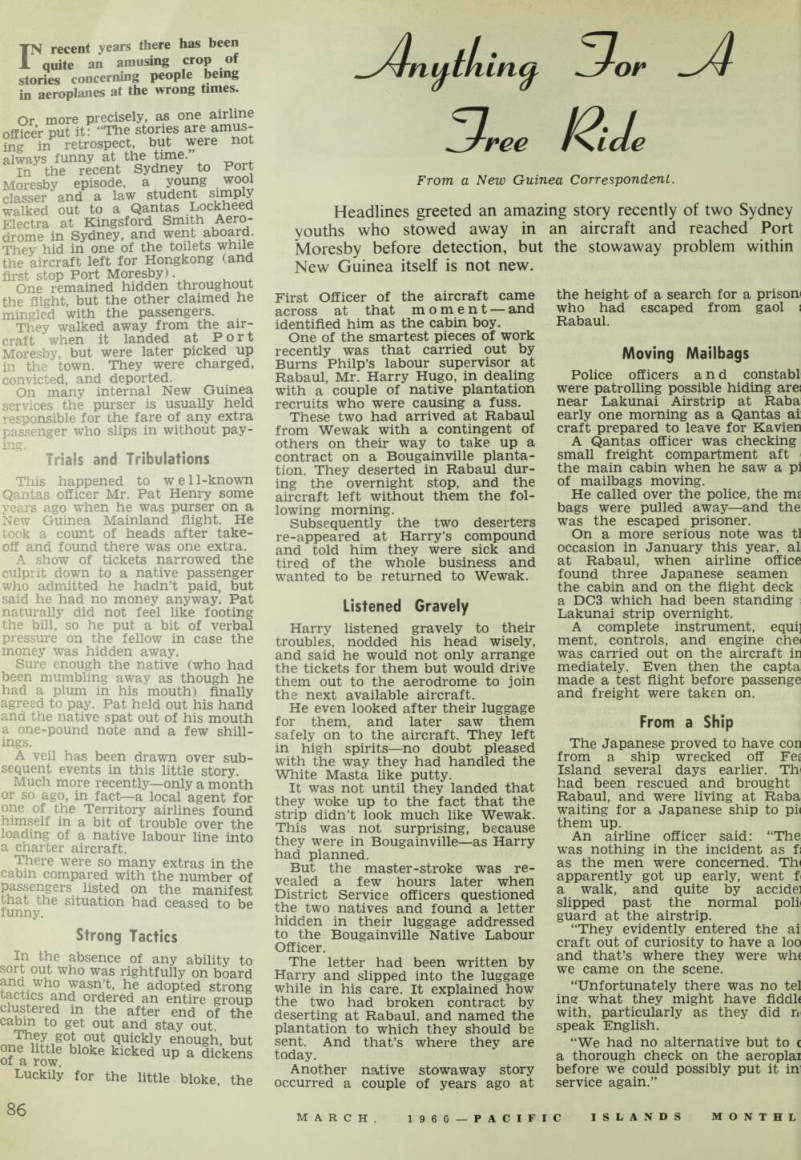
At Kavieng, New Ireland, recently I had a talk with Victor Nicolai about the dream fish" of Norfolk Island. Victor, who spent many years in Norfolk where tiong other things he helped build the whaling station, told me that reports of ie nightmare-creating potency of the so called dream fish are not exaggerated. He iid they were caught on the rocks anywhere around the island, and had a strong nell of iodine, although the taste of the flesh is pleasant. If you fry the body and at it you get a moderate nightmare; but if you steam and eat the head, the night iares are terrific, says Vic. They are horror nightmares of falling, fire and of things wning at you. You can sleep, and wake, and sleep again, but you don't go on ith the same dream you start a new one entirely. And when you get up the uxt morning, the hangover is frightful!—Lew Friday.
vel where the fish would expect to be delivered and where they ould congregate in anticipation, uch levels were sometimes in ex ?ss of 100 fathoms, and the fisher ten operated in a fairly close roup over the so-called hole.
If any man was noticed to be seating by fishing at a shallower r greater depth his fishing days ould be over.
Hole-fishing was generally done i the morning, and surface fish ig farther off shore in the after oons, the season commencing as Don as the sword-grass came into loom, about mid-October and con nuing through until early June, lest times were considered to be uring the week of the new moon.
Off-shore, where the fishing is lainly for bonito and dolphin— nown in Tahiti as Auhopu and lahimahi —seabirds were the great uide to success. Noddy terns were le surest indication of bonito be )w. Noddies accompanied by oobies were an indication that the onito were feeding and in a mood d take a lure. But if there was flock of small dark terns with mixing of other types of birds tiat was a sign that bonitos were elow but were unlikely to be in a seding mood.
One, two, or three rapidly circling rhite terns meant dolphins below, ut if the dolphins were jumping lear there was no use wasting time n that school, as they would not e likely to take a hook.
Shelter for Fish
So the canoes, or launches today, rould speed after the circling birds, nd arriving “on location” the ishermen would dump overboard iry leaves, straw, or other trash rtiich would float on the surface nd provide some slight shelter for he small-fry upon which the big ish were preying.
This had the effect of holding the shoal stationary and giving the fishermen a chance to get busy round its perimeter with their pearl shell lures and barbless hooks at tached to short lines on the ends of 15 ft bamboo poles.
These pearl-shell lures are still favoured today. Depending on the light, a different shade of lure would be selected. A knowledge of the right lure for the prevailing weather conditions was an art, and a good lure was looked on as a great asset.
Tahitians' Respect
The Tahitians always treated dolphin with respect. When still fishing for them with flying-fish bait, the first one hooked would never be hauled directly from the water.
Dolphins are loyal to companions in distress and they will not leave a hooked companion so long as he is left in the water.
Thus, by leaving the first one in, the others will remain in the area and are easily hooked, too—but in no circumstances would the Tahiti ans of former times take more than nine dolphins from any one school.
Schools rarely number more than a dozen fish.
One method of dolphin fishing was with buoyed lines. A fisherman would head off-shore with half a dozen light wooden poles each six or seven feet long, with stones lashed at one end and a fishing line attached also to that end. Thrown overboard these poles would ride upright half out of water, and as soon as a dolphin took the hook—baited with crayfish or flying-fish meat— the watching fisherman could tell from the movement of the pole.
Another interesting type of fish ing may be seen at certain times of the year at French Polynesia’s phosphate island of Makatea—and
(Continued on page 99)
[?]e “dream fish". Fisheries Officer of [?]e South Pacific Commission, Mr. H. [?]n Pel, says so far he has not been [?]le to obtain a correct identification of the fish. See below.
abtless at many other islands, ere, as the overseas vessels load }ir cargoes, the fishermen with ;ir outrigger canoes are busy ;ching a type of small mackerel, rhe equipment is a tiny rod not ire than a foot long and slimmer in a pencil, with a line of the ne length and a very small hook ached. The bait is white coconut sh. rhe fish move in dense shoals and j fisherman, with the aid of a ,ss-bottomed shallow box, peers vn into the clear water watching * the schools. As soon as one proaches he chews and spits
mouthfuls of coconut into the water.
The fish feed on this furiously.
The fisherman then hastily enters the water, baits his hook with a tiny fragment of coconut meat, and plunges the rod right into the shoal of feeding fish. If lucky, he will hook fish as fast as he can haul them out and re-bait the hook —which a good fisherman can do at great speed.
These are but a few of the end less methods of the Islands.
But here is a modern Japanese method of coastal fishing which could well be tried in the Islands.
It calls for a launch with a source of electric power. About a dozen lights spaced 60 ft apart are strung
out on a buoyed line so that they are suspended about 10 ft below the surface with one end leading into a surround-net or trap.
After dark all the lights are switched on, and after about two hours, when they should each have attracted a school of fish, the lights are extinguished successively from the distance end, until finally only one light remains within the netted or trap area, where—if everything has gone according to Hoyle—all the fish are concentrated.
The method is apparently highly successful in the right location with the Japanese. But then, the Jap anese, like the old-time Polynesians, have a way with fish.