In Europe
pp. 71-75 · Read in the full issue


Sydneysider Goes Walkabout You Won’t Move In Europe
TORREMOLINOS, SPAIN: Heaven help the overseas ‘ourist in Europe in the coming summer. The Olympic Games ire on in Rome, and there are plenty of signs that there, and elsewhere, this will be a season to out-do every other tourist season that has gone before.
any of you, there in the South Pacific, are planning a holiday in Europe, any time between ,y and October, you want to tch any ideas of leisurely touring, putting up when and where the icy moves you. Europe this nmer will be as comfortable as * London Underground at peak ir; as exclusive as Bondi Beach a hot, January Sunday, f you haven’t already done it, ik a hire-car now; reserve accom idation without delay. But if you lue peace and quiet, try South lerica, instead; arrange a safari South Africa. Go to Queensland; Korolevu Beach, Fiji. Better still, iy home and save your dough!
For one thing, Europe has never m more prosperous, therefore local ople, once content to stay home d let the rich foreigner do his irst, now compete with the •eigner for accommodation and irist delights. Secondly, there is e perennial American tourist who, season or out, can be found at iy given sp9t where they have itel rooms-with-bath. he Lid is Off
oreign Travel
Thirdly, and for the first time ice 1939, the lid is off foreign avel for the tourist from the UK. i very recent years he has been stricted to £lOO per annum for reign travel. In the years im ediately after the war, he was lowed nothing, or next to that, bis year he can spend what he tes.
Since December, a large proportion : the advertising space in London id provincial newspapers, and in le national magazines has been
devoted to Your Holiday This Summer. “You” are invited to come to Blackpool (or Liverpool or Devon); to cruise the Thames; hire a caravan at Bournemouth; or patronise one of half-a-dozen hotels on the Isles of Wight or Man.
In addition, the whole of Europe is to be the oyster of Mr. and Mrs. and, especially, Miss John Bull. Ten days in Switzerland are offered “from £24”; 15 days, air travel each way, in Tangier, the Italian Riviera or Yugoslavia from 42 guineas; eight days in Belgium from a modest £l3/10/; 15 days’ air holiday in Spain from 36 guineas. Etc., etc.
What’s Best Winter
or Summer?
I suspect that from is the operative word —although the whole thing is intriguing. Take the 15 days in Spain, with air travel, from 36 guineas. The cheapest air travel, UK to Southern Spain by one of the lesser known airlines is £3O return. (BEA’s regular daytime flight, Lon don-Gibraltar, is £52/17/ return).
Hotels and pensions in Spain are cheap, but not all that cheap. How do the agencies do it? That is the From-36-Guineas Question.
All this minimum price tourism need not affect you who are pre pared to pay more, you probably think. Don’t you believe it. With half the typists and junior clerks in Europe taking their From 20 Guinea’s worth all the way from Norway to Casablanca, the pressure is on from the bottom and you’ll be competing with them, alright, right from that cup of coffee to that film from the camera shop.
I last came to Europe in the
northern summer of 1955, It was one of the good years, in that there was sun and little rain. I bucked the full blast of the tourist run around for three months from southern Italy to the north of Scot land and swore I never would again.
In comparison, what are the pros and cons of coming to Europe in their winter?
Obviously, on the con side is the weather, but as a bad northern summer, which happens four out of five years, can be almost as un pleasant as a northern winter, this objection boils down mostly to the restricted hours of daylight avail able in this season, and this can be a real curse.
There are, nonetheless, avenues of escape. In France and Spain they cheat old GMT and advance their clocks one hour. This means that daylight, and the business of the day, get going even later than in the UK but you get that extra hour at the other end of the day where it does most good. Here, in southern Spain, the sun is currently emerg ing from the sea at 8.25 local time.
It begins to get dark again around 7 p.m.—or 6 p.m., GMT.
The Spanish Are \
Midnight Eaters
As the Spaniards eat dinner some time between the ungodly hours of 9.30 and 11.30, and are still scream ing around the old hacienda at 1 a.m., making noises like a Moorish bazaar in full blast, they are not, by nature, early risers, so that morn ing hour doesn’t matter much any how.
Oddly enough, although it is holi days for everyone, and the wealthy have been steadily reduced in num bers, the convention that mass holi days come in summer is still adhered to. The result is that from May to
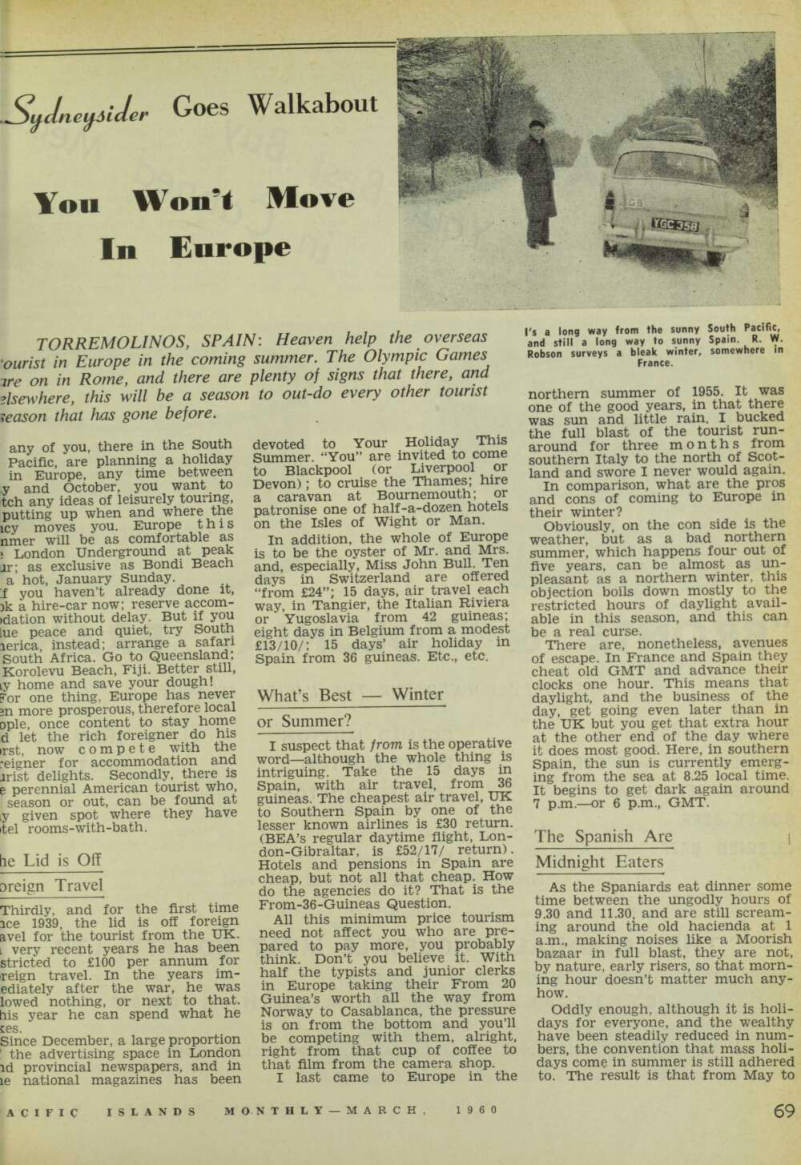
I'S a long way from the sunny South Pacific, and still a long way to sunny Spam R. W.
Robson surveys a bleak winter, somewhere in France.
member, but mostly in July and just, the sunny coasts of France, W and Spain are crowded to ex iion point, but in the once de :ble winter “season” they are as li as the dodo. :ere in Torremolinos, eight miles [he west of Malaga, and facing sria across the Mediterranean tre it narrows and funnels in to JStraits of Gibraltar, the excellent :ter climate is largely neglected, lie northern France and Ger :iy lie snow-covered, and Lon jers creep around in their winter hotels here that are designed to iimmodate 200 guests are currently “ring for 30, with hotel tariff at low off-season rate, laptain James Cook, in one of his mals from his first voyages in Southern world, observed that he matter of latitude in relation warmth the Northern Hemis re could give the Southern 10 irees. This place bears that out. he latitude is about 37 deg. N— ut the same distance from the nator as Melbourne, Vic. The .ter climate, however, is similar that of about 27 deg. S—that is, lewhere along the NSW coast ween Sydney and the Queensland der. e Rain in Spain
Not Always
[Tie rain in Spain doesn’t always y on the plains, of course. Since have been here we have had le wet days; some cloudy; there /e been some morning mists and : other occasional trimmings of iter. But there have, also, been ny long days of brilliant sun ne when it has been pleasant to i-bathe; and delightful to wander •ough the valley orange groves, ile the pink-white puffs of almond es in full bloom, march-up the untain sides above us. [There is a mildness about the ,ce, missing from even a couple hundred more miles to the north, ercoats have been shed; the car’s iting and demisting devices, which nt continually at full blast in gland and France, have never ;n used. finally, you are an individual at s time of the year; not one of ; un-numbered tourists of later . People have a willingness, and 5 time, to serve you. tfot that there are not some im rfections even in this Eden; The anish passion for uncarpeted irble floors and glazed tiles as ilding materials is a cross to bear, leir lofty rooms with curved arch iys, and nooks and crannies, n’t made for coziness, either, id their domestic mod. cons, are e generation behind England, two hind Australia and three behind
E Usa.
Torremolinos, at the end of the Civil War and for some years after, was just another poor village on the verge of starvation. It is only in the last 10 years that the metamorphosis has taken place. The village now is swamped by the new section that spreads west towards Marbella. Two more luxury hotels have opened in the last few months; at least four more are in course of erection—plus apartments, villas and bungalows galore, for rent.
The 40-odd miles from here to beyond Marbella have caught the attention of the real estate merchant.
Former agricultural land and rocky outcrops “with views”, are being subdivided and sold to anyone—
foreigner or native doesn’t matter according to the notice hoards in Spanish, English, French and Ger man.
When the tourist money-tree flowers in this place, and so far it is just in bud, it will give the local people an alternative industry to the pitiful peasant scratching that passes for agriculture in this land of barren slope and mountain. But T7 ou can already see the pattern of advanced countries being re- The turning over of the pockets of agricultural land to speculative building and tourist hotels; the change from fishing and gardening to catering to the de mands of the tourists. (Over)
At the same time, with increas tourist traffic, will come a bigt demand for the products of the j and the land, with consequent bo< in prices for the commodities whi are now plentiful and cheap.
It will be interesting to see tl Costa del Sol five years from no but I think that those who ha already discovered it and samp] its more simple joys will have h the best of the bargain.
Mad Aussies Who Knew No Better We drove down through Fran during the January storms th covered all Europe from the She lands to the edge of the Meditc ranean with a coating of snow ai ice.
The French villages were as emp as the H-bomb devastation seer from Nevil Shute’s On the Beac the French farmers had gone in their ramshackle farmhouses a: pulled the doors to after them. T lorry drivers were prudently hoi up somewhere, waiting for the roi gangs to throw grit on the icy ros bends and hills. Only Australiai who had never seen snow on roa before, and knew no better, plough' on. We had the long, straight roa of France practically to ourselve* Within a couple of miles of t] Mediterranean shore we droi through the thickest snow storm all; drifts of snow continued wi us all the way to Barcelona, j Barcelona, all the winds in creatk blew from the snow-covered pea: and froze us to the marrow.
We beat it further south—aloi the last 650 miles that would brii us to the famous Costa del Sol whe it was possible (but not, on our pai probable) to bathe in the sea : January.
The road from the French front! to Barcelona is good; from th point on it develops its own waywai Spanish way.
Spanish roadbuilders still emplc the round and over (rather ths through) technique, and as the bu of this part of Spain is rugge marble and granite mountain, wil the butt end of ranges falling ini the sea, there is a great deal to g round and over.
The Streets Are Made
For Wheel-barrows
From Barcelona we f ollowc practically every indentation of tl coast, with occasional excursions ir land to wind over gaunt hills an down through the wheel-barrow wide streets, of some ancient villag In common with France and Eng land the by-pass road is rare.
This is an incredibly old lam Phoenicians, Greeks, Carthaginian Romans and Moors have come, gon
tingled and what remains is the ent-day Spaniard, still living in « villages founded in antiquity ) obviously little improved since. h. a lorry, two donkeys, a bicycle seven villagers toting wine or tr bottles into one of those :ts and you have a traffic-jam makes the immovable object the irresistible force look like
>ergarten stuff.
the motoring sense the [hard has not yet emerged from jera when a bloke was supposed irecede the automobile waving a Hag. Few footpaths are provided where, but where they are these ■vidualists still prefer to walk in i or street. lie whole pace of the roads (and large extent that of the whole utry) is geared down to the uitous donkey and his pro dus load of wet sea-sand, marble s, crushed rock, haystack-sized of brush, scrub, vegetables or nans. :e a Hint From
Expert!
btoring here can be anything, ihe way from frustration to fun. it just isn’t for the guy who eves that its only purpose is to from here to there in the rtest possible elapsed time, he roads themselves are often ly surfaced, they are tortuous, row, cut like ledges into the cliff ( and insufficiently marked with 1 signs. If you are a timid driver, ised to marathon contests of driv skill; scare, frustrate or tire ily— leave your car at home, ter still, fly to Gibraltar and 3 a Drive Yourself vehicle. The d between Malaga and Algeciras, en in moderation, will be your i. f, on the other hand, you are the -enturous type; like performing ts of derring-do that have been ‘quailed since our grandfathers t took up the internal combus i engine seriously—you won’t do ter anywhere; Try yourself out sunny Spain! datron Dorothy Maye, MBE, of ! P-NG Department of Health, 0 is planning to retire shortly 1 settle down in South Australia, 5 given long years of outstand ; service to the Territory. She nt to Rabaul from Canberra in 6, then on to Kavieng, where she s nursing wounded servicemen en the Japs landed there in 1942. e was a prisoner of war, first at haul and then in Japan until the i of the Pacific war. Returning the Territory in 1948, Matron lye was at Moresby and at Lae til she became ill recently and ;nt a short time in Taurama spital, Port Moresby, as a patient rself.