Great Astrolabe
pp. 63-67 · Read in the full issue
Among The Beauties Of The Great Astrolabe
Story and Photographs by Rob Wright
On the night of June 5, 1827, the sailing ship Astrolabe was ploughing through rough seas approximately 60 miles to the south of what is now the port of Suva. Her master was the intrepid French explorer and navigator Dumont d’Urville.
Suddenly from out of the blue-black haze ahead, appeared the white outline of breakers on a coral reef. Hastily the ship was put about. Disaster was narrowly averted.
>Y daylight, d’Urville saw the ) reef to be a massive coral barrier, up to a mile in width, d unbroken for a distance of me 20 miles. Behind this pro jtive barrier lay the island of idavu, fourth largest island in the ji group, and scheduled during a ief period—lB74/77—to become a rt of call for trans-Pacific ships.
Painstakingly d’Urville traced the ig loop of reef to the north, nam g it the Great Astrolabe Reef in mour of his ship. At the northern ), before the reef turned and r ung to the south on the leeward ie, the explorer found a channel lich separated the Great Astrolabe ;ef from an egg-shaped barrier arcely a mile distant.
No Tourists
To this channel, he gave his own ime—d’Urville channel, and the parate ring of reefs to the north ! named the North Astrolabe Reef, at because of the bare black mass rock protruding from the centre this lagoon, it became more miliarly known to local sailors as )lo —which, in the Kadavu dialect cans “rock”. In later years a
light-house was erected on this spot.
Dumont d’Urville probably never ever heard the phrase “tourist potential”, nor would he have ever been aware of the fact that one day the area which bears his name and that of his ship, would be one
of the finest « off the beaten track” spots for tourists.
Kadavu have been itinerant yachtsmen and fishermen. This is ? r ™ft a is y r eqSed^o? n th? ! Xrt O SI journey from Suva. Now, with the
h?s V6 ?uxmm-y Pt ketch^^Ma^oro?with
charter and tourist cruises, the wonders of a Pacific lagoon will be open to anyone with the time to make the trip. The Maroro is perhaps better known to Pacific sailors as the former Hifofua, the Tongan Government yacht built by Charles Bailey, of Auckland, in 1927. She has the stately lines and seaworthiness of most sailing vessels of that era. I recently made a
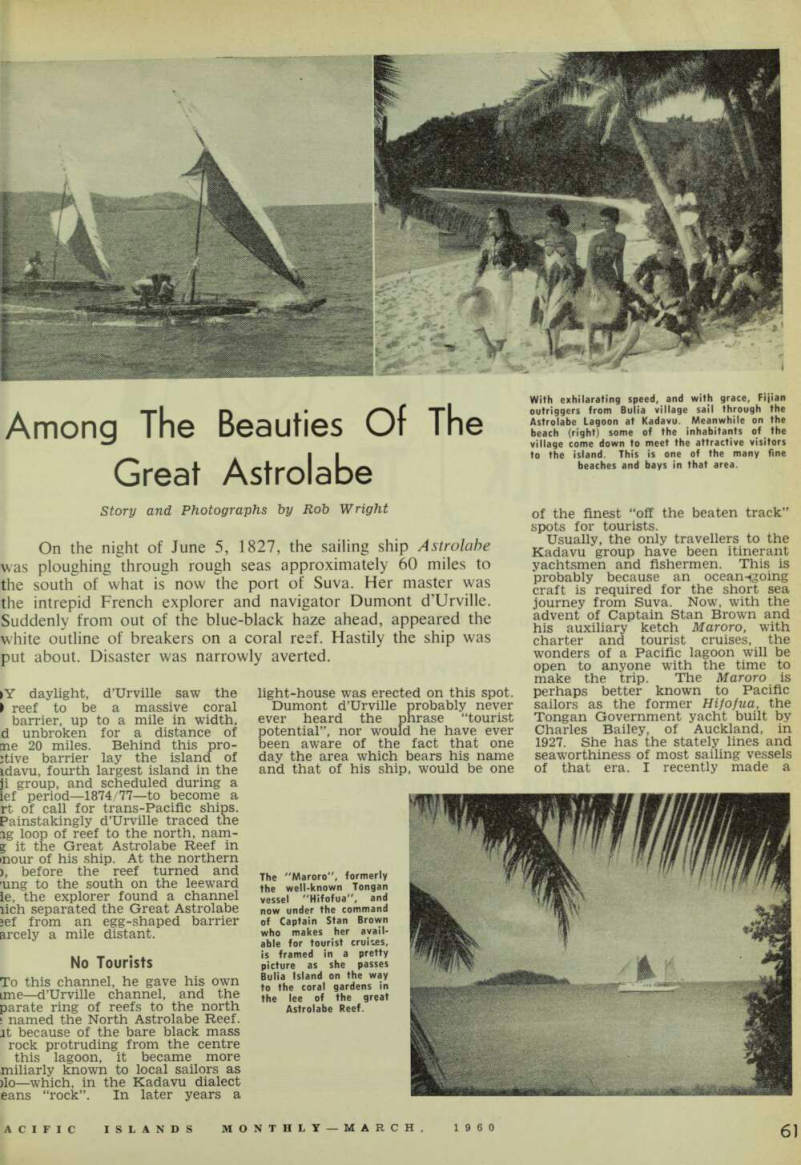
The "Maroro", formerly the well-known Tongan vessel "Hifofua", and now under the command of Captain Stan Brown who makes her avail able for tourist cruses, is framed in a pretty picture as she passes Bulia Island on the way to the coral gardens in the lee of the great Astrolabe Reef.
With exhilarating speed, and with grace, Fijian outriggers from Bulia village sail through the Astrolabe Lagoon at Kadavu. Meanwhile on the beach (right) some of the inhabitants of the village come down to meet the attractive visitors to the island. This is one of the many fine beaches and bays in that area.
ist-survey-cum-film-making trip
Cadavu on the Maroro. With us movie-maker Robert Steele, his leraman Bob Clough, and a bevy Suva’s prettiest and shapeliest s who were to be featured in lences both above and below er. sing both power and sail, the rt ocean hop was over in a fcter of a few hours. Plenty of k space and comfortable ac imodation added immeasurably the pleasure of the journey.
Turquoise and Shades
Ve entered the island-studded rolabe lagoon through Usborne is, near the northern end, lough there are two other passes, ards the centre and one to the th. The sea in these impounded ;ers was calm, and in colour auoise, shading off to greens and wns near the reefs. 7e soon passed Vanua Kula, an t just within the entrance, and aile farther south, drew abeam Dravuni, a long narrow island of tening white sand and coconut ms, one of the two inhabited nds in this little paradise. (ur objective was Yaukuve, an nhabited island still farther th, where we planned to hor for the evening. The water 5 crystal clear and the anchor Id be clearly seen as it grabbed a hold in the coral. The ship’s ,t and a bathing party were soon r the side and heading for the ch. . stroll around one of these nds is educational and interest- The beaches of clean white
sand hold innumerable little treasures in the shape of sea-shells and pieces of coral. Fringing the beach are the inevitable coconut palms—those stately trees of grace and beauty, and fine props for my camera.
Lush Undergrowth
Lush undergrowth is encountered as one pushes deeper into the island.
Indigenous trees and shrubs are crowned with sweet-scented flowers and brilliant foliage. Here and there an orchid peeps from gnarled trunks, trunks misshapen by hurricanes of the past. As the sun
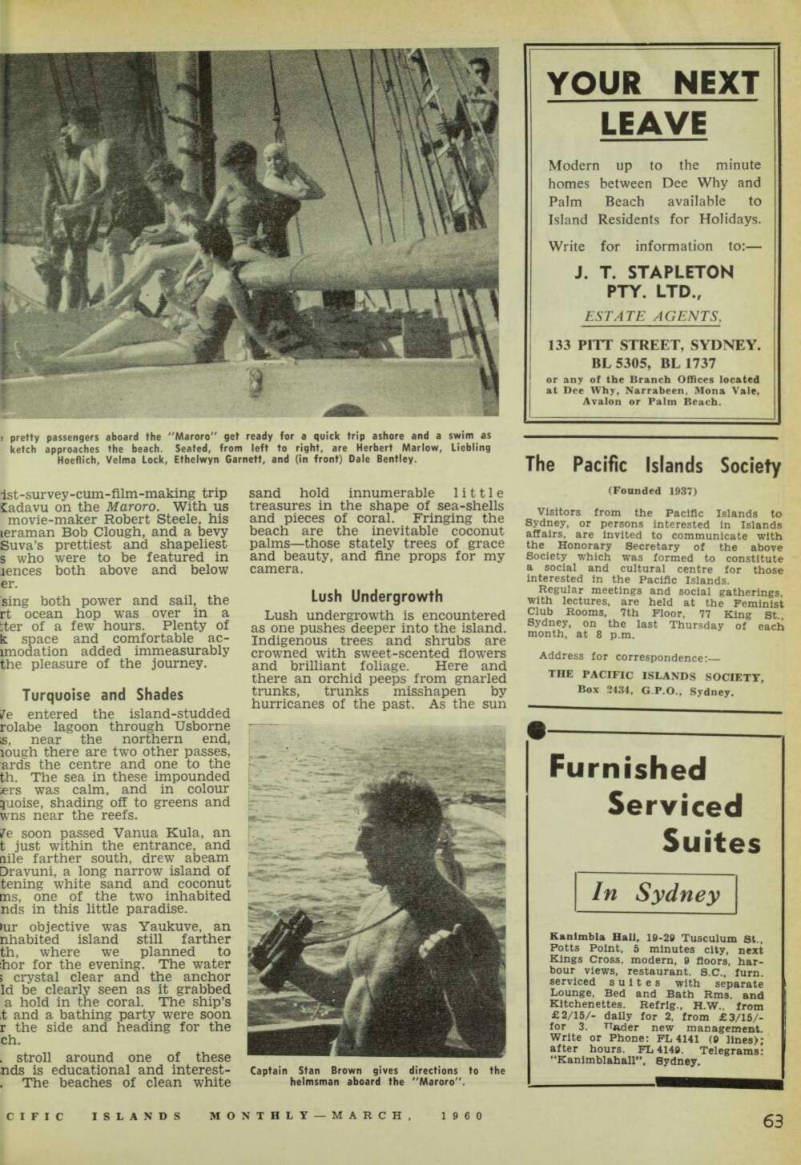
[?] pretty passengers aboard the "Maroro" get ready for a quick trip ashore and a swim as ketch approaches the beach. Seated, from left to right, are Herbert Marlow, Liebling Hoeflich, Velma Lock, Ethelwyn Garnett, and (in front) Dale Bentley.
Captain Stan Brown gives directions to the helmsman aboard the "Maroro".
down beyond the reef, it ouetted, for fleeting minutes, the ingular mat sails of takias— an sailing canoes—skidding for ir anchorages off the villages, » tuneful island melodies sung I played by Wesele, the Maroro’s an engineer and deckhand ipatriots, blended with the iquility of the evening. No sties, bells, motor-horns, or me calls there.
we were under way at first light i n the morning, slipping past the island of Yaukavulailai, and rounding Bulia to the east. We were making for the lee of the Great Astrolabe Reef, where some of t he finest coral gardens in the archipelago exist,
Coral Gardens
I had visited this area several years ago with the Frank Hayford expedition, making underwater movies of the corals and fish. And this time we had a similar purpose.
Equipped with aqualungs and underwater cameras, and assisted by Colin White, president of the Fiji Underwater Spearfishermen’s Association, the task of recording on film the marvels of this under water world soon began.
Corals of every shape, texture, s i Z e, an( j co iour surrounded us, while t he fish which inhabited them were surely the most magnificent treasures the sea could create. In scintillating colours and exotic designs of reds, yellows, blues, and purples—these jewelled creatures swam by in kaleidoscopic parade.
Greetings
. We spent hours where we would like to have spent days, but there was other work to be done. The were photographed in the water and out; on the beaches and on board ship.
At Bulia, one of the two in habited islands, Fijian outrigger canoes put out to welcome us and put on dazzling and exhilarating exhibitions of speed and grace.
At Herald Pass on the lee side 0 f the lagoon, spearfishermen entered the water in search of big fish. On a previous trip, they had filled a boat with large succulent
inhabitants of the deep water around the passage, but on this occasion, the prey were camera shy and only a few fell to the hunters.
But time and tide caught up with us. We left Astrolabe lagoon and its island gems, skirted Solo light house, and set a course for Suva.
Astrolabe lagoon with its delightful beaches, its coral gardens and exotic fish, soon seemed remote.
[?]-foot shark browses slowly along a reef entrance as sunlight mottles its back, providing it with a ready-made camouflage pattern. This is one of [?]nderwater shots taken by Rob Wright in the Astrolabe Lagoon. Rob (seen right) was equipped with aqua-lung, flippers and, of course, under water camera.
Small black fish feed off a ledge on an under water reef. In the lower picture, some of the small exotic fish which abound among the scintillating corals of the Great Astrolabe Reef.
Fiji's maze of coral reefs are second only in size to the Great Barrier Reef of Australia.