It’s Clean-up Month In
pp. 47-53 · Read in the full issue

The Aussies Look In At Vila
It’s Clean-up Month In The New Hebrides
From Stuart Inder VILA, New Hebrides Well, it was Vila when I first got out my ballpoint to write this, but that was two hours ago, and now I could just as well dateline it from Nadi, Fiji, where we are about to refuel, or from 24,000 Feet Somewhere Over the Pacific, or even [ hope before the day’s out from Richmond, New South Wales.
17HETHER one place or another, it’s all in the day’s work for this frame-shattering RAAF rcules transport aircraft I happen be riding in at this moment— and a platoon of Australian ny sappers, and a few assorted is of picks and shovels, water iks and garbage cans, tent pegs 1 haversacks —all stacked roof h, including the sappers, f you’ve never had the adventure being in a Hercules, then it looks e the inside of a pregnant duck h all the bones showing, and it mds like the inside of a railway mel with a train going through.
But whether you choose to go by ; looks or the sounds of it, you • left with a hemmed-in, locked feeling, and it’s hard to believe s thing is really doing 280 mph 24,000 ft. But they tell me that’s iat’s happening. rhe RAAF boys have efficiently nded out chunks of cotton wool • the Army’s ears, with the happy rning that “the noise that does a harm is the noise you can’t ar”. But since there couldn’t be y noise left in this part of the cific that we can t hear, the ad ;e falls on deaf ears, as it were.
18,000 Miles
rhis Hercules, with a mate, left e RAAF station at Richmond sterday to collect the 70 Army ppers who have been helping to ;k up the pieces in Vila for the 5t month, following the two hurri nes that hit the town December id January. I was on this one len it left Richmond.
The Hercules are part of the \AF’s 36 Transport Squadron, lich with this flight has now flown total of more than 18,000 miles tween Richmond and Vila in the st few weeks, carting the Army id its equipment on its clean-up b.
In that time they’ve burned up lot of kerosene, and probably
strained a few ulcers among the crew in landing on Vila’s grass air strip, where the cows have to be rounded-up before you can put down.
But more than anything—although it was not planned that way—these flights have done more for British morale in the New Hebrides Con dominium than anything since the French got beaten at Agincourt in 1415.
As somebody said to me in Vila last night, “If possession is nine points of the law, then this place is a French Colony. And what a lift it’s been to have the Aussies in.
Brought everything with ’em and just got on with the job!”
The news that Australian Army and Air Force stocks are high in
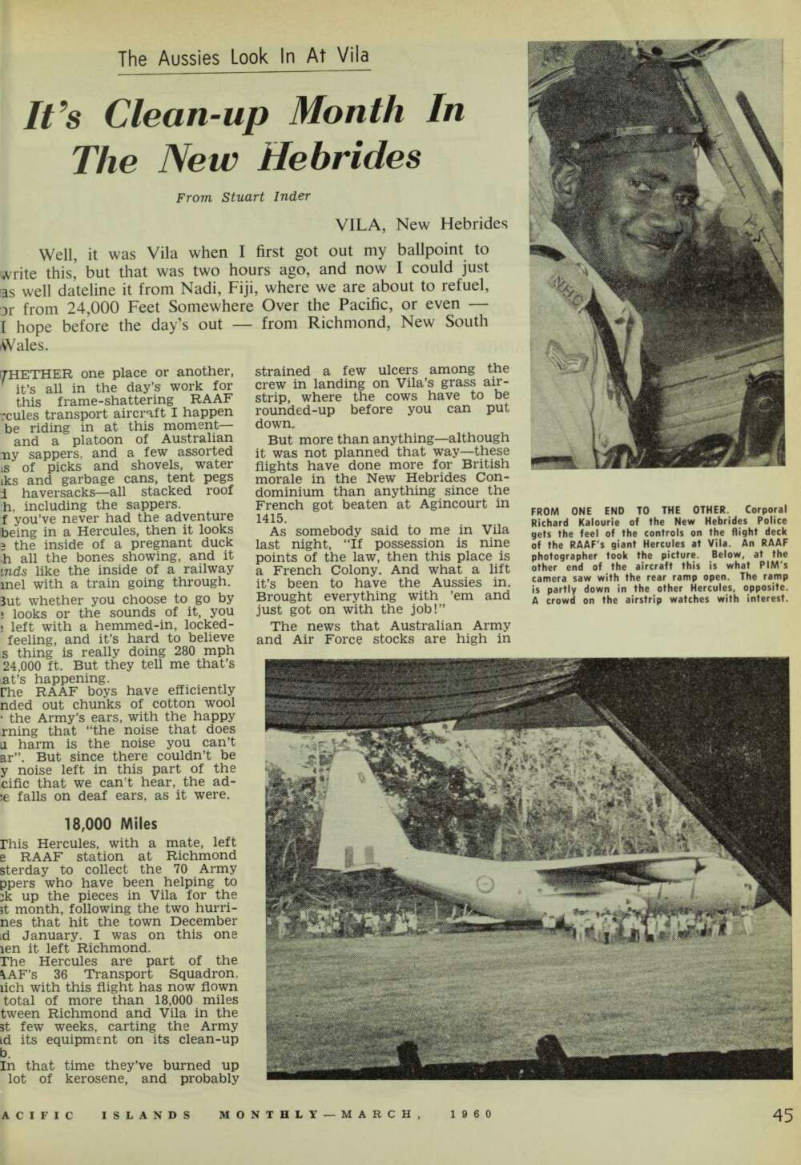
FROM ONE END TO THE OTHER. Corporal Richard Kalourie of the New Hebrides Police gets the feel of the controls on the flight deck of the RAAF's giant Hercules at Vila. An RAAF photographer took the picture. Below, at the other end of the aircraft this is what PIM's camera saw with the rear ramp open. The ramp is partly down in the other Hercules, opposite.
A crowd on the airstrip watches with interest.
),own right now is the more in ins in view of what the Aus : a newspapers have been so ,il about in the last few weeks.
'iv’ve been complaining that alia had sent too little help sa too late, and that more men El have been sent a lot more y if Australia really wanted to ie right thing.
They're Happy
11, I don’t suppose anybody in would have complained if |ody in Australia had decided ad three times as many men times as quickly, but since didn’t, I can assure anybody interested that Vila is not laining about what it did get. 11 has had French, New Zea- Fijian and Australian help and excuse me while I say alia has made the biggest i. i can’t turn a couple of 3ns of strange Army men loose town the size of little Vila ,ut everybody knowing about pecially when they arrive with ind of roar that can be pro i by the four turbo-props on of these pregnant ducks.
Jeeps Down The Ramp
•thermore, a few hundred pairs itive eyebrows naturally go up the back ends of the ducks themselves into ramps, and the bowels of the Hercules a jeep and a Land-Rover, fol l by a mobile cooker, a trailer, npressor, tents for the whole ngent and even a 200-gallon • tower. ce landed, the boys didn’t ask 3dy for anything, but put up tents and got stuck into the from 6.45 a.m. to 4.30 p.m. day, including Saturdays, and only three Sundays off out of dve they’ve been here. d they’ve behaved themselves— ct which has not gone un ed by the realistic Vila locals, remember when they were all g once and in the Army them 3. the sappers are tradesmen,
and the procedure has been for them to tackle any job which any home-owner or businessman has asked them to do—with the British Residency as the go-between.
They’ve concentrated mainly on replacing roofs—because just about everybody lost one. Whether they are French or British houses hasn’t mattered—a fact which has also been pasted in the hats of many observers in this Condominium headquarters town, where Anglo- French relations are one of the main topics of interest.
Offices Last
Office buildings belonging to the “Pandemonium” have been given last priority for repairs, with work being concentrated on private hous ing and essential services. That’s credit to the Government.
The most lasting impression of Vila I take away with me is the picture of sandbags holding down roofs right around the town. There are presumably nails in the roofs, too, but nobody is taking any chances Much of the work done so far has been temporary—there will be the
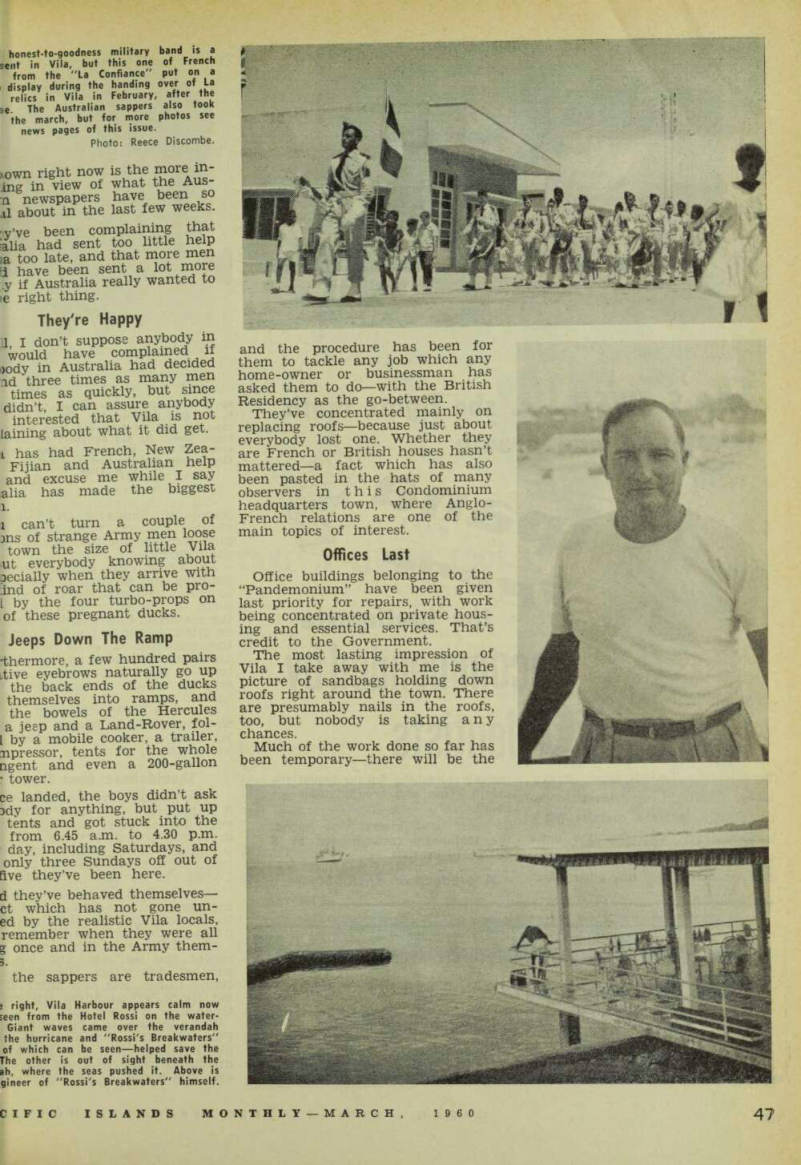
honest-to-goodness military band is a sent in Vila, but this one of French from the "La Confiance" put on a display during the handing over of La relics in Vila in February, after the [?]e. The Australian sappers also took the march, but for more photos see news pages of this issue.
Photo: Reece Discombe.
[?]e right, Vila Harbour appears calm now seen from the Hotel Rossi on the water- Giant waves came over the verandah the hurricane and "Rossi's Breakwaters" of which can be seen —helped save the The other is out of sight beneath the ah, where the seas pushed it. Above is gineer of "Rossi's Breakwaters" himself.
sound of hammers in Vila another year yet, when all the si plies come in, for they are short the moment.
But among the permanent w done by the sappers is the rep of one of the wharves, the repla ment of the water pipe line fr the mainland to the British hosp: on Iririki Island in the harbour, £ the construction of a 40-ft si and concrete bridge on the airst road —a great improvement on original timber bridge that \ washed away.
Vila has collected much of wreckage now and heaped it in hi piles on a vacant block near waterfront.
"Should Have Been Here!"
“You should have been here wl it happened!” they kept telling yesterday as Kiwi Reece Discon drove me around the town on wrong side of the road, which is legal method of driving in V “What you see now is nothing!
“See the Post Office—oldest bui ing here and the first we’d like have seen go, and the hurricj never touched a damn thing on “See BP’s over there —wind i roofed the lee side, and left weather side intact. Hurricanes funny things. See over there. T] old shack left standing but eve thing near it wiped out.”
But although its a pity about tl Post Office there are plenty of oti old buildings that the hurrica: mercifully removed from the sci and Vila is gratful for that.
Mr. J. S. Rennie, British Resident Commissi in the New Hebrides, left Vila on leave same day that the Australian Army sappers turned home. He had postponed his leave cause of the hurricane. Acting Resi[/] Commissioner for the next few months is C. H. Allan. —RAAF photo
11 local fears to the contrary, Jesn’t take any imagination mow to see what the hurricane 3 Vila. The leaves are coming on the trees and the palms, but clearly there were no leaves a month ago, m-up trunks and tangles of by the wayside show how the were blocked; and it is quite us that repairs had been made bout 80 per cent, of Vila’s tog s - , XI. 3 astonishing thing—and they shake their heads over it in -is that nobody was killed, ugh stories of narrow escapes wo-a-penny.
Happiest Owner
ibably the happiest property r in Vila at the moment is ;ieur A. Rossi, who with his and daughters runs the Hotel i, right on the waterfront. As itter of fact, the verandah goes over the harbour. It’s a new rete structure, not yet finished very near it, and after every else’s roof had gone, the Hotel i was a haven for the homeless, t M. Rossi smiles wisely when congratulate him on his good in emerging unscathed. It is, binks, more like good manage t. And most of Vila are happy time to admit he is probably .ossi’s Breakwaters” were the ;t weapon. ley are two breakwaters, built if coral and cement directly on reef in front of the hotel—built ite the good-natured advice of enthusiastic drinkers who used lang over the verandah and ih Rossi and his boys at work the job. Most people decided
Rossi was just wasting his time.
But came the hurricane and those two breakwaters undoubtedly kept the huge seas from undermining the hotel’s foundations. Even then, when it was all over it was found that the sea had swept one of the break waters bodily from its foundations and moved it several yards closer to the hotel. , „ . .
“Ha ha!” exclaimed M. Rossi to me last night, pointing over the hotel railing to the breakwaters with what looked like a gleam of victory still in his eye. “I am now going to build three more of them — there! there! and there!”
The betting is the drinkers won’t
offer any free advice this time.
It’s typical of the warm spirit that’s in Vila—despite all the petty official nonsense of the pande monium system of Government— that nobody begrudges M. Rossi his little victory. .. ..
They are happy to note the bright spots, even if they belong to some body else. „ .
Considering the large financial loss suffered by everybody in the New Hebrides— something in the order of about £A500,000 according to what Acting British Resident Commissioner C. H. Allan was say ing last night—not to mention the little personal tragedies such as the
Peter Day, OC of the contingent of an Army sappers who helped clean up The men were from 17 Construction [?]n and 7 Independent Field Squadron.
AF also had an officer stationed at Vila the month-long operations—F./Lt. W. M. sey. Both were personally popular —RAAF photo.
of private belongings and the rt-rending job of cleaning up, i people of all nationalities are ting a remarkably cheerful face things
Ithough perhaps “face” gives the
•ng impression. That sort of ig is more inbred, or at least eloped over a long period of exience with the vicissitudes and laraderie of Islands’ life. ■here was certainly nothing wrong h Vila’s hospitality at the Hotel Inst nio'ht—or was it this ming T-when they put on a nk you and farewell party for RAAF Another one had just n put on sometime earlier for Army and that was quite a show, , they tell me. don’t know who arranged last ht’s farewell, but most of Vila med to be there and the hosality kept on flowing until M. ssi took himself to bed and deled to keep the storeroom open 7 inne-pr ; i j orY , occllTri 3ut it didn t matter. * a ® sl J™ n ; that not all rmgmg I can lr , ir \ ea £ s at 0 81 J.nn S e to the turbo-props of this conmded pregnant duck. ih, now here comes Nadi’s big w airstrip looming off the starird wing. Don your Mae Wests, kmIiSISi S6at belts ’ prepare hit the beach.
(Otnote from Richmond
iN the way back from Nadi they ‘ sent word around the Hercules that the boys were going to get real Islands’ welcome when they
arrived back at Richmond after their month’s absence. We were go ing to be met by the South Pacific Association”, who would all be dressed up in Islands attire and hand out a war-whoop or two.
But at Richmond we were greeted not by the Islands but by the Customs. And as the Army filed into one end of the office, out from the other came a solitary colourful figure in what appearedl to be a grass skirt, arm bands and head dress that could have been a com bination of New Guinea Highlands Fijian, Tongan and Hawaiian, but more likely Hollywood. But before the figure even mg anybody, it turned tail and bolted.
I suppose that was the Sout Pacific Association. I dont know whether it was the entire South Pacific Association or n °t—because I have never heard of an asso ciation before—but I recognised the fleeing figure as belonging to Mr.
John Antonio, a 26-year-old Fijian clerk, who worked in the Public Works Department of the Con dominium Government in Vila for a little whi j e before going on to Noumea. He’s been in Australia since 1958.
T t vpar in Sv dnev John got a nouncing his engagement to a Syd ney nurs i ng s i s ter—it was to be a real Islands wedding, the news papers said. But the marriage didn’t eventuate.
The Army told me later that it was a Mr. Antonio who had arranged the welcome by the South Pacific Association.
[?]ever a Hercules arrived at Vila it made sure it brought in a good supply of cold milk from [?]alia. And didn't the children know what to do wilh it! It's not sure here whether they are proposing a toast or asking for more.