Territories Talk-Talk
p. 39 · Read in the full issue
By Totala
There has been some talk these last few months about the utcast children in Japan”left there by their vicemen fathers. In most cases the commentators have been listers of religion, regretting this “blot on Australia s record i the Flowery Kingdom. More recently a Sydney businessman, d an officer of the NSW Benevolent Society has added his vulder to the wheel. Good luck to him.
FORTUNATELY these mvenirs de guerre are all a art of war’s aftermath and the it publicity is the outcome, no of our changed attitude ids sociological problems and nergetic tendency for planning body’s life. . . 0 not recall any such interest shown in the “mixed races” lets of War I in France, Bel or Great Britain. But there progeny; but no planning in days. * point which occurs to me is What of the “mixed bloods” ;w Guinea, following three and f years of Japanese tat Territory? Has officialdom record of these “souvenirs” left le Japs? What has become of ? .o know for a fact that the Nip is, whilst in occupation of NG, very strict instructions not to fere with Asiatic or native Bn. Nor did I hear of many 1 of rape being committed in labaul area. It could have been rent in the outlying districts, t the Jap brass-hats are quite stic about sex matters. In Rabaul ’42 to ’44 there were some 3,000 bers of the Oldest Profession visits to them were conducted parade, with the Kempei Tai rolling the queues. Had Ameri and Aussie Service Chiefs in n and Korea been as realistic b might not have been so many ;s” on the records of the Occu m Forces as described now by ministers of religion! is a bit late I expect to worry ,t such amenities for the next After A- and H-bombs have , dropped and guided missiles let i there won’t be much human srial left in an attacked country the invading troops to rape. iionaries he News *in-up girls” and poor housing ight P-NG missionaries into the light last month as a result of
their outspoken comments on these subjects. Rabaul Methodist Chair man (Rev. W. Button) pulled no punches when he expressed his opinion to the local Advisory Coun cil on a glamour-calendar which had been circulating in the town, em phasising the usu a 11 y-accepted charms of the female form divine. [See Tropicalities, page 81].
Thirty years ago the reverend gentleman would have had no dif ficulty in making his point—the dangerous effects upon the emotions of the indigenes: but it is a bit late now in 1960. The damage has been done; there are no mysteries at tached to the European female form.
For years now “house-boys” have displayed the glossy pictures of lingerie advertisements and film magazine reproductions of strip tease artistes on the walls of their sleep-outs.
The horse has bsen stolen; so why bother about locking the stable door? That is a phase of our modern
civilisation in which the clock can not be put back.
Time was when police censorship on cinema posters was alert, and old Bob Kennedy, Rabaul’s cinema manager, spent much time conceal ing the nether limbs and generous cleavages on cinema posters with printer’s ink.
It’s the floating population in a native country who are the greatest offenders against “good taste”. After the garrison troops’ occupation of the town during War II there was little left unknown to the indigenes
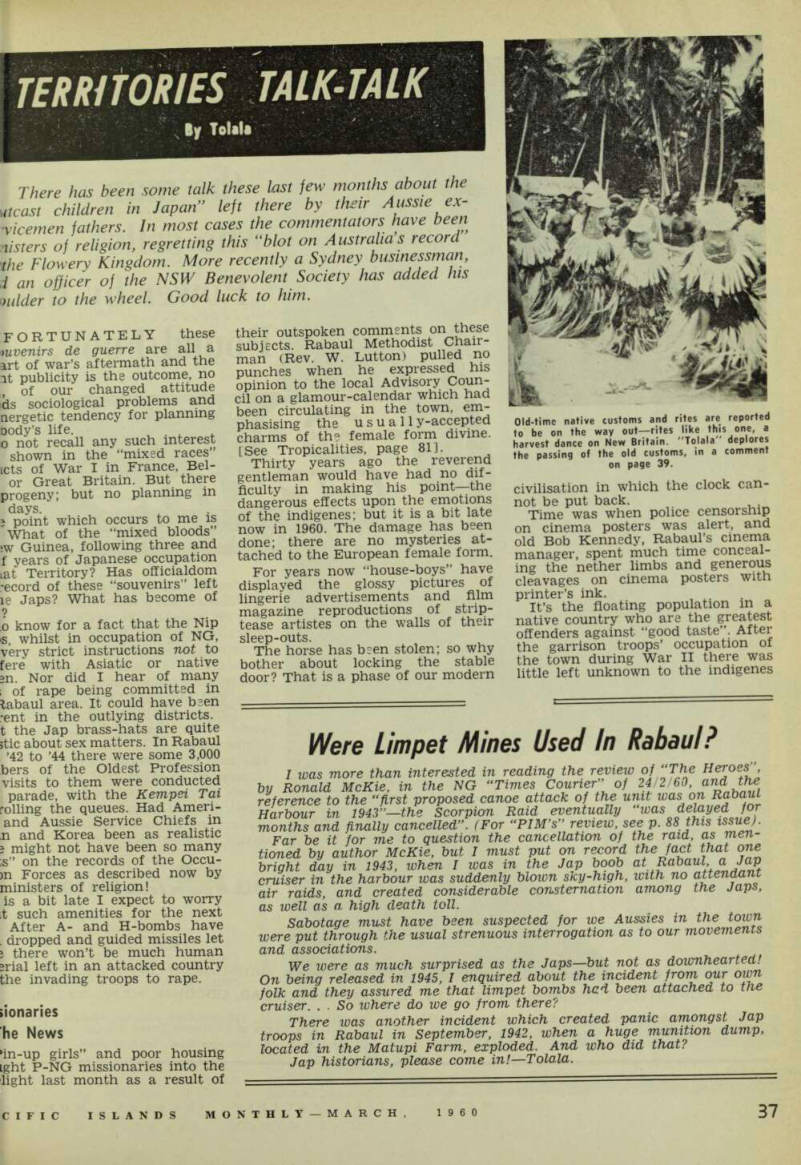
Old-time native customs and rites are reported to be on the way out—rites like this one, a harvest dance on New Britain. "Tolala deplores the passing of the old customs, in a comment on page 39.