Pacific Commerce and Produce
pp. 162-164 · Read in the full issue
P-NG Wants More Overseas Trade Representation
From a NG Correspondent An Australian Government trade
delegation which visited Papua-
New Guinea in January returned with at least one concrete re commendation from the Terri
tory’s businessmen that the
Territory vitally needs overseas
trade representation.
r[IS point was strongly made on a number of occasions by repre sentatives of commercial or ganisations and primary producers who met the delegation throughout the tour.
At the same time the leader of the delegation, Mr. A. J. Campbell First Assistant Secretary of the Australian Department of Trade was quick to point out that Aus tralian Trade Commissioners in overseas countries already have powers to act on behalf of Papua- New Guinea. y Said }**■ Cam P b ell: “The main °/ argument, then, seems tb tbat u the greatest possible use should be made of these com missioners on New Guinea’s behalf.
That seemed to be what many of the businessmen we met required”.
Two other officers accompanied Mr. Campbell. They were Mr. F.
Weekes, also from the Department of Trade; and Mr. E. J. Wood, the Assistant Secretary of the Depart ment of Territories.
Mr. Campbell made it clear in all his interviews that his mission was not to give advice, or to give answers, or to carry any specific submissions to the Commonwealth He said that the delegation had come to the Territory to obtain background information on trade matters which would assist the mutual operation of the Depart ment of Trade and the Department of Territories.
Nevertheless he ran into a pretty solid barrage of advice and requests from businessmen and producers He was told that: • Capital was sometimes hard to attract from outside because the present economic and administra tive trends in the Territory (par ticularly the Trust Territory of New Guinea) were breeding economic insecurity. • The Territory was sometimes forgotten when Australian trade officers negotiated overseas bilateral agreements. • Income tax was affecting the operation of commercial enterprise because salaried staff were restless. • Although native labour appeared cheap on paper, its full implications meant an item of great expense.
Mr. Campbell said that his dis cussions in the Territory on possible protective tariffs to help develop ..ocal secondary industry had brought forth mixed opinions.
Some businessmen had favoured such a system, but others had felt that the consumption market was so small that the system was not justified and would only add to the immediate cost of living. The latter opinion had been supported by a statement to the effect: “If a local manufacturer can’t compete on our local market without protection, e .•* las nothing to offer.
Either he is not running the busi ness correctly or he has foolishly stepped into a market which could be supplied more simply and economically by imports”.
Value of P-NG's Exports
Rises by 31 per cent. to ß T e nnp d -?n°snL trade figures for the year 59 frariP I°’ 19 f 9 ; are disclosed in the 1958- 59 trade report for Papua and New Guinea just issued. Details are:
Because of higher copra and cocon prices and increased shipments in ( cocoa and coffee, export returns we: by just over 31 per cent.
Overall, imports did not vary gr though some individual items die instance, £200,000 more foodstuffs, ir rice and cereal preparations were bn into the Territory, while machinery transport equipment fell by £383,00C Australia supplied goods i £13,406,000, her nearest competitor USA £1,400,000 and UK £1,338 000' she took well over half the exi £8,789,000 worth against UK’s £4 94 (mostly copra and by-products) Canada’s £1,111,000 (coconut oil).
ARC'S Bwata Well
Is All Gas, No OH
Bwata well, in Papua, will be plu and the drilling outfit moved elsew reported Australasian Petroleum Co Ltd., on February 5. Gas had flowe the rate of 20 million cu. ft. a day all evidence showed there was no ur lying oil accumulation there.
Effort now will be concentrated c new site at lehi. From a base camj the Kikori River, helicopter landing were being cleared, early in Febn along the access route to lehi.
Union SS Co.'s Profit
Dropped Sharply
Net profit of Union Steam Ship Cc NZ, Ltd., dropped from over £1,000,00 £377,170 to September 30, 1959, repo directors in January. This mainly result of the NZ import controls, w at one time resulted in 16 ship’s b laid up.
Dividend on ordinary capital, all by P. and O. Steam Navigation Co., maintained at 8 per cent. The pub held preference shares get sVs> per cen The company is preparing plans for placement and additions to the ci fleet, with vessels of changed design.
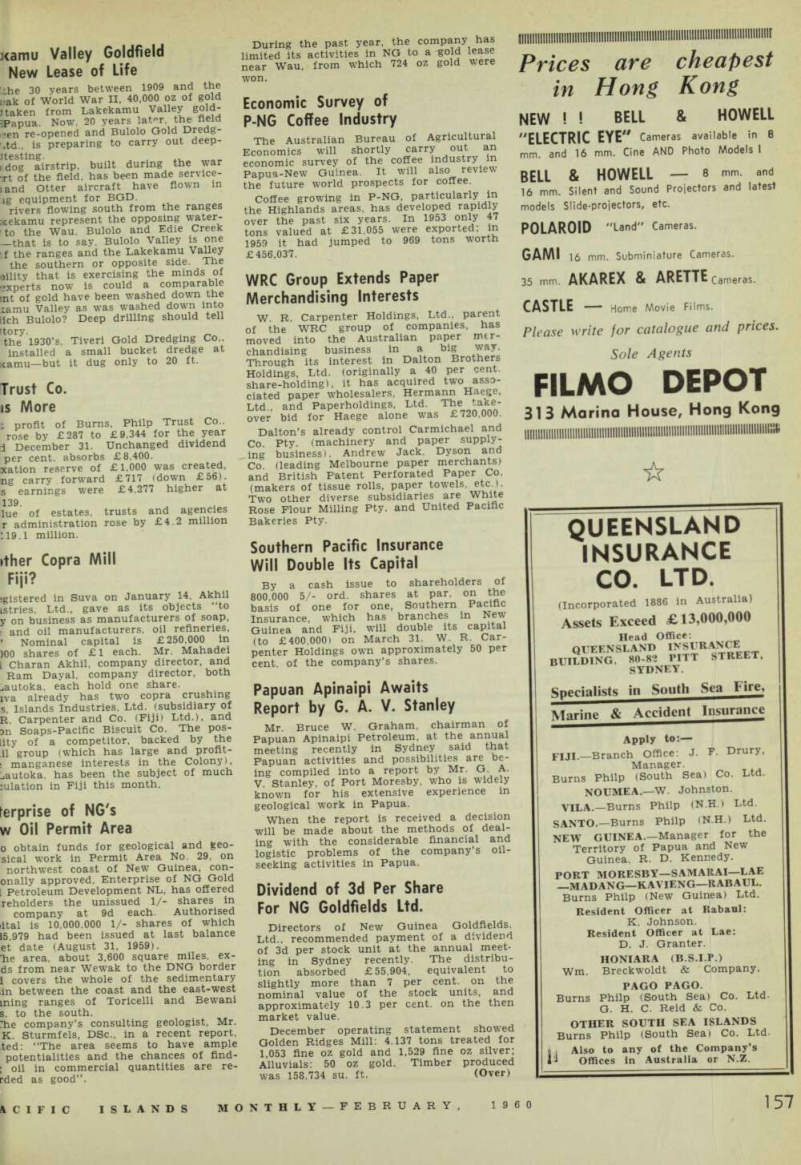
FOW FIJI. James A. Langbein, has been posted to Fiji where he has joined the New Zealand Ministry of Works team controlling the Nadi International Airport reconstruction contract.
He has replaced Mr. E. N. L. collier, who has joined the staff of Garmm on (Makaya), Limited, controlling organisation with activities scattered throughout the South Pacific.
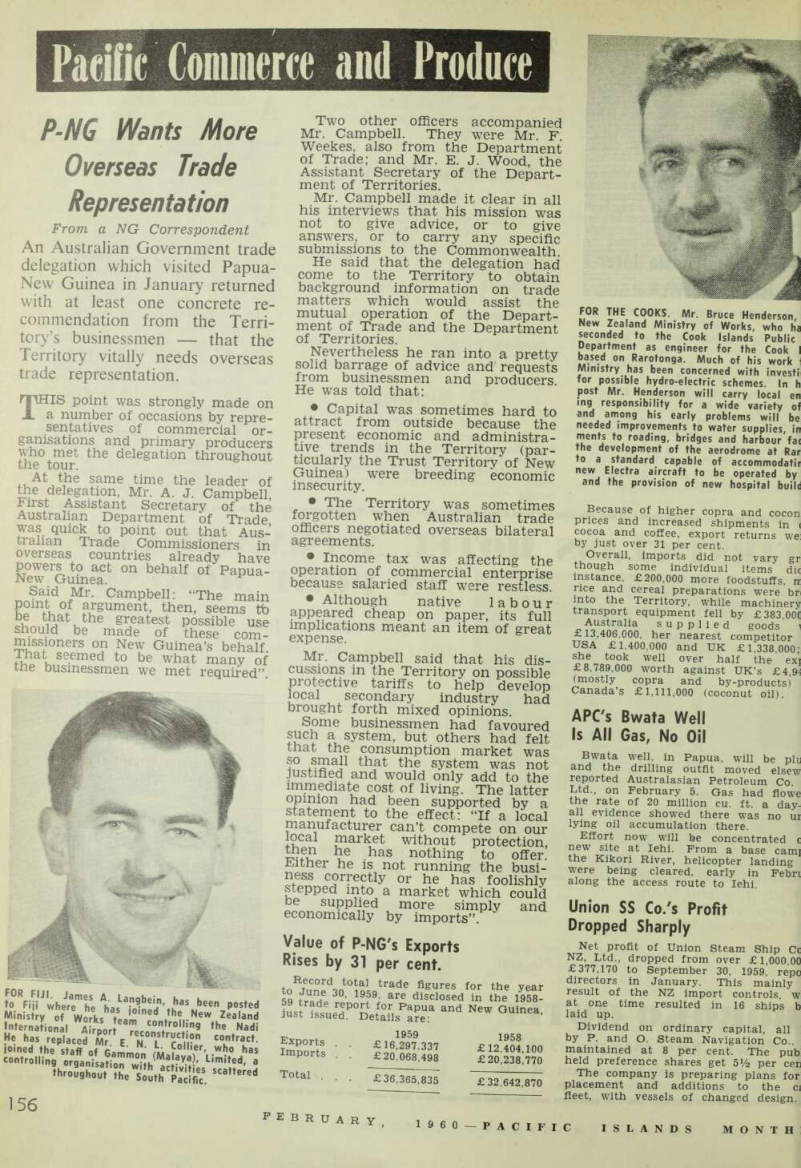
FOR THE COOKS. Mr. Bruce Henderson, New Zealand Ministry of Works, who ha seconded to the Cook Islands Public Department as engineer for the Cook I based on Rarotonga. Much of his work i Ministry has been concerned with investii for possible hydro-electric schemes. In h post Mr. Henderson will carry local en mg responsibility for a wide variety of and among his early problems will be needed improvements to water supplies, in ments to reading, bridges and harbour fac the development of the aerodrome at Rar to a standard capable of accommodatir new Electra aircraft to be operated by and the provision of new hospital build
Exports .
Imports 1959 £16,297.337 £20.068.498 1958 £12.404.100 £20,238,770 Total . . £36,365,835 £32,642,870
xamu Valley Goldfield
New Lease of Life
'.the 30 years between 1909 and the t-ak of World War 11. 40,000 oz of gold t taken from Lakekamu Valley gold- IPapua. Now. 20 years laW, the field ■ s en re-opened and Bulolo Gold Dredg ed., is preparing to carry out deep- Jtesting. . a .. »dog airstrip, built during the war irt of the field, has been made service land Otter aircraft have flown in ig equipment for BGD. rivers flowing south from the ranges ikekamu represent the opposing water -to the Wau, Bulolo and Edie Creek —that is to say. Bulolo Valley is one tf the ranges and the Lakekamu Valley the southern or opposite side. The oility that is exercising the minds of experts now is could a comparable int of gold have been washed down the xamu Valley as was washed down into ilch Bulolo? Deep drilling should tell l93o’s. Tiveri Gold Dredging Co., installed a small bucket dredge at samu—but it dug only to 20 ft.
Trust Co.
is More
i profit of Burns, Philp Trust Co., rose by £287 to £9,344 for the year 1 December 31. Unchanged dividend per cent, absorbs £8,400. xation reserve of £l,OOO was created, ng carry forward £717 (down £56). s earnings were £4,277 higher at 139 lue of estates, trusts and agencies r administration rose by £4.2 million 119.1 million.
ither Copra Mill
Fiji?
sgistered in Suva on January 14, Akhil istries. Ltd., gave as its objects “to y on business as manufacturers of soap, : and oil manufacturers, oil refineries, ’ Nominal capital is £250,000 in )00 shares of £1 each. Mr. Mahadei i Charan Akhil, company director, and Ram Dayal, company director, both jautoka, each hold one share, iva already has two copra crushing s, Islands Industries, Ltd. (subsidiary of R. Carpenter and Co. (Fiji) Ltd.), and on Soaps-Pacific Biscuit Co. The pos- Lity of a competitor, backed by the il group (which has large and profit ; manganese interests in the Colony), jautoka. has been the subject of much julation in Fiji this month.
terprise of NG's
w Oil Permit Area
0 obtain funds for geological and geo sical work in Permit Area No. 29, on northwest coast of New Guinea, con onally approved, Enterprise of NG Gold [ Petroleum Development NL, has offered reholders the unissued 1/- shares in company at 9d each. Authorised iital is 10,000.000 1/- shares of which 15,979 had been issued at last balance et date (August 31, 1959). ’he area, about 3,600 square miles, ex ds from near Wewak to the DNG border 1 covers the whole of the sedimentary in between the coast and the east-west ining ranges of Toricelli and Bewani s. to the south. lie company’s consulting geologist, Mr.
K. Sturmfels, DSc., in a recent report, ted: “The area seems to have ample potentialities and the chances of find ; oil in commercial quantities are re rded as good”.
During the past year, the company has limited its activities in NG to a gold lease near Wau, from which 724 oz gold were won.
Economic Survey of
P-NG Coffee Industry
The Australian Bureau of Agricultural Economics will shortly carry out an economic survey of the coffee industry in Papua-New Guinea. It will also review the future world prospects for coffee.
Coffee growing in P-NG, particularly in the Highlands areas, has developed rapidly over the past six years. In 1953 only 47 tons valued at £31,055 were exported: in 1959 it had jumped to 969 tons worth £456,037.
WRC Group Extends Paper
Merchandising Interests
W. R. Carpenter Holdings, Ltd., parent of the WRC group of companies, has moved into the Australian paper mer chandising business in a big way.
Through its interest in Dalton Brothers Holdings, Ltd. (originally a 40 per cent, share-holding), it has acquired two asso ciated paper wholesalers, Hermann Haege, Ltd., and Paperholdings, Ltd. The take over bid for Haege alone was £720,000.
Dalton’s already control Carmichael and Co. Pty. (machinery and paper supply ing business). Andrew Jack. Dyson and Co (leading Melbourne paper merchants) and British Patent Perforated Paper Co. (makers of tissue rolls, paper towels, etc ).
Two other diverse subsidiaries are White Rose Flour Milling Pty. and United Pacific Bakeries Pty.
Southern Pacific Insurance
Will Double Its Capital
By a cash issue to shareholders of 800 000 5/- ord. shares at par, on the basis of one for one, Southern Pacific Insurance, which has branches in New Guinea and Fiji, will double its capital (to £400,000) on March 31. W. R. Car penter Holdings own approximately 50 per cent, of the company’s shares.
Papuan Apinaipi Awaits
Report by G. A. V. Stanley
Mr. Bruce W. Graham, chairman of Papuan Apinaipi Petroleum, at the annual meeting recently in Sydney said that Papuan activities and possibilities are be ing compiled into a report by Mr. G. A.
V. Stanley, of Port Moresby, who is widely known for his extensive experience in geological work in Papua.
When the report is received a decision will be made about the methods of deal ing with the considerable financial and logistic problems of the company’s oil seeking activities in Papua.
Dividend of 3d Per Share
For NG Goldfields Ltd.
Directors of New Guinea Goldfields, Ltd., recommended payment of a dividend of 3d per stock unit at the annual meet ing in Sydney recently. The distribu tion absorbed £55,904, equivalent to slightly more than 7 per cent, on the nominal value of the stock units, and approximately 10.3 per cent, on the then market value.
December operating statement showed Golden Ridges Mill; 4.137 tons treated for 1,053 fine oz gold and 1,529 fine oz silver; Alluvials: 50 oz gold. Timber produced was 158,734 su. ft. (Over)
Nl Whaling to Seek
£50,000 for Expansion
Norfolk Island and Byron Bay Whaling Go., Ltd., will shortly issue £50,000 registered convertible unsecured 10 per cent, notes.
Funds will partly finance the estimated £ A 140.000 to be spent on the Great Barrier Is. (NZ) station, the chairman, Mr.
N. G. Bell, told the annual meeting re cently.
Increased quotas, from 120 to 150 whales, at Byron Bay and Norfolk Island had been chief factor in larger earnings.
Group profit rose £45,187 to £63,063 for the year ended October 31. Dividend, re sumed at 10 per cent., required £42,000