Pacific Report
pp. 119-147 · Read in the full issue

The month’s round-up of news and pictures of people and events, from PIM correspondents in the South Pacific.
lew Britain's Worst
forms For 20 Years
While cyclonic weather lashed te Queensland coast and a devastat ig typhoon struck the New Hebrides ,te in December, an arm of the sormy conditions struck out and rought to New Britain the most amaging weather it has known for t least 20 years.
In Rabaul alone nearly 30 inches f rain fell, making the month the ettest December on record, but in le Bainings district some falls ex eeded 45 inches.
A native plantation worker rowned in the flooded Warangoi iver, 30 miles from Rabaul, and ve others narrowly escaped death r hen a flood-undermined road ecl ipsed beneath their car near avuneram, nine miles from Rabaul.
Road damage was so extensive i Rabaul and district that works fficers estimated £2,000 a week was eing spent on repairs for several reeks after the storm died away.
In the producing areas, floods and ain took heavy toll of plantings nd equipment. Damage was par- Lcularly heavy along the strip of lantations between the Bainings oastline and the mountain range ehind them.
Landslides demolished five-year id cocoa plantings, and floods cashed away buildings, leaving a etal bill for damages which cannot et be estimated.
Roads at the back of Kokopo, 20 [files from Rabaul, turned into wamps, and other roads closer to labaul were cut open with gullies ,nd erosion channels.
Power station and telephone echnicians worked long hours to epair services affected by the rain.
In the western parts of New Iritain at least eight bridges were lestroyed, two of which were steel pan bridges.
At the height of one of the stormy peeks the Assistant Administrator >f Papua-New Guinea, Dr. J. T. >unther, decided to fly to Hoskins flrstrip to inspect New Britain out tations. Wet weather prevented a ouch-down, and Dr, Gunther went >n to Rabaul.
It made little difference to the
ultimate result of his tour, but it was not funny for the New Britain District Commissioner, Mr. John Foldi, who was in a storm-tossed boat travelling to meet Dr. Gunther.
He turned round and went back to Rabaul.
On the production side, the rain reduced the output of cocoa and caused losses to plantations relying on sun-driers. Under the circum stances, the quality of cocoa which some properties continued to pro duce was laudable, although the out put was down.
Plans For P-NG
Mineral Search
A group of businessmen was con sidering the spending of £111,600 on a search for minerals in Papua- New Guinea, an AAP-Reuter report from Port Moresby said in January.
If the group decided to go ahead with the plan and the results were promising the total investment could be “very much more sub stantial” the leader of the group,
Mr. George Scholey, of Manila, said.
“Present indications are that they will have a team of Filipino geologists and surveyors working in the Territory within three months”, Mr. Scholey said. “From what I already have seen of mining prospects during a few days in the Territory there is room for invest ment and my report to my partners should be favourable.”
Mr. Scholey, who is an American, and manager of the Philex Mining Corporation, said his group was primarily interested in mining copper, but also was interested in gold.
“We would consider buying an existing mine if prospects were good enough. We have been thinking of investing in a search for minerals
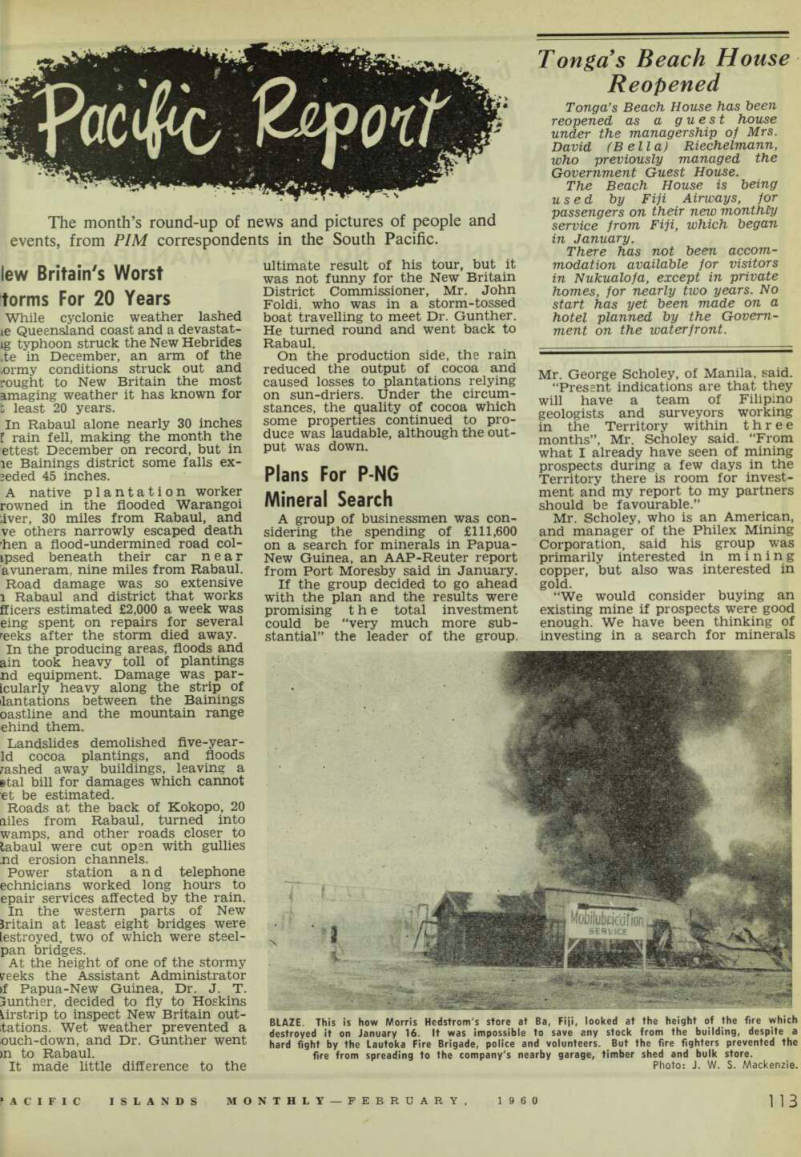
BLAZE. This is how Morris Hedstrom's store at Ba, Fiji, looked at the height of the fire which destroyed it on January 16. It was impossible to save any stock from the building, despite a hard fight by the Lautoka Fire Brigade, police and volunteers. But the fire fighters prevented the fire from spreading to the company's nearby garage, timber shed and bulk store.
Photo: J. W. S. Mackenzie.
:.ie Territory for about two years, •ems very suitable for us because Government is helpful, tax is too high and the place is wide n for development,” he said. ir. Scholey said his partners ‘3 businessmen in Hongkong and nila.
larming" Increase
Suva Thefts
jurglaries at Suva since the •ember riots have reached such ming proportions that com :ies which handle theft, etc., jirance, have expressed concern Ihe number of police available for : patrols in the city at night, ccording to some Suva reports, thefts point to “a mastermind tewhere along the line”. There uvidence of careful planning in stores chosen for robbery, and type of goods stolen. •ne result of the insurance and nmerce compaints to the Police nmissioner, Mr. R. H. T. mmont, was an immediate in ise in the number of foot patrols, /ith a force with an establish it of 564 and no provision for radual increase to meet the needs a growing population, Mr. mmont was forced to fall back the special constabulary which, the space of a little more than a r, have earned the thanks of citizens for the sterling work y have done. !ach night regular and specials rol the streets of the city, con trating mainly in the commercial a, but at times spreading out the residential suburbs.
Tie number of burglaries dropped ry sharply soon after the patrols •e strengthened. But it is a little d on the specials who do a night patrol and then have to go to ir normal work the next day. wever, they are a cheerful lot, 1 showed their merit during the ;s. l few days after the first com ints the police made a great il of stolen property and court es were expected to follow hin a few days.
I Fiji Govt. Wage
iployees Get Raise
ls a result of negotiations be len the Fiji Public Works Depart nt Employees’ Union and the De tment, which had been going on ce last June, agreement was ched in mid-January whereby onists will receive increases, re spective from August 1, varying m 4id per hour for the lowest d workers down to id per hour those on the highest rates. The v minimum rate thus becomes per hour.
Ls a result of this agreement the vernment announced next day it all other Government hourly,
daily, and monthly unestablished workers numbering about 1,500 would receive increases on the same scale. Workers other than PWD had received increases in December comparable with those awarded to sugar mill workers earlier in the year on the basis of recommendations by a commission of inquiry. The basic rate was thereby increased by 3d.
This has now been further increased, in line with the PWD scale, to 4 2 d. The new December scale was retrospective to October 1, but this has now been adjusted August i.
The Fiji Government had announced earlier in January that as a result of representations made by the Fiji Industrial Workers’ Con-
gress and the Public Works Depart ment Union, it had decided to post pone implementation of the pro posed policy whereby considerable staff reductions were to have taken place, farming out much PWD work to private contractors. The gov ernment is now giving considera tion to the points raised by the unions.
Theoretically, the transfer of work to contractors would call for more labour by them, but it is probably doubtful whether anything like all the PWD labour would be so absorbed, so some unemployment would seem probable.
It was never intended, however, that the plan be implemented in
other than gradual stages ove] period of years.
Almost all schemes in Fiji h been held up pending release of Burns Commission recommen tions, which will effect every ph of Colony life.
Following the announcement of creases in rates through governm casual-worker ranks, Christie Nielsen and Gammon Ltd., overs contractors handling the Laub wharf and Suva slipway jobs, i nounced that in line with an agr ment which they had with the G eminent, they too would incre their rates on the same scale.
Papeete Tourists Found
It a Dull Day
The Tahitian newssheet Dehats.
January was critical of the sit tion which allowed the town Papeete to be completely closed during the New Year holid during the arrival of 3,000 touri The tourists arrived on th ships only to find the streets di: the shops closed, no restaura open and no taxis. There were even enough seats for them £ hundreds of tourists sat on curb with their feet in the gutb said Dehats.
The post office was not open nobody could post cards to tf friends. One shopkeeper had tal charge of over £lOO worth of p cards to post the next day.
The Dehats added that, to it all, even the tourist bureau \ closed.
It commented that if Tal preferred to live on its fame, w indifference to the vast sums 1 3,000 tourists might have left foreign exchange, it should reme ber that the impression left on 3,i discontented tourists would d courage 50,000 others in the futu
It Burnt Without
Any Fuss
Without fuss and generally u noticed (Rabaul did not learn abc it for nearly a week), the veter motor vessel Los Negros burnt her moorings at Manus Island i cently.
The Rabaul-based Los Negn skippered by Harry Brutnall, Rabaul, was a total loss after t fire.
Even the newspapers missed o on the fire, although one pap apologetically mentioned t subject a couple of weeks lab claiming that the loss of the sh must have been one of the quiete shipwrecks in history.
But there is one better.
Only half a mile from the doo step of the same newspaper, t] solitary top of a mast stands thr feet out of the waters of Simpst Harbour, Rabaul.
It is all that remains above wat
the motor vessel Balus, which nk at anchor seven months ago id is considered a total loss.
Balus had been at anchor for sarly a year when she filled and nk. She was one of the ugliest ofiled vessels ever to operate out Rabaul, but had a long life of eful service.
oncessions to Tourism—
jt Not to Charity
Firms or organisations making nds available to the Fiji Visitors’ ireau to help promote the valu ile tourist trade —now worth ,000,000 a year to the Colony—will it pay income tax on these alloca ms. No such taxation concession .11 be made, however, to firms, ganisations, or individuals making ants to recognised charities.
This was mentioned by Mr. E. R. jvington, Fiji’s Financial Secretary, len presenting the Budget for 1960.
Mr. Bevington said that in Idition to the amount of £9,000 set ide for operations of the Fiji isitors’ Bureau—the Government urist publicity agency—the Gov nment would, in addition, this sar subsidise on a £1 for £1 basis d to a maximum of £2,000, all •ants made by firms and organisa- Dns interested in the tourist busi-
Jss.
Referring to the taxation con issions, Mr. Bevington said: “While on this subject, I should £e to say that the Government
is often pressed to make a similar concession in respect of gifts to charity. I regret we cannot do this, This particular gesture to tourist grants is not charity—it is the purest self-interest.”
Some people in Fiji feel that it would also be in the purest self interest for the Government to make such concessions in respect to charities.
This view is that charities may not earn money, but they certainly cost money, they are to a large ex tent the responsibility of the Gov ernment, and the Government could save money by doing its duty in this way through private charitable organisations.
Floating Trade Store
Floating Trade Store
A married couple with a 37-ft Danish Sea Boat class yacht have brought something new to New Guinea. They are Mr. and Mrs. E. G.
Berg, who have applied for a pedlar’s licence from Lae—they are going to barter goods from the Bluebird II like the Pacific traders of a hundred years ago.
The yacht is equipped with a deep-freeze unit to hold one ton of fish, and they intend fishing Huon Gulf waters. Mr. Berg will employ native fishermen, using his own nets and equipment, and paying the
[?] Territory families were linked when [?] bara May Taylor became Mrs. Lawrence [?] nard Kelly at St. Mary's Catholic Church, [?] New Guinea, on January 16. The bride [?] the eldest daughter of Mr. and Mrs. J. A. [?] lor, of Lae, and the bridegroom is the [?] ngest son of the late Mr. T. J. Kelly, and [?] Catherine Kelly, of Mascot, Sydney, [?] rrence Kelly and his two elder brothers are farming at Erap, near Lae.
Photo: 0. Brabant.
.tives in goods, which they prefer hard cash. An unwritten law lists along the coast: water adjoin g the villages belongs to that par sular village, and natives become sentful if other tribesmen fish eir waters. By not carrying native ew members, Mr. Berg hopes to r oid tribal squabbles, and will em oy local natives from each village iere he anchors.
A Swede, Mr. Berg was in the avy from the age of 15 until he signed in 1947. He met his wife Darwin about nine years ago, len he decided to go to New uinea, where he worked as a iner with New Guinea Goldfields id., Wau. His fiancee joined him iere about four years ago and they ere married. For the last seven .onths, the Bergs have been at
inschhafen where he purchased
le hull of Bluebird II and finished hiding her. They have now made leir headquarters at Salamaua and ill bring the freshly caught and eaned fish to Lae at regular in ;rvals.
Forerunner to Bluebird II was luebird I, which they had in Port [oresby. The yacht was left on the each, for a time, but vandals ripped her, and she was eventually complete write-off.
ome Hot Tempers
i Rabaul
Tempers ran hot in a spectacular icident involving Tolai natives and hinese at Rabaul recently, but olice and Administration officers mnd no evidence to suggest that le disturbance was of racial origin.
“It was just a flare-up of tempers inch could have happened to any ne here or anywhere else,” a olice officer said after the fire rorks had died away.
Highlight of the incident was a bouted threat at one stage that a ang of influential Chinese was oming to Rabaul “to cut the throats f big-headed natives”.
The trouble started in the Chinese entre of Matupit Farm, when a Jhinese motorist accused four stives of spreading false stories bout him.
The natives told him they had no
time to discuss the subject and told him to drive on. According to re ports reaching police, the Chinese threatened the natives with retri bution from a gang of influential overseas Chinese, and then drove away.
The natives followed the Chinese to his house, where they alleged he appeared waving a rifle and re peating the threats.
The story of the threats spread quickly through native groups in Rabaul, particularly among crowds of natives watching a soccer match at Queen Elizabeth Park.
A Chinese motorist (not connected with the first one) tipped a small child with the mudguard of his car immediately outside the football ground. The child was not hurt, but a big group of natives closed in on the car shouting and waving their arms.
The driver wound up the windows and locked the doors in the centre of the rapidly-growing crowd of natives, who held him prisoner for nearly ten minutes.
About 200 natives were pressing round the car by the time police arrived to disperse them. They broke up quietly, and many of them
voluntarily arrived at the Rabaul sub-district office the next day to make statements.
Suva Meetings in
Albert Park Only
Had a new Fiji regulation regard ing public meetings which was brought into force in January applied in December there would possibly have been very little damage asso ciated with a December meeting in Rodwell Road.
Under the new regulation all future open-air meetings must be held in Albert Park.
Window smashing is an infectious form of hooliganism, and it seems most probable that had there been no windows in the vicinity when
In Sydney
Mr. Victor Garcia, of Noumea, looks happy here surrounded by three Maori nurses, at a Polynesian Association function in Sydney. The girls, Alice Pirere, Betty Reihana and Margaret Grant are all at Sydney Crown Street Women's Hospital. —Tele-Photos.
COLLAPSE The occupier of this house at Madang, NG, Mrs. Teong Hop, was absent at a picture theatre with four of her children when a rain tree (right) collapsed on the house, wrecking it completely. Another child, who stayed at home, surprisingly escaped iniury. Photo; S. Diczbalis.
the December stone throwing started, there might have been very little damage to property and the situation might never have got out of hand.
As it was, the meeting took place in Rodwell Road at one of the few central areas where there is room for a large gathering, and the windows nearest happen to be those of the large firms. Had there been other firms occupying those sites their windows would probably have been broken just as readily. Instead, the smashing of the windows in these European stores helped to provide a basis for a racial interpretation of events which perhaps never existed in the strict sense.
Thpv / ll Be Back
c or some More
It was the second night of the New Year and bearded Captain Toshio Mizushima had just finished a cup of sweetened coffee when the hull of his ship ground to a stop on a jagged bed of coral and rock, For the 100-ton fishing vessel Sumayahsi Maru the grinding stop spelt the end of a long and busy life; and for Mizushima the cup of coffee proved to be the last he was to have for many a day.
Mizushima and his 23 crewmen— sailors, fishermen, technicians— swam for safety away from the reef
to where they could hear the v breaking on the shore. Mor found them sitting on the san< Fead Island, 150 miles due norl Bougainville in Australian tru ship territory.
There they stayed for five < salvaging their personal belong from the wreck and waiting fo answer to their radio distress < The manager of Fead Island Pla tion, Mr. Bill Hallam, also radio messages to Rabaul.
When no other Japanese ve appeared on the scene and v food was becoming scarce, Guinea Administration officer Rabaul arranged the diversioi MV Kilinailau, which was tn ling between Bougainville Rabaul.
On January 8, the Japa arrived at Rabaul. They wei
strange-looking crew. Some '
heavy sea boots and had wrai towels around their heads. Ot wore several sets of clothes to duce the carrying problem. S had guns—which were quickly pounded—and most of them scratches from the sharp coral Mizushima had extracts from ship’s papers scribbled on piece paper and floating around in pockets with cigarettes and mate The Japanese spent another : days in Rabaul before a mo< steel-hulled Japanese fishing ve Azuma Maru, came to take tl home again. Accommodation scarce so the men slept on ( under a big awning.
They took the wreck and the j sequent shuttling around in t stride and did not seem dei affected. “We will be back for s< more fish one of these da Mizushima said.
The "Most Successful
P NG Scheme Yet"
In preparation for a big flusl cocoa beans during 1960, the T Cocoa Project of New Britain rapidly going ahead to spent new authorised loan of at
£Bo,Ooo.
The money will be used to ext facilities at 17 fermenteries alre operated by the scheme i possibly to establish new ferm teries.
Total authorised borrowings the scheme now exceed £220,i and repayments are being m well to schedule. The money borrowed from the Bank of > South Wales under guarantee fr the Papua-New Guinea Administ tion.
The most recent loan authorised by the Australian Mi ster for Territories, Mr. Haslu during a tour of the Territory a following a request from nat growers that money was urger needed.
Spokesmen for Government a
vate enterprise have both made quite clear recently that the lai scheme is perhaps the most jcessful native agricultural leme ever launched by the ministration in New Guinea, rhe only shade of criticism ticeable at times is that the leme may be expanding too Didly for the general good of the iustry.
But this view is not shared by [ministration officer, Mr. F. itano, of Rabaul, who has close sociations with the scheme.
Vlr. Reitano says: “The industry sound and so is the scheme. The tive people themselves are play l a bigger and bigger part in 3 management of their own imary production affairs. ‘The mere fact that loan repay mts are up to schedule shows at the scheme is basically sound d successful.
"There are now 17 fermenteries crating, and one alone has been own to turn out 30 tons a month, ic scheme is one of the biggest ings we have struck for building i not only the native economy t the economy of the Territory a whole.”
One of the newest fermenteries away from the mainland of New Itain and is situated on Watom land off the north coast near tbaul.
Mr. Reitano said recently that e Watom Island fermentery was it yet handling a big tonnage, but i believed it would increase.
. .. M , . „ rexte
A New Headquarters For
The Rabaul Police
?r^if ) ofVaT^m a tSe eW cr S &£££%* existing Quarters wlil be the provision of a vastly-improved scienunc ment on fofna?rol tW c°arr y " d ” m r\X P eQSpp C ed S air-conditioned an
nsive filing and reference section will be included for investigation The radio equipment will consist
3M2Sss
H of a will be a totante, and. another «■ . nnlirf* station The eauip
-n? P ?s a r\n|e
° f a a ‘lea.st 40 miles from the central The new’police station is being
uilt beside the existing one. and hen the shift is made the present nation will become the Rabaul fire 'completely new quarters for native Dnstables are being built b^”, d ie police station, including a mess all, kitchen and store.
Work on the new building was elayed early in the New Year when
reather conditions prevented the
ontractors from obtaining a con- Lnuous supply of timber, but con duction is now going ahead apidly.
iji Farm Sledges
Jow Forbidden
The primitive sledges known as hazitas, commonly used by Fiji ndian farmers, bcame illegal in all he dry areas of the Colony as from anuary 1, 1960.
Some time ago this measure was .pproved by the Legislative Council ls a move to combat serious soil irosion problems in many parts of Piii. The sledge is considered a najor factor in soil erosion causes, ts banishment has been strongly ipposed by farmers, mainly because >f its low cost as a means of farm ransport. A ghazita is often made ’rom the fork of a tree and its cost nay be negligible. Farmers must low purchase carts as these are jonsidered to be less damaging to ;op soil and less productive of watercourses.
As from January 1, cane farmers are also forbidden to plant cane parallel with the land-slope. This is another conservation measure.
No Out-patient Treatment
For Fiji lepers Yet
At present it would be unwise to treat infectious leper patients in Fiji on an out-patient basis.
Dr. P. W. Dill-Russell, Director of Medical Services, told the Fiji Legislative Council this in reply to a suggestion that facilities should be
made available for patients to carry on in business.
Dr. Dill-Russell said that while in many parts of the world the disease was treated on an out patient basis, this was only done where the problem was so vast that segregation was impossible, or where the problem was so small that patients could be easily supervised in their own homes.
Fiji, he said, was approaching the latter stage fairly rapidly and when he felt that this point had been reached he would say so, but. said Dr. Dill-Russell, he would prefer not to be rushed as he had a duty to the public.
Dr. Dill-Russell said that where in 1957 there were 559 cases at Makogai, today there were 320. In 1958 a record number of 125 cases were discharged as cured, and that record would be beaten in 1959.
"Make It Museum
Year" In P-NG
“Make 1960 Museum Year" is the wish of the Chief Justice of Papua- New Guinea, Mr. Justice A. Mann, who is also chairman of trustees of the Papua-New Guinea Museum.
The museum has been given space for its displays m Port Moresby, but the entire project is still in its formative stage.
When he is on circuit through the Territory. Mr. Mann loses no opportunity of “selling” the museum idea to as many people as possible, and of obtaining their support.
From all parts of the Territory he has already collected a series of articles or promises of articles ranging from collections of shells and butterflies to ancient native artifacts.
Mr. Mann said recently: We have a building and the oPP°r tun ny to get properly started. That s why I say ‘make 1960 museum year for the Territory’. I feel that the scope of a museum in a country such as this is very great.
“An overseas scientist who has been collecting specimens here has
New Club
Building
A new building for the Kone Club is now under construction for P-NG public servants, near Administration headquarters, Konedobu, Port Moresby. The club is on the foreshores and has a view up the har bour towards the town proper.
Photo: Papuan Prints.
rnade a double collection of e\ thing to help us get our mus going. This is the sort of thini appreciate very much, and w will play a big part in ensu that we have a good museum of own,”
Fiji Rice Flying-Squad
On the Job
In the Rewa Valley of Viti L where the cane farmers are tun somewhat reluctantly to rice foil mg the closure of the CSR Nan sugar mill, the District Adminis non, Dapartment of Agriculture the CSR have jointly establishe sort of rice flying-squad to < with any outbreaks of the disi known as Rice Yellows.
The team has been establishec ensure that the dire predict] made by some farmers in regarc rice do not eventuate.
A constant watch will be kept crops throughout the entire a and at the first signs of I Yellows a spraying team will r to the farm to deal with it.
Farmers are, however, being ur to keep a close lookout themsel and to call on the team at the f signs of disease. That way the g ernment and the CSR, which establishing a new rice mill to d with the crop, are confident that damage suffered in some areas Fiji from this disease last year m not be repeated. A moderate cha: will be made by the insecticide tei to cover the cost of the work.
Recently married at Taurama Chapel, P[?] Moresby—Mr. and Mrs. David Copeland. M[?] Copeland was formerly Miss Beverley Dixon .
Photo: Papuan Print
hanks for a Bumper
hristmas Party
More than 80 children received )y s, and made inroads on a mnt’iful supply of food and drink, i the annual Christmas party pro ded by the New Guinea Women s lub in Sydney.
The secretary, Miss V. Thwaite, in muary, thanked the following sople for their donations for the arty; Robert Gillespie Pty. Ltd.; Mrs. ott; Mrs. L. Northam; Mrs. Neil; [rs. N. Lawes; Mrs. P. Stewart; Mrs. ymington; Mrs. V. B. Pennefather; lurns Philp & Co. (Sydney) ; Mrs. lien limes; Mrs. B. Perriman; Mrs.
Green; W. R. Carpenter & Co.
Sydney); Mr. Tony Edged; Mrs. K.
Ilvey; Mrs. Ginman; New Guinea Hub (Rabaul); Mrs. T. Muller; Mrs. j M. Haviland; Mrs. E. Jones; lurns Philp & Co. (Port Moresby); drs. Wauchope; Captain McFadyen; firs. R. Pye; Mrs. C. Perichon; Mrs. 3. Bennie; Mrs. J. Keenan; Mrs. H.
Johnston; Mrs. Cole; Mrs. E. Good; JLrs M. Carpenter; Mrs. J. Dunbar leid Kokopo; Pacific Islands Monthly; Mrs. Page; Mrs. H. White nan; Mrs. Una Adams; Mrs M.
Uostello; Mrs. Normoyle (Port Moresby); Mrs. J. Duncan; Mrs. G.
Sturgeon; Mrs. G. Thomas.
Transport Charges—
No Holds Barred
The charges thought up by “ship ping and forwarding agents” almost beggar description, according to some people who have to pay them.
Not long ago a resident of Suva sent a small case of personal effects to Sydney—total value, £4 or £5.
These are the charges he was obliged to pay in Suva before the case went onto the ship:
Duty, tax, wharfage, 3d; freight to Sydney, 18/-; attending and , ’ 7/6; entries, 2/6; cartage and handling, 2/6; insurance, 5/3; bill of lading, 1/6.
A total of 37/6.
But we haven’t seen anything yet.
These were the charge? imposed by the Suva firm’s opposite number, in
Sydney:
Bond charges, 16/-; stacking, 9d; wharf age and entries, 2/6; stamp duty on in surance policy, 9d; customs entries, 10/-, attention to statutory declaration, 7/b, agency and attention. 12/6; stamp duties 2/6; ship’s order, 2/6; verification with customs at wharf, 15/-; American Trading charges, 7/6; sundry, 1/9; attention at bond, 2/6; wharf attention, 5/-; cartage, loading and unloading, 15/-. The modest total was £ 5/2/9.
If you are wondering what to do with your enterprising and growing son, there could be a great future for him in this kind of business.
No holds barred.
Is Fiji's Cocoa
The Wrong Type?
Is the variety of cocoa which Fiji has adopted in its cocoa develop ment programme the wrong type for the world’s markets? Some people apparently think that it is, but the Department of Agriculture does not agree.
In a recent broadcast address Mr.
C. Walker, officer in charge of the Government agricultural station at Naduruloulou discussed this question.
ill, he said, has adopted the iiitario hybrid, which was pro in the West Indies, Ceylon, jioa, Indonesia, and Papua-New mea, because there were already 0 trees of this type in the :3 ny which had survived from tier attempts to establish the ustry They showed very little kse in Fiji and some were in orous bearing despite neglect ana [Ticanes. Using material from :se Fiji could make an immediate tad bulk quantities of Forastero Thich makes up the bulk of the ■'ld’s supply—been brought m, :re would have been a severe risk introduction of serious diseases, a there was no guarantee that it old do well. , .
The Government had brought in ne Forastero and planted it m lict isolation so that it could be •efully observed for any signs of lease, but this material could not used by planters for another *ee or four years at least.
Meanwhile, a technique of hybrid id production will be carried out, d these should be available by 53 by which time the present inters would have had enough ex rience to take advan f age of the perior planting material, rhe main consideration, Mr. alker said, was that a well fer mted, properly dried grade of coa be produced. If the standard right, there will be no difficulty the Trinitario strain finding a
ady market.
rcadia Strikes
rouble in Suva
The 29,734-ton Arcadia, south >und in January, was in trouble Suva Just after she had been ■ought alongside by the harbour aster, Captain E. L. James, and as being made fast, steam was jcidentally fed to the port engme 1 the “ahead” position and the ;ssel started to move forward.
Before the movement was noticed le vessel was gaining way, and ily by some very quick releasing
of lines and an “astern” manoeuvre on both engines was a serious mishap averted. There was no ship immediately ahead, fortunately, for Arcadia moved forward about 60U ft before being halted. She swung her bow away from the wharf and for a moment a collision with the local 119-ton wooden vessel Fijian Princess, anchored off the end of the wharf, seemed imminent. Some of her Fijian crew jumped over board. A steel hawser which fouled the port propeilor caused a delay of 19 hours in clearing the 20-odd turns round the shaft. The RNZAF diving club, together with other commercial and government divers, assisted in clearing this tangle.
Cargo nets were lowered to pro tect the divers from possible shark attacks. The bulk of the work fell to the skin divers who, operating with aqualungs and swim fins, were far more mobile. They worked in teams of two and three. This was the second occasion in which Air Force underwater men have featured in the news. About a year ago they investigated the wreck of a missing American yacht, Annette, on a reef in the Lau group.
Skin divers with aqualungs Prepare to go below from a diving barge in Suva Harour to clear the propellors of the big P. & O. liner "Arcadia" in January. In the foreground are sections of the steel cable which had already been cut from the shaft with hacksaws. See story below.
At left, Government diver John Slatter takes time out for coffee dur ing work on the "Arcadia", as Flying Officer R. Brimblecombe, who headed the RNZAF diving team, prepares to go below. At right, Colin White, president of the Fiji Spear Fisher men's Association with his compressor, which was run almost con tinuously pumping air bottles during the div ing operations.
Photos; Rob Wright.
hat's Behind The
irlines Breakdown
With the breakdown in the French istralian traffic rights agreement December still in the news, and e suggestion growing that the ench were to go a step further banning TEAL flights into French ilynesia, the Melbourne journal of rways and aviation news, Aircraft, January published an appraisal the situation which was, to those the know in high places, right i the ball. It was almost, some id, as if Aircraft was stating fic ia 1 Australian Government >licy on the situation.
The breakdown, said Aircraft, irned back the clock to much trlier days of horse trading in iternational air transport rights 3gotiation. And it went on: “If it now makes curious reading > a world accustomed to more iphisticated aviation diplomacy lere is cause to consider the im itations. They suggest very bluntly lat this is, perhaps, a sample of lings to come—a power-politics spression of the birth of European ir Union.
“There was a time in the sphere f international dealings when Aus ralia was known to play the game f traffic rights in a jealously re trictive manner; stubbornly defend ng these shores against all in
vaders of the national airline’s pre serve There is a tendency still, therefore, to look closely at our own attitudes and to seek there the cause of such a breakdown. In more recent years, however, the appioach has been more far-sighted and much more smooth, and a succession 01 highly successful negotiations— most notably that with the United States—has demonstrated a good international reaction.
“A close examination of the back ground to the French-Australian talks certainly does not convince the fair-minded observer that Aus tralia in this instance can be rightly accused of greed. On the other hand the refusal of the French to post pone the talks for a few months, and allow the existing informal arrangement to continue for that period, is strong evidence that France was, at least, impetuous. The immediate loss was that of France, not Australia, for TAI now has to plan for a much less advantageous route. Similarly, the cutting of the airline linking Noumea, French New Caledonia, with Australia will hurt the nationals of that French pos session much more than it will affect Australia. . .
“The French are known, also, to have made a blunt threat that New Zealand is also in line for a similar guillotine in regard to TEAL’S pre sent rights to operate to Tahiti— solely because Australia is a halt partner with New Zealand in TEAL And this despite the fact that TEAL’S flying-boats were Tahiti s sole air link with the world in the days before TAI came into the picture. , , “An even more curious aspect oi the whole question is the fact that France has precipitated this rift so soon after winning substantial rights in the United States—rights that, for the first time, give TAI and Air France a first-class chance of de
veloping a soundly economic South Pacific route, linking their Oceanic possessions into a round-the-world airline pattern. They have a jet air port under construction at Papsete, and planned late next year to intro duce DC-8s to this service, via Aus tralia, Noumea, Tahiti to Los Angeles. mA , “For some years now TAI has serviced Noumea via Darwin and Brisbane for a weekly DC-6B ser vice In return Australia’s Qantas has had rights at Noumea, serving it once a fortnight from Sydney.
“In seeking a new formal agree ment France asked Australia for traffic rights at Sydney and beyond as an alternative to Brisbane. They wanted two services a week, initially by DC-7C and later by DC-8. One of these services would fly via Noumea and Tahiti to Los Angeles, there to link with Air France in a round-the-world route. The other would terminate at Tahiti, where, of course, there would be other con necting links to North America and
T PLANE OUT. Qantas DC4 "Hongkong [?] der" and its crew just before the aircraft Noumea on December 31 for Sydney the Qantas plane out before the French tralian traffic agreement ended. The Pilot, tain J. Christensen, is on the left and Qantas [?] nt Jean Brock is on the right. The aircraft [?] ater flew low over Noumea in final salute.
Photo: F. Dunn.
Seven Years
In The Cooks
Back in New Zealand with the Health Depart ment at Wellington is Mr. Morell Mackenzie, who has been dental officer at Rarotonga in the Cooks since 1953.
Here at his departure he is with his wife and family.
Photo: D. C. Berry.
er South America. Australian apartment of Civil Aviation momists estimated the value of istralian rights on these services about £1,000,000 a year to TAI d Air France. , x ‘Australia was prepared to grant ?se requests provided Qantas was /en reciprocal rights at Tahiti and Paris for which a trans-Atlantic ik is available to Qantas under the
istralia-USA agreement. France
'ered rights at Tahiti, or Paris rith Marseilles suggested as an bernative) but not both. From ese points of view neither was epared to budge and the deadlock iveloped. There followed the sug stion of Australia that negotia ons should be resumed next year, ie refusal of this by France and ie announcement that the existing
mporary arrangement—and the
rvices under it—should cease from tnuary 1, 1960.
“The French delegation was led 7 the Director of Air Transport for ie Ministry of Transport and üblic Works, M. Pierre Moussa. he Director-General DC A, Mr.
G. Anderson, led the Australian *hgation.
“It is understood the French view as that Australia over-valued its ghts and wanted too much for too ttle. For their part Paris and Tahijfi ere equally generous as individual tiers for what they sought. Th°y ad the strong view that Tahiti ould develop as a major tourist entre of the Pacific, and that they ould be re-routed via Djakarta, In etter than Australia could do with ut Tahiti. It was suggested that ’Al’s route to Noumea and onwards ould be re-routed via Djakarta, In onesia, and Biak, Netherlands New Juinea—for which Dutch rights are xpected to be given. Darwin might
be used for a refuelling stop only.
“The Australian view was that the rights sought at Paris (which in the jet age is too close to Lon don to be utilised economically) and Tahiti were not a matter of immedi ate consequence, for there was no plan for Qantas to use them for several years at least. The airfield at Papeete would not be ready for a year and there was doubt whether, even then, it would be suitable for QEA’s Boeing 707/138s. On the other hand the Australian view was that the rights sought at Sydney con veyed an immediate and substantia* benefit to the French airline.”
Some Action On
Fiji Bananas
In mid-January the Fiji Depart ment of Agriculture issued a state ment foreshadowing the imposition of banana quotas on suppliers, so that all will have a fair share of the export market.
New Zealand is likely to take about 240,000 cases from Fiji this year, and as production is likely to exceed substantially that amount a quota system seems called for.
Should suppliers, having been allocated a quota, fail to meet it without good reason, they will have to expect a reduction in favour of other suppliers who regularly meet
their promised quantities.
The quotas will eventually be vested in the proposed Banana Marketing Board, but until that is set up the Department of Agri culture will set quotas according to the supplier’s estimate of his capability, the quantities he has produced for shipment in the past, and on field inspection of his areas.
Quotas will also be set according to the quality of the fruit con sistently supplied for shipment.
Quality will be given particular emphasis, the statement says, in view of the criticism of the Fiji product in New Zealand as com pared with the product for some other producing territories, and in view of New Zealand’s right to choose freely the sources of her banana imports. (See p. 65 this issue.) A week later it was also announced somewhat belatedly many will consider —that the Gov ernment’s Standing Finance Com
mittee had set up a sub-committee to make a detailed examination of a proposal for an experimental dried banana project. The proposal was put forward by Mr. H. B.
Gibson, senior European elected
Mlc.
The sub-committee will consist of the acting-Financial Secretary, Mr.
H. P. Ritchie (chairman); Mr. J.
A. Moore; Ratu Edward Cakobau; Mr. S. Narain; and the Commerce and Industries Officer, Mr. R. W.
Parkinson.
This sub-committee will no doubt investigate the highly optimistic reports of market possibilities for this product made by Mr. B.
Proweller, a business man, who made an exploratory visit to the United States late last year.
PlM’s Auckland correspondent re ported from there in late January: A suggestion made in the Fiji Legislative Council in January that the Fiji Government was not doing enough towards urging New Zealand to accept larger shipments of Fiji bananas did not raise much enthusiasm from Mr. C. Ross Walker, general manager of the im porting organisation, Fruit Distri butors Ltd., which handles all such fruit coming into New Zealand.
Fiji had failed to grasp the opportunity which New Zealand had offered it for larger consignments in recent years, Mr. Walker said.
Where Fiji had failed to grasp this opportunity, Western Samoa had made great efforts to meet the need.
With a progressive outlook and provision of a modern shir terminal, he said, Western Se can ensure the availability bananas all the year rounc adequate quantity and at an price. Western Samoa had ser New Zealand over 800,000 case each of the past two years, could only supply 149,000 case 1958 and 65,500 cases last ' Tonga had stepped up her ou and would be supplying n< 30,000 cases in January.
Apart from the irregularity supply from Fiji—and Mr. We did not say that this was ab the fault of the Fijians, climate also involved, the New Zea! demand for bananas, especiall; January and February when ! stone fruit is available, does ] a limit. At this time of the the quantities required are sh between the producing territor Mr, Walker did not say so, it may fairly be assumed that Zealand would give some prefer to trade with Western Sa where she has closer ties responsibilities for developmem Samoa can deliver the goods, as has demonstrated that she car Realising that should spur into much greater research into possibility of processed bam and other markets.
Japanese Timber Interest
In the South Pacific?
There seems some indication t Japanese buyers may stir up timber market in the South Pac The Japanese Government is habilitating the Japanese forests part of a long range plan, and a result Japan has to increase imports of logs to keep up v local demands, in addition to ke ing pace with its exports of vent and plywoods.
The Japanese have been buy logs from as far away as Gha Now, Japanese interest in exp: ing logs from Manokwari, Neth lands New Guinea, is increas rapidly. In short succession, seve groups of Japanese businessn representing prospective buyers h visited the district and entered i: negotiations with local contract* throwing in offers of loaning he; equipment to get large-scale logg operations started. Similar ope tions for Ryukyu Lumber Comps (from Okinawa) have been star in the Hollandia district.
Recently the Japanese presid* and vice-president of the N Guinea Bussan Company (also fn Okinawa) were at Manokwari, a said they intended to open up branch office in the town. T 1 bought a building there.
Japanese buyers have sho themselves interested in acquiri mixed shipments of all kinds
über except kwila, and some poor ,des of light brown wood. The ,ding rules are not too strict but dw for some oversize and extra Vithin a 12-mile radius of Mano ari port, a quantity of more than million cubic feet of the required ibar is readily available out oi estimated total of 80 million Die feet. however, according to some re nts it is doubtful whether the therlands New Guinea Govern »nt will consider granting con isions in the Manokwari area to •al contractors or other small
tie operators to provide logs for
The Government might prefer to ve the market to a suitable large m, applying for a concession of e whole area.
There has recently been a rumour at a large American corpoiation, »t previously engaged in logging, it with business interests in Japan, is been seeking an option from e Government.
Three professors of the Ag"icul ral University of the Netherlands, Wageningen, are currently visit g NNG investigating timber pos bilities. Professor G. Hellinga, rofessor J. F. Kools and Professor H Becking will remain for two onths studying the problems of 3re s t exploitation and related tatters.
nportant New Cocoa
liscovery in P-NG
A New Guinea agronomist had iscovered a new method of pro essing cocoa which is expected to Lve a great boost to the Territory’s ocoa industry and prove very aluable to other cocoa growing Duntries, AAP-Reuter reported from >ort Moresby in January.
The Acting Director of Agriculture a the Territory, Mr. W. Conroy, aid that the agronomist, Mi'. L. A.
Jridgland, working at Kerevat Gov
eminent Research Station near Rabaul, discovered a method of hastening the drying wet cocoa beans.
“In short, Mr. Bridgland’s process means a much greater volume of cocoa beans can be handled in much the same area of drying space as previously employed at cocoa fer menteries.” fermented “Cocoa beans are first ifrmenreu then dried. Mr. B^’ ldgl^4’ lv d^ m g five years’ research completed, found that if a great amou t of heat was used on wet beans early in thp drvine process the beans can be put away still partially da ™P * n boxes or bins for up to a week with-
can Sen'be falfen out
again and the drying process com- “This is over-simplifying the pro cess, of course, but in general less time and less space are needed to dry beans, and losses fro]* 1 weather can almost completely be cut out by the new process.’
Mr Conroy said that cocoa was the “boom crop” of Papua-New Guinea and market prospects were excellent. , . . . “We are now investigating prospects of adapting present Terri tory machinery or building new machinery to use the Bndgland s r “We believe it will enable Terri tory fermenteries to greatly reduce the cost of drying and greatly im
re efficiency,” he said, r Bridgland discussed the re :ch at world cocoa conference at •'a, Ghana, last year, and the k aroused great interest. don’t say every cocoa growing ntry will immediately change to [ new process, but many are very irested and it will help other ntries in their own lines of re i-ch,” Mr. Conroy said. ■lr Bridgland left the Govern jit service late last year and is r working in private enterprise [he Rabaul area.
sre'll Be More Fiji
using Soon
lollowing the recent opening of Fiji Government low income ising project at Raiwaqa, Suva, ;ender has now been let for a ther group of 22 single-unit Ases in concrete block construc i at Raiwaqa, and the Housing fchority has called tenders for first stage of a similar project Lautoka, in this case 19 duplex ises to be erected in Dravum ’he Raiwaqa second stage project j been let to Millers Limited at :ontract price of £19,993/1/2. Nine iders were received, including one m Australia.
st Another
lat Got Away
[ntent on hooking a juicy perch, lateur fisherman Don Matheson ,s a bit annoyed when he felt his .e snag somewhere in the dark pths of Rabaul Harbour. [t was 11 o’clock at night and his tie dinghy was rocking gently jre than half a mile offshore. He *ked and weaved the line but it mldn’t free.
A few yards away his two com ,nions, Bill Bates and Harry irtis, sat in a larger dinghy.
Bates wasn’t sure at first, but he ought Matheson’s dinghy started move. A few seconds later he
was sure of it. “There’s something pulling you through the water,” he called But by that time, Matheson him self was only too aware of what was going on. There was a big fisn down below, and it was taking him for a ride. The second boat came up beside him, and the three men lashed the two boats together.
Then the fun started.
Lst Bill Bates continue the story: “Lashed together, and with the fish ing line taut over the bow of the smaller boat, we moved off at a smart 2 h knots. We didn’t think it would last long, but two hours later we were still going strong. By that time we had gone round and round in a big circle in the harbour, cover ing about four miles altogether.
“It was getting pretty late by then, and we decided to try to land the big fish. We made a few at tempts and then the line snapped.
“When we hauled it up there was
only one hook left on it, with a tired 10 lb perch dangling on the hook.”
The three men believed that the fish which pulled them round the harbour was probably a groper, and that it could weigh up to 400 lb.
They think that Matheson probably hooked a small fish, and that the groper rushed in, swallowing the small fish, the hook and several feet of fishing line.
Huge Increase in Ship
Travel Predicted
The Orient and Pacific Lines Agencv Inc.—the American office of this big British shipping com bi n e —predicts that the Line’s Pacific passenger traffic this year will be at least double that of last, and there will be a further very substantial increase in traffic when the 45,000-ton Canberra and the
FAREWELL Chief Judge R. V. Kay (centre) who has recently retired from the Cooks, poses for a farewell with Chief Officer of Police J. O Helloran end Police Officer I. Best (right), and 'erne members of the Cook Islands Police Force at Rarotonga.
Photo: D. C. Berry.
40,000-ton Oriana are commissioned in 1961. These two ships alone will cost the Line £30,000,000.
Last year there were 13 O & P Pacific sailings; this year there will be 18—representing 7,000 berths.
Next year with the new liners in service there will be 11,300 berths — and the Line is convinced that, far from this being the All Air Age, the Pacific passenger trade is as yet only in its infancy, especially in the moderately priced tourist class sphere.
And if further proof of faith in the sea passenger trade is wanted, a contract was signed in November between the American-European Travel Project Incorporated of New York and the Verholme United Shipyards of the Netherlands for
the building of four mammoth 120,000-ton passenger liners each capable of carrying 8,000 passengers plus a crew of 2,000 on the Amster dam-Lisbon-New York service.
All meals will be on the “serve yourself” buffet scheme and there will be many other innovations to reduce operational costs and fares.
These ships will sail under the Dutch flag.
Meanwhile in Britain there is talk of building high-speed passenger vessels of the “floating on-air” variety which will skitter across the oceans some distance above the surface at perhaps 100 miles per hour. Such ships would pose a very real threat to the air lines by reducing the present ad vantage of speed.
Suva Youth Clubs
Are On The Way
The United Kingdom, throug Colonial Welfare and Develop] Fund, has given £5,000 towards establishment of two youth < in Suva.
The project was organised Rotary, which has collected £l2 Fiji Government has given a fui £5,000.
The first building, already nea completmn, is located in Marks 1 ? n .f, . area. The other wil built in Samabula suburb. Each consist of a gymnasium, kitchen cafeteria, office, “quiet room” library, a store and accommoda for an instructor, and the cos So e ni Wo^uil^ s is estim at~c £19,000. The balance of the me will be used towards running a Each centre will be capable ?n™ mg a member ship of al
New Tongan Vessel
Leaves Japan
The Tuna long-liner Teiko ' ton wooden vessel built for Tonga Government, successf sailed her trials in January and expected to reach Nukualofa in February. Prince Tungi said i when he passed through Suva ] m January, after visiting Japan j other countries of Asia.
The vessel is commanded by C tain Isamu Naoi, a Japanese fish master, who has been in Tonga G eminent employment as a fishei adviser since 1957. Teiko will crewed by Tongans when fish operations commence.
The first South Pacific vessel engage in Japanese long-1 methods of deep-water tuna fish: with an Islands crew, her operatic will be watched with the keenest interest.
Representing an investment of 1 tween £30,000 and £40,000, she equipped with 300 baskets of lor hne (each 48 fathoms) which, wh all laid out, will extend over abc 14 miles. (See p. 31).
A Cement Works—But
Absolutely No Dust
The Suva Rural Local Author and the Town Planning Board h agreed “in principle” to the esta lishment of a cement works on t Wailekutu Quarry Road within t Qoya Forestry Reserve, subject certain conditions.
The approved sight is alternati t© one near Lami. The applicatic lor that site was strongly opposi by many nearby residents.
The conditions now laid dov are that dust does not, in tl opinion of the Local Authorit create a nuisance to people with;
five miles of the works; that dust control equipment is installed to the satisfaction of the Authority, that machinery noise, including' that from transport vehicles, does not create a nuisance within a mile of the works; that no damage is caused to crops or vegetation by dust or fumes; that there is no obstruction of traffic on the main road nearby, and that further conditions may be imposed after the Authority has seen the company’s detailed plans.
Suva City Property
Changes Hands
The Colonial Mutual Life Assur ance Society purchased in January one of the most valuable business sites in Fiji, the Central Buildings in the heart of Suva. The price has not been disclosed.
The purchasers will demolish the existing building and erect a modern air conditioned office block.
Chatham Is. Cleared
: or Flying-Boats The Te Whanga lagoon in the Chatham Islands has again been cleared for use by RNZAF flying boats and the occasional passenger service to and from the main island.
Chatham, of this group east of New Zealand, has b-en resumed.
The air service was suspended in November when a flying-boat was wrecked on an uncharted reef or rock in the lagoon. In January two Civil Aviation Department DC3’s flew to the island to land on the privately-owned air strip— which is inconveniently located tar from the main settlement of Waitangi—and landed a team of surveyors to re-beacon the landing area of the big lagoon. Following completion of this work a Sunder land made two flights to the island at the beginning of February, principally to transport school children back to their schools in New Zealand.
Jame Plantation
Reported Sold
The well known Jame plantation on Jame Island, off the west coast of Buka, has been reported sold.
A Rabaul report in January said the plantation had been sold to Rabaul interests by owner Fred Archer, who bought the plantation in 1927 and did a first rate job in building it up.
Mr. Archer had been active in the Planters’ Association and in the organisation of the Bougainville Company, which was formed to pro vide much needed shipping services to Bougainville.
Nuimate plantation, Tonga, has also been sold.
Nuimate has been occupied by the Brahne family for two generations,
[?] ng recent Islands weddings was the marriage Sister Mary Amos to Captain Geoffrey Pig [?], of Qantas, which took place in the [?] eran Church, Lae. -O. Brabant.
Sydney wedding of Islands interest Miss [?]arie Roberts, of Sydney, to P-NG Education [?] ficer Jim Metcalfe, of Angoram. The service was at St. Ambrose Church, Concord West.
[?] iss P. Creed and Mr. James Marlow, who were [?] arried at the Ela United Church, Port Moresby, [?] cently. —Papuan Prints.
Popular young Chinese couple Joyce Ning and Thomas Seeto were married at St. Mary s Catholic Church, Lae. A very big reception followed. —O. Brabant.
A quiet wedding at the Lutheran Church, Lae, recently—Peg Arbuthnot, of Rabaul to Mr.
A. Blackman, of New Guinea Goldfields, Wau.
Both are well known Territory residents.
Photo; Pat Robertson.
Members of two well-known Port Moresby families. Miss Annette Stoneham, and Mr. W.
L. Richter, were married at St. John s Church, Port Moresby. —Papuan Prints.
■was sold by Mr. and Mrs. Otto me two popular Nukualofa periimes who P ln December went retirement in New Zealand. jie lease still has about 20 years xe expiry and it has been ;ht by the Mormon mission for iice reputed to be about £40,000. •dll assist with food Production expenses for missions
ss r d >^nSlil
■ S sin% n e d lUs%oSK/f e |?GOV- S“Llfcv n of not manting mme will continue. ...
ive to liquidate
r « * n Kir
mac Group in PNG
in application to the Supreme irt of Papua-New Guinea to lidate Hamac Holdings Ltd., of lIG, would be made in February Harvey Trinder (NSW) Ltd. said Harry Watson, executive officer he latter company, on February 9.
"his is the latest move in the gled financial affairs of Hamac idings and its network of sub- .ary trading, planting and hotel apanies in the Territory.
S that 1 the Hamac com*
were in IL^ t n formation^“from creditors sought mlOTmation iroi Harvey Trmder be i firm of insurancewdl kno co Sn™ c ted with Hamac oroKers , o. b learned Trinder associated with the (NSW) associated Hamac group rg something and unsecured creditors
(NSW) Ltd' to'protot lte Interests,
Harvey Trinder debts in 21 days, The demands were not met; thereupon the company set in motion the legal procedure for the liquidation application.
Vessels Lost In
Bs|p Samoa
DJ,r ' lo . vp _. rt .
Loss of two inter-island vessels, qu© m ESI Bnd toe m Am can Samoa, munities they handicap to the communities t y served.
MV Baruku <6O-ft 15 ft beam), on her way from Honiara to
Sbour “aFtef on thl
fierce stom 24 and ree f surrounding Kai * e au became a battered wreck^ Originally owned by the BSIP Government, she was taken over three vears ago by the semi-Gov ernme^t Ports Authority as a gen eral purpose ship. Within two years, era th other Govern ment vessels Melanesian, Batua for £AIO TOmine . sweeper owned by the people of and sent out distress signals The Apia motor launch Suhmom a nd a Japanese fishing vessel from Pa go went to her aid and^took .off passengers and crew. Manua Tele later sank in deep wa er ‘ ... r u
Western Samoa Has
n . v ..
Record Year
Western Samoa had a year of re^r(J earnings> despite a fall in banana and cocoa exports, thanks oa a considerable boost in copr a pro duction duetto soared from 11,000 a l9 e sB^o 17000 tons, and with prices at a record high, and banana
and cocoa exports by no means un satisfactory, the territory has had an excellent year.
Banana shipments fell by almost 100,000 cases to 884,000 cases, which figure is comparable with earlier years. Banana earnings in 1958 were £442,040 and last year were £392,975, but on top of this figure for 1959 the growers received a production bonus amounting to £39,616. The standard of fruit was markedly improved and closer co-operation between growers and the Depart ment of Agriculture’s inspection service was a feature of the year.
Figures for copra and cocoa earn ings were not given in the govern ment despatch from Apia.
Fiji Copra Tax Up,
Cane Tax Unchanged
The Fiji tax on copra to provide funds for the Coconut Pests and Diseases Board was increased from 17/6 to 21/- per ton of copra at the January session of the Legislative Council.
Despite strong opposition by xndian members and opposition in principle by some other members, export tax on sugar cane remains at the 1959 level. It amounts to approximately 9d per ton of cane delivered to the mill or a total con tribution of about £74,000.
Both taxes were a subject of con siderable debate, more especially the cane tax. Government view on the latter tax was that while some cane farmers might be feeling the pinch “*6, P a y~ ou t for cane this vear w£s £IW to £7 - 2 million - which was £1.3 million more than had ever been paid out before, therefore the
Industry was well able to pay the tax.
It was also pointed out that the great majority of Indian cane farmers are no income-tax payers but that they have the benefit of all the services provided by income tax payers. This was one way of ensuring that this relatively prosper ous section of the community paid their fair share of government revenue.
A motion that the Secretary of State for the Colonies be asked to give favourable consideration to a reduction in the farmers’ contribu tions to the Sugar Stabilisation Fund —it amounts to about 2/1 per ton of cane—had a more favourable reception.
The Government view on this was, however, that in this relatively prosperous year for the majority of farmers, and in view of the un certain outlook for the world sugar market and the comparative small ness of the fund, now was not the time to halt such contributions.
Nevertheless it was agreed that representations would be made for a reduction in the contribution.
More Anti-Viet
Demonstrations in Noumea
Another deputation from Viet Nam was expected to arrive in Noumea in February for further dis cussions on the repatriation of the loca! Viet population. Meanwhile, there have been anti-Viet demon strations in Noumea with huge letters in white paint being splashed in the streets with slogans along the lines of “Viets go home”. There was a procession of about 60 cars and trucks on January 15.
Nickel Proposal
For New Caledonia
Mr. Rene Mayer, a director of Societe Nickel, addressed a sps session of the New Caledonia Te tory Assembly in late January, a arriving from America. He gave members a detailed account of Nickel Company’s position in nickel market. He said the sit tion looked well with ferro ni( but matte nickel (which is more fined) was not selling well beca the price was still too high. ' situation called for a joint effort the New Caledonian legislature j the Nickel Company.
Mr. Mayer said that in return a possible investment of sc millions of pounds, Australian, mechanising the present coke fi smelters, the New Caledonian . sembly would be asked to lower . port taxes on nickel by 50 per ce for 10 years.
The Nickel Company wo u guarantee to export a set quant of nickel over this period, thus i suring the New Caledonian bud] of a fixed sum. . If the company exported less th it promised it would make up t sum to the New Caledonian Gc eminent.
There was no immediate deb£ on the proposal.
Foreign Exchange
Office To Go?
A Noumea report says that oi of New Caledonia’s most detest organisations—the Foreign Exchan Office—may shortly be abolishe The office was created at the b ginning of the war, and handl import licensing, among othe things. These licences will con under the Minister of Finance, the report.
,a to Have Street
inhering
, the time that Suva was de ed a city several years ago, many os streets did not possess names. ;the intervening years most n all have been named and a it is now to be made on a jibering system for residences business houses, he system to be adopted will ow the plan used by Honolulu, sting residences and buildings not decide the sequence of nbers, but the streets will be nbered at regular intervals ry 10 ft in city business areas, every 40 ft in residential areas the intervals adopted by Hono i. . house will take its number from numbered point nearest to its irance, and the same will apply business houses. Thus not all nbers may be in use, but pro on will be there for any future i-division of properties or for idences to be erected in the iure. is in other cities, the numbering I be in the direction away from ; nearest post office or away from iin streets with odd numbers on i left. i standard type of 3-in. high mber plate will be adopted, but is not yet decided whether these II be imported and sold to the blic by the council or by private alers. Property owners will, how er, be required to use a standard pe adopted.
Numbering will start in the main siness area and will gradually be tended out into the suburbs.
A few streets will be renamed, or vided into two as a matter of nvenience, under the plans now ing prepared.
The numbering will finally do vay with a situation which has be ime an increasing source of an jyance in recent years as the city’s jpulation and buildings have eadily expanded.
Bunting's, Lae, Changes
From Trading to Agencies
The old-established store of Bunt ing’s, in Lae shopping centre NG, closed down as a trading establish ment on February 12, and will re open on March 1 as the agency for Australia West Pacific Line m con junction with the present AWPL representative, Mr. R. Tebb.
Australia West Pacific Line runs the motorships Aros, Citos, Delos and Milos between Australia and the Far East, with southbound calls at NG ports, BSI, and New Hebrides.
The services are expected to expand with the addition of two new vessels to the Line in 1961 Bunting’s will also handle other agencies at Lae (including Papuan Air Transport Ltd.) and conduct a customs and forwarding business,
Mr R. F. Bunting said in February.
Other branches of Bunting s, at Goroka (NG) and Samarai and Popondetta will still remain €SSS ally merchandising and trading stores.