Can Hurricanes Be Diverted
pp. 86-99 · Read in the full issue
What are the chances of attempting to divert a hurricane from its natural path? Not bad at all, not bad at all except that the cost of the job would be more than the amount of damage the hurricane would have done anyhow.
THE fact that anybody thinks it’s even possible to divert a hurri cane is interesting news, but meteorologists have been studying the problem for some years and last year they took stock.
The US Weather Bureau, the Air Force and other US Government agencies launched a full-scale hurri cane busting or diverting project in June, 1956—the work to take at least five years.
Aerial flights into the calm “eye” of a hurricane have been going on in the Caribbean and the North West Pacific annually since then.
Other field work has been carried out in various parts of the world and is closely linked with rain mak ing experiments in which Australian scientists of the CSIRO have been among the leaders.
A recent survey of results was carried out by Dr. Archie Kehan, a of long experience 16 * - U£ L Weather Bureau and the US Air Force. ipedologists are not at all lespondent that hurricane diversion ti S nmp P nf oje^is to ° ex P en sive at the noment. They say that if more Were mac * e available by vari es Governments to carry on re
>6earCr^rrk ’ m ,? re might
>e made in discovering cheaper
rays of climate control. P
Some Bright Ideas
n\ df?as put .forward for
innate: control in specific areas is ne which would involve towinp
tuge icebergs from the Arcto o?
antarctic to tropical or subtropical
areas. There they would slowly melt and have a substantial effect on the climate nearby—or perhaps over a considerable area if they could be moored in a current so that their cooling influence would drift along a coast-line. & A regular supply of well developed bergs moored between Fanning and Christina B Island could, for instance, ?oiT e a considerable effect on rain an<* f ert i llty in the Gilbert and Jpljce Elands as the cold water WOUId take a great deal of ice over a long period.
Less costly might be a scheme pro by * a Russia n engineei whereby a dam would be built be tween the mainland and Sakhalii Island north of Japan with gate which would permit the tidal curren to flow only north.
This would have the effect o blocking an important cold oceai current and of warming thousand; of miles of Asiatic coastline. Th( w 1 J^°Vi d K be only five miles lon* but would be a tremendous under taking, due to the strong tidal flow.
Its erection would, it is thought have a profound effect on th( climate of Japan by raising the aii
temperature sufficiently to prevem
Sw? S m w “ ter ’ an d this mighl effect the paths of the typhoon;
(Continued on page 93)
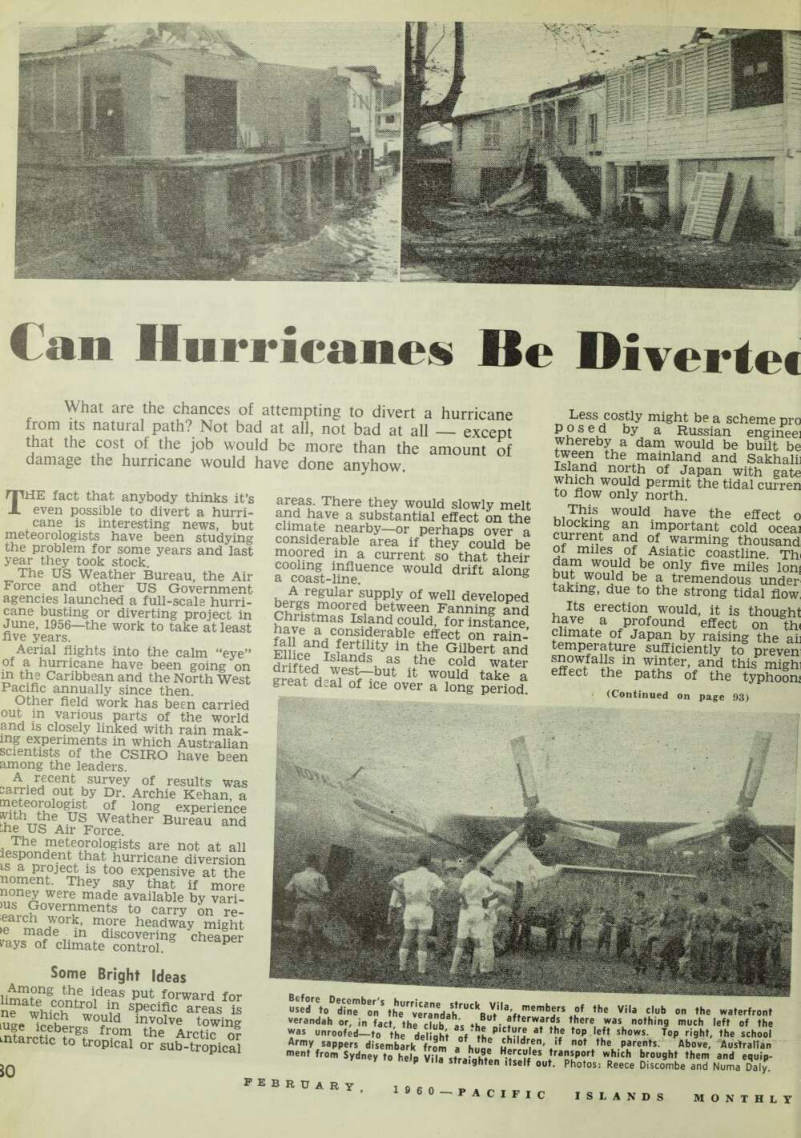
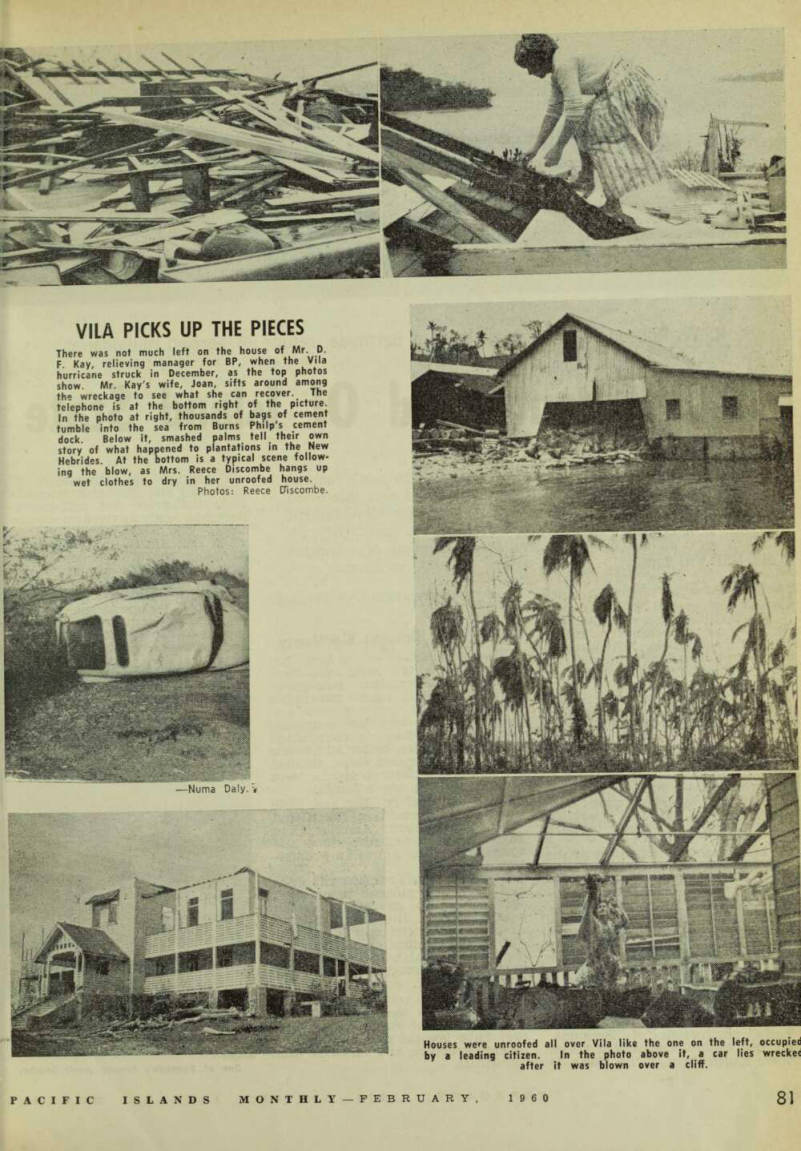
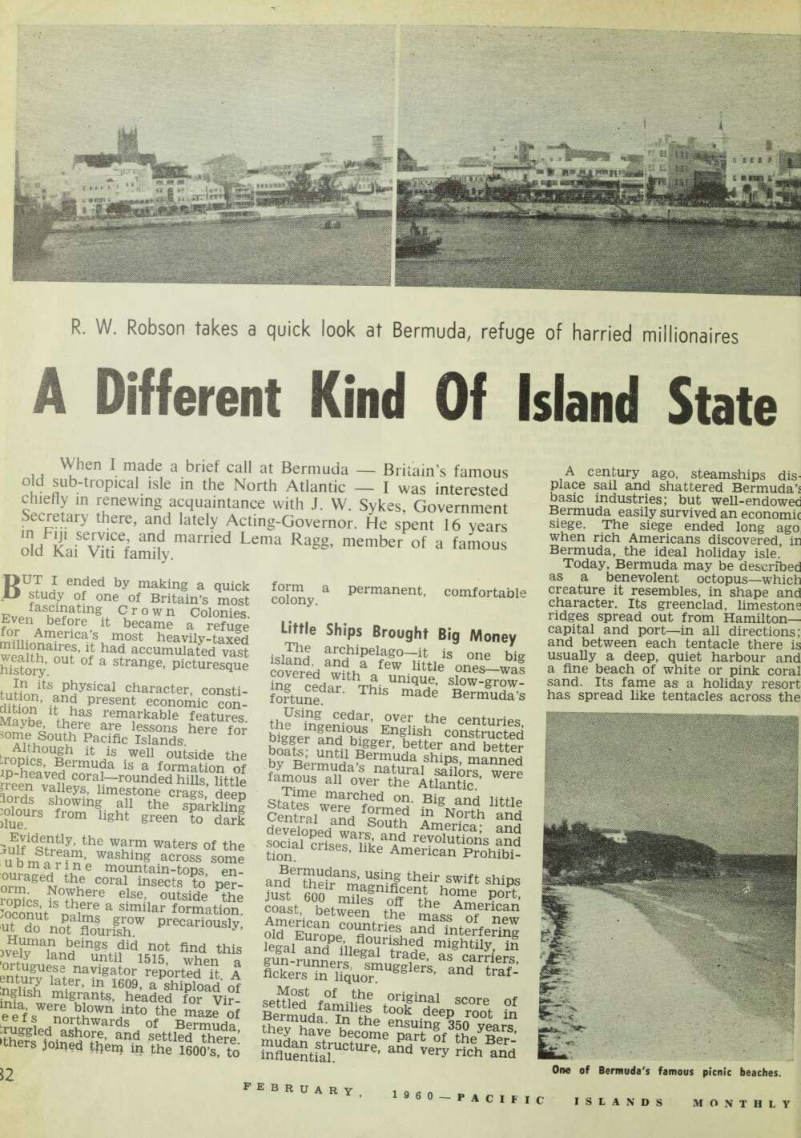
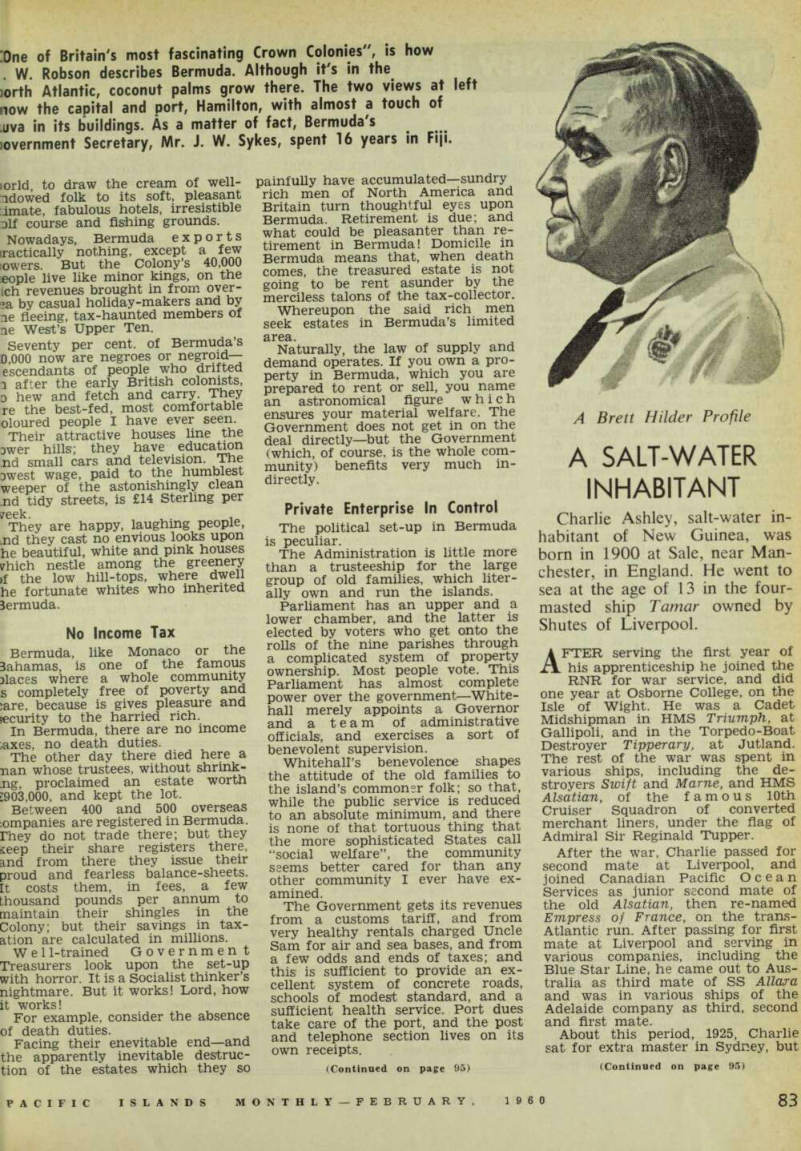
Before December's hurricane struck Vila, members of the Vila club on the warerfront used to dine on the verandah. But afrerwards there was nothing much left of the verandah or, in fact, the club, as the picture at the top left shows. Top right, the school was unroofed- to the delight of the children, if not the parents. Above, Australian Army sappers disemberk form a huge Hercules transport which brought them and equip ment from Sydney to help Vila straighten out.
Photo: Reece Discombe and Numa Daly.
Vila Picks Up The Pieces
There was not much left on the house of Mr. D.
F. Kay, relieving manager for BP, when the Vila hurricane struck in December, as the top photos show. Mr. Kay's wife, Joan, sifts around among the wreckage to see what she can recover. The telephone is at the bottom right of the picture.
In the photo at right, thousands of bags of cement tumble into the sea from Burns Philp's cement dock Below it, smashed palms tell their own story of what happened to plantations in the New Hebrides. At the bottom is a typical scene follow ing the blow, as Mrs. Reece Discombe hangs up wet clothes to dry in her unroofed house.
Photos: Reece Discombe.
Houses were unroofed all over Vila like the one on the left, occupied by a leading citizen. In the photo above it, a car lies wrecked after it was blown over a cliff.
—Numa Daly.
which cross the Japanese islands ea fn very few places in the world is current diversion possible on such a scale, and there seems little prospect of any such current being squirted into the Islands from a new direction.
Smoke It Out!
The releasing of artificial clouds at very high altitude by means of rockets has also been considered.
A cloud layer of some thousands of square miles placed above a hurricane might have the effect of causing it to disperse or at least change its behaviour but that would take a lot of smoke or other material to produce and the job would be complicated by the high velocity winds at upper levels.
Australian bush fires have fre quently produced a fairly dense high-altitude haze over New Zea land, but no study has been made of the immediate effect on New Zea land weather. This is another of the fields in which much more research
is required.
The Best Hope
The best hope so far seems to be cloud-seeding in the very early stages, although the US Standard Research Institute is less than
optimistic about practical ad
vantages because of the high costs involved. . , American Nobel prize winner amd pioneer in cloud-seeding, Dr. Irving Langmuir, is one of those who says that seeding experiments 1 could eliminate hurricanes.