London Traffic Is
pp. 63-67 · Read in the full issue


Sydnegsider Goes Walkabout London Traffic Is Out Of Hand
LONDON- Probably if all visiting colonials were instructed before arrival to treat England, and particularly London, like a foreign country, and not just an extension of home a lot ot heartburning would be saved on both sides. The paths of the bloke from the outer dominions and the home-grown English man have diverged a long way in the last 175 years, and any similarity between the way of life in Australia, for example, and in the UK is now largely co-incidental.
THERE are far too many people in this country to be able to live comfortably with the current wave of prosperity. It is frustrating for the visitor who doesn’t know the rules to have to compete with 10,000,000 Londoners for a 10 bob seat in a movie; a 23 bob seat at a play; for a midday sandwich and a cup of tea; or a fourpenny bus ride.
The solution is the thrice-cursed
queue, which the Englishman, and particularly the Englishwoman, still forms at the drop of a hat.
You have to learn new eating laws, and (particularly) new drink ing laws; new shopping hours that change from district to district and almost from street to street. New working hours and new sleeping hours—it’s useless expecting the average Englishman to function properly before 10 a.m.; he has hardly got the sleep out of his eyes by then.
Slap Right Back
at the Shophands But that’s all in the material plane, just Junior League stuff. It’s when you get to human contacts that you get into the post-gradu ate class. Spoiled by a decade of booming tourism, the London shop assistant, the clerk, the minor official have all developed a quick brush off tactic that’s a world beater. In three seconds flat, you can be made to feel as unwelcome as a piece of very dead fish; organised into a queue 300 yards long; pushed up the wrong dead-end lane; told you can’t do that here, madam; or we never stock that, madam. The only defence is to slap right back, and you are frequently “in”, and then these new lords of creation some times become quite human.
On the other side of the ledger, the English can’t place our accent and consequently can’t pigeon-hole us. This puts them at a disadvant age and they retire behind what’s called English reserve, but which can also sound like plain damn rudeness, until you get used to it.
They also hate our attempts to cut across the thousands of self-dis ciplinary rules they have built up to enable 11 million of them to live in this city called London, and a further 40 million odd to live in this small island.
Guide-books about London, and England, all about historic sights and monuments, are endless. But there is a crying need for some thing along the lines of How to Live with the English, Without an Apoplexy.
The Changes of
Four Years When at the limit of exasperation, it is good to remember that it is the first few weeks that are the worst. After that you get almost to like the place. Here are a few of the obvious changes since I was last here about four years ago: TRAFFIC: On that occasion I be lieved that it was less nerve de stroying to drive a car in London (and England) than in Sydney; that drivers were more courteous; parking easier. None of that is true any more. There probably is a statistic to show how much the car population has increased but what it is I know not. It’s obvious, how ever, that if it goes on at the pre sent rate, it won’t take four more years to bring everything to a dead stop.
What are they going to do about it, if anything? Not even the blitz loosened things up! Wherever there was a bomb site four years ago, now there is a building. Town planning and rights of land ownership don’t go together.
London’s maze of dead-ends,
Among the Islanders "Sydneysider" met in London ... Ted Fulton, of Mukurapau Plantation, Kokopo, as seen by Brett Hilder.
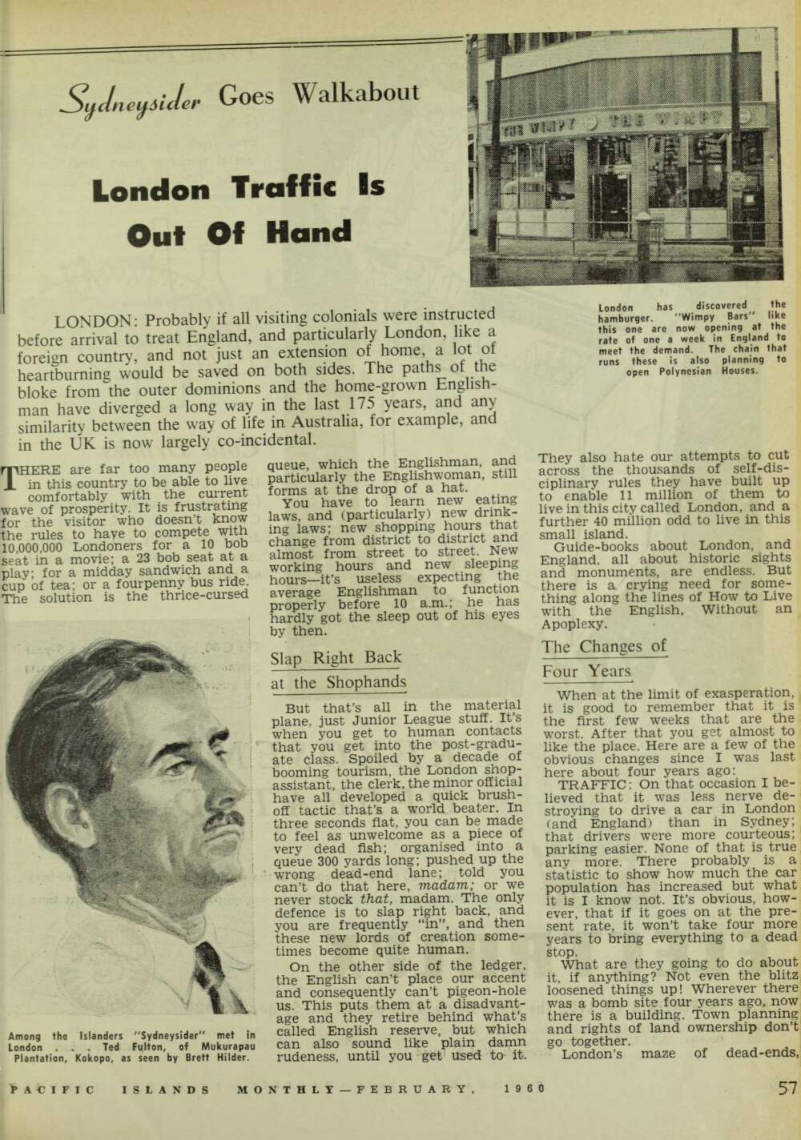
London has discovered the hamburger. "Wimpy Bars like this one are now opening at the rate of one a week in England to meet the demand. The chain that runs these is also planning to open Polynesian Houses.
; iffic roundabouts, Pink Zones, one -,v streets are scientifically planned ' some Traffic brain; but coupled Jth London’s speed demons, who inverge on you three ways at once supersonic speeds, it becomes a cDtorised jungle in which no j arter is given. That’s fair enough, though it doesn’t provide for the •ranger in town.
IThe London driver’s reaction to lything that displeases him—and sat ranges from anything but in untaneous jet take-off when the ■;ht turns amber, to everything tat looks like obstructing his pro icss—is to lean on the horn button hurl abuse from the driving seat. ’The parking problem seems un xely to be solved until they invent •llapsible cars that can be carried tside like a brief case; and the nee sacrosanct zebra pedestrian icssings are so no longer, or only you insist. Take your life in your imds and plunge out onto one, and te traffic will come to a screeching nit. Hesitate in the gutter and the ime of chicken is on with victory i the bloke in the vehicle.
COSTS: With the possible excep on of clothing, and then it is cheap ily if you shop away out in outer irkness at Tooting Bee or Edgware oad, everything is dearer than in ustralia though wages are lower, ixes higher. Fruit, meat, vegetables :e in the luxury bracket, although, 5 usual, everything is available if DU pay enough for it. Peaches, pricots, and plums are selling here i January—probably from North frica; black grapes from some ontinental hot-house. Chrysanthe mms as big as a Pekinese dog, ilips and daffodils, hyacinths in ots are all available at astro omical prices. But it is in the small jrvices where the jolt comes most; loe repairing, dry cleaning, hair ressing and similar services are 3 per cent, higher than at home.
One price exception is TV sets; le local popular 17 in. size sells rom about 50 guineas, half the rice of similar Australian models.
But the programmes are just as unk as those below the Line: Westerns, corny variety, and news asts that look as though they have een photographed through seven lyers of gauze round about dawn).
tetter Cooking,
brighter Pubs
The standard of cooking seems nproved, although the growing and ating of brussels-sprouts, is still, egrettably, a national pastime. The übs, country, town and suburban, lave got even brighter; most of hem have had new face lifts, new iecor. The beer is still warm and reak like water, but the hospitality 3 always there, the sandwiches are Lne.
These pubs stand out like beacons n contrast to the tatty, dirty un
inspired village tea shop that is the onlv alternative in the light refreshment field. For comfort, civilised form of drinking they stnnd out also in contrast to the seething mob of grog swillers that characterise the hotefs of Australia, New Zealand and the Pacific Islands.
There are two places in England where you can get quiet, no queues, elbow room and some peace: One’s in church, the other’s a pub.
SURPRISE: One result of prosperitv and progress is the almost universal adoption of central heating, not only in large blocks of flats, stores, pubs, hotels and public
buildings, but in private homes This has come over the UK in the last few years almost to the same degree that f ir - c ° ndlt f lo^ id^ as TT ?A t th tourist spots of Florida, USA.
The result is that the sting has almost entirely gone from the Eng lish winter and you are much more likely to die of a heat stroke one of these artificial tropics, than take a death of cold outside.
Even the 9 uts^ de , i^^h^der comes as a relief and is no harder to bear than the occasional cold spells of a Sydney winter. Your Sydneysider came equipped with wool pants' and vests against the expected
jzzards, but so far has had no )ed of wool garments. The vest, unsullied, mint condition, is used, Jlled up, as a tea cosy—an item )th which the flat is not equipped.
IBut there are signs of winter, ne look at the sun per week is rerage. The light comes between 8 jid 9 a.m., by 3 p.m. it is twilight, ,irk at four. 'The sky is grey and dri P s dnzzl !; ito muddy pavements and the iist flows up the river and around ue bar^ B branches of the trees in :ie parks. It sounds melancholy, ut it has its own peculiar beauty ad charm. In small doses.
Another sign of .winter isthat .r Winston Churchill has flown to
jie Mediterranean.
Dme Other Islanders
m Walkabout
According to the proverb, you ave only to stand long enough on nv street corner in London ana Feryone in the world will go by. hat’s as maybe, but according to nore reliable statistics there are imething like 60,000 Australians ving in the UK (most of them in London) at any given minute.
There are a fair sprinkling of slanders amongst them, too Ithough probably not so many at iiis time of the year. Amonerst the ew, Mr. and Mrs. E. T. Fulton, of lukurapau Plantation, Ko ko po, Jew Guinea, turned up during the irst we?k in January, with their hree young daughters, Mary, Ehza .eth and Catherine. It is a snap loliday to take in the girls’ school lolidays, and combining a bit ot jlantation business for Mukurapau.
In the late 30’s, when we were >oth younger, Ted and I, with nembers of my family, were lartners in a gold-mining lease on he Ulahau, in the mountains be ;ween But and Maprik, NG. I re nember one occasion when we were somehow by ourselves on the lease [ was recovering from a bout of nalaria and he was in the middle an attack of gastric fever. We were sour with the world and wflh each other, but to cheer ourselves up we sat and planned that, if the lease turned out alright, we would put the money into a plantation — not because plantations were then considered lucrative—they weren’t— but because it sounded a "n ee life” in comparison with the one we were leading.
Much water flowed under the bridge and Ted. at least, achieved his plantation. As well as organised family reunions periodically ever since, we have occasionally run into each other unexpectedly in un scheduled places.
In those old Ulahau days, when we had prospects and little else, when we lived on a steady diet of canned meat and taro; and life was
a succession of fever and ram and mildew; damp-bedsails and boys blankets under a tent fly when out prosp cting, and the same furnish ings under a sac-sac roof when in camp; we didn’t think ahead to a day when we should dine en famille at the Dorchester, Park Lane. I, for one, had never heard of the place then.
Perambulating Girls
There Are Aplenty But back to these perambulat ing Australians; A large proportion of the 60,000 semi-permanents are young girls in their early twenties who come over here in droves in every ship. .
With nothing much behind them but a return fare, they settle in for a working holiday of usually two years that takes in just about everything from North Cape to Gibraltar.
Thr.e typical examples whom we have been seeing in the last weeks are Dora Ragg, daughter of Mr. and Mrs. David Ragg, of Fiji and Sydney, who is dug in for the time being doing research for the next edition of Chamber’s Encyclopaedia.
Beatrice Hilder , daughter of Captain Brett Hilder, of Burns Philp Line ships, and Mrs. Hilder.
Beatrice is currently having a b9Ut of hospital, which she is treating like these youngsters treat all
temporary impediments to their planned route of progress, but be fore that was designing for a Susan Small subsidiary.
And Robin Ritchie, daughter of a Pacific Publications director, who is 5 ft 2 in., 23, and with a pal has ridden her motor scooter all over Europe from Norway to Spain and back again. She is a trained nurse, but when out of funds, washes dishes if necessary—an occupation that cuts across any language barrier. .
She had dinner with us, at Simp son’s, in the Strand—a poised, well groomed young woman. After it, she unparked her scooter from a side street, broke out a crash helmet and a pair of fleecy-lined boots from a carry-all, said her good-nights and rode off and away into the swirling fog of a London winter night. , . . „ Some of these days, no doubt, all of these youngsters will go back home and marry Australians who most likely will try to convince them that a woman’s place is in the home.
Only two applications were received for the right of operating the catering concession at the terminal building at the new Nadi Airport, and the concession has been let to Messrs. George Barros and Peter Slimmer, lately of Pan American Airways catering staff at Nadi.