New Guinea Doctors
pp. 51-53 · Read in the full issue
Have A Lot To Do
Death of a Child
A Coroner’s Court in Rabaul in January found that a V°ung native child had died at Nonga Base Hospital because of an over dose of chloroquin administered by mistake, by a native medical orderly. The Coroner found the mistake was due to language dif ficulties (the orderly had not understood the order of the Euro pean medical assistant) and oy the inexperience of both the orderly and the medical assistant, who was in charge of the hos pital The Coroner, commenting on the fact that the assistant was in charge said that with present staff shortages the hospital! was fortunate to have the man at all.
No blame could be attached to him. This article describes the hospital at work.
By Lew Priday
The lack of public spirit in Australia must surely take some of the blame if the Health Department of New Guinea is short handed. If, say, young doctors have the urge to lead a busy and useful life they could consider New Guinea, where the health needs of the natives are overwhelmingly great.
When I was in Rabaul recently, 70 more doctors were expected, hich meant that the medical licers working for the Department i the whole New Guinea Islands ;gion, which extends from Manus 3wn through New Ireland to ougainville and New Britain, would umber 12 instead of 10.
The district already contains one Lrge base hospital at Nonga, near ,abaul, four district hospitals with iboratory and operating facilities, nd 10 subsidiary hospitals.
Visit to Nonga
Then there is the large Catholic lission hospital of 300 beds at r unapope, Kokopo; and there are tiree specialised hospitals, two for jprosy cases (at Torokina, Bougain ille and Anelaua, New Ireland), nd ’ the third for TB and chest iseases of 250 b-ds at Bita Paka, 7 miles from Rabaul. These three ,re run conjointly by the Govern ment and the Catholic mission.
Another important sign of what s going on is the aid posts that t re springing up in all the villages, [hey now number 288 in the whole irea.
The big Nonga Base Hospital is beautifully situated overlooking a bay A board on the lawn outside the hospital informs you that the hospital is a gift from the People
of Australia to the People of the New Guinea Islands. The cost was £500,000.
The hospital is to have a paying section and a non-paying section, but when I was there only the non paying section was established The paying section —generally called until now the “European hospital —was situated at Namanula, but plans were afoot for moving it to Nonga.
The non-paying section, with about 300 beds in the different wards, was opened in December, 1958. It had, when I was there, a European staff of five medical officers, a dental officer, nine registered and three partly trained nurses, a physiotherapist, an X-ray technician, a pathology technician, and about eight European assist ants, with about 100 native assist ants. The European non-medical staff numbered ten.
Teaching Unit
The paying section at Namanula had a matron, five registered nurses, and a number of orderlies, all Euro peans, with native helpers.
The hospital at Nonga now has its teaching unit, where native trainees, young men and girls, undergo a 4-year course. I was told by Mr. E. Lindfield, principal of the Rabaul Medical College, that the male trainees are quicker in the up take than the girls, who are some what lacking in elementary educa tion.
Besides the two operations—one of them a case of elephantiasis — by the resident surgeon, Dr. B.
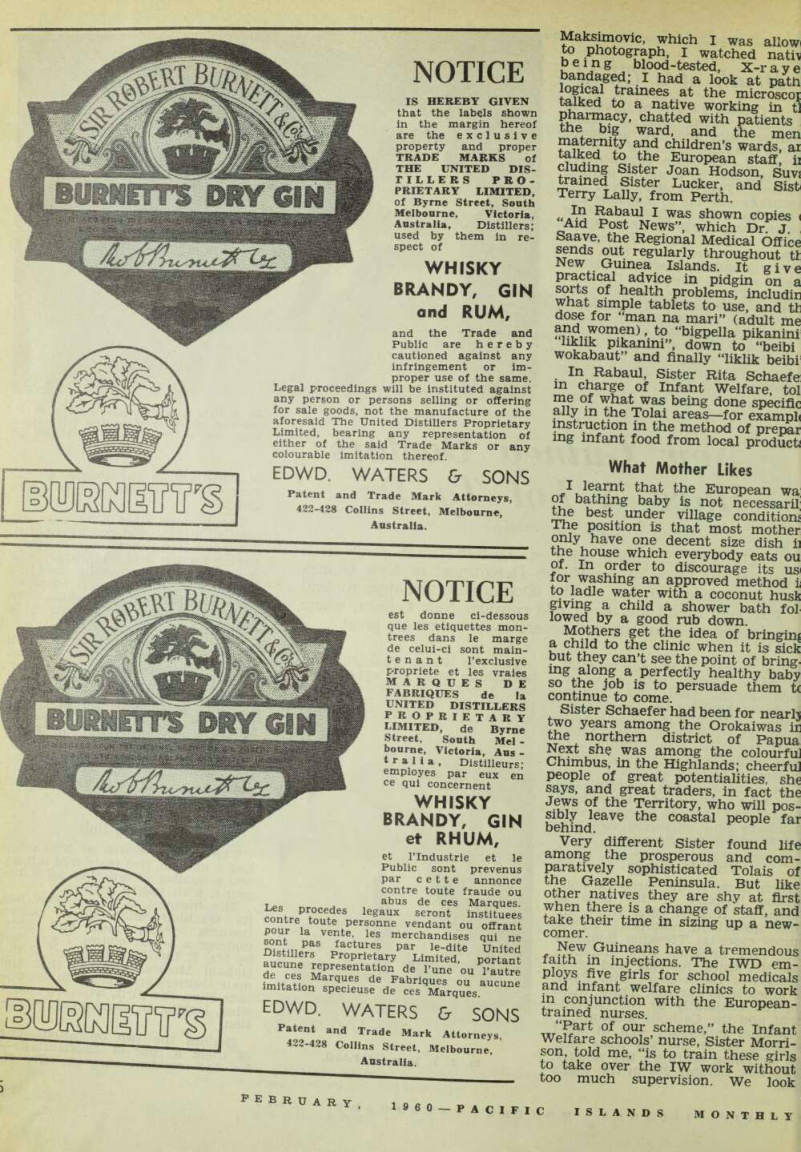
Dr. J. J. Saave, of Rabaul.
Photo: Lew Priday
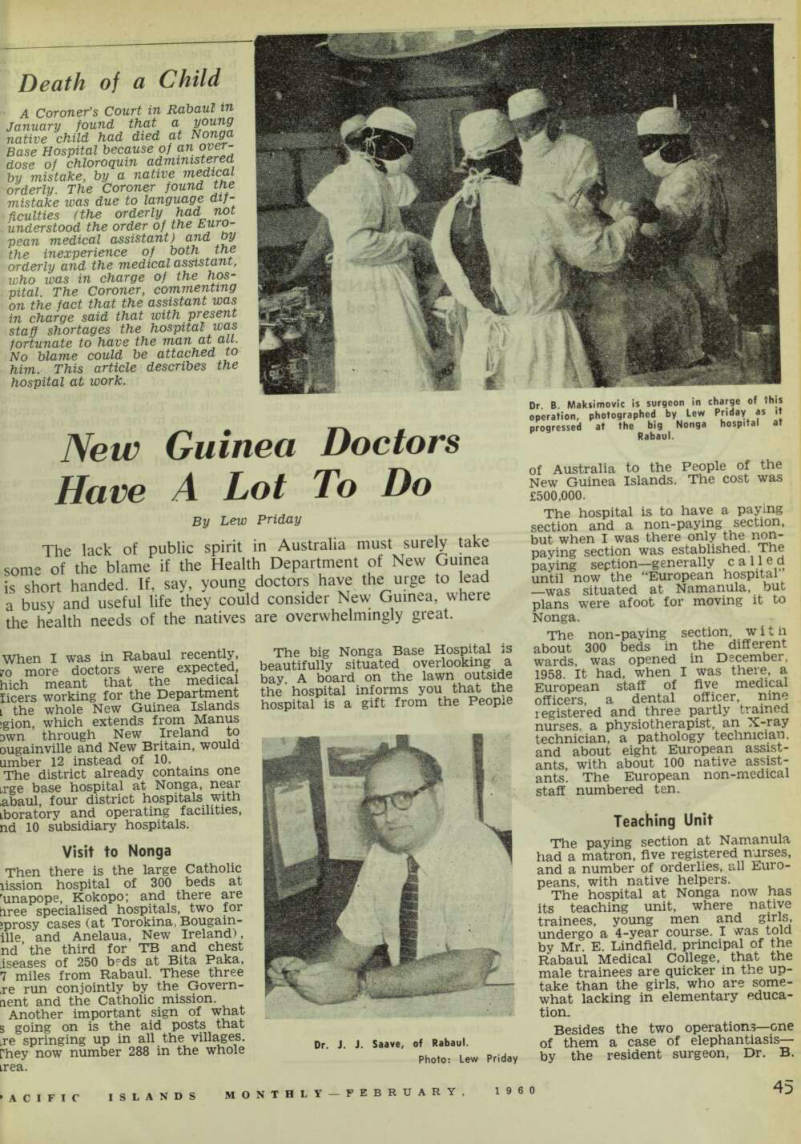
Dr. B. Maksimovic is surgeon in charge of this operation, photographed by Lew Priday as it progressed at the big Nonga hospital at Rabaul.
Maksimovic, which I was allows to photograph, I watched nati\
being blood-tested, X-r aye
bandaged; I had a look at path logical trainees at the microscor talked to a native working in tl pharmacy, chatted with patients the big ward, and the men maternity and children’s wards, ar talked to the European staff, ii eluding Sister Joan Hodson, Suvj n iste / Lucker - and Sist Terry Lally, from Perth. , I** Rabaul I was shown copies < Aid Post News”, which Dr J Saaye, the Regional Medical Office sends out regularly throughout tb New Gumea Islands. It give practical advice in pidgin on a sorts of health problems, includin what simple tablets to use, and tb dose for “man na mari” (adult me and women), t° “bigpella pikanini hkhk pikamni”, down to “beibi wokabaut” and finally “liklik beibi . In Rabaul, Sister Rita Schaefe: m charge of Infant Welfare, tol me of what was being done specific ally in the Tolai areas—for exampb instruction in the method of prepar mg infant food from local product!
What Mother Likes
I learnt that the European wa of bathing baby is not necessaril the best under village conditions The position is that most mother ■ y have °ne decent size dish ii the house which everybody eats ou ot. in order to discourage its us< for washing an approved method i, to ladle water with a coconut husk giving a child a shower bath fob lowed by a good rub down.
Mothers get the idea of bringing u the clinic when it is sick but they can’t see the point of bring ing along a perfectly healthy baby so the job is to persuade them tc continue to come.
Sister Schaefer had been for nearh two years among the Orokaiwas in the northern district of Papua Next she was among the colourful Chimbus, in the Highlands; cheerful people of great potentialities, she says, and great traders, in fact the Jews of the Territory, who will pos sibly leave the coastal people far behind.
Very different Sister found life among the prosperous and com paratively sophisticated Tolais of the Gazelle Peninsula. But like other natives they are shy at first when there is a change of staff, and take their time in sizing up a new comer.
New Guineans have a tremendous laith in injections. The IWD em ploys five girls for school medicals and infant welfare clinics to work in conjunction with the European trained nurses. iTr“5 art of our scheme,” the Infant Welfare schools’ nurse, Sister Morri son, told me, “is to train these girls to take over the IW work without too much supervision. We look
ward to the day when they will iable to do this work themselves, ieady we have successfully tramed number of girls.” :)r Saave hinted at a building .erne that is being planned all r the New Guinea Islands area the next three years. The natives, ippears, are getting tired of their ;ive material dwellings of bamboo, :-sak, etc., of which there is a >wing shortage. Buildings are now ng started of eight parts of local ivel mixture to one of cement. A lage housing scheme of this kind mires a great amount of co eration between the Health and Drks Departments and the natives.