he Man Who Was Not
p. 47 · Read in the full issue
Too Late
Commander R. B. M. Long, OBE, Australia’s wartime director Naval Intelligence and an organiser of the famous Coastwatchers, ,ed in Sydney in January, aged 60. A brief obituary übll f hed “PlM’s” January issue, but here, Commander Eric Feldt, a leaa g Coastwatcher and author of (< The Coast Watchers ”, pays a more zrsonal tribute to the man who did so much.
In warfare, one of the essen als of success is to be ready i time. In the success of the
bast Watchers, the complete
ess of their organisation before
le Japanese entered the war
fas a considerable element.
Watchers could have been j improvised after Pearl Harbour but they would have been largely leffective without a basic orgamsa ion to supply them, to collect, Dilate and disseminate their infor lation. And it is solely due to the ite Commander, R. B. M. Long, >BE, that the Coast Watchers were eady in time.
When war broke out in 1939, I ras ordered to report to the Director f Naval Intelligence. We had known ach other since we were 13-year- Ids, when we joined the Royal Lustralian Naval College, but had een out of touch since I had been a New Guinea.
He had changed little. The thick et figure, the broad forehead, seri ns expression and the thin-lipped mall mouth were the same, and the mile was as ready as ever. With the far just started and an enormous xpansion under way, he was errifically busy, wi t h harbour ecurity, secrecy of sailings, safe ;uarding convoy information and ;nemy shipping, on his mind.
He gave me a couple of days to ;et into the picture, then dismissed ne to the Islands to expand the :oast Watching organisation there, vhich had been the special care of lis Civil Assistant, Walter Brooks >ank.
So the expansion was started in [939, in time.
On The Job Promptly
He dealt promptly with my re quests. I wanted teleradios; he sup plied them. There was war in Europe and the Pacific was not in volved and he must have had to Dvercome opposition, or at least inertia, to his proposals.
I wanted more staff and he sup plied it, including our term mate Hugh Mackenzie. In consequence,
we were ready when raiders appeared and this justified his at tention to the area, but in the back of his mind was always the pos sibility that Japan would enter the war.
When Japan commenced hostil ities, his duties multiplied. He was one of those men who could work for very long hours and still keep a clear mind, he smoked heavily but rarely took a drink and had no recreation that anyone could see.
But his courtesy remained unim paired, there was always time to see the visitors and then was always the ready smile.
Problems arose quickly. To ensure that intelligence was passed to all Services no matter by whom col lected, he designed the basic organ isation of the Combined Operational Intelligence Centre (COIC), later used by General MacArthur’s and lower Headquarters.
He saw that for unconventional organisations, such as the Coast Watchers there must be a single controlling head, and his initiative caused the Allied Intelligence Bureau to be formed, but he himself was left out of it, being required in Naval Intelligence, Under the area system, the South Pacific came under the US Navy, while General MacArthur com manded in the South West Pacific, and Coast Watchers operated in both, sometimes reporting across the line of division. Commander Long acted as link between the two areas when necessary, and there was no friction.
Great Organiser
For the invasion of Guadalcanal, he collected Merchant Navy officers with knowledge of the area, he re cruited others with knowledge of the Solomons and handed them over to us, helping us greatly.
In addition, he had his conven tional duties as DNI to perform, but still made time to organise the de spatch of the Lyons expedition against Singapore, when a disguised sampan sent in canoes which sank 35,000 tons of Japanese shipping.
During all this time, Long was an acting commander. The Navy is a hard boss. An officer, if not pro moted to commander when in the “zone”, misses out altogether, and in the fierce competition, and in spite of the highest results in examina tions, Long had been passed over.
But he slaved on patriotically, da? in and day out, knowing there wai no reward in higher rank for him but true to the naval tradition tha when you are given a job, you do it no matter what.
He left at the end of the war, am was promoted to commander on re tirement and was awarded the OBE He entered business and was sue cessful. He kept in touch with mos of his old associates and it was : shock to all to learn of his deatr which was completely unexpected.
His accomplishments are know] to those who worked with him, an who saw what was done and it was done. In the war in th Islands, he is the man who gc things done in time. How often w heard the expression during th war; “Too little, too late”.
Commander Long did enough, an
he did it in time.-
Eric Feldt.
Rotary Comes
To Tahiti
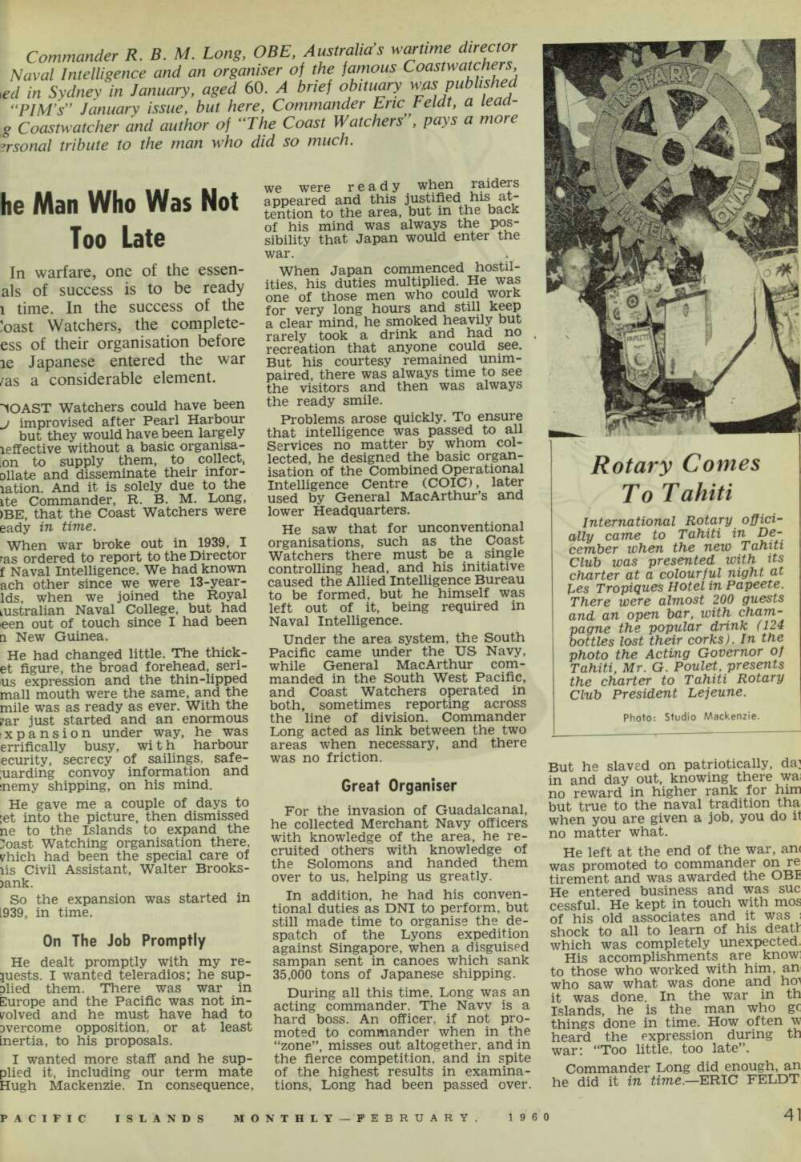
International Rotary offici ally came to Tahiti in De cember when the new Tahiti Club was presented with its charter at a colourful night at Les Tropiques Hotel in Papeete.
There were almost 200 guests and an open bar, with cham pagne the popular drink (124 bottles lost their corks). In the photo the Acting Governor of Tahiti, Mr. G. Poulet, presents the charter to Tahiti Rotary Club President Lejeune.
Photo: Studio Mackenzie.