Never Happened
pp. 21-22 · Read in the full issue
Horror Hanging That Never Happened
Errol Flynn’s autobiography, “My Wicked, Wicked Ways”, runs true to the style that New Guinea old hands came to expect from him that is ultra-egotistical and contemptuous of others’ reputations and of the truth.
FLYNN’S book is at present being serialised in America and in England and will be published soon in book form in New York.
The first part of the book (as published in the January issue of the American magazine, True) gives a highly coloured account of Flynn s early experiences in New Guinea, and tells of one occasion in 1926
when as a cadet patrol officer in Rabaul he was serving under “Dis trict Officer Taylor'’. He was told that there had been a massacre at Madang—four prospectors had been killed and the culprits had to be brought in.
The New Guineans were to be shown that “they couldn’t go around killing white men”, Flynn reported, and District Officer Taylor (who is not given initials) had told him, “You will be assigned 10 native policemen. With these armed men you will complete your assignment”.
Flynn then tells how the whole party, including Taylor, voyaged several hundred miles to Madang, broke into four groups, one of them led by Flynn, and each went inland to capture the murderers.
"Suspects" Arrested
Flynn says his party found none, but the other parties had rounded up “about a dozen suspected ring leaders”.
Flynn adds that Taylor decided to stage a combination feast and public hanging to which all New Guineans in the region were summoned. In the coming days “schooners arrived from Rabaul laden with taurau (rice)—tons of it—and calico to be dispensed at the hanging. A carrot and club approach; show them we can be tough, show them we can be useful.”
A gallows of coconut branches
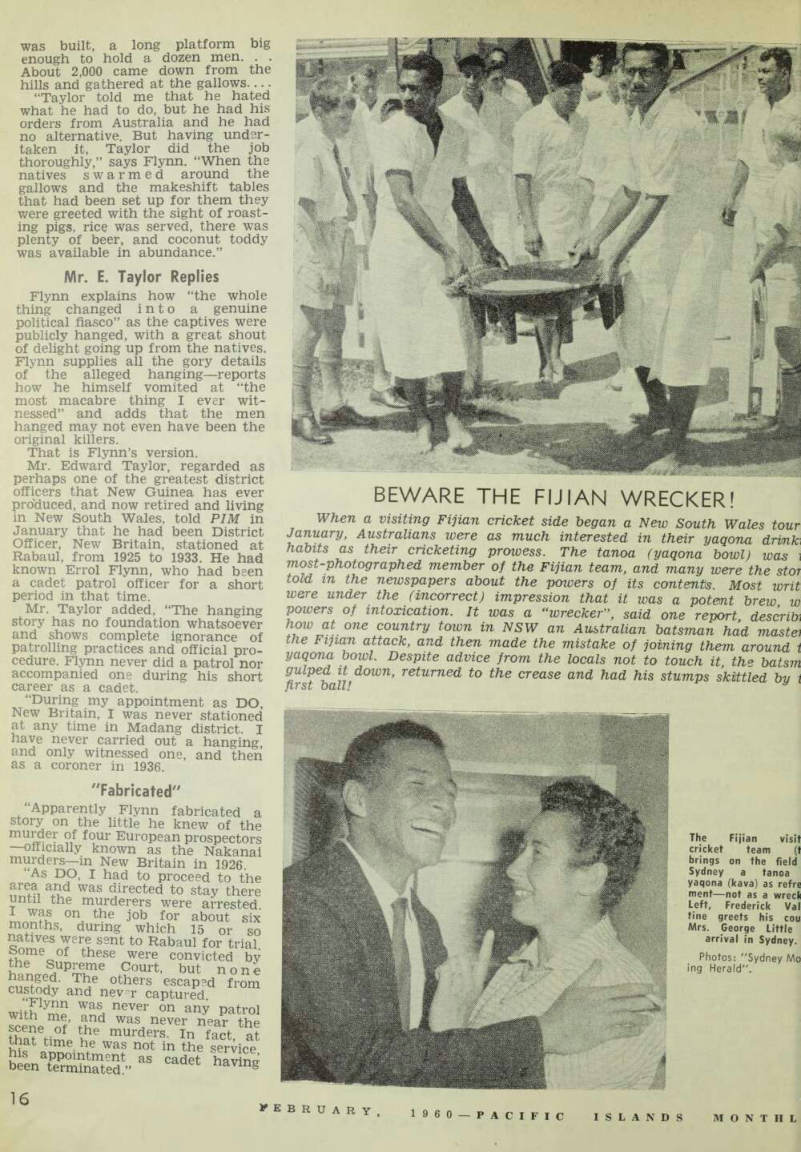
The late Errol Flynn.
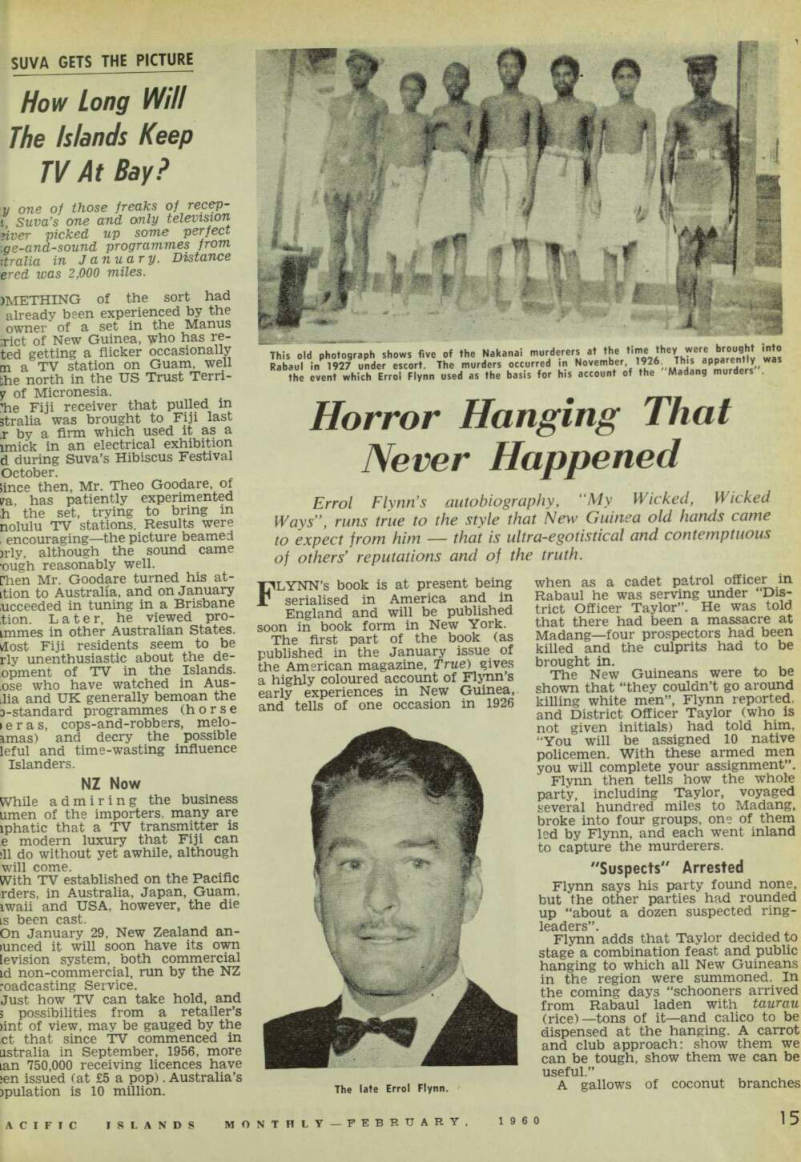
This old photograph shows five of the Nakanai murderers at the theyr were brought into Rabaul in 1927 under escort. The murders occurred in November 1 926. This apparently wes the event which Errol Flynn used as the basis for his account of the Madang murders
was built, a long platform big enough to hold a dozen men. . .
About 2,000 came down from the hills and gathered at the gallows “Taylor told me that he hated what he had to do, but he had his orders from Australia and he had no alternative. But having under taken it, Taylor did the job thoroughly,” says Flynn. “When the natives swarmed around the gallows and the makeshift tables that had been set up for them they were greeted with the sight of roast ing pigs, rice was served, there was plenty of beer, and coconut toddy was available in abundance,”
Mr. E. Taylor Replies
Flynn explains how “the whole thing changed into a genuine political fiasco” as the captives were publicly hanged, with a great shout of delight going up from the natives.
Flynn supplies all the gory details of the alleged hanging—reports how he himself vomited at “the most macabre thing I ever wit nessed” and adds that the men hanged may not even have been the original killers.
That is Flynn’s version.
Mr. Edward Taylor, regarded as perhaps one of the greatest district officers that New Guinea has ever produced, and now retired and living in New South Wales, told PIM in January that he had been District Officer, New Britain, stationed at Rabaul, from 1925 to 1933. He had known Errol Flynn, who had been a cadet patrol officer for a short period in that time.
Mr. Taylor added, “The hanging story has no foundation whatsoever and shows complete ignorance of patrolling practices and official pro cedure. Flynn never did a patrol nor accompanied one during his short career as a cadet.
“During my appointment as DO, New Britain, I was never stationed at any time in Madang district. I have never carried out a hanging, and only witnessed one, and then as a coroner in 1936.
"Fabricated"
“Apparently Flynn fabricated a story on the little he knew of the mU3 p" er °f European prospectors —officially known as the Nakanai murders—in New Britain in 1926.
As DO, I had to proceed to the area and was directed to stay there until the murderers were arrested. * j° b for about six months, during which 15 or so natives were sent to Rabaul for trial these were convicted bv the Supreme Court, but none hanged. The others escaped from custody and nev=r captured.
Flynn was never on anv natrni scene "of’ thJ? Wa ' S ,, never near the
LTfiS. aS having