foTf years,
pp. 103-113 · Read in the full issue
HE BUILT IT IN HIS SPARE TIME
On January 8, 1957, Joyita went n Horseshoe Reef in the Koro Sea -that resulted in her being out of ommission until October 6, 1958. luring 1959, business was slack and he ship was laid up for a time. )n one occasion she put back with ter master ill, and there were everal other technical hitches.
Then, on November 20, the wooden essel again went ashore on Vatualu. She floated clear after a ouple of hours, proceeded to Levuka or inspection, then sailed for Suva.
St e S to S h r k s e anT te at ba L d e^ k S a 'hart, was pumped out sufficiently ms be beache d d\r a r S e o pairs Wh i e n e Deember the then owners (Mr David S he vessel and it is now owned by hoducer’s Shipping Co., a group of ranua Levu planters) were conemulating putting the vessel up for notion again, “as is, where is .
There are probably people in the ISA who would buy her simply as collector’s piece. nriTTr 1 tit f-pTjTh patp? • Mr tpw
motioned
L hfISS the
j? for P re sale oerto t tL / has now also the same owner’s other -essel, Foxton, 209 tons, a wooden win-screw Auckland-built craft, aunched in 1929. She, too, will be tverhauled and offered for sale.
Ships in which Mr. Graham has it one time or another had a share lave contributed largely to post-
war South Pacific shipping history, Names like Karoro, Alexander, Nuka- Urn, and Scot will all ring bells. Add to them Nikau, now owned by HP’s, inaha is being registered in Vila (New Hebrides) and Foxton probably in Suva (Fiji).
Ttx , O
•TH E Y V E GOT FIJI S LAUNCH: The Auckland Division of the RNZVR has benefited by thede commissioning of the RNVR in Fiji, 72-ft patrol launch which was HMS Viti, loaned to the Fiji unit,
SSWTT'ffiTSftta? vetel^r
™Nzs
foTf years,
This HDML will n 0 lon ß er b£ : ar the
ZSvWfcw""" l
simply no. Jo&d.
Wires Everywhere: The
boffins are at it again. While the ironmongery from above falls all around, they’re busy fixing lots of w i res down below to detect what goes on overhead. Wake Island (be tween Hawaii and Guam) was the first Pacific Island to be wired for missile detection-or is it sub marine detection?—early last year, Five 70-mile electric cables radiate spoke-like from the island along the b °ttom and the r is I “ t w^°^ er t^^Sr wm similarly wired up mis year, Another expensive piece of wire will be snaking its way right across the Pacific from Sydney, via Auck land, to Canada in the next four years. It will be the first trans-
Pacific telephone cable—the present cables are telegraph only, except for one cable from USA to Hawaii laid several years ago.
The Sydney-Auckland section will be completed by 1962, then the main span will be laid in the two fol lowing years.
To cost £26 million, the cable will have “repeater” amplifiers, which should never require any attention, every 27 miles, and it will be capable of handling 80 simultaneous con versations. The job will be done by the cable ship Monarch, owned by Cable & Wireless Ltd. • SOLD EAST: The well known Union Co. trans-Pacific freighter Waikawa, laid up in Vancouver, due to lack of profitable business over the past year, is reported sold to Hongkong, and there were rumours —which could not be confirmed in Auckland—that Wairuna, similarly laid up in Auckland, might also soon change hands. Of the other vessels which have operated trans pacific in post-war years, Waite mata has been in continuous ser vice, and Waihemo and Waitomo have recently resumed after a period of idleness. With Wairata and Wairimu on the service to India, all these ships were war-time built in Canada or US.
• Another Stranger: The
3,038-ton, single-screw, motor vessel Mundalla, ex Mundoo, recently sold by the Adelaide Shipping Co., is reported to have transferred to Vila registry in the name of Southern Shipping Co.
Inquiry in Auckland as to whether this might in fact be the Southern Cross Shipping Co., of Vila, owners of the small Suva-registered tanker Verao, which operates trans-Tas man in the molasses trade, brought an emphatic denial that there was any connection between these two companies.
PIM has no information as to Mundalla’s intended trade. It is pos sible that the transfer of registry to Vila is simply associated with the delivery of the 33-year-old vessel to overseas ship-breakers. • STAND CLEAR: Falcon Island, in the Tonga Group, gets most of the publicity when there’s talk of jack-in-a-box islands, but there are others, and the waters just east of Epi and north of Tongoa, in central New Hebrides are worth careful navigation. A number of undersea volcanic vents are in this
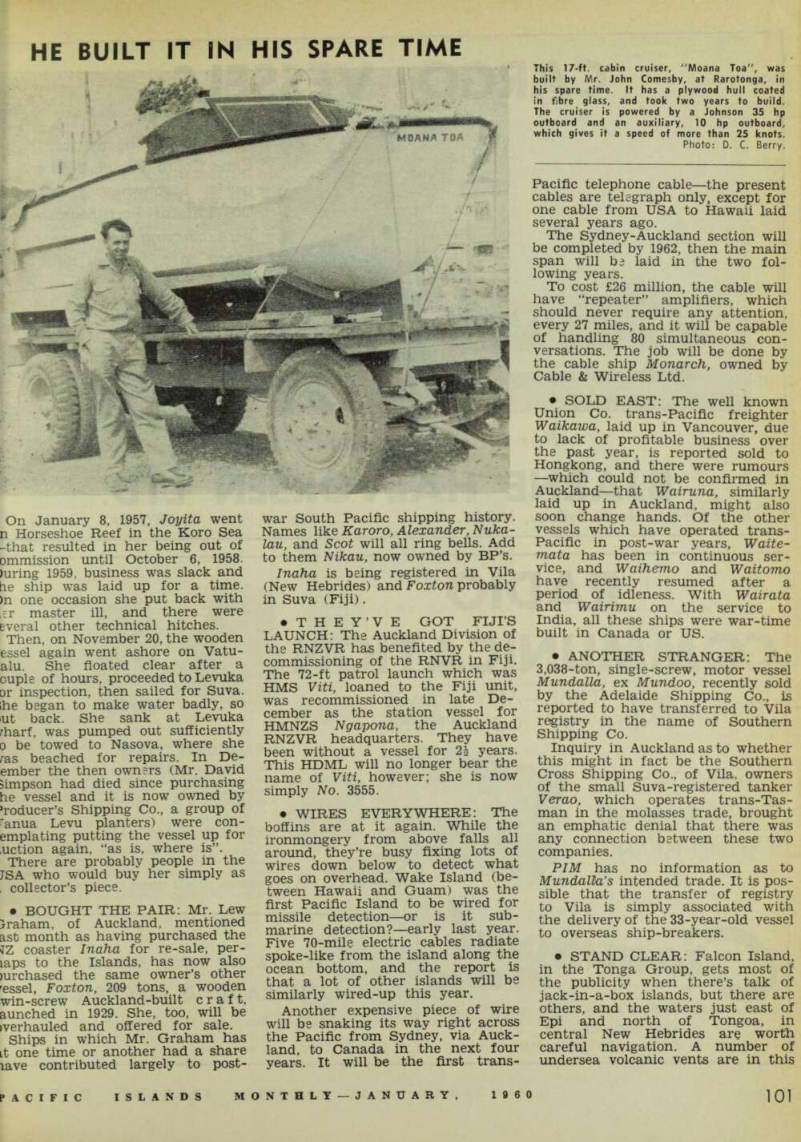
This 17-ft. cabin cruiser, "Moana Toa", was built by Mr. John Comesby, at Rarotonga, in his spare time. It has a plywood hull coated in fibre glass, and took two years to build.
The cruiser is powered by a Johnson 35 hp outboard and an auxiliary, 10 hp outboard, which gives it a speed of more than 25 knots.
Photo: D. C. Berry.
rrea and there may or may not be •rater over them.
A hump of pumice reaching nearly 100-ft above sea-level appeared here in 1949 and was given the mme Kama Island—but it had all roded away again through wind, lain, and sea, a year later. Other uch pumice heaps appear from ime to time in this vicinity, and me was in the making again in September when there was consid erable volcanic activity with smoke dsible for miles belching from a :rater about 3I miles east of Epi md 3 miles north of Tongoa. Large jatches of floating pumice, likely to >e mistaken as shoals, were drift ng on surrounding waters.
• Trouble At Vila: An Ex
flosion of another kind and an out >reak of fire in the engine room )f the small vessel Tokelau, as she ay in Vila Harbour on September !9, caused considerable v damage to he ship and serious burns to one 'Jew Hebridean member of the ;rew, who jumped overboard but vas rescued by boat. PIM has no ;echnical details of Tokelau, which s owned by Mr. Marcel Marinacce, vho also owns the 211-ton Deutgan, mother craft which has made head lines in the past.
• Another Light: Future
Solomons navigators, as they :ruise past Rua Sura Island, at the eastern end of Sealark Channel, will ponder for a while the unexplained loss with all hands of the BSIP Gov ernment vessel Melanesian some where near Sikiana on or about July 10, 1958. A collection is now being taken up for half the cost of a lighthouse for Rua Sura; the other half will be met by the Gov ernment. • USE OTHER DOOR: If recom mendations made by a Fiji Economies Committee are accepted by the Government, Levuka will cease to be a Port of Entry—and there is little reason to suppose that the recommendations will not be acted upon. The Committee found that Levuka’s trade had declined to such an extent in recent years that few overseas vessels now had need to call there. The establish ment of copra crushing mills at Suva halted the direct loading of big ships at Levuka. A saving in Customs staff could be made by re ducing the port from its Port of Entry status. • THE T H R E E-S T O R I E D ADMIRAL; Rear-Admiral J.
Richard Evenou, commander-in chief of French land, sea and air forces in the Pacific, who paid an official visit to NZ in December, is a man of wide experience, equally at home in a diving suit as on the bridge or in an aircraft cockpit. The vessels of his Pacific command are Francis Gamier, La Capricieuse, La Confiance, Tiare and Lotus.
• Look Who’S Here: New
Zealanders are likely to be found in unusual places, but one of the least expected places must surely be in a Japanese merchant marine officers’ training ship. When Tokyo Mercantile Marine University’s 3,171ton Ginga Maru (Ginga means Milky Way) called at Auckland in July, 1957, and again when the vessel called at Papeete several months ago, the ship’s complement included one lone European, Professor Eric S. Bell, lecturer in English, amongst her 21 officers and instructors. Mr.
Bell, formerly of Christchurch, has lived in Japan for many years—he
was interned there throughout the war, and Japan is now very much, his home.
Ginga Maru gives a year’s prac tical training—following the theo retical shore training—to about 60 budding deck officers and 45 en gineer officers. Captain H. Orihara is in command.
• They All Got Home: Chief
Radio Officer Toshio Tobita, of the Taiyo Company’s tuna mothership Tenyo Maru No. 3, writing from Yokosuka, reported that his ship arrived home on November 23, and Jinyo Maru on November 24, thus
:iding the 1959 mothership tuna ishing season.
Tenyo Maru No. 3 sailed for the mtarctic late November to load ackaged whale-meat from the ictory ships which were already eading South for the baleen haling season, due to open about anuary 7. Southbound, some of lese fleets were sperm whale fish ig. Two southern voyages at most, len it will be time for Tenyo \aru No. 3 to set course again for le GEIC-Fiji area to mother the )60 Taiyo fleet of longliners which ill be already on the job and wait ig to discharge into her when she rrives at the end of May.
• Headache South Of Mid
WAY: Captain A. Foot, of the utch salvage tug Elbe, had a spot • bother 630 miles south of Mid ay in mid-December. The old US avy aircraft carriers Guadalcanal id Mission Bay, stripped of fit ngs and bound for Japanese melt ig pots, parted the tow-line in eavy weather, and the towing gear ailed the tug’s propeller. Out went radio call for assistance, and in ent the US Navy with the carrier on Homme Richard and the de royer Richard S. Edwards.
Aboard each of the derelict irriers was an eight-man tow-line nding crew but, surprisingly, jparently no portable radio equip .ent for communication with the ig.
• Coming Your Way: If
:ums of aviation gasoline start lowing up in Tonga, Fiji, and irther westward, 10 to 1 they’ll be ■om the French Polynesia Public forks Department’s 235-ton LCT e Porionuu, which took the big unge at the end of last July.
News of the disaster has only just Itered through to PIM. The vessel as running a cargo of aviation isoline from Papeete to Bora ora airport when she suddenly irang a serious leak during the ght and went down in about 20 inutes, somewhere off Huahine. r ith her went the captain’s new otor scooter and his two sextants id chronometer. The 11 men )oard got a boat away, but had a ard 17-hour windward pull to uahine, where they arrived safely.
Purchased as war-surplus from awaii about eight years ago, Te yrionuu’s bottom plating was said i be in poor condition at the time f her sinking.
• In Town Tonight; Captain
ugh Williams, of Rarotonga, took Is 117-ton Noumea-built Dobiri ito Auckland on December 20, and le will remain there until the end ! the Cooks hurricane season (if Dt sold sooner, as seemed possible). or the run south, the vessel was anned by her four-man crew, plus volunteer emigrants, and she
carried a cargo of about 200 of the owner’s empty fuel drums for refilling While the 85-ft wooden vessel lies at Auckland, with engineer Les Livingstone holding the fort, Captain Williams may take a furlough in Japan.
• Pom-Poms In Sydney; The
French frigate La Confiance (Commander d’Antin de Vaillac, eight officers and 121 ratings) from Noumea station, was in Sydney for three weeks to December 20, for drydocking and general refitting. Three years ago, the Commonwealth Government agreed to allow French ships stationed in the Pacific to do annual refitting in Sydney She is a 2,200 tons A class frigate, built in UK in 1943, and handed over to a Free French crew for Atlantic
convey work during the war was named after a famous French warship which captured a much larger British man-o-war, Kent, in the Bengal Gulf in 1800.
Launching Near; Because
Edinburgh’s summer has been par ticularly fine work by Grangemouth Dockyard Co. on Moana Roa, re placement for the old NZGS Maui pomade, has been speeded up some s \ x weeks ahead of schedule, Launching is expected early in February. For the Cook Islands and Niue trade> she will carry 40 passengerS) have 85,000 cu. ft. in £ulated cargo capacity, and is ex ted to ake 131 kno ts.
K m,,
• On Helen Reef; To Help
salvage one of Japan s most modern
irgo ships, Nagasaki Maru (7,000 ms), aground on Helen Reef, Aus •alian diver Jack Childs flew from .abaul, NG, to the Carolines late ecember. The grounding ripped er hull from stern to engine-room ad Childs will work underwater in le flooded holds to build a frame ork into which hundreds of tons f cement can be poured to seal le damage. It is planned then to ear water from the holds by pump ig; Childs will set some 600 ex losive charges in the reef to blow away from the hull; then Chitose laru, the 3,000 tons mother ship of apan’s salvage fleet that has been iking part in the salvage of war me wrecks in New Britain and ougainville waters will take her in >w for Japan—if all goes well.
Chitose Maru left Rabaul on •ecember 15 for Helen Reef with cargo of timber, sand and cement >r the salvage operation. She was > call at Hollandia, NNG, to pick p two salvage engineers who flew own from Japan.
In open ocean, Helen Reef is a arrow belt of coral surrounding vo small uninhabited islets right own in the south-west corner of le US Trust Territory of the acific Islands.
O Wharf At Tarawa; The
rilbert & Ellice Islands Colony rovernment is building a small harf at Tarawa and Mr. D. Buck, mior partner of Wilton and Bell, .ondon, consulting engineers for le Fiji Government (who has been i Fiji looking over the Lautoka harf project) took the opportunity f inspecting it in December, when •ansport was available.
Mr. Buck is also checking on pro ress of the plan for two new slip
ways at Suva (one to take ships up to 1,000 tons deadweight, the other to 500 tons); there has been
some engineering difficulties so far,
because of the depth of mud on Suva’s harbour floor. His firm, too, has a
scheme before the Fiji Government
for the reconstruction of King’s
Wharf, Suva.
The Condominium Government
of the New Hebrides was also in terested in Mr. Buck’s visit to the Pacific. He had been asked to re port on the possibilities of a deep water port at Vila.
News of Cruising Yachts
• ROMAYNE, of Vancouver, 49Vz-ft. ketch and one-time yacht of the son of Kaiser Wilhelm of Germany, arrived at Auckland from Rarotonga December 2.
Then things started to happen. Crewman Hans Reiner married crewgirl Ann Cowan within a day or so of arrival, and crewgirl Emily Shepard announced her intention «>f marrying owner-skipper Stuart Riddell -n January 16. Also aboard and relaxed: Michael Kinloch and sister Caroline, and navigator George Miller. This yacht, com pleted 1928, will be In Auckland for a few months. Picture, page 111. • SEA CHANTY, of Vancouver, 16 days out of Suva, dropped anchor at Russell, NZ, on December 2, and will be in NZ waters for some months. • PATSY JEAN, of NZ, left Rarotonga November 16—same day as ROMAYNE — bound for Nukualofa and Auckland. With owners Don Silk and Bob Boyd was Cook Islander Nekeare Tutini. She arrived in Whangarei in mid-December. • SIREN, Suva - built ketch long beached at Rarotonga, has now been al most completely rebuilt by Don Silk and Bob Boyd. It is understood they will re turn from NZ after the hurricane season to complete the job, and probably to put
Reported missing re cently between Raro tonga and Wellington, NZ, with lone yachts man James Moore aboard, the "Drifter", is here photographed at Rarotonga.
Photo: D. C. Berry.
e vessel to work in the inter-island de. » WANDERER, with Stirling Hayden 1 children, arrived back at San Francisco m Tahiti in November. » SARONG, which left Auckland in mid- S for Sydney, changed hands there, re ned to NZ, then sailed again for Europe, ared Balboa about November 16 for the lapagos, French Polynesia, Auckland i Sydney. Aboard the 37-ft. Colin Archer ch is owner Ted King, Ted Payne, ter Wilson, and Andy Sundstrom. No ter details, except that the ketch left L several months ago. > JANIS, of Sydney, with Anton vacek, and TE RAPUNGA, of Tasmania, ;h in Auckland since last March, show signs of moving yet. George Dibbern TE RAPUNGA returned to his farm •lier in the year, leaving the boat in i hands of an Aucklander. » DUGOUT is the name we’ll call the parently unnamed dugout canoe which
Michael Fomenko paddled from Banks Island. Torres Strait, to Merauke, Dutch New Guinea. in November - December.
Following this 126-mile hop. 29-year-old Fomenko is now reported to be sharpening his paddle for a further reef-hopping ex cursion to the Solomons in easy stages—if they will let him. • BALEOUT could be a more fitting name for the twin outrigger contraption consisting of a main body of five end-to end 44-gallon oil drums plus one for each outrigger which Peter Pedaja, of Sydney, wearing green Tyrolean hat, white shirt and tie, fawn waistcoat, and tartan swim shorts, boarded for a trans-Tasman voyage in December. The accommodation was pro vided by cutting the upper side out of one of the drums. Fortunately, the sea was too rough right at the start, so Pedaja put back, sold the strange con traption, and is now saving for something more seaworthy. He made a similar sortie from Darwin two years ago and was rescued. • RANGINUI, 33-ft. Auckland ketch which was a contestant in the 1956 Auckland-Suva Race and afterwards sailed to Noumea and on to Port Moresby, met her fate on a reef off Cooktown, Queens land, on December 5. With owners Harold Farnsworth and Mervyn Whitten was Sydney crewman William Balmain and the yacht was bound from Port Moresby to Auckland. The men were lucky in getting a small dinghy away at night in bad weather. Thanks to the box-kite of an emergency radio transmitter they were sighted by the tanker STANVAC PALEM BANG after a long hard row towards land. They had rowed 24 miles in 16 hours and were then about three miles off Cape Bedford and 20 miles north of Cooktown.
They were landed at Cairns. The yacht was a total loss, with no insurance. • RAFTS of the RON TIKI type are still in fashion. The latest one hasn’t a name yet, but it will soon set off from Guatemala as the vehicle for a Radio Ham DXpedition to Lima, Pern, calling at Cocos and possibly the Galapagos. Estimated duration of the voyage, 90 days each way. Radio callsign OA3F. The raft will consist of 36 26-ft. balsa logs. To supply radio power there will be a diesel generator aboard, and 200 gallons of fuel. No details of crew yet available. Launching date: soon.
• POSEIDON, successor to GEMINI, which Jack and Leah Wheeler sailed through these pages in recent years and sold last year, now rides a Honolulu moor ings and will probably be seen south of the Line one of the days. Built in US this year, POSEIDON is a steel double bottomed ketch, 48-ft. x 13 3 ,4-ft. x 6-ft., of 1 4-in. plating. She has a diesel which gives her an easy 8 knots, and carries 1,000 gallons of fuel and 300 gallons of fresh water in the bottom tanks. There is inside steering from a midships dog house. She’s the Wheeler family’s idea of what a cruising boat should be. • SHEARWATER, of Brisbane, with Bill Sellen and Sid Nettleton, now at Auckland until about Easter, called at Gau, Lakeba, Vavau after leaving Suva in September.
Permission to call at Nukualofa after Vavau —a rhinoceros beetle port—was refused, so the yacht continued direct to NZ. • WANDERER, of Auckland, with Tom Buchanan and companions, is likely to clear Auckland for the Islands In March- April. • WHITE SQUALL, of Auckland, with Ross and Doreen Norgrove, who have cruised the Islands before, will be headed for the US Pacific Coast via Islands ports about March-Aprll. • KOCHAB, of England, with Dr. John Franklen-Evans, was last sighted at W’han garei. NZ. He too is reported to be plan ning to head for deep water again early in 1960. • SINGORA, of London. England, a 63year-old 40-ft. ketch should be somewhere along the route to the Pacific. She sailed some months ago. No details of crew other than believed three men aboard. Our in formation shows the owner as Lieut.-Col.
L. H. Landon, R.A.
[?]e "Camilla", a Swedish tanker, seen for the first time in Lae, New Guinea, as she called in [?]m the Persian Gulf to unload 4,000 tons of petroleum products in November. She later went to Rabaul and Queensland. She has a crew of 42, and was one of the largest tankers to have put in at Lae. Photo: Pat Robestron.
The "Craig J", recently arrived at Rarotonga, where its owner Dayton John Lalonde, an American, is attempting to break a record for a lone handed circumnavigation of the world.
The ketch is only 20-ft.
• MARILEN of Los Angeles, with Mr. id Mrs. E. Howard Gee, children, and lends, which left Suva November 8, lied at Atiu Island on December 2 en ute from Nukualofa to Papeete, South nerica, and home. This is a 60%-ft. itch. • CRAIG J—some say J CRAIG, the -ft. ketch in which Dayton J. Lalonde r La Londe) arrived at Rarotonga on >vember 22, intends to try for a non-stop mp from there to Brisbane. Lalonde id he is attempting to break the round e-world lonehanded record for speed id size of boat. He left New Orleans me 4. Precise dimensions are not known, it this yacht is approximately 20-ft. o.a. id 16-ft. waterline. She was cutter or ion rigged when the voyage commenced, it the mast was broken and with the ro pieces she was later re-rigged as a itch, according to our brief informa m. This cruise should be worth watch g- • TE MATANGI was the source of some »rry for a while in mid-December. A Payday” distress call was picked up by iller’s Launch Service radio station at ussell, northern New Zealand at 2.4 p.m. i December 18. Two calls were heard at short interval, but although the “May iy” signal was clear the message, in a Oman’s voice, with a child’s voice in the ickground, was indistinct. It was thought i relate to a fire and to the vessel turn ,g turtle. The Search and Rescue rganisation went into action—but not itil 5.30 p.m.—when all shipping was ad sed by Auckland Radio of the known stalls. At daybreak next day, an air larch commenced in waters north and ist of NZ. It was thought that the call ight have come from the 35-ft Nevada stch TE MATANGI. owned by the Ferguson imily and understood to have left Nuku lofa about December 10 for NZ, but later &R reported that it had been confirmed rat TE MATANGI had no radio trans dtter. Up to late December, the source of re call was still a mystery, but the caller >uld have been at no great distance from ussell as the radio range of a small vessel a 2182 kc/s in daytime would not be reat. • WANDERER 111 and the Hisoocks, ccording to an unconfirmed report, left
the UK in July on another world cruise. hive not yet
Z and' £L2£t
fr'„r,J a a"r ! r t ? o raw, D w°| h l h
ass
Virgin Islands, in recent years. • EOLE, a 32-ft. (approx.) steel doubleender, with Radio Ham Guy Clabaut, of Paris, which has been in Papeete since early July, is expected to continue west about April. • KQRRIGAN, which New Hebrides trader and planter Bob Paul, bought from American lone-hander Bob Grant after she went aground on a reef off the west coast of Erromauga, NH, in mid-1955, was lying in Vila harbour, having an engine fitted when the hurricane hit the group in Decernber. Originally salvaged from Erromanga by
Paul, she was towed to Tanna, where she
Kerrigan Jsjt Sts Kss
fab^ped^LS't' r 1 ed P ' S .me 50 yards »s .2= £* a rtf a ss * new set of ribs. • NEW SILVER GULL arrived in Sydney from Fiji on November 20 at the end of a 12-years’ voyage, during which the Scotts estimated they visited about 480 ports in Pacific and South American waters. With the Scotts on the last leg from Suva, were John Boulton and Gus Smith, both of Suva. Boulton has since returned to Suva while Smith is at present working in Sydney. Mr. Scott will spend the next 12 months recuperating from a recent opera tion, and he and his wife have no cruising plans for the immediate future.
[?]e yacnr "Romayne", of Vancouver, In Auck land in December. See page 107.