Pacific Shipping And Cruising Yachts
pp. 99-101 · Read in the full issue
Those who imagined that the air age would quickly wipe out the sea passenger trade are being proved falser prophets every day. Latest to join the fleet of ocean giants which will service the Pacific Islands in the next few years, is a 21-knot 22,000-ton 1,400-passenger one-class sister to Shaw Savill’s Southern Cross.
'I OUT HERN CROSS represented 5 the most daring and revolu tionary change in passenger bip design in post-war years—a no argo vessel with engines aft, de igned solely for the comfort of assengers and for operations ccording to a strict timetable Trough elimination of cargo delays, ’hat this beautiful ship has filled be bill is proved by the fact that haw Savill has now ordered another nd by the fact that others are nitating the design.
The O & P liner Canberra, soon 5 enter service, is a similar vessel, ut has the further unusual feature f twin slde-by-side funnels like lose of a whaling factory ship.
No name has been announced yet Dr the Shaw Savill vessel, whose eel will be laid in March, and hich would enter service in April, )62, when the connection with Fiji, nd perhaps Tahiti, will be doubled.
In the war for the Pacific assenger trade, in which big iritish, American, Dutch and balian (Panama flag) lines are com eting, hard words were flying in lecember. The British Conference Ines were telling their Europe ound passengers that there may be o rides back home to the Pacific Dr those who perhaps think of iving money by travelling to urope with the “pirates”—that is, le Dutch and Italian lines, especi- Ily the Sitmar Line which has been laking deep inroads. Sitmar has icreased its trans-Pacific voyages :om two to five per year over the ast three years, and its scheduled ill at Tahiti en route to Panama ; forcing the Conference to make imilar provision. Between 400 and 00 passengers boarded Sitmar essels at Auckland (NZ) alone this ear, and the Auckland agents re orted that there were 700 applica ons for berths in Castel Felice in anuary.
Sitmar was quick to reply to the inference Lines that a return assage will be guaranteed to all r ho travel to Europe, though it r as not stated how this would be one. Sitmar has heavy commit lents in the Italian migrant trade d Australia on the outward-bound oyages.
Conference Lines later explained
that they would not refuse to carry ex-Sitmar passengers, but they would naturally give first priority to passengers who had made the Europe-bound voyage in their own vessels.
While competition is keen, there is no sign of any fare reductions.
• Ship Safety —And The
10,000 TO 1 CHANCE: During 1959, at least two vessels were lost in the South Pacific as a result of collisions in coastal waters. A daily news despatch concerning one of these accidents called it a “10,000 to 1 chance’’. Without suggesting that any such philosophy was re sponsible for either of the two dis astsrs, the idea conveyed by that news despatch is totally inaccurate and the odds could be reduced by at least 9,900 under similar circum stances.
It should surely be worthwhile for yachtsmen and launch owners, and perhaps some Islands smallships masters, to ponder that ships lay courses from light to light and from headland to headland, usually by the shortest available route. Thus ships on reciprocal courses can be fully expected to meet each other —
if not head on, at least at no great spacing of their tracks. That they do not meet head on more often is likely to be due to errors in steer ing or fortunate terrors in allow ance for compass and current.
• The Emergency Radio:
Although no progress was made during 1959 towards establishment of legislation whereby all registered trading craft in the Islands could be compelled to carry one of the foolproof type of waterproof port able emergency radio transmitters, there is continuing progress in the design of such equipment.
With the transistor now firmly established we may be certain that much lighter and more com pact transmitters of lower power and requirements will soon appear.
There has also been great progress in the development of devices pro ducing electric power from the sun’s light or its heat.
It is now possible to produce a transmitter of reasonable power for life-boat use which could be entirely powered by the sun. The objection to batteries for emergency trans mitter use lies in the fact that too often these are unserviceable when really wanted. • DOWN TO WORK: The Scripps research vessel Stranger, mentioned last month as having called at
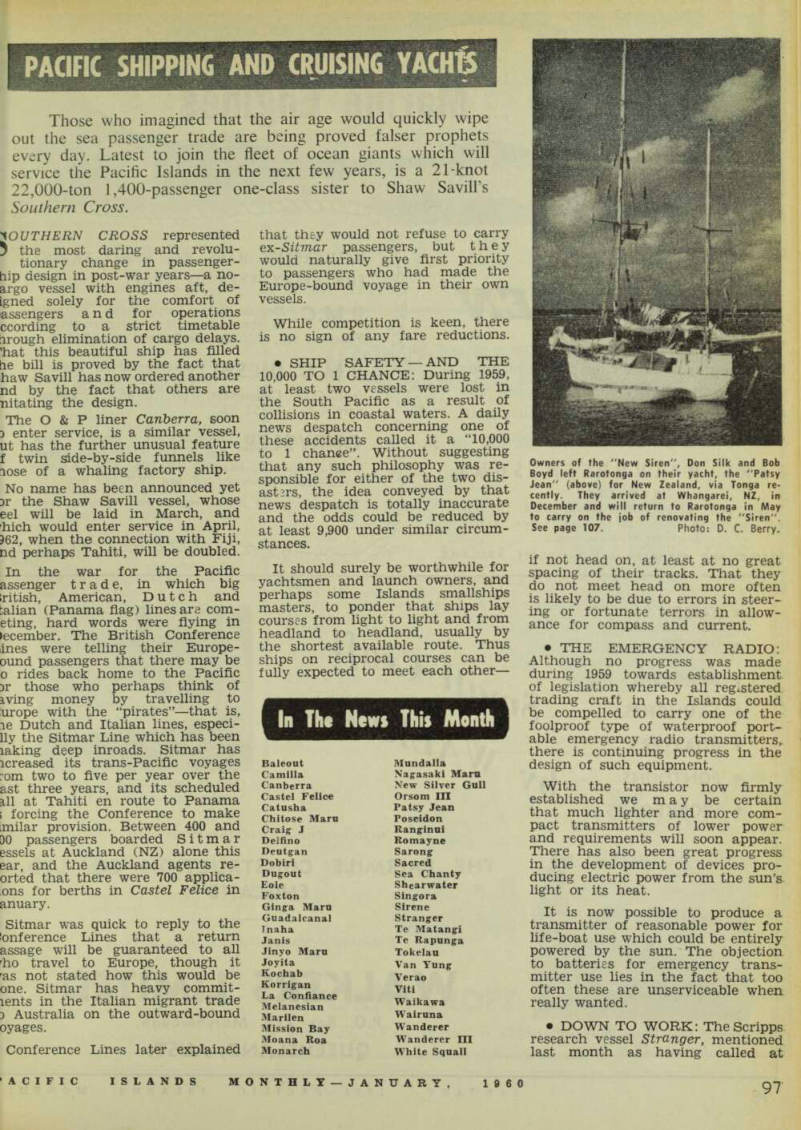
Owners of the "New Siren", Don Silk and Bob Boyd left Rarotonga on their yacht, the "Patsy Jean" (above) for New Zealand, via Tonga re cently. They arrived at Whangarei, NZ, in December and will return to Rarotonga in May to carry on the job of renovating the "Siren".
See page 107. Photo: D. C. Berry.
lonolulu, arrived at Bangkok late 11 November to carry out a big irogramme of oceanographic re sarch in the South China Sea.
The South Pacific Commission’s’ itest Quarterly Bulletin contains in interesting article by Michel ngot, which makes it clear that ’ranee is contributing its share in ceanographic research in the South acific tropical area with the foumea-based 75-ft wooden vessel )rsom 111, owned by the French nstitute of Oceania, which organ iation is equivalent to Australia’s iSIRO and New Zealand’s DSIR.
Apart from her important con ribution to the IGY, Orsom Ill’s rork has apparently firmly estab shed the fact that a tuna fishing idustry employing Japanese long ne methods could be based on Idumea with the main operational rea south-west of New Caledonia, specially in summer months.
It has been proved that surface shing methods would not be suc essful, except close inshore, where smaller troller-fishing industry rould be warranted.
As a result of these findings there 5 already interest in commission ig vessels for the latter type of ishing which calls for less capital.
• Something Slipped: Navi
ators of trans-Pacific vessels, like 11 other navigators, would like the nagnetic and geographic poles to oincide, but at least they can be hankful that things are not as Dr. ’akeshi Nagata says they were 500 o 1,000 million years ago.
Dr. Nagata, leader of the Jap nese IGY Antarctic expedition, has alculated from magnetic readings aken down South last year, that he North Pole formerly was located ,t what is now 3 degrees N and 127 iegrees W—or midway between ?ahiti and Mexico —but there was irobably no water there then, so ympathy for the old-time Second Jates may be reserved.
• The Four-Legged Trade:
7he ex-passenger liner Delfino, of LOOO tons, and on Fiji registry, sailed rom Sydney for San Diego (USA) irith her third cargo of about 25,000 ambs in mid-December, but it was eported at about that time that the >ermit which Mr. James Delfino, of California, had obtained from the JZ Government for the shipment »f 10,000 cattle from that country lad now lapsed.
The stalls built in the 8,174-ton delfino are designed only for the larriage of sheep, and no other sat sfactory stock vessel could be chartered on suitable terms to carry he cattle, the shipment of which nmmenced in July, 1958, when the inverted 6,923-ton Catusha made me voyage with 1,100 head, after yhich she was sold and broken up dr scrap.
In addition to shipping difficulties, here has been strong opposition
to the importation of live lambs also.
• Another Rare One: Suva
saw the South Korean merchant flag for the first time, and the Finnish flag perhaps for the first time, during 1959. There now seems a possibility that 1960 might open with the appearance of a Chinese Nationalist-flag vessel, though this was not quite certain in mid-De cember. The 5,806-ton, French-built, 23-years-old Van Yung, ex La Quinta, ex Louis L.D., ex Fomal haut, ex Louis L.D., was to load scrap in NZ ports in December- January, and then go on to Suva if a possible consignment of over age empty drums was finalised.
This ship is owned by the Taiwan Chung Hsing Steam Ship Co. Ltd., which also owns a 37-year-old 2,704ton steamer named An Lung (which may perhaps be translated as “one lung” at this stage of her career!)
• Still In Trouble: Ever
since the 70-ton Joyita sailed on her ill-fated voyage from Apia on October 3, 1955, she has never long been out of trouble.
Towed into Suva and sold by her Honolulu owner to Mr. David Simp son, of Vanua Levu, at an auction in July, 1956 (price £2,425, plus Customs duty £1,260), the one-time yacht was extensively rebuilt and was recommissioned in November, 1956, in the Fiji inter-island trade.