He Knew The Value Of
pp. 84-97 · Read in the full issue
The Kokoda Trail
By Basil Hall
Such acquaintance as I had with Sir Hubert Murray, began when he bailed me up behind his dining room door to ask what the devil I was doing in Port Moresby. The occasion was an evening towards the end of 1938, when the Old Man (as everyone called him) turned on one of his infrequent inner parties at Konedobu, and showed the kind of host he could be when the mood was on him.
-A^een^„ Hubert had Papua L f l o e r Ut^ an i;°° Vernor °i in the fleldof ’ J are ? ord tion Hp Sd Lon ft, 1 admmistratraha hid tV 3 hen Aus " hours 6 Germans for neightt o , , . to pttnKMci, ° A ffic F s , had helped to establish the Australian mandate
thpfj Ger pans surrendered
iqis P°™ on of New Guinea in on thp nl j l ° W ’ . Wlt .h the Germans thai ii,P- rod i a £ am » there were signs Srf?? a - h £s and imitators, the
brhfg Guinea
into it once more S W Gumea That was what he wanted to tniv about. wanted to talk I could tpii hirv, T , , m only what I had
learned in the course of a trip begun in Fiji, and continued In leisurely fashion through the New Hebrides and into New Caledonia, When Hitler had won his way at Munich, I had seen French reservists in Noumea reading the firs t of the warning orders that Preface mobilisation. It was a time of taut nerves, when a careless crack could buy an argument, if not a fight, as easily in the Fiji club as in the more relaxed atmos- Phere of Madame Reid’s in Vila. • ™ ere a nese in New Caledonia; most of whom Were . rec - ent ar f l Y als brought in to operate iron mining concessions on the east coast, where production was on a scale sufficient to turn
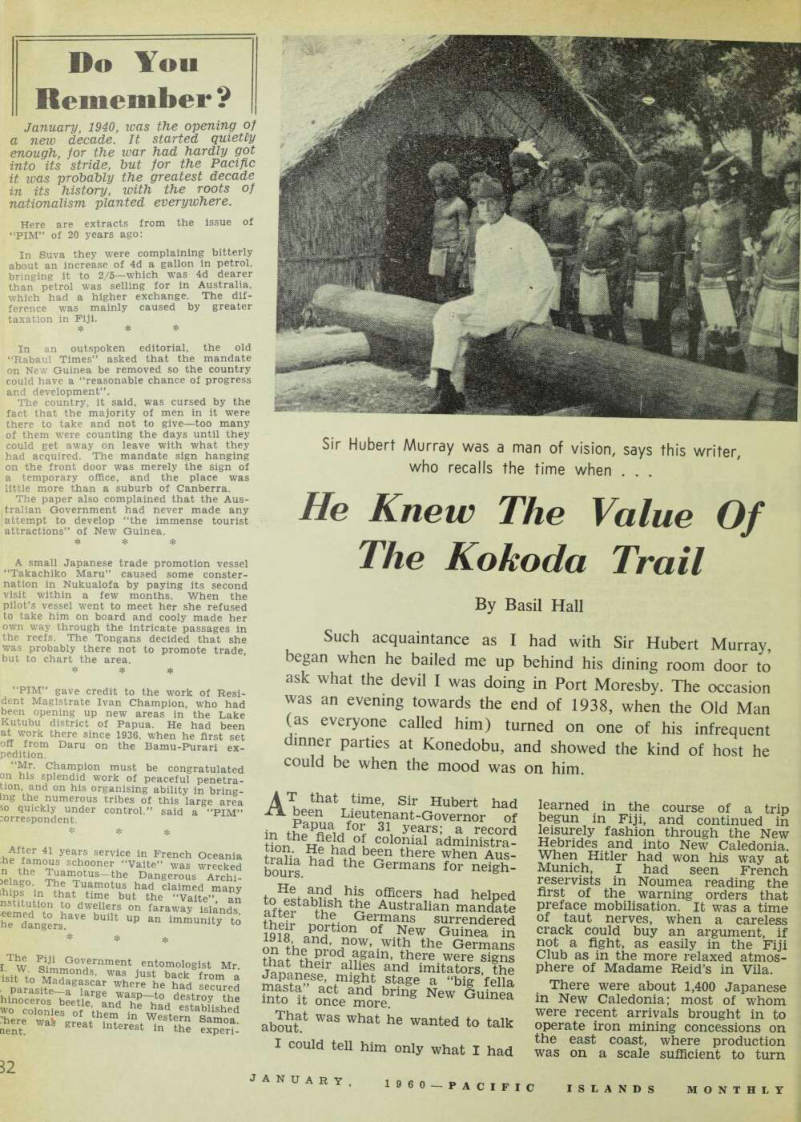
Sir Hubert Murray was a man of vision, says this writer, who recalls the time when . . .
At left, Sir Hubert Murray, the most famous of Papua's administrators, photographed towards the end of his long term, among the Papuans for whom he did so much.
around a 10,000-ton ore freighter in three days.
Noumea was like a garrison town.
Under the French system of compulsory military service, it was the training centre for the western Pacific zone. Permanent Army personnel belonging to the in structional staff were all over the place, and ready enough to talk about the 2,000 young men who were in their charge.
Coming from all walks of life, many of those recruits were to find a place in units of the Free French forces, who fought so well at Bir Hakeim in the Western Desert.
It was anyone’s guess, then, as to what the Jap’s intentions were, but, whatever way the cat jumped, the French appeared to be in better shape to meet the future than most of us.
Dining Room Door But, what began in mock solemnity behind Sir Hubert’s din ing room door in Port Moresby, extended over a week spent in the official yacht, Laurabada, at the Old Man’s invitation.
It was beginning to look as if a certain pattern was forming around the Marshall and Caroline islands, which Japan had closed to foreign observation in 1935. Sir Hubert discussed this, and other points of Japanese expansion.
In addition to the 151,000 Japanese who lived in Hawaii before the war, there was a colony of 15,000 of them in Mindanao in the southern Philippines.
And, while interest in New Caledonia could be explained by a need for raw materials, it was doubtful whether trade alone was responsible for a Japanese settle ment on the shores of Geelvink Bay in Dutch New Guinea, where some old German plantations had been taken over by a branch of the Nanyo Kohatsu Kaisha (South Sea Development Company), who were known to enjoy the patronage of the Japanese Navy.
Wherever one looked, there seemed to be Japanese!
In the Mandated Territory, the Japanese community had interests extending from Manus to the Solomons. They numbered less than 50, but the localities in which they lived were significant, and, once this was pointed out, it came as no surprise to learn that the only Jap in Papua (a half caste) looked after a small plantation facing China Strait, from where he could see the shipping passing through.
Not long before, this man had been visited by the crew of a
Japanese vessel tied up at Samarai.
That was the Takachiko Maru, one of a pair of smart little ships of about 600 tons, which turned up at times without much notice and called at ports in both Territories, before proceeding to New Caledonia and the Hebrides.
Trade done did not amount to much, and, one way and another, there was a good deal of speculation about their actual business.
Little To Be Done a ui, o fVlic ?o b b r d o|e MMS our own resources in men and in New Caledonia Haohie e fn^nnk W n ftPriSJSp might be &ble to loolc Jiiter tiieir own people, but the New Hebrides was wide open.
In Fiji they were not much better off, for the defence of that widespread group rested in the first instance upon a militia force of 396 men, made up of separate com panies of Fijians, Indians and Europeans.
While in Suva I had seen them Troop the Colour in heart-warming style, but there was nothing then to show what magnificent jungle fighters the Fijians were to prove.
However, news of this volunteer fighting force, brought up the question of raising native troops in New Guinea. The Old Man intro duced the subject himself as show ing the part Papua could play in the defence of the Commonwealth.
In this he was much more realistic than the common run, for, while staff appreciations going the rounds just then nearly all accepted the possibility of an enemy landing somewhere between Brisbane and Sydney, the Old Man was convinced that Australia’s front line should
(Continued on page 95)
be pushed forward to the arc of islands than run from Singapore to Suva.
Weak as the line was, the weakest part was the Mandated Territory, where a stultifying clause in the agreement prohibited the building of defensive works, or the training of native troops other than for simple police duties.
Local troops must therefore come from Papua, where according to the Old Man, the constabulary were soldiers in all but name.
On the Job Quietly This line of reasoning was no abstract talking point. Quietly and entirely on his own responsibility, the Old Man called for an accelerated intake of police recruits in 1938, a precaution that helped enormously when the Papuan Infantry Battalion came to be raised.
Trained and commanded for a time by Major L. Logan, Head quarters Officer of Constabulary in Port Moresby before the war, and at a later stage by officers of the calibre of “Bill” Watson —who hav ing won the MC and DCM in World War I, was to add a DSO to his distinctions as a result of operation on the Kokoda Trail—the PIB grew into the Pacific Islands Regiment, which, with strong reinforcements from the Mandated Territory,
numbered something like 5,000 men by the time the war ended.
The Old Man lived to see guns on Paga Hill and troops in Port Moresby, but I have the best of reasons for knowing that, as far back as 1938, he was talking about the importance of what he called the “only transverse roadway in New Guinea” —the Kokoda Trail, He even urged me to accompany the post boy who took the mail to Buna, and so see the possibilities of attack against Port Moresby being mounted from across the Owen Stanley Range.
It was common knowledge (even in Japan) that one could use motor vehicles or ride a bicycle for long distances between the coast at Buna and the Government station at Kokoda.
The roughest section of the track was always on the southern side of the range, and the gruelling part it played in subsequent proceedings was not due to lack of warning, but to the blank incredulity that greeted the Old Man’s information.
This is the man whom only last year, in Port Moresby, I heard described as a “showman”; it was said that he was aloof, remote and cold.
That was not my impression. I think of Sir Hubert Murray as a great Australian, as one who was able, shrewd and clear-sighted to the end —a grand old man.