Aid Project Mercury
pp. 63-65 · Read in the full issue


The South Pacific Will Aid Project Mercury
From Ralph Craib, in San Francisco A gigantic United States multi-million dollar space research programme is prompting greatly increased official American interest in the South Pacific.
PE latest important announce ment is that Pacific tracking stations will be a vital part of Project Mercury, which America xpects will be the West’s first ffort to put a manned satellite into rbit around the earth.
A 25-million-dollar world-wide ystem of tracking stations, includi ng the Pacific ones, will be com peted in 1960.
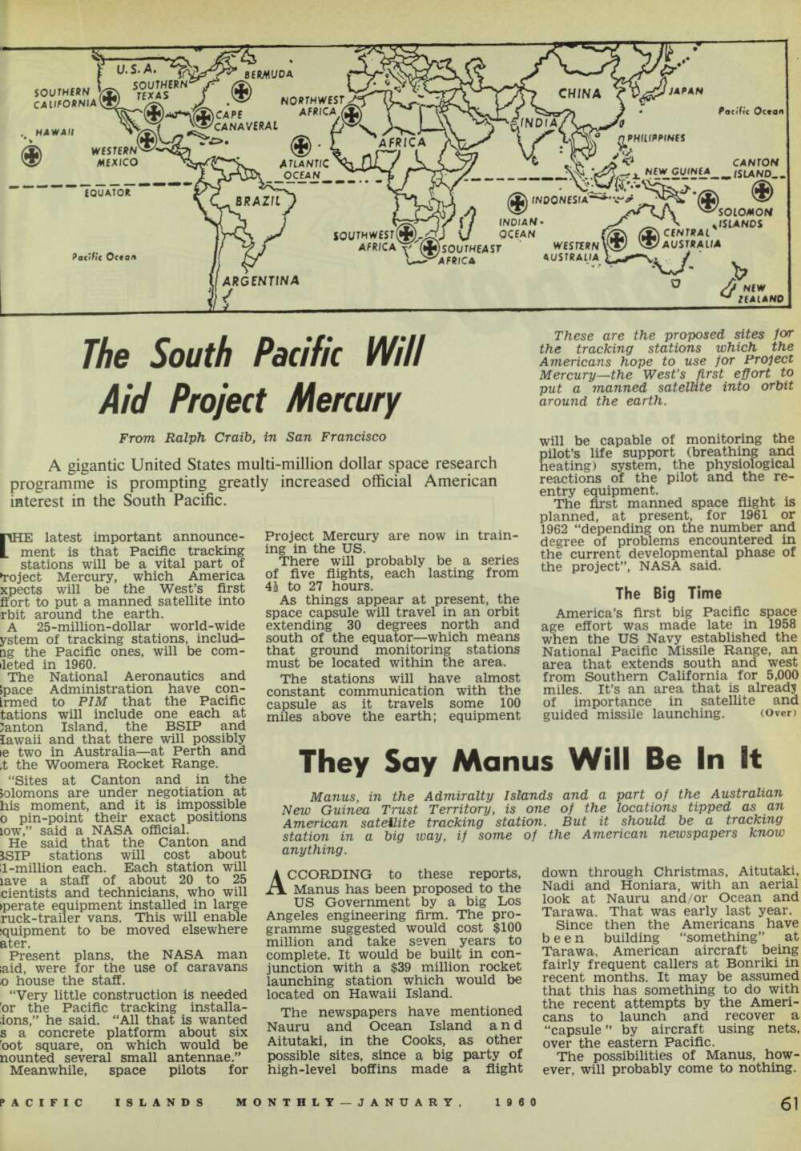
The National Aeronautics and Ipace Administration have con- Lrmed to PIM that the Pacific tations will include one each at Janton Island, the BSIP and lawaii and that there will possibly ie two in Australia —at Perth and ,t the Woomera Rocket Range.
“Sites at Canton and in the k)lomons are under negotiation at his moment, and it is impossible o pin-point their exact positions low,” said a NASA official.
He said that the Canton and SSIP stations will cost about 1-million each. Each station will lave a staff of about 20 to 25 cientists and technicians, who will ►perate equipment installed in large ruck-trailer vans. This will enable equipment to be moved elsewhere ater.
Present plans, the NASA man aid, were for the use of caravans o house the staff.
“Very little construction is needed hr the Pacific tracking installa tions,” he said. “All that is wanted s a concrete platform about six hot square, on which would be nounted several small antennae.”
Meanwhile, space pilots for
Project Mercury are now in train ing in the US.
There will probably be a series of five flights, each lasting from 4h to 27 hours.
As things appear at present, the space capsule will travel in an orbit extending 30 degrees north and south of the equator—which means that ground monitoring stations must be located within the area.
The stations will have almost constant communication with the capsule as it travels some 100 miles above the earth; equipment
will be capable of monitoring the pilot’s life support (breathing and heating) system, the physiological reactions of the pilot and the re entry equipment.
The first manned space flight is planned, at present, for 1961 or 1962 “depending on the number and degree of problems encountered in the current developmental phase of the project”, NASA said.
The Big Time
America’s first big Pacific space age effort was made late in 1958 when the US Navy established the National Pacific Missile Range, an area that extends south and west from Southern California for 5,000 miles. It’s an area that is already of importance in satellite and guided missile launching. (Over)
These are the proposed sites for the tracking stations which the Americans hope to use for Project Mercury—the West’s first effort to put a manned satellite into orbit around the earth.
Rear Admiral Jack Monroe, -mimanding officer of the range :id of the Naval Missile Test acility, has predicted an eventual ivestment of $4-billion in the mge.
It is now in use by Royal Air orce and United States Air Force •ews learning to fire guided dssiles.
There is no danger of chunks of ardware falling upon islanders, le admiral told PIM.
“I would say the danger is so imote that there is no danger at 11. These things are difficult to iiarantee 100 per cent. But the jsk is so small that any reason ble man should be perfectly filing to take it,” Admiral Monroe lid.
Admiral Monroe has previously cknowledged that it would be ossible to fire missiles from lalifornia west to the Eniwetok tomic Proving Grounds in the larshall Islands. But he said there 'ere no plans for such a programme t the moment.
The Pacific is ideal for rocket ge scientists because of its vast mpty areas, the Admiral added, •he Atlantic was a “small fish ond” by comparison.