Country Show"
pp. 59-61 · Read in the full issue
“A Real Good Country Show"
From a New Guinea Correspondent.
The Australian tradition of an annual Agricultural Show has long since spread to the Australian Territory of Papua- New Guinea, but never before has the Territory enjoyed the number or variety of Shows that are being staged these days.
THERE are now even regular Show followers, with plane loads of sightseers attending every one around the Territory.
The last Show was at Lae—which was the first for Lae—and the latest has just been held not far away, in the mountains at Wau, which has the hone or of having held the Territory’s first post-war show, in October, 19 IS This year’s Wau Show was the eleventh (somi how they missed one year) and the pessimists who thought it might have been held too soon after Lae’s, and badly attended, needn’t have worried, Eight hundred Europeans paid admission (Wau’s entire population consists of 375 Europeans, including a few miners working at Edie Creek, 28 Asians, 15 Euronesians and 14,000 natives). And there were 3,000 New Guineans thronging the magnificent setting in Coronation Park, which has a natural raised ridge to serve as a grandstand, with the glorious background of the Kuper Range, with 9,500 ft. Mt. Missim and a five mile mountain front. The mists linger along the lower slopes of these mountains, giving an alpine look.
There was a real atm:sphere of a real good country Show, where everyone puts all they have into it.
The natives had no less then ’ separate dancing groups strung cut over the showground, and put on what was undoubtedly one oi tne finest exhibitions of native dancing seen in the Territory. The chorus from the throats of 1,000 excited dancers rolled across the green liie the echo of a Stone Age symphony, j n Ladder Dance To round-off the grand parade, the Upper Watuts put on something which few even of the old-timers had seen before—a ladder and whip cracking dance, in which five figures perched on top of 40-ft bush ladders and swung cane whips, as the “ringmaster” at ground level kept pace with the upper strata boys, The ladders had no support other than being thrust into the ground, This apparently was an ancestor dance.
There was also a head-on “fight” between two tribal groups with bow strings twanging and stone clubs swinging in true wild Menyamya fashion. As each wave advanced
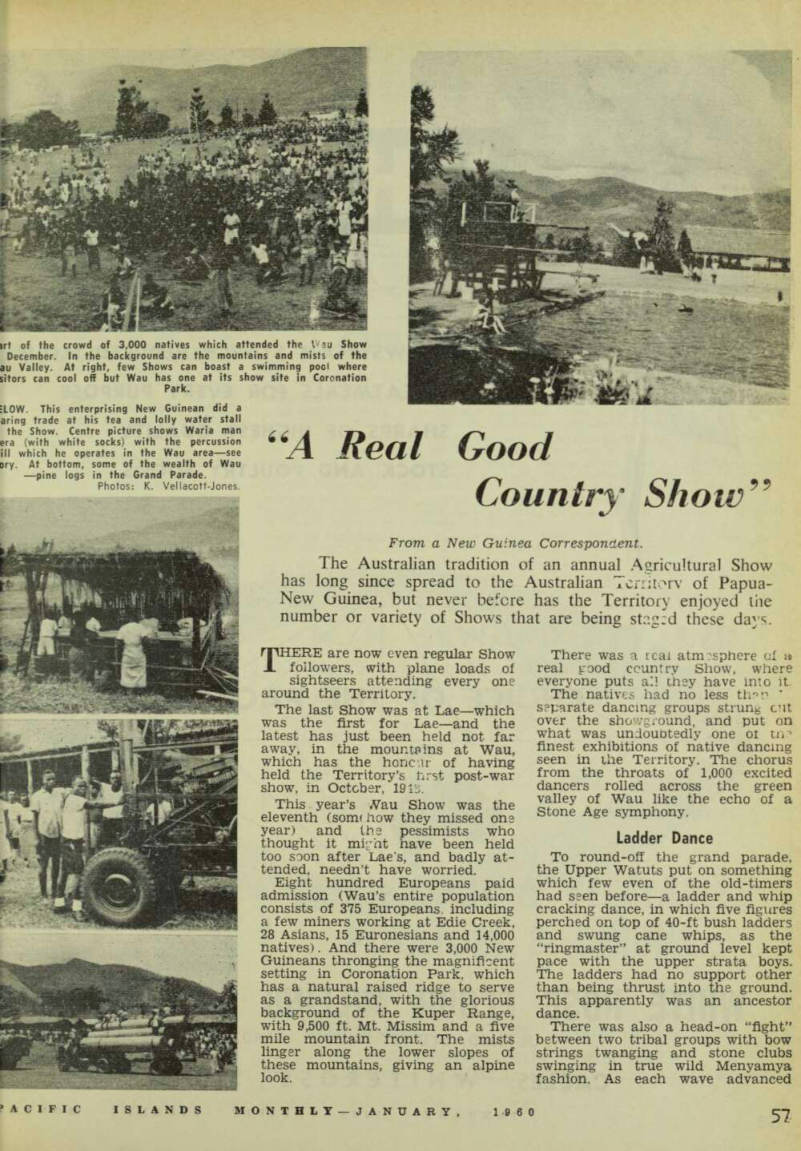
[?]rt of the crowd of 3,000 natives which attended the Wau Show [?]December. In the background are the mountains and mists of the [?]au Valley. At right, few Shows can boast a swimming pool where sitors can cool off but Wau has one at its show site in Coronation Park.
[?]ELOW. This enterprising New Guinean did a [?]aring trade at his tea and lolly water stall the Show. Centre picture shows Waria man [?]era (with white socks) with the percussion [?]ill which he operates in the Wau area —see [?]ory. At bottom, some of the wealth of Wau —pine logs in the Grand Parade.
Photos: K. Vellacott-Jones.
id retreated, the dead bodies ere hauled off unceremoniously, to i wailed and wept over by the omenfolk.
The Show had more than native mcing to offer.
New Guinea Goldfields Ltd. lived p to its name with an exhibit on dw to win gold, with a model of jep mine workings and a ton sized ock of “gold”.
The Department of Mines had a “rcussion drill pounding a deep Die in the ground to demonstrate dw it is assisting the mining in istry by being hired out for test rilling. It’s in such demand that it booked ahead for several years.
With the drill—a Bethune 400 — lere was its operator, a Waria itive named Mera, who although e lacks formal education, quickly loved from labourer to operator of le equipment and is now in sole large of the drill and of its work ig team, without supervision.
Halls of Agriculture The “Halls of Agriculture” were ot exactly marbled halls—they ere of bush timber and thatched >ofs —but there the farmers of Wau fid district had the fruits of the irth well displayed.
Former Assistant District Officer, irned farmer, Lloyd Hurrell, got Ef with the honours for general ?riculture, and first prize for the Bst overall Show exhibits. Second /erall was pioneer old-timer Mick eahy.
Mr. Hurrell’s display of farm pro iice included wool, sunflower seeds, hole corn, cracked corn, “ham lered” com, sorghum, eggs, pota >es and other vegetables, jams, allies, chutneys, milk, honey, pea uts, strawberries, coffee. Other ex ibits by him in other sections in- Euded dairy cattle, geese, ducks, ens and dogs.
Wau bases its economic fortunes on gold, coffee and timber, and now mixed farming, but there was not much at the Show to highlight the coffee industry. But perhaps Wau people thought that wasn’t needed — the visitor had only to look out across the beautiful valley to see 500 acres of coffee scattered about in large and small blocks.
Commonwealth New Guinea Timbers Ltd. and New Guinea Gold fields Ltd. had a big-time display of hoop and klinkii pine, and an ultra-modern line of plywoods and plywood furniture.
There were the sidelights.
There was, for instance, the work ing model of a Five Head Stamp Battery for handling gold-bearing ore, a neat bit of work made by a
Papuan apprentice fitter, Harry Pidian, from Dam, who had his work displayed alongside a model mine ore bin fabricated by fellow apprentice Jonatana Vartova.
Eleven-year-old Geoffrey Pascoe, of Wau Primary School, showed his skill with a doll’s house of ply wood; the furniture he made him self, even to stitching the bed quilts. It got him first prize in the children’s woodworking section.
One enterprising local New"
Guinean applied for and obtained a refreshment booth concession at the- Show, erected his booth near the native exhibits and did a roaring, trade in tea, lolly water and a cooked meal of rice and meat.
Little Wau’s eleventh Show was a wow!
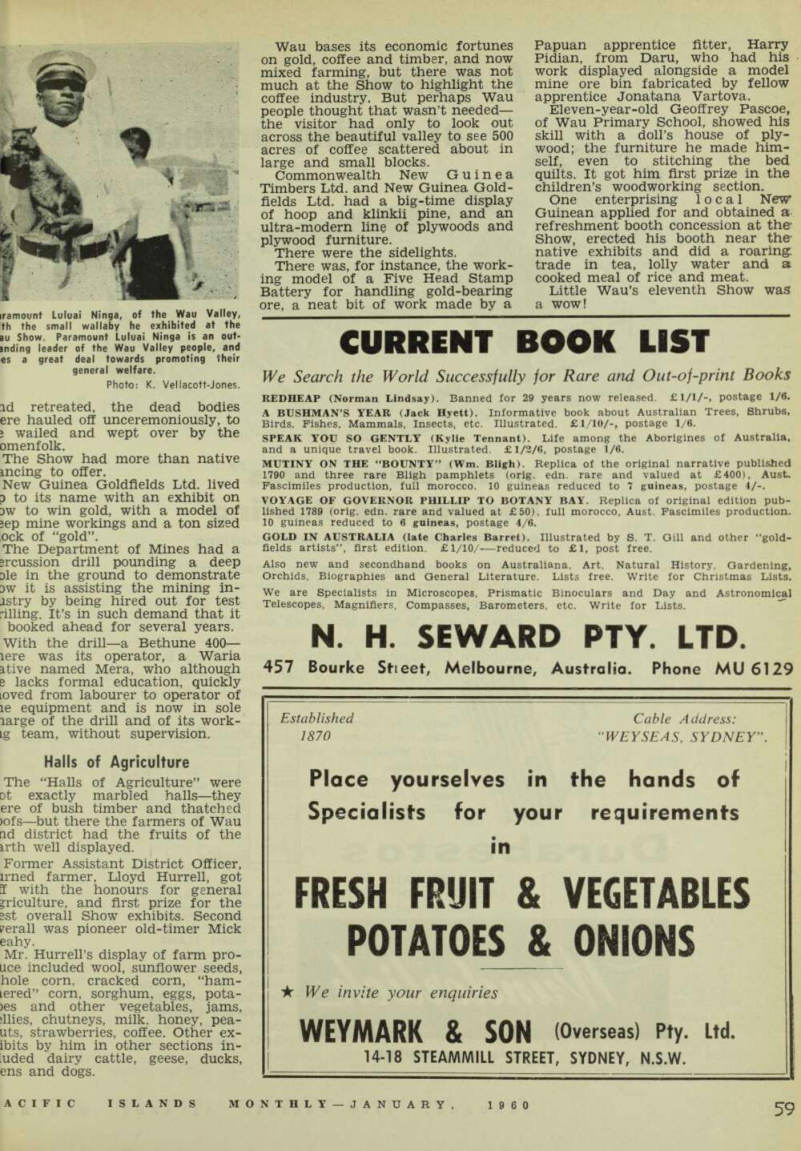
[?]ramount Luluai Ninga, of the Wau Valley, [?]th the small wallaby he exhibited at the Wau Show. Paramount Luluai Ninga is an out [?]anding leader of the Wau Valley people, and [?]es a great deal towards promoting their general welfare.
Photo: K. Vellacott-Jones.