Pacific Air Transport Faces
pp. 43-47 · Read in the full issue

Everyone Wants To Be in On The Act Pacific Air Transport Faces Its Most Vital Period Yet
As 1960 opens, the South Pacific is faced with the most vital period in its history in the realm of air transport. The new year means the beginning of big battles between America, France and the British Commonwealth for air traffic across the Pacific.
CHE South Pacific air pattern could change completely.
The fight has been brewing for ;veral years, but a whole series of *cent events has brought it to a ead. These are: • World airlines have been able ) consolidate regular trunk routes, nd now have the desire and the ircraft to create new traffic —and le South Pacific has been chosen s the area where a tourist drive ill pay big dividends. • Decisions will be made this ear by the American Civil Aero autics Board on a whole series f applications involving new ser- Ices through the South Pacific. • A breakdown in negotiations etween Australia and France in- Dlving reciprocal air rights between ustralia and France, including the rench Pacific territories; an event hich has thrown a great many irline schemes into the melting ot. • Introduction of jets on the acific, coupled with recent work in le Antarctic which will make it ossible before long to run air ser ices between Australia and South merica over the South Pole. • Improvement of Pacific air orts, and creation of new ones, at ey points in New Guinea, the olomons, New Caledonia, Fiji, merican Samoa, Tahiti and ventually Easter Island.
World airlines have been flying tore passenger miles each year >3,800 million in 1958, an estimated 1 800-m ill io n by 1961, 105,300 million by 1965) and air cargo has een booming, too, and will eventu lly match passenger growth.
It was inevitable that the Pacific ould finally have to have a share f it, especially since the big stup ing lines predicted the coming acific travel boom several years nd laid their own plans accordingly.
American Plans
The American CAB investigations, which have been going on since early last year, involve the whole of the Pacific basin, that is, the North and South Pacific. President Eisenhower himself has been in terested in sorting out all American aviation agreements in the area, and a complete review is being under taken. Among the companies that have applications are some that have hardly entered the South Pacific, but want a bigger share in it now.
The CAB has already heard evidence on the applications in Honolulu, Los Angeles and San Francisco and it is currently sit ting in Washington. Final recom mendations will probably not be made until 1961.
San Francisco correspondent Ralph Craib reported in early January that some witnesses had
described the Pacific as “the last great undeveloped tourist area”, and he said it was significant that many of them repeatedly stressed the im portance of economy class fares in the Pacific.
Hawaiian Airlines president Arthur Lewis said his company was convinced that Tahiti would develop into a major tourist resort if properly promoted and that “you will see one of the most phenomenal developments of tourism ever wit nessed in the Pacific”. Members of his board felt so strongly about it they were now investing in the hotel development in Papeete, he said.
The five firms after new routes are, Trans Ocean Air Lines (a supplemental carrier with 13 years Pacific experience, now operating between the US mainland, Hawaii and the Far East, to the US Trust Territory and Samoa) ; Pan American World Airways; Hawaiian Airlines (30-year-old company now operating within the Hawaiian chain); United States Overseas Air line (supplemental carrier, which has pioneered economy class services from the US mainland to Hawaii); and South Pacific Airlines (formed by the Dollar family, an old American shipping family, which hopes to commence Honolulu- Tahiti services in February).
One American company will get a route to compete with a French Pacific crossing. Under the US- French agreement, an American carrier will receive authority to operate from the US to Hawaii, Tahiti, New Caledonia and beyond to NZ and Australia. (Over)
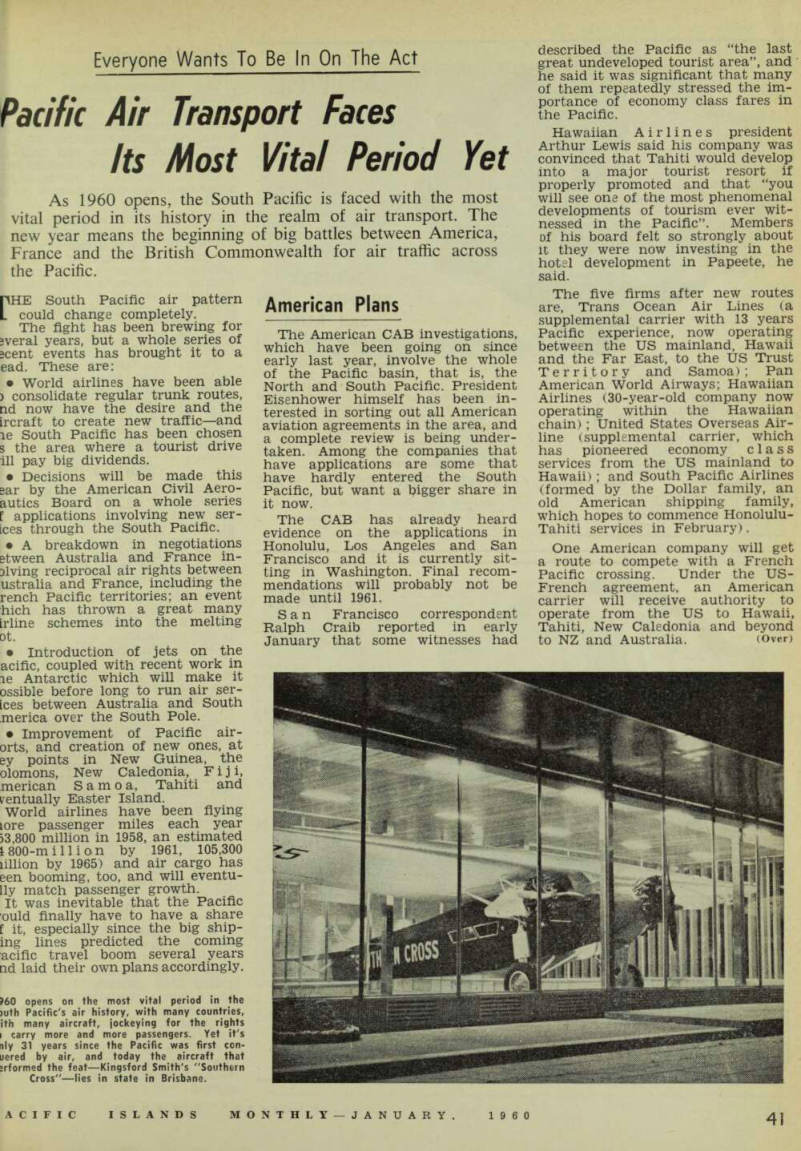
[?]60 opens on the most vital period in the [?]uth Pacific's air history, with many countries, [?]ith many aircraft, jockeying for the rights [?] carry more and more passengers. Yet it's [?]ly 31 years since the Pacific was first con [?]uered by air, and today the aircraft that performed the feat —Kingsford Smith's "Southern Cross" —lies in state in Brisbane.
France-Australia
The France-Australia aviati breakdown occurred in Decemt The two countries have had a te: porary agreement for some yea giving the French airline TAI 1 right to use Darwin and Brisba on the way to Noumea, and for Ai tralia to operate to Noumea. T agreement was due to expire on I Comber 31, 1959.
During the talks (which initia began in Paris late last year) t French offered a series of servii involving Paris and/or Tahiti addition to Noumea, and asked ] Sydney in return. Australia said ] Australia offered to continue t temporary arrangements until son thing satisfactory to both si( could be worked out, but this til France said no.
Thus by January i, the li Qantas plane had flown out Noumea, causing consternation 0 page 20) and the last TAI pla had picked up and droppi passengers in Australia (TAI is si entitled to technical stops in Ai tralia).
Worth a Lot According to an official a nouncement by the Australian E partment of Civil Aviation, t granting of Sydney to TAI woi have meant giving it extra busin< worth £1 million a year, and tl was far more than Australia woi get out of either Paris or Papee Papeete is not much good Qantas except as a route to Sou America, via Easter Island, but th is not yet built, DCA’s 1 ’ figure might have been rig (TAI announced later that was exaggerated and at t most it might stand to profit £250,000 a year) but there was me to it than that.
TAI is going for a round-th world service, for which Sydn would be a vital airport, enabli] it to compete with Qantas (TAI h recently been given permission run the remaining Pacific legs fre Noumea through Papeete, Honolu and Los Angeles, with Bora Bora alternative until Papeete comes in operation, probably in October), will be using bigger aircraft on th service (DCS’s about June or Jil 1961) and will need Sydney to he fill them.
"Difficult"
With France’s help (TAI is n Government-owned, but is very do to the present French Governme; because of its financial ramifie tions) TAI appears to be attemp ing to get a stranglehold on Pacii air transport. It has two first-cla airports in Noumea and Papee (now building) to help it.
On the strength of how diffici TAI has been making things f Qantas in New Caledonia, the Au
alian authorities had doubts i)out what would happen once TAI ent round-the-world through /dney.
Some of the weapons in use by AT include special fares for cabot ;e traffic, financial exchange con ols which influence passengers to ;e TAI, and a direction to Gov nment servants that they support AI.
TAI has wanted Sydney badly, id still wants it.
The chances are that it will want badly enough in future to start te negotiations again with Aus alia.
he New Patterns
Meanwhile many new patterns •e developing.
It was thought significant in lumea that Pan American Airways presentative there took the first rcraft out to Sydney following mediation of Qantas service. PAA is landing and traffic rights in ew Caledonia.
TAI has a regular service from Dumea to Auckland, but according a Wellington report, this might rike official trouble with the New ;alanders soon.
The fast growing New Caledonia jyalty Islands internal air ser ce operated by Transpac has taken i interest in the New Hebrides ith the idea of establishing a new ternal airline. According to one port, Transpac might make an rangement with a planter and ader, Mr. Robert Paul, of Tanna, tio has been interested in estab ;hing such a service, but who has ) aircraft. The arrangements, said ie report, might initially be for six onths.
Director of Transpac, Mr. Henry artinet, in December, made a sur w in a Stinson, and landed at me islands that had never had a ane before —such as Tanna. He lid particular attention to old war ne strips. Negotiations are being nducted with land owners for the ie of sites for strips, and a new mpany is being formed, which will ie Herons. TAI once tried to com ne with Transpac but couldn’t. It ight try again.
BSIP Plans
An internal air service is also anned for the BSIP. The BSIP overnment has asked the Civil nation Adviser, Mr. A. Corbin, to bmit a report giving detailed timates of the capital required and nning costs.
A Honiara correspondent says it not the intention of the Govern ent to compete with commercial rlines but merely to supplement e inter-island service given by lall ships.
The correspondent says in addi m to present airfields in use— iikum and Henderson, Yandina (in e Russell Islands) and Munda
ew Georgia) there were many old ,r-time strips now overgrown, lich could be cleared and put to
Fiji Airways
Meanwhile, there are develop ;nts in Fiji Airways. Qantas took ji Airways over in 1957, and at 3 end of 1959 there was an nouncement that New Zealand uld also share in the company. At e end of December there was a ether announcement that Britain uld also be a partner.
Fhe company is small at the jment, operating Herons and overs within the Colony, and :asional charter flights to Tonga, it it looks as if it might be allowed go farther afield. [t was announced in Suva in De uber that Fiji Airways would cnmence regular monthly return ?hts to Fuaamotu Airport, Tonga pu, late in January. It is ex cted that the accommodation oblem at Nukualofa will be terh rarily overcome by Fiji Airways ranging to lease Beach House arding house, which has been ed as a residence for Government icials since it ceased public busi ss several years ago.
If the traffic warrants more fre ent flights these will be made. The itial monthly flights will be on a al basis. The flight each way takes out three hours in the Heron, The aircraft will remain at laamotu overnight.
In Auckland, in December, Rear imiral George J. Dufek, who re ntly retired from the US Navy— > was commander of Operation jepfreeze—to join Pan American rways as special consultant in the
South Pacific, said that Pan Ameri can would start flights from Los Angeles through Papeete to Sydney —with possible touch-down in New Zealand—in about 18 months time.
The New Zealand touchdown would be subject to New Zealand approval, and Admiral Dufek in dicated that the bargaining point would be Tafuna Airport in Ameri can Samoa. He considered that TEAL would be wanting to use Tafuna as the nearest up-to standard airport for connection with Western Samoa after the Solent flying-boat is replaced by the Electras this year. Only New Zea land airport at present suitable for the Pan American Boeings is at Christchurch. Auckland’s new air port is held up through argument as to siting.
Admiral Dufek said that Pan American expected to be operating trans-Antarctic flights between Aus tralia, New Zealand, and South America in about eight years time.
This would provide a very much shorter route than the trans- Pacific Qantas is also aware of the pos sibilities of the Antarctic route.